
Retevis Adjustable Throat Mic Walkie Talkie Earpiece
4.1Editor score
Adjustable flexible neckband
Concealed acoustic tube
Finger push-to-talk switch
Wide radio connector support
Throat mic for gaming guides compare voice clarity, comfort, noise reduction, connector fit, and controls, helping players choose the right communications
A throat microphone transfers speech through vibration from the wearer’s neck, reducing the amount of surrounding noise picked up by an ordinary boom microphone. That makes it useful for gaming sessions in crowded rooms, online calls, streaming, and mobile play, provided the device uses a compatible connection and the game supports external voice input.
The products in this guide were compared using the information supplied for voice pickup, adjustability, PTT controls, connector type, cable design, intended applications, and user ratings. Most are tactical or two-way-radio headsets, while one is a conventional USB gaming microphone and another is a compact wireless lavalier system, so connector compatibility is central to the comparison.
The picks show that no single design suits every player: throat-vibration models prioritize privacy and noise control, USB microphones prioritize familiar computer setup, and wireless lavalier systems prioritize discreet recording. Ratings and availability can change, so readers should verify the current listing, included accessories, and connection requirements before ordering.
4.1Editor score

4.0Editor score
3.7Editor score
This side-by-side comparison highlights the major differences among throat microphones, conventional gaming microphones, and wireless lavalier systems. The key selection points are voice pickup method, connector compatibility, PTT access, cable or wireless design, comfort, and the environments each product is intended to serve.


The Interface Z Tactical Throat Mic is a security earpiece built around a dual throat-microphone transponder. Its 3.5 rating places it behind several of the more highly rated products in this guide, but its defining feature is a focused throat-vibration pickup system. The unit is designed for Element and Z Tactical PTT equipment and is not presented as a universal computer or smartphone gaming microphone.
We may earn a commission when you buy through this link, at no additional cost to you.
The ABS and nylon neckband offers a flexible structure, while the transparent voice tube keeps the visible profile relatively restrained. Its two sensitive throat sensors are intended to improve pickup compared with a single sensor. Mushroom earplugs are included, and the overall layout resembles a covert communications earpiece rather than a conventional gaming headset, which may appeal to players who prefer a nearly invisible microphone arrangement.
The main limitation is compatibility. A player cannot assume that this product will work with a PC, console, controller, or smartphone simply because it is described as a throat microphone. It also offers fewer documented controls than some competing products, with the supplied information focusing on the Element and Z Tactical PTT interface rather than mute keys, gain adjustment, or general-purpose computer controls. Its 3.5 rating also suggests that satisfaction may vary considerably among users.
This is a sensible choice for a gamer who already uses compatible Element or Z Tactical radio equipment and needs voice pickup in a noisy setting. It is less suitable as a universal gaming purchase. Verify the radio model, connector arrangement, and control expectations before buying, especially if the intended use includes ordinary voice chat on a desktop platform.
The dual sensitive throat transponder is the product’s most notable technical feature. It captures speech as vibration through the neck, reducing dependence on a conventional microphone exposed to room noise. This can help during crowded matches, shared gaming rooms, or mobile play where keyboard and fan noise may otherwise become prominent.
The flexible ABS-and-nylon band and transparent tube create a relatively discreet profile. Players who do not want a boom arm or large desktop microphone can position the band around the neck and route the clear tube toward an earbud, although actual comfort and microphone placement will depend on neck size and movement.
We may earn a commission when you buy through this link, at no additional cost to you.
The Retevis Adjustable Throat Mic has a 4.1 rating and stands out for its combination of throat-based transmission, an adjustable neckband, a finger PTT, and broad compatibility with two-way radios. The supplied compatibility list covers Retevis, Pxton, Baofeng, and Kenwood models, making it one of the more versatile radio-oriented choices in the roundup.
We may earn a commission when you buy through this link, at no additional cost to you.
Its voice pickup works through throat vibration rather than a room-facing microphone, which helps reduce interference from background noise. The flexible neck section can be adjusted to fit the wearer, while the clear acoustic tube is intended to provide private communication without a conspicuous boom. The finger PTT can be worn on a finger or attached to a handlebar, giving the user some freedom in how transmission is activated.
That flexibility also creates a compatibility boundary. This is a K-head two-pin radio accessory, not a standard USB gaming microphone, and the product information does not indicate a 3.5mm or wireless game-controller connection. A PC gamer would need additional compatible radio equipment or an appropriate interface. The clear tube and included mushroom-style listening hardware may also be less comfortable over very long sessions than a conventional padded headset.
It is a strong recommendation for airsoft, outdoor team activities, event staff, and players who already communicate through compatible two-way radios. It is not the first choice for someone wanting a simple headset that plugs directly into a gaming laptop. Confirm both the radio brand and exact model before ordering, and check whether the application supports external radio communication.
The documented radio list includes numerous Retevis models, several Baofeng radios, Pxton equipment, and Kenwood devices. That breadth is valuable because connector names alone can be misleading. Checking the exact model against the listing reduces the chance of purchasing a throat mic whose radio connector or accessory interface does not match.
The adjustable neckband is intended to remain close to the throat while accommodating different neck sizes. The removable finger PTT can be positioned on a finger or secured to a handlebar, making it practical for riding, airsoft, and other activities where the wearer may not want to reach for a control on the radio.
We may earn a commission when you buy through this link, at no additional cost to you.
The Retevis Two-Pin Throat Mic combines a vibration-based transmitter with an adjustable neck section, a sensitive finger PTT, and a clear acoustic-tube earpiece. Its 3.9 rating places it slightly below the Retevis model ranked second, though the supplied feature descriptions suggest a similarly practical design for noisy environments.
We may earn a commission when you buy through this link, at no additional cost to you.
A major advantage is adjustability. The neck section can be tightened to suit the wearer, which helps position the throat sensor consistently. The soft mushroom earbud is designed for extended wear and can be used on either the left or right ear. The clear tube and neck-worn layout maintain a discreet profile, while the finger PTT provides direct transmission control without moving the hand to a radio.
Compatibility is extensive for a two-pin radio accessory. The listing mentions Retevis, Baofeng UV-5R and related models, Pxton, eSynic, Arcshell, and Kenwood radios. However, the connector still needs to match the device and its accessory standard. There are no documented mute buttons, monitoring controls, gain settings, or gaming-platform features, so this should be treated as a specialized communications earpiece rather than a conventional PC headset.
Choose it when you use a compatible radio, participate in noisy team activities, and value a secure fit and discreet profile. It is less appropriate for standard console gaming unless you already have a radio-based communication setup. Confirm the radio model and connector, then position the neckband snugly without restricting comfortable movement.
Because throat microphones depend on physical contact, the adjustable neck section is more than a comfort feature. A closer, more stable fit can help maintain consistent vibration pickup. The wearer should adjust the band so the sensor sits firmly against the throat without creating discomfort during long sessions.
The soft mushroom earbud and transparent acoustic tube give the product a lower visual profile than a full-size gaming headset. It can be worn on either side, which helps users establish a comfortable arrangement when speaking while gaming, driving, working, or taking part in outdoor activities.
We may earn a commission when you buy through this link, at no additional cost to you.
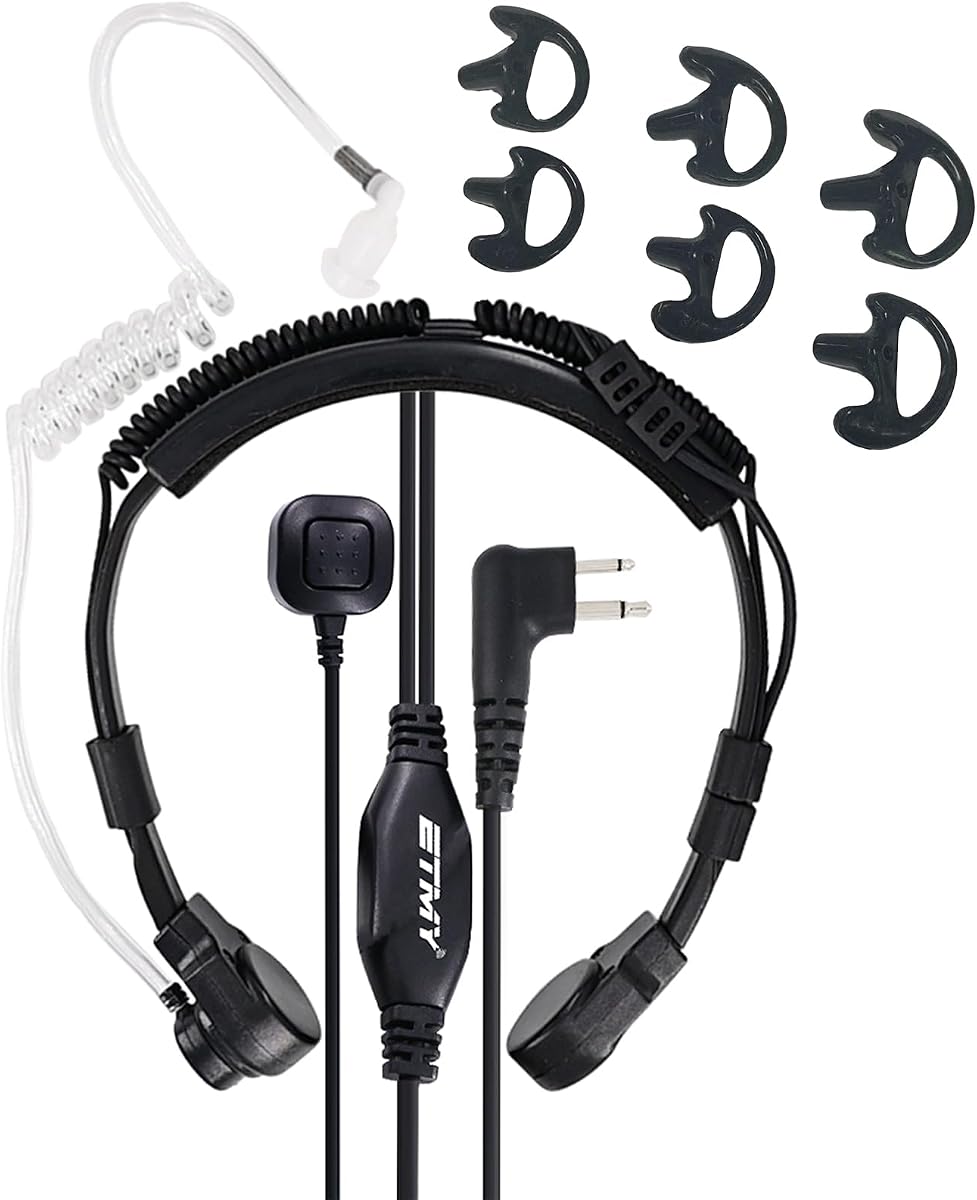
The ETMY M-Connector Throat Mic offers throat-vibration pickup, a light 64.5g air-conduction earpiece, an extended cable, and a clearly identified Motorola-style connector. Its 3.7 rating is moderate, but the specification detail makes it easier to assess than listings that provide only a product name.
We may earn a commission when you buy through this link, at no additional cost to you.
This model is built for users of Motorola two-pin systems, with the listing citing CP200, CLS1410, and similar devices. It explicitly warns that the ET-ER401 M-type plug is not compatible with Baofeng radios. The connector uses a 0.25cm TS plug in a standard two-pin M-head arrangement, so checking the radio’s accessory port is essential before purchase.
The total cable length is listed as 152cm, divided into a 112cm earphone cord and a 102cm microphone wire. That long routing can provide freedom of movement and make it possible to conceal the cable under clothing. The PU cable is described as flexible yet strong, while air-conduction listening avoids the need for an earbud seated directly in the ear canal. These attributes are useful for mobile or tactical setups, although they do not convert the radio accessory into a universal gaming microphone.
It is a good pick for someone using a compatible Motorola radio in a high-noise environment who wants a light, concealable arrangement. It will not suit a Baofeng owner or a gamer expecting a direct PC connection. Buyers should also confirm that the software or game accepts audio from the intended radio or interface.
The explicit distinction between M-type and K-type connectors is one of this model’s most useful features. Rather than implying broad radio compatibility, the listing identifies Motorola two-pin systems and warns against Baofeng use. That clarity helps buyers avoid an otherwise common source of frustration.
Separate 112cm and 102cm cable sections offer enough length to route around the body or beneath clothing. The long design can prevent a lead from restricting movement, although extra cable may need careful management to avoid snagging during active play or outdoor use.
We may earn a commission when you buy through this link, at no additional cost to you.
The Caroo U94 Tactical Throat Mic is one of the strongest all-around choices in the roundup, with a 4.0 rating and a documented emphasis on throat-vibration transmission, a tactical PTT, and broad radio compatibility. Its low-profile construction is aimed at situations where clear communication and discreet listening matter more than the familiar appearance of a gaming headset.
We may earn a commission when you buy through this link, at no additional cost to you.
The listing names Baofeng UV-5R, UV-5RA, BF-888S, UV-82 variants, and Kenwood and Retevis models. A U94-style tactical PTT provides a more deliberate way to activate transmission than an ordinary microphone, which can be useful in team events. The neckband, clear silicone earpieces, and transparent acoustic tubing keep the setup visually restrained.
A throat microphone can help in high-noise environments because it depends on neck vibration rather than a microphone exposed to nearby sound. The manufacturer specifically highlights skiing, cycling, climbing, running, casinos, airports, paintball, police, crowd control, conventions, and concerts. Those are credible low-visibility communication scenarios, though actual gaming performance still depends on the radio, interface, and game software.
This is a strong recommendation for airsoft players, event teams, and users of compatible Baofeng, Kenwood, or Retevis radios. It is less convenient for someone who wants to plug directly into a gaming PC without additional hardware. Verify the radio model, the PTT arrangement, and the included accessories before ordering.
The U94 tactical PTT gives the wearer a direct transmission control within easy reach. It is particularly relevant for airsoft, security, and event use where players need to communicate without repeatedly touching a radio mounted elsewhere on the body.
The listed radio support and low-profile acoustic setup make the headset more versatile than a single-purpose gaming accessory. It can support group communication during sports, production work, security, or outdoor activities, provided the connected radio carries the audio the game or application needs.
We may earn a commission when you buy through this link, at no additional cost to you.
The Retevis ETK007 has a 3.9 rating and focuses on precise throat positioning, background and wind noise reduction, and an adjustable neck section. It includes two pairs of extra earplugs in different sizes, giving users a way to improve the fit and comfort of the listening side.
We may earn a commission when you buy through this link, at no additional cost to you.
Its vibration-based voice transmission reduces the amount of ambient interference picked up by a conventional exposed microphone. The adjustable throat section allows the sensor to sit closer to the neck, which is important for clear transmission. A finger PTT allows the wearer to control communication without moving both hands to a separate radio.
The model uses a K-head two-pin connector and supports a long list of Retevis radios. The listing explicitly says it cannot be used with DEWALT walkie-talkies, so buyers should not interpret generic two-pin terminology as universal compatibility. It also does not provide a documented direct connection to computers, consoles, or phones, and there are no listed gain, mute, or monitoring controls.
The ETK007 suits users of compatible Retevis equipment who spend time in windy or noisy settings and want a secure, discreet headset. It can support team-based gaming when connected through the appropriate radio and interface, but it is not a turnkey choice for casual players. Match the radio model and connector before buying.
The adjustable neck component lets the user bring the sensor closer to the throat for more consistent pickup. This is a meaningful benefit for a vibration-based microphone because small changes in position can affect how clearly the transmitted signal is received.
By transmitting speech through the neck rather than collecting it from the surrounding air, the headset is designed to reduce environmental interference. That makes it particularly useful outdoors, where wind, traffic, and other participants can make an open microphone difficult to use.
We may earn a commission when you buy through this link, at no additional cost to you.
The ETMY K-Connector Throat Mic is developed with airsoft, motorcycle riding, security, hunting, and other high-noise activities in mind. Its 3.9 rating is solid within the group, and the supplied specifications distinguish it with a 150cm cable, three pairs of small, medium, and large silicone earbuds, and a lightweight 62g design.
We may earn a commission when you buy through this link, at no additional cost to you.
Throat-vibration pickup is the core voice mechanism. The listing says it cuts ambient noise by 40% and is suitable for loud airsoft play, although shoppers should treat that figure as a manufacturer claim rather than an independently verified result. Its stronger practical distinction is the reduction of environmental sound pickup, which can make team callouts easier to understand while still leaving some awareness of the surrounding game.
The K connector is supported across numerous Retevis, Pxton, BaoFeng, and Kenwood models, with other K-connector radios also included. The long cable can be hidden under clothing to reduce tangles, and a PTT lead can pass through a sleeve. Three earbud sizes address the common problem of loose earbuds falling out during movement.
This is an appealing choice for airsoft players who already use a compatible radio, particularly those who value anti-fall earbuds and a concealed cable. It is less relevant to a console player without radio equipment. Confirm the exact model, connector, and software route before purchasing, and avoid relying on exaggerated performance language when evaluating it.
The inclusion of small, medium, and large silicone earbuds addresses fit more thoughtfully than a single included pair. A stable earbud is important during running, crouching, cycling, or airsoft movement because a loose earpiece can disrupt the low-profile cable arrangement.
The listed 150cm cable gives enough slack to route beneath clothing and around the body without holding the head in place. The PTT lead can be threaded through a sleeve, providing a more convenient activation point during active movement.
We may earn a commission when you buy through this link, at no additional cost to you.
The 3.5mm Throat Mic with Finger PTT is the most broadly device-oriented product in the list, with compatibility claims covering mobile phones, laptops, computers, Android devices, iPhones, iPads, iPods, and gaming systems including PS5. Its 3.2 rating is the lowest among the included items, so buyers should treat it as a convenient but less strongly endorsed option.
We may earn a commission when you buy through this link, at no additional cost to you.
Its defining advantage is the standard 3.5mm connection. Rather than requiring a specific radio, the product can connect to devices that accept a compatible headset jack. A laptop or older gaming system may therefore use it more easily than the tactical models. The supplied information does not explain whether a combined headset jack or separate microphone input is required, so hardware inspection remains important.
The throat-vibration system reduces background noise and supports discreet communication through a transparent acoustic tube. A finger PTT provides manual activation and can reduce unwanted open-mic transmission. On the other hand, the product’s listed compatibility examples include several older mobile devices, and there are no details about modern USB-C adapters, controller support, microphone gain, or platform-specific controls.
Choose it if your gaming setup has a usable 3.5mm microphone input and you prioritize a simple, concealable throat-based microphone. It is less appealing for a modern all-wireless setup, and its lower rating warrants realistic expectations. Test the connection with a short call before relying on it for an extended gaming session.
A standard 3.5mm plug can be more approachable than proprietary radio connectors. It may work directly with suitable laptops, phones, or gaming hardware, although users should verify whether the target device provides a microphone input, a combined headset socket, or a separate port for the PTT control.
The clear acoustic tube keeps the earpiece visually understated, while vibration-based transmission reduces the amount of background sound entering the signal. That combination can be useful for a player who wants a discreet microphone without positioning a large boom near the mouth.
We may earn a commission when you buy through this link, at no additional cost to you.
The HyperX Quadcast 2 Frost is not a throat microphone, but its 4.6 rating and explicit focus on gaming, streaming, and podcasting make it an important alternative in this comparison. It uses a conventional desktop USB form factor, so it does not provide the privacy, low-profile appearance, or neck-vibration pickup of the tactical products.
We may earn a commission when you buy through this link, at no additional cost to you.
The listed headline features include on-board controls, LED lighting, and a removable shock mount. Those details suit a desk-based setup: USB connectivity removes the need for a separate audio interface, on-board controls allow quick changes without opening software, and the shock mount helps isolate the microphone from desk vibration. It is also easier to position precisely than a neck-worn device.
The tradeoff is visibility and physical stability. A desktop microphone occupies space near the monitor and may pick up room or keyboard sound through conventional air-based capture. It also cannot be worn under clothing or used while moving around, making it less appropriate for airsoft, mobile gaming, or concealed communication. The supplied product data is brief, so fewer specific claims should be assumed beyond the features named in the listing.
This microphone is a strong choice for a player who values simple computer setup, visible recording status, and direct control over a full-size gaming microphone more than discretion. It is not the correct choice for someone specifically seeking throat-based noise rejection. Buyers should decide whether the keyword reflects the desired pickup technology or simply the best microphone for gaming.
A USB desktop microphone is generally easier to integrate into a gaming PC than a proprietary radio accessory. The player can connect the microphone, select it in the game’s voice settings, and adjust basic controls without building a separate radio or interface chain.
On-board controls and LED lighting provide immediate visual and physical feedback. The removable shock mount also allows the microphone to be positioned on a compatible arm or stand, which is useful for streamers who want to place the microphone consistently near the mouth.
We may earn a commission when you buy through this link, at no additional cost to you.
The DJI Mic Mini has the highest rating in the guide at 4.7, but it belongs in the roundup as a wireless alternative rather than a true throat mic. The package includes two transmitters, one receiver, and a charging case, creating a flexible setup for gaming commentary, livestreaming, interviews, and on-location recording.
We may earn a commission when you buy through this link, at no additional cost to you.
Each lavalier transmitter weighs only 10g, according to the supplied information, making it far less noticeable than a conventional headset microphone. The system supports 48kHz sampling, 120 dB SPL, and up to 400m transmission according to the listing, with a claimed 48 hours of battery life when used with the charging case. It also offers Basic and Strong noise-cancellation levels for different environments.
Unlike a throat microphone, this system does not transmit speech through neck vibration. It captures voice through a miniature lavalier worn on clothing, which can be excellent for streamers who move around, create outside, or want a less visible microphone. The trade-off is the need to manage wireless connections, receiver placement, batteries, and device compatibility rather than simply relying on a 3.5mm or radio lead.
Choose the DJI Mic Mini for mobile commentary, video production, interviews, or livestreaming where wireless freedom and a discreet lavalier profile matter. It is not the right answer for a player specifically seeking a throat microphone or a simple wired gaming setup. Confirm how the receiver connects to the target computer and whether the chosen application accepts its output.
The 10g transmitters are designed to be unobtrusive when clipped to clothing. That makes them useful for streamers or players who move around while talking, because a lavalier does not need to remain centered on a fixed stand or be carried by a neckband.
With two transmitters, one receiver, and a charging case, the package supports several recording arrangements. The listed maximum transmission distance and battery duration make it especially relevant to creators who work outside, although the receiver must be positioned and configured correctly for stable transmission.
We may earn a commission when you buy through this link, at no additional cost to you.
The most important decision is whether a throat microphone fits the player’s device and communication route. After confirming the connection, prioritize voice pickup, comfort, PTT access, cable management, and the environments in which the headset will actually be used.
A true throat microphone captures speech as vibration through the wearer’s neck. This can reduce the effect of room noise, keyboard sound, and other airborne interference because the microphone is not positioned in front of the mouth. It also creates a lower-profile setup, although the neckband must remain properly fitted for the sensor to maintain contact. A conventional USB gaming microphone captures sound through the air and offers a familiar desktop form, while a lavalier system also captures through air but places the microphone close to the clothing and mouth.
Choose vibration pickup when noise control and discretion are the priority. Choose a desktop or lavalier microphone when easy setup, visible controls, or mobile creation matters more.
Connector type is the decisive factor for most products. K-head and M-head two-pin radio plugs serve different radio families, and even within a family, accessory ports and supported model lists can vary. The 3.5mm model is more broadly applicable to older wired devices, while the HyperX uses USB and the DJI system relies on wireless receiver and ecosystem connections. A gaming headset also needs a route into the game, such as a radio connected to a computer interface.
Verify the exact device model, connector shape, required radio interface, and software input before buying. Do not rely on broad terms such as universal or two-pin alone.
Noise reduction depends on more than a marketing label. Throat sensors work best when they sit firmly against the neck, while a boom microphone can be positioned close to the mouth. Environmental factors such as wind, fans, music, and nearby speech still affect results, and conventional microphones may capture room acoustics that a throat unit avoids. For a wired desktop setup, shock mounting and physical placement also matter. For wireless lavalier recording, clothing placement and the available noise-cancellation mode can be equally important.
Prioritize the pickup method and placement details that match the player’s environment. In a crowded room, vibration pickup or a close lavalier may be more useful than an open desktop microphone.
A throat microphone cannot perform well if the sensor floats or presses awkwardly against the throat. Adjustable neckbands, flexible materials, and multiple earbud sizes help create a stable and comfortable arrangement. The clear tube may also be lighter than a full headset, but it can pull differently during movement. Long sessions should be evaluated with the microphone in its intended position because fit and comfort can vary by neck size and preferred earpiece placement.
Look for an adjustable neck section and at least two earbud sizes. Test the product for tightness, cable pull, and pressure before a long match.
Push-to-talk can be useful when a player does not want teammates to hear background conversations or game audio. Finger PTT designs place the control on a finger, a sleeve, or another accessible point, while radio-mounted PTT options may keep the headset simpler. The presence of a PTT does not guarantee that it will work with every game: the radio, computer interface, and game software must all be configured to carry the intended audio path.
Choose a PTT arrangement that suits the player’s movement. Confirm that the game supports push-to-talk input through the selected radio or adapter.
Cable design affects how freely a player can move. Long cable runs can be routed under clothing and leave enough slack for bending or running, but they must be secured so they do not snag. Short leads are tidier for a stationary desk but may restrict a neck-worn arrangement. Wireless systems remove the cable between the microphone and receiver, although they add battery management and setup complexity. A conventional desktop USB microphone stays at the desk and therefore needs no body routing.
Match the cable strategy to the play style. Use concealed routing for active movement, a fixed stand for desk gaming, or wireless capture for mobility.
Gaming and streaming setups need reliable voice capture, but they also involve monitoring, program output, and sometimes separate commentary. A throat mic can provide private team communication, while a large USB microphone or wireless lavalier can be positioned for a more polished broadcast. A player who records both voice chat and commentary may prefer a conventional microphone for program audio and reserve a throat unit for team coordination.
Consider whether the product handles live speech, recorded commentary, or both. For polished content, a familiar USB or wireless microphone may be easier to integrate into the streaming software.
Before the first session, identify the correct input on the computer, console, radio, or receiver. Connect the throat mic, select the correct microphone source in the game or recording application, and set a moderate input level. For a throat microphone, place the sensor snugly against the lower throat or upper neck without squeezing excessively. The exact position should capture clear speech without requiring the wearer to raise the voice.
Secure the clear tube and any radio or receiver cable so movement does not pull the earpiece or throat sensor. When using PTT, become familiar with the activation point and test whether the game software recognizes the control. If the game relies on continuous open microphone communication, test for unwanted room noise and adjust the software’s push-to-talk behavior where available. Wireless systems should be fully charged and paired before a session.
After use, disconnect the product gently rather than pulling on the thin tube or connector. Keep the throat sensor and earpiece dry, and wipe away perspiration with a lightly damp cloth if permitted by the manufacturer’s care instructions. Avoid harsh chemicals, twisting the neckband, or tightly winding a thin radio cable. Store the unit in a dry place with the earpiece protected, and inspect the connector and cable for damage before the next use.
Yes, but it usually needs a compatible connection route. A standard 3.5mm throat mic may work with hardware that accepts a microphone input, while radio-based models may require a two-way radio and an appropriate interface. The game must also be configured to use the resulting audio device. A USB gaming microphone or wireless receiver is usually simpler for a direct desktop setup.
They can be better in noisy or privacy-conscious environments because they pick up vibration from the throat instead of sound from the surrounding room. They are not automatically better for every recording use. A conventional USB microphone is often easier to position, offers visible controls, and integrates more directly with a gaming computer.
It depends on the console and the microphone connection it supports. A wired 3.5mm product may be usable with a compatible controller accessory, but proprietary radio connectors will not connect directly. Check the console’s supported microphone types, accessory requirements, and any software restrictions before making a purchase.
They are different two-pin radio accessory connector standards used by different device families and models. The ETMY K-Connector model supports K-connector radios, while the ETMY M-Connector model is intended for Motorola-style two-pin systems and explicitly does not support Baofeng radios. Always compare the full product title and compatibility list with the exact radio model.
The sensor should rest firmly against the throat where it can detect speech vibration while remaining comfortable. An adjustable neckband can help refine the position. If the voice sounds weak or inconsistent, reposition the sensor and check the input level before increasing the game’s microphone sensitivity.
Not necessarily. Many of the products in this guide use a finger or tactical PTT to control transmission, but a PTT is not always identical to a dedicated mute switch. Players who want instant muting should check whether the radio or connected interface provides that function or whether they need an additional in-game or software mute control.
Comfort depends on the neckband tension, earpiece size, cable routing, and the user’s neck. Adjustable designs and multiple earbud sizes can improve the fit. A proper initial setup, with the sensor firmly but comfortably placed, is important because excessive pressure or an unstable position can become distracting over time.
A wireless system is attractive for mobile creators, streamers who move around, and users who want a concealed lavalier. The DJI Mic Mini is the wireless option in this guide and is not a neck-worn throat microphone. Choose it for flexible recording and direct wireless operation, or choose a throat headset when vibration-based pickup and radio compatibility are the priority.
The Caroo U94 Tactical Throat Mic offers the strongest balanced combination of low-profile design, tactical PTT access, noise-focused voice transmission, and broad radio compatibility. The Retevis Adjustable Throat Mic is also highly practical, especially for users of compatible Retevis, Baofeng, Pxton, or Kenwood radios, while the ETMY M-Connector model provides a lightweight option for compatible Motorola-style setups.
Compatibility should be the first filter, not the last. Players using a PC with a standard audio input may find the 3.5mm throat mic or a USB gaming microphone more straightforward, while airsoft and outdoor users may already have compatible radios. Those wanting unrestricted mobile recording should compare a wireless lavalier such as the DJI Mic Mini. Comfort, PTT behavior, and the game’s input settings then determine the most practical final choice.
Ratings can shift as more customers share experiences, and included accessories or device support may also change. Before ordering, verify the current listing, connector, radio model, power requirements, PTT function, and application compatibility. Reviewing those details carefully is the surest way to avoid choosing a well-designed microphone that cannot connect to the way you actually play.