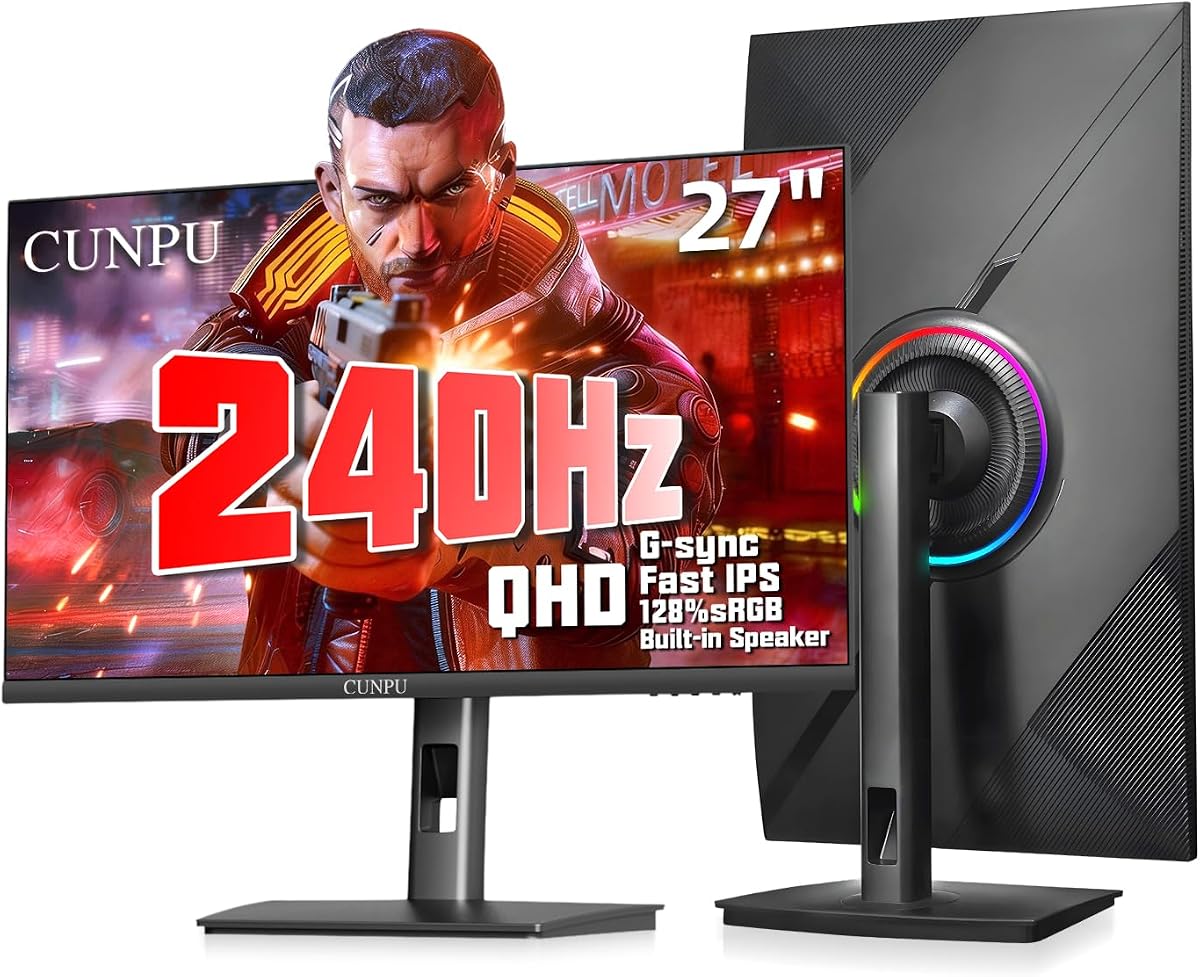
CUNPU 27 Inch 1440P
4.2Editor score
QHD Fast IPS display
240Hz refresh rate
1ms GTG response time
Fully adjustable gaming stand
A monitor that can rotate vertically can transform a cramped workstation by making documents, code, social feeds, and creative projects easier to view. The right model also needs a stable stand, dependable color, useful resolution, and connections suited to your devices. Portrait capability is useful, but it should support the rest of your setup rather than dictate it.
We compared ten monitors based on their published specifications, physical adjustment options, display performance, port selection, and intended uses. The list covers business displays, productivity models, and high-refresh-rate gaming screens. Particular attention was given to whether the stand or panel provides a genuine 90-degree pivot, since rotation must be supported by the hardware rather than merely suggested in a product description.
Each review identifies the strongest reason to consider a particular model and the compromises that may affect your choice. The first three recommendations cover the best balance of features, value, and premium performance, while the remaining entries highlight worthwhile alternatives. Product listings and pricing can change, so confirm current specifications, compatibility, and availability before purchasing.
4.2Editor score

4.7Editor score

4.4Editor score
As an Amazon Associate we earn from qualifying purchases.
The comparison below places the ten vertical-pivot monitors side by side, focusing on the factors that most affect portrait use: panel resolution, refresh rate, stand flexibility, mounting support, and connectivity.


The CRUA 24.5-inch combines a practical vertical pivot with unusually strong gaming specifications, including a 200Hz refresh rate and 3ms response time. Its listed 4.2 rating reflects a product aimed at people who want portrait flexibility without settling for a basic office panel. The 1920-by-1080 resolution is familiar, while the stand permits a full 90-degree rotation for documents, code, and compact side-by-side layouts.
We may earn a commission when you buy through this link, at no additional cost to you.
Its stand also provides 120mm of height adjustment, 15 degrees of tilt in either direction, and 15 degrees of swivel. That range makes it easy to move between landscape gaming and portrait reading without rearranging the desk. A 75-by-75mm VESA pattern adds another layer of flexibility, allowing the display to move to a compatible wall bracket or articulating arm. The three-sided narrow bezels keep the frame visually restrained when viewed vertically.
For gaming, the CRUA supports FreeSync and can use its HDMI 2.0, DisplayPort 1.2, and 3.5mm audio output connections. The supplied information says DisplayPort reaches the full 200Hz while HDMI supports 120Hz and 144Hz modes, making port choice relevant for a gaming PC. Color specifications include 120% sRGB, 8-bit rendering, 16.7 million colors, 300cd/m² brightness, and a 1000:1 contrast ratio. These are respectable rather than exceptional color figures, but they should suit general creative work and entertainment.
This is the best-balanced recommendation for someone who wants one screen to handle fast gaming, everyday computing, and occasional portrait work. The limitations are the modest FHD pixel count and a gaming feature set that does not reach the 240Hz level of several alternatives. Even so, its combination of pivot support, height adjustment, high refresh rate, FreeSync, and a compact frame makes it a versatile choice for a dual-purpose desk.
The 90-degree pivot transforms the display from a conventional landscape screen into a tall workspace for code, spreadsheets, chat threads, and documents. Because the base also raises and swivels, portrait mode does not require sacrificing all desk adjustment.
A 200Hz refresh rate, 3ms response time, and FreeSync provide a strong foundation for competitive play. DisplayPort is the preferred connection when pursuing the highest listed refresh rate, while HDMI remains convenient for laptops and consoles.
We may earn a commission when you buy through this link, at no additional cost to you.
The CUNPU 27-inch is the most feature-dense premium model in this guide, combining a 2560-by-1440 Fast IPS panel with a 240Hz refresh rate and 1ms GTG response time. Its 4.2 rating does not diminish the strength of the specification mix, but the monitor is clearly intended for buyers who want sharper desktop detail and unusually fluid motion from the same adjustable display.
We may earn a commission when you buy through this link, at no additional cost to you.
Picture quality is supported by 125% sRGB coverage, 100% DCI-P3 gamut coverage, HDR10, a 1000:1 dynamic contrast ratio, and more than 16.7 million colors. The panel is also specified for both FreeSync and G-Sync compatibility, which can help synchronize frames with compatible graphics hardware. Two 2W speakers add basic entertainment and conference-call audio, while the entertainment OSD includes GAME, FPS, RTS, MOVIE, and TEXT modes plus a black equalizer and backlight controls.
Portrait support is backed by a stand with 90-degree pivot, 90-degree swivel in either direction, a minus-five-to-15-degree tilt range, and 5.11 inches of height adjustment. The quick-mount bracket is designed to attach without screws, and the 100-by-100mm VESA compatibility broadens mounting options. Connectivity includes DisplayPort 1.4, two HDMI 2.0 ports, and a headphone jack, with stated support for desktop PCs, laptops, tablets, mini PCs, Switch, PS5, and Xbox consoles.
The CUNPU is a persuasive premium recommendation for a user who values both QHD clarity and high-refresh gaming. It may be overkill for standard office tasks, and a powerful graphics card is important if sustained 240Hz gaming is the goal. Even without demanding hardware, however, its 1ms response, extensive adjustment, wide color coverage, and rotating stand make it especially complete for mixed creative and gaming environments.
QHD provides a meaningful increase in workspace area compared with FHD, which is valuable when the monitor is rotated for code, timelines, spreadsheets, or image editing. The extra pixels can also make a single landscape screen feel less crowded.
The 240Hz panel, 1ms GTG response, adaptive-sync support, HDR10, and broad gamut coverage create a strong feature set. It is particularly attractive for gamers and creators who want a single display to handle demanding visual work.
We may earn a commission when you buy through this link, at no additional cost to you.
This 23.8-inch vertical PC monitor stands apart through connectivity rather than display performance. It provides HDMI, VGA, BNC, USB, AV, and audio input and output, along with two built-in speakers and a remote control. The listed 3.7 rating reflects a specialized product whose broad interface selection is more compelling for offices, installations, and mixed-source setups than for high-speed gaming.
We may earn a commission when you buy through this link, at no additional cost to you.
The screen uses a 1920-by-1080 FHD panel with 100% sRGB color, 250cd/m² brightness, a 1000:1 contrast ratio, 178-degree viewing angles, a 60Hz refresh rate, and a 5ms response time. That specification is appropriate for documents, surveillance viewing, general office work, and casual media use. Ultra-thin bezels on three sides give it a modern appearance and can be helpful in a multi-monitor arrangement.
Its stand allows 90-degree vertical rotation, 45-degree left and right swivel, height adjustment, and upward tilt. The key caveat appears in the product information itself: the monitor does not automatically rotate. The connected source device must support portrait output, and its display settings must be configured accordingly. That makes it less convenient for hot-swapping between landscape and portrait, but it remains flexible for fixed installations.
Choose this model when the number of input and output options matters more than gaming speed. It is especially relevant for users connecting PCs, laptops, CCTV equipment, Raspberry Pi systems, TV boxes, or media sources. The trade-offs are obvious: a lower 60Hz refresh rate, a lower rating than most alternatives, and the need to manage orientation through the source device rather than with automatic sensor-based rotation.
HDMI and VGA cover common computing needs, while BNC, AV, audio, and USB broaden the monitor's usefulness for specialized equipment. A remote control can make operating the display more convenient when it is positioned in a shared or mounted installation.
Portrait output depends on the source device and operating system rather than an internal orientation sensor. Check that your computer, docking station, and graphics driver can present a portrait desktop before relying on this feature in a fast-switching workflow.
We may earn a commission when you buy through this link, at no additional cost to you.
The Samsung 24-inch S40GD is a straightforward business monitor that includes the vertical movement modern productivity setups need. Its 4.4 rating is among the strongest in the guide, and the design emphasizes an IPS panel, narrow border bezels, height adjustment, and a pivot that permits a vertical view. It is a sensible choice for office work rather than competitive gaming.
We may earn a commission when you buy through this link, at no additional cost to you.
The 100Hz refresh rate is a meaningful step above the basic 60Hz category and can make scrolling and general interaction feel smoother. Samsung also provides adjustable game settings, a dedicated Game Picture Mode, reduced blue light, and flicker reduction. These features broaden its appeal when the office display is occasionally used for casual games, although the product information does not advertise an ultra-fast response time or explicit adaptive-sync support.
The main benefit is straightforward: a height-adjustable screen can also be pivoted vertically, allowing users to reclaim desk width and view tall documents, webpages, and forms more comfortably. The slim border design preserves a clean appearance, while the IPS panel is described as maintaining consistent colors and brightness as viewing angles change. That consistency is useful for general office work and shared viewing.
This Samsung is a well-rounded business option for anyone seeking vertical rotation without paying for high-end gaming specifications. The supplied information does not enumerate exact ports or detailed stand measurements, so buyers should verify those details against the current listing. Its 4.4 rating, 100Hz refresh rate, IPS panel, and flexible stand nevertheless make it one of the more confident recommendations in this category.
The S40GD focuses on the fundamentals that matter in an office: consistent color, slim bezels, height adjustment, and vertical pivot support. It avoids unnecessary complexity while remaining suitable for everyday games and media.
A 100Hz refresh rate supports smoother everyday interaction than many basic business panels. Reduced blue light and flicker-reduction features also align with the display's intended use during long work sessions.
We may earn a commission when you buy through this link, at no additional cost to you.
The KTC H27F7 combines a 27-inch Fast IPS panel with a 240Hz refresh rate and 1ms response time, making it a compelling high-speed option for competitive gaming. Its 4.5 rating is among the best in the guide. Although its resolution remains 1920-by-1080, the fast refresh and broad ergonomic range make it appealing when motion clarity and portrait flexibility matter more than maximum pixel density.
We may earn a commission when you buy through this link, at no additional cost to you.
The picture specification includes 131% sRGB color coverage, 350cd/m² brightness, a 1000:1 contrast ratio, HDR support, low blue light, and flicker-free operation. Adaptive-sync compatibility is also included, helping deliver smooth visuals without tearing when paired with a suitable graphics card. The fast IPS panel prioritizes quick transitions while retaining the wider viewing angles associated with IPS technology.
Portrait rotation is supported by a pivot range of plus or minus 90 degrees. The stand can also tilt from minus five to 20 degrees and raise the display by 130mm, giving users room to align the panel with a laptop, stacked screen, or wall-mounted arrangement. Connectivity includes two HDMI ports, DisplayPort 1.4, and USB 2.0, and the 100-by-100mm VESA pattern allows compatible mounting solutions.
The KTC is best suited to competitive gamers who want a large, fast screen and may occasionally rotate it for a vertical task. Its main limitation is FHD resolution: at 27 inches, it provides fewer pixels than a QHD model of the same size, so text, complex documents, and detailed editing may not look as crisp. Within those boundaries, the refresh rate, response time, stand adjustment, and 4.5 rating create a strong gaming package.
The 240Hz refresh rate and 1ms response specification are designed to keep fast movement clean. Adaptive sync adds another layer of smoothness, although achieving the full refresh rate depends on the graphics card, game, and connection used.
A plus-or-minus 90-degree pivot, 130mm height range, and broad tilt allowance make the display easy to reposition. The larger 27-inch footprint still benefits from a deep desk, especially when alternating between landscape gaming and portrait work.
We may earn a commission when you buy through this link, at no additional cost to you.
The KTC H25T7-3 pairs a compact 24.5-inch footprint with a 240Hz refresh rate, making it a useful choice for gamers who want high-speed performance without moving to a 27-inch panel. No customer rating is listed in the supplied product data, so its appeal should be evaluated from the specifications rather than treated as a proven user favorite.
We may earn a commission when you buy through this link, at no additional cost to you.
The Fast IPS panel offers a 1920-by-1080 resolution, 178-degree viewing angles, a 1ms MPRT response time, and FreeSync support. HDR400, 114% sRGB coverage, 16.7 million colors, 350cd/m² brightness, and a 1000:1 contrast ratio complete the visual specification. These are solid gaming-oriented figures, though the gamut is less expansive than the premium QHD alternatives in the guide.
The stand includes pivot, tilt, and height adjustment, allowing the screen to move into portrait orientation and change its viewing angle. Low blue light and flicker-free operation are also specified for longer sessions. Two HDMI 2.0 ports, DisplayPort 1.4, and one USB 2.0 port provide flexible connections, while 100-by-100mm VESA compatibility allows the screen to move to a wall mount or articulating arm.
This monitor is most appropriate for a desk where a 24.5-inch diagonal is easier to manage than 27 inches but FHD is still acceptable. It can serve as a fast gaming display while also rotating for browsing, documents, or messaging. The lack of a listed rating and relatively modest sRGB coverage prevent it from leading this roundup, but its speed, ergonomic flexibility, and compact format are compelling.
A 24.5-inch FHD display offers a middle ground between a compact laptop companion and a full-size desktop monitor. The 240Hz refresh rate still allows it to serve as a dedicated competitive-gaming screen when paired with capable hardware.
Pivot, tilt, and height adjustment support a comfortable viewing position, while low blue light and flicker-free operation suit extended sessions. VESA compatibility makes it easy to relocate the panel after the base has served its purpose.
We may earn a commission when you buy through this link, at no additional cost to you.
The KTC H27E6S is a feature-rich white gaming monitor that combines a 2560-by-1440 Fast IPS panel with a standard 240Hz refresh rate and an overclocked 275Hz mode. Its 4.5 rating and extensive specification sheet place it among the strongest performers here. Vertical pivot support is joined by height, swivel, and tilt adjustments, allowing the display to function as a gaming screen and a portrait productivity panel.
We may earn a commission when you buy through this link, at no additional cost to you.
Visual performance is driven by HDR400, 400cd/m² brightness, and 123% wide color gamut coverage. The product information says the 275Hz setting is overclocked, so achieving it may depend on signal compatibility and system capability. Adaptive Sync is included to reduce tearing, stuttering, and input lag, while built-in speakers offer a convenient option for everyday media and gaming audio.
The stand provides explicit height, pivot, swivel, and tilt adjustment, with the ability to rotate the monitor vertically for coding, browsing, and content creation. This makes the large panel more versatile than fixed-stand gaming displays. VESA compatibility adds a broad range of mounting choices, and the white finish may complement a lighter desk or minimalist gaming setup.
Two HDMI 2.0 ports, DisplayPort 1.4, and USB 2.0 provide the main connections, with stated support for consoles, PCs, and laptops. This is a premium-spec recommendation for users who want sharp QHD imagery, exceptional motion capability, and genuine portrait adjustment in one display. The main limitation is cost and hardware demands relative to FHD models, particularly for taking full advantage of the 240Hz or overclocked refresh rates.
QHD supplies enough pixel density for detailed creative work while the 240Hz standard mode supports fast gaming. The 275Hz overclock adds headroom for compatible systems, though it should be treated as an extra capability rather than a guaranteed everyday mode.
Height, swivel, tilt, and vertical pivot make the monitor adaptable to gaming, editing, browsing, and document-heavy work. The white enclosure gives buyers a distinctive alternative to the predominantly dark gaming-monitor designs in this category.
We may earn a commission when you buy through this link, at no additional cost to you.
The KTC H25T7-3 listing emphasizes a bright, fast 24.5-inch Fast IPS display with a true 90-degree pivot. Its 4.3 rating, 240Hz refresh rate, 1ms MPRT response, and 400cd/m² brightness make it an appealing option for a compact gaming setup that also needs occasional portrait use. The monitor is particularly attractive for users who prefer a smaller footprint than a 27-inch model.
We may earn a commission when you buy through this link, at no additional cost to you.
Color performance is described through 94% DCI-P3 and 114% sRGB coverage, while HDR400 adds stronger highlights and deeper contrast. The panel offers 178-degree viewing angles, which is useful when the screen is moved between landscape and portrait positions. Adaptive Sync and the 1ms MPRT specification are intended to keep fast motion clear and reduce tearing in compatible games.
Ergonomics are unusually comprehensive for this size. Height adjustment, a 90-degree pivot, and minus-five-to-20-degree tilt allow the screen to be positioned for different tasks. VESA compatibility supports compatible wall brackets and monitor arms, while low blue light and flicker-free operation are included for long sessions. Two HDMI 2.0 ports and DisplayPort 1.4 provide modern connectivity for PCs, laptops, and consoles.
The monitor is a good fit for gamers who want fast performance, solid brightness, and a flexible stand without moving to QHD. Its principal limitation is again the 1920-by-1080 resolution, which may limit fine text and editing detail compared with the 27-inch QHD models. The bright HDR presentation, wide color coverage, and clearly specified vertical adjustment nevertheless make this a confident alternative within the gaming category.
A 400cd/m² panel and HDR400 can produce more impactful highlights than many competing FHD gaming monitors. Broad DCI-P3 and sRGB coverage also benefits colorful games, video, and light creative work.
The combination of a 90-degree pivot, height adjustment, broad tilt, and VESA compatibility ensures portrait use does not require a separate stand. It is a practical way to preserve one screen for both fast games and tall documents.
We may earn a commission when you buy through this link, at no additional cost to you.
The 27-inch Samsung S40GD is the larger counterpart to the 24-inch model in this guide. It combines a spacious IPS display with a 100Hz refresh rate, height adjustment, and pivot support for vertical viewing. Its 4.4 rating suggests a well-received business monitor, and the larger panel can offer more room for multitasking even before it is rotated.
We may earn a commission when you buy through this link, at no additional cost to you.
Samsung emphasizes consistent colors and brightness across the screen, especially as the viewing angle changes. That quality is particularly relevant when pivoting the monitor because the viewer may be positioned off-center relative to a flat display. The borderless design keeps the visual footprint tidy, while reduced blue light and flicker reduction support comfortable use during long working sessions.
Although the primary focus is business and general content use, the display also includes optimizable game settings and a Game Picture Mode. The 100Hz rate is smoother than a standard 60Hz office monitor and is sufficient for many casual games, although it falls well short of the 240Hz options elsewhere in the list. Exact port details and the range of stand adjustment are not provided in the supplied information, so those should be confirmed before purchase.
Choose the 27-inch version when a roomy business display matters more than high-end gaming performance. It can serve as a large landscape monitor for spreadsheets and media or turn vertically for webpages, messages, and documents. Compared with the 24-inch Samsung, it offers a larger canvas with the same core strengths, making it a solid choice for buyers who want more screen area without the complexity of a gaming specification sheet.
A 27-inch panel can show more applications, reference material, or timeline detail at once. Rotating that larger display can also create a substantial portrait canvas for reading and communication workflows.
The 100Hz refresh rate, adjustable game settings, reduced blue light, and flicker reduction provide a comfortable balance between work and entertainment. It is not aimed at competitive gaming, but it handles everyday games competently.
We may earn a commission when you buy through this link, at no additional cost to you.
The Dell S2425HSM combines a polished productivity design with a 144Hz refresh rate, 1ms MPRT response, integrated speakers, and a highly adjustable stand. Its 4.7 rating is the highest listed rating in the guide. Although the 23.8-inch FHD format is conventional, the combination of vertical pivot, smooth motion, and integrated audio makes this a strong all-purpose recommendation.
We may earn a commission when you buy through this link, at no additional cost to you.
The 1500:1 contrast ratio supports clear image presentation, while the 144Hz refresh rate and 1ms Moving Picture Response Time are designed to produce smooth, tear-free viewing when paired with compatible hardware. AMD FreeSync is included for synchronization with compatible graphics systems. These specifications extend the display beyond basic office work and make it suitable for casual or moderately fast gaming.
Audio is handled by two integrated 3W speakers, which can be useful for video calls, system audio, and casual media without requiring a separate desktop speaker. Dell also highlights a four-star TÜV-certified eye-comfort feature designed to reduce harmful blue light while preserving image quality. Dell Display and Peripheral Manager provides an application for optimizing a compatible Dell workspace.
Height, tilt, pivot, and swivel adjustments allow the panel to move into portrait orientation and find a comfortable viewing angle throughout the day. The exact port selection is not fully detailed in the supplied information beyond an HDMI connection, so buyers should confirm the current connector list. Even with that caveat, the strong rating, smooth refresh rate, flexible stand, and built-in audio make the Dell a particularly complete general-purpose vertical monitor.
A 144Hz display makes cursor movement, scrolling, and casual games feel noticeably more fluid than a 60Hz panel. FreeSync and the 1ms MPRT specification further improve its appeal as a dual-purpose screen.
The dual 3W speakers reduce desk clutter and support calls or media, while TÜV-certified eye-comfort features target longer sessions. These details make the monitor particularly well rounded for everyday home and office use.
We may earn a commission when you buy through this link, at no additional cost to you.
The best vertical monitor balances true physical rotation with the resolution, panel quality, connectivity, and ergonomics needed for your desk. Use the following factors to compare models beyond the headline pivot feature and avoid paying for specifications that do not improve your actual workflow.
In short, look for explicit 90-degree pivot support and a stable base. A qualifying mount or articulating arm can also provide rotation even when the original stand is less flexible.
Choose FHD for a smaller footprint and adequate everyday clarity; choose QHD for a denser professional workspace. Do not rely on screen size alone, since panel resolution has a direct effect on readability.
Match refresh rate and response specifications to your games rather than treating a larger number as automatically better. Ensure your graphics hardware and selected cable can drive the intended mode.
Prioritize accurate color and useful viewing angles for work, then treat HDR and brightness as secondary benefits. For professional color work, verify the model's specific gamut and calibration-related claims.
Look for pivot plus height, tilt, and swivel rather than judging comfort by rotation alone. Make sure the base is stable and that the screen can be raised high enough for your seating position.
Confirm both the VESA dimensions and accessory weight capacity. An arm can be especially valuable when the original stand lacks sufficient pivot, height, or reach.
Choose the ports your setup will actually use and confirm source compatibility before ordering. For portrait workflows, verify that the computer and driver support manual rotation.
Match the screen's footprint and adjustment range to your desk, not just its screen size. Test the intended workflow mentally before committing to a large or fixed stand.
Begin by assembling the stand on a flat, stable surface and attaching the panel according to the manufacturer's instructions. Connect the appropriate video cable, power, and any audio or USB accessories before rotating the display. Use the stand's height, swivel, and tilt controls to establish a comfortable landscape position first. When switching to portrait mode, move surrounding objects out of the way and rotate the panel only through its supported range.
For portrait use, open the display settings in your operating system and choose the correct orientation. Some systems provide an automatic rotation command, while others require the user to select portrait manually. Apps with strict landscape assumptions may need to be rearranged, and wallpapers, video-call previews, and on-screen controls can initially appear sideways. Update graphics drivers and applications when necessary, especially if the display is connected through a dock or compact laptop.
Care for the screen by cleaning it with a soft, lint-free microfiber cloth and avoiding liquid directly on the panel. Do not press on the display, and avoid placing the base near the edge of a desk where an impact could tip it. For mounted models, inspect the bracket and tighten loose fittings periodically. When using an articulating arm, keep cables loose enough that movement does not pull the connectors, and clean the ventilation openings without allowing dust or moisture to enter the housing.
A vertically rotating monitor can pivot approximately 90 degrees so its height becomes greater than its width. This portrait orientation is useful for reading long documents, viewing code, working with messaging applications, or placing a narrow display beside a larger landscape monitor. The physical screen must support the pivot, and the connected computer must also be able to send a portrait image.
No. Swivel and pivot are separate adjustments. A stand may rotate the display left and right while keeping the panel in landscape orientation, or it may offer a stated plus-or-minus 90-degree pivot that allows portrait use. Look for explicit vertical-pivot or portrait-rotation language in the detailed specifications and illustrations.
Not always. Some operating systems and graphics drivers can detect orientation and rotate the desktop automatically, while others require a manual portrait setting. Certain multi-port monitors also do not include internal orientation sensors. Check your operating system and docking setup, and plan to rotate the image through software after physically turning the panel.
FHD can be sufficient for a compact 23.8-inch or 24.5-inch model, especially for documents, browsing, and general office work. A 27-inch FHD panel may look less crisp because the same pixel count is spread across a larger area. QHD is generally preferable for detailed code, spreadsheets, photo work, and multitasking, although it requires more graphics and system resources.
No. Business monitors with IPS panels, 100Hz refresh rates, and pivotable stands are often better suited to office productivity. Gaming monitors add high refresh rates, fast response specifications, and adaptive synchronization, which can also benefit media and general interaction. Choose the display category according to your primary workload rather than assuming vertical rotation requires a gaming model.
Usually, provided the monitor has a compatible VESA mounting pattern and the arm supports its weight. Match the interface size, such as 75-by-75mm or 100-by-100mm, and confirm that any quick-release plate can be removed. An articulating arm can provide more pivot, height, and reach than the factory stand, making portrait positioning more convenient.
At minimum, choose a monitor with a connector supported by your computer, such as HDMI or DisplayPort. DisplayPort is often necessary to reach the highest advertised refresh rate on gaming monitors. USB, audio, or legacy inputs add flexibility for specialized installations, but they should complement rather than replace a compatible primary video connection.
A rotated 24-inch display usually takes less horizontal space than it does in landscape orientation, but it still needs depth for the stand, cable bend, and rear housing. Large 27-inch models may require a deeper desk. If using a wall mount or articulating arm, check the arm's reach and ensure the base can be removed without leaving excess clutter.
The CRUA 24.5-inch stands out as the most balanced general recommendation, combining a true 90-degree pivot with 200Hz refresh, FreeSync, broad stand adjustment, and a compact footprint. The CUNPU 27-inch QHD is the premium choice for buyers who want finer detail, 240Hz performance, HDR, wide color coverage, and extensive adjustment. The Samsung 24-inch S40GD is the most accessible business option, offering an IPS panel, 100Hz refresh, height adjustment, and vertical pivot in a straightforward package.
Prioritize explicit 90-degree pivot support, enough resolution for the content you will view, and a stand that suits your desk. Gamers should balance refresh rate, response time, and adaptive synchronization, while productivity users should emphasize IPS consistency, viewing angles, and physical adjustment. Ports matter too, especially if the display will serve a laptop, console, or specialized source such as a CCTV system.
Finally, verify the current product listing before ordering because specifications, included accessories, port details, and prices can change. Check that your computer supports the desired resolution, refresh rate, and portrait orientation, and confirm the display's VESA pattern if you intend to use a monitor arm. With those details confirmed, one of these ten models can provide a more practical and comfortable vertical workspace.