
Long Probe Deep Soil Salinity EC Moisture Meter
Backlit digital display
Long stainless-steel probe
Portable soil and solution use
This Soil Salinity Testers guide compares ten digital and professional soil meters for salinity, EC, pH, temperature, accuracy, durability, and ease of use by
Soil salinity testers help growers identify excessive dissolved salts that can interfere with water uptake, reduce nutrient availability, and restrict healthy plant growth. The right instrument depends on whether you manage containers, greenhouse beds, fields, aquariums, pools, or nutrient solutions, as well as the measurements and construction required for your environment.
This guide compares ten available soil and water salinity meters using their stated capabilities, measurement functions, probe design, display features, environmental protection, and intended applications. It includes dedicated soil EC meters, broader multifunction plant testers, saltwater instruments, and handheld professional tools, while distinguishing garden-oriented products from laboratory-style and aquatic-focused devices.
Each review explains the strongest use case, notable specifications, practical limitations, and ideal buyer. Ratings reflect the supplied product data, while products without a listed rating are shown as unrated rather than being assigned a score. Product availability and prices can change, so readers should confirm the current listing and specifications before purchasing.

4.6Editor score

4.3Editor score
The comparison below highlights the measurement range, display, probe or instrument design, and most suitable application for every listed meter, making it easier to separate dedicated soil tools from multiparameter aquatic testers.



The Long Probe Deep Soil Salinity EC Moisture Meter is a straightforward, portable instrument designed for checking salinity in garden soil, greenhouse growing media, and nutrient solutions. Its most notable feature is the extended stainless-steel probe, which makes it more suitable for deeper insertion than a short, surface-oriented plant probe. The product listing includes a backlit digital screen, while no customer rating is supplied.
We may earn a commission when you buy through this link, at no additional cost to you.
The device emphasizes straightforward operation: insert the electrode into the soil or hydroponic nutrient solution being tested and read the result on the display. Its stainless-steel probe is described as practical and long-lasting, and the compact, lightweight enclosure should be easier to carry between a greenhouse, raised bed, and indoor growing area than a larger bench instrument. The screen illumination is particularly helpful in greenhouses, covered growing spaces, or during early morning and evening checks.
The principal limitation is the absence of a published rating and detailed technical accuracy information in the supplied data. Buyers also receive fewer explicit measurement details than they would from a meter with a stated EC range, temperature compensation, automatic calibration details, or a quantified waterproof rating. Its exact measurement suite should therefore be confirmed on the listing before purchase, especially if a numeric salinity reading is required for agronomic decisions.
This meter makes the most sense for hobby growers, market gardeners, and indoor cultivators who want a simple way to inspect multiple beds and solutions without buying a large instrument. It is also a practical choice when a long probe is more important than laboratory-grade specifications. For users who require a documented accuracy range, regulated salinity reporting, or certified calibration procedures, a more specialized model is the safer choice.
The extended electrode is the defining feature here, allowing the user to place the sensing tip farther into the growing medium. That can be useful when surface conditions do not accurately represent the zone around a plant's root system.
A backlit display improves visibility in shaded greenhouses and indoor spaces, while the compact construction supports repeated checks without leaving a meter stationed at home.
We may earn a commission when you buy through this link, at no additional cost to you.
The 2 in 1 Digital Plants EC Meter combines electrical conductivity and temperature measurement in a focused soil-monitoring tool. It has the highest listed customer rating among the products with confirmed scores, at 4.6, and pairs that strong reception with clearly stated technical information: an EC range of 0–4.00 mS/cm and accuracy of plus or minus 2% of full scale.
We may earn a commission when you buy through this link, at no additional cost to you.
Temperature is a valuable companion to an EC reading because temperature affects electrical conductivity measurements and provides useful context about the root zone. The probe is rated IP67 for protection against water and dust, making it better suited to outdoor beds and changing weather than an unprotected consumer probe. A green backlit LCD presents the results clearly, and the stated ten-to-fifteen-second reading period keeps routine checks reasonably quick.
The trade-off is specialization. Unlike broader multifunction meters, this model focuses on EC and temperature rather than adding soil moisture, pH, light, NPK, or water-quality functions. It also does not describe automatic temperature compensation, calibration solutions, or a stated EC resolution in the supplied information. Buyers needing a broader diagnostic picture may find a seven-in-one or eight-in-one instrument more useful.
This is a strong recommendation for gardeners, greenhouse operators, and farmers who specifically need repeat EC readings alongside soil temperature. The documented range, accuracy, waterproof electrode, and digital readability make it easier to justify than an underspecified meter. Choose it when two well-defined measurements are enough; choose a more comprehensive model when moisture, pH, or nutrient readings are also priorities.
The stated 0–4.00 mS/cm range and plus-or-minus 2% full-scale accuracy make this model more transparent than many general-purpose listings. Those details help buyers judge whether the intended use falls within the instrument's stated capabilities.
The IP67 electrode offers meaningful protection for outdoor use. Combined with the backlit screen, it is well suited to quick checks in beds, containers, and greenhouse areas where moisture and changing light are normal.
We may earn a commission when you buy through this link, at no additional cost to you.
The 7-in-1 Digital Soil Tester Kit combines seven plant-care measurements in one unit and has a 4.3 customer rating. Its functions cover soil moisture, pH, temperature, light intensity, fertility, TDS, and EC. This broad suite gives it the strongest appeal among the garden-oriented options for users who want one instrument to answer several common plant-care questions.
We may earn a commission when you buy through this link, at no additional cost to you.
The large LCD uses a white backlight to keep readings visible in daylight and darkness. A low-battery warning helps prevent confusing readings from depleted power, although four AAA batteries are not included. The stated procedure is to insert the probe approximately 10 centimeters into the soil and wait about ten seconds. The clear numbers and intuitive symbols are also designed to make results easier for beginners to interpret.
Its limitations are important for realistic use. The product must not be used to measure liquids directly, so its TDS and EC features should be understood in the context of the listed soil and water-quality measurement functions rather than assumed to work as a submerged aquatic instrument. Dry, hard soil can damage the probe; the instructions advise moistening the test area and waiting ten minutes before attempting a reading.
This kit is best for indoor plant owners, container gardeners, and general outdoor growers who want moisture, pH, temperature, light, and salinity-related information in one device. It is less appropriate for a professional requiring published EC accuracy specifications or a full laboratory soil analysis. Within the general gardening category, however, its screen, breadth, and simple procedure make it a particularly useful all-in-one package.
Combining moisture, pH, temperature, light, fertility, TDS, and EC reduces the need to move between separate meters. It is especially helpful when diagnosing why plant growth or watering behavior seems inconsistent.
The large backlit display is valuable in a dark utility room, a densely planted greenhouse, or a patio checked after sunset. Clear symbols also reduce the interpretation burden for less experienced growers.
We may earn a commission when you buy through this link, at no additional cost to you.
The Pool Salt Tester 5-in-1 is a digital aquatic instrument for measuring salt levels, pH, TDS, EC, and temperature. Its 4.4 rating places it among the stronger confirmed products in the list, although it belongs to a different category from conventional soil probes. It is intended for pools, aquariums, hot tubs, seawater, and food-related salt concentration checks.
We may earn a commission when you buy through this link, at no additional cost to you.
One of its most useful characteristics is flexible unit presentation. The meter can display PPM, PPT, or percentage, with a stated swimming-pool range of 0–9999 ppm, a seawater range of 10–200 ppt, and a food range of 0.01–25%. The unit automatically changes to PPT when the ppm value exceeds 9999. This makes the device useful across environments with very different concentration expectations rather than limiting it to a single application.
Operation is described as uncomplicated: dip the probe into the water and read the LCD, with no complicated setup or calibration procedure required according to the listing. The limitation is equally clear. This is not a soil-insertion meter and offers no guidance for reading root zones, mixing multiple samples, or monitoring a growing bed. Its performance claims in water should not be transferred automatically to potting soil or field conditions.
Choose this model for pool owners, aquarium keepers, or marine hobbyists who want salinity alongside pH, TDS, EC, and temperature in a single probe. It is a better fit for a saltwater system than for someone searching for a dedicated soil EC meter. Users should also confirm the relevant range and displayed unit for their intended sample before making routine management decisions.
PPM, PPT, and percentage formats let the instrument serve fresh or treated water, seawater, and concentrated food samples. Automatic switching above 9999 ppm helps preserve readability in high-concentration environments.
The probe is used in liquid rather than inserted into soil. Its straightforward process is useful for frequent spot checks, although the buyer must not confuse it with a root-zone salinity instrument.
We may earn a commission when you buy through this link, at no additional cost to you.
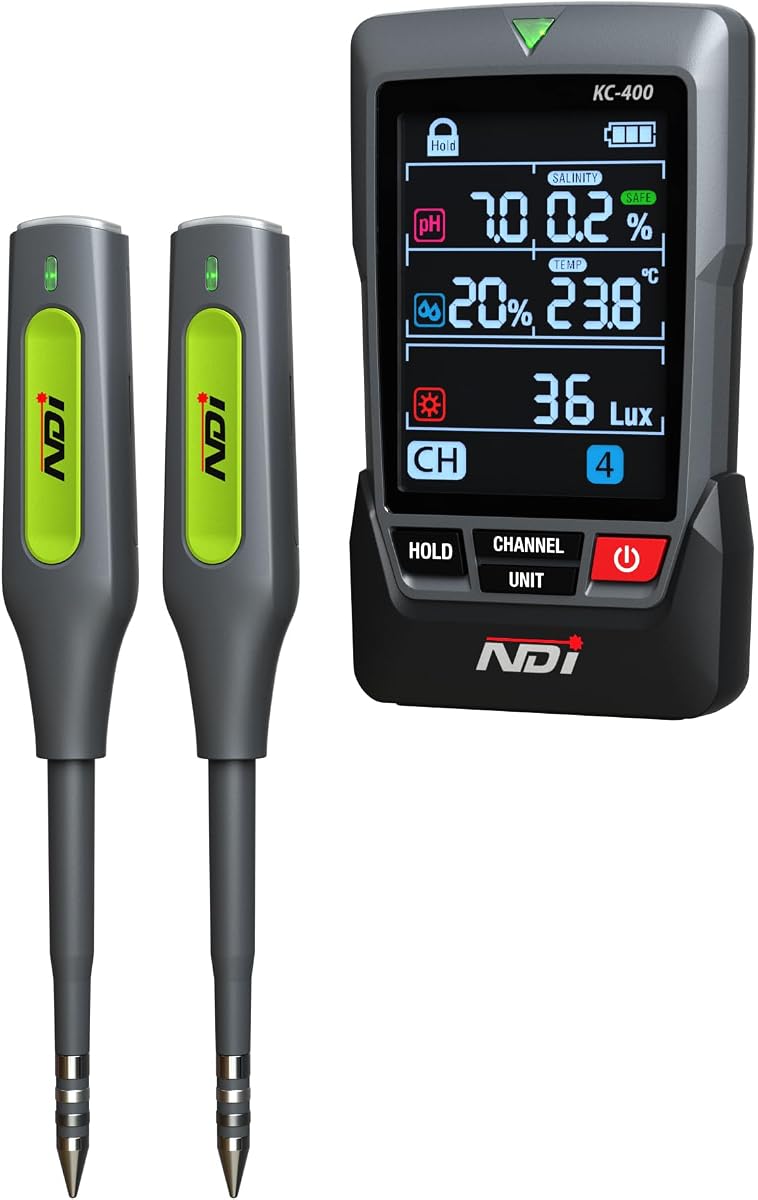
The NDI Multifunctional Soil Meter is designed for growers, landscapers, and agricultural users who want to monitor several locations rather than carry a single probe throughout a property. It supports up to five probes, uses wireless transmission, and is described as measuring pH, salinity, temperature, and light intensity. The listed rating is 3.9, and the supplied listing information is limited.
We may earn a commission when you buy through this link, at no additional cost to you.
The multi-probe and wireless design is the product's central appeal. A grower can potentially distribute sensing points across beds, rows, or separate growing areas and avoid managing multiple exposed cables. Light intensity and temperature add environmental context, while pH and salinity address two of the most important chemical variables affecting plant performance. The title also mentions acoustic wave growth assistance, although no supporting explanation is provided here.
The limited information creates more uncertainty than for a product with a detailed measurement range, accuracy statement, or waterproof rating. Buyers should ask whether the five probes are included, what wireless range they support, whether readings are synchronized, and which functions operate simultaneously. They should also confirm the salinity scale, calibration process, and power requirements before relying on the meter for critical decisions.
The NDI is most appropriate for landscapers, greenhouse operators, and growers with multiple monitoring zones who value wireless deployment over a highly specified standalone meter. It is less suitable for a first-time buyer seeking a simple, fully documented device or a professional who must present calibrated readings for a formal analysis. Confirming the omitted operating details is essential before purchase.
Support for up to five probes is meaningful for larger properties. Multiple points can help reveal differences between beds, rows, or irrigation zones that a single reading could miss.
Wireless transmission can simplify installations where long probe cables would be inconvenient. Because the supplied details are sparse, buyers should verify compatibility, range, and data handling before committing.
We may earn a commission when you buy through this link, at no additional cost to you.
The Hanna HI98319 Marine Salinity Tester is a compact handheld colorimeter intended for direct salinity measurement. It is designed for marine biology, aquariums, and other saltwater contexts rather than for inserting a probe into soil. Its listed rating is 3.9, and the product's appeal comes from focused operation and portability rather than a broad collection of gardening measurements.
We may earn a commission when you buy through this link, at no additional cost to you.
The handheld format is described as easy to carry to different test locations, which is useful for marine biologists, aquarium hobbyists, and field workers who need to move between tanks or samples. Simple button controls reduce the learning curve, while the colorimeter form differentiates it from conventional probe-and-screen meters. The listing does not provide a salinity range, resolution, accuracy, calibration method, or power information, so these details should be confirmed.
There is also an important category distinction. A marine salinity checker can be excellent for water samples but still be inappropriate for soil, potting mix, or nutrient solution. The supplied data does not describe a soil probe, EC output, pH, temperature compensation, or moisture measurement. Buyers looking for a gardening meter should instead consider a device explicitly designed for insertion into growing media.
This is a compelling option for a user whose needs are narrowly focused on portable marine salinity checks. It may also appeal to buyers who prefer a dedicated instrument over a multifunction model. For crop-salinity management, however, choose a meter explicitly rated for soil and solution measurements, and verify its units, range, and calibration procedure before sampling.
The colorimeter design and direct measurement focus suit saltwater applications. It avoids the complexity of a broad multifunction meter when salinity is the only parameter being monitored.
The compact handheld body supports field use and quick checks in different locations. Users should confirm battery, calibration, and range details that are not included in the supplied information.
We may earn a commission when you buy through this link, at no additional cost to you.
The 4-in-1 Digital Soil Moisture Meter covers four common plant-care needs: soil moisture, pH, temperature, and sunlight intensity. Its 4.2 rating indicates a reasonably well-received general-purpose instrument, but it is not designed primarily as a salinity meter. Gardeners seeking a broader diagnostic kit may find its everyday plant metrics more useful than its name initially suggests.
We may earn a commission when you buy through this link, at no additional cost to you.
The display uses a large LCD with white backlighting, and the head rotates from 0 to 45 degrees. That angled design can make the screen easier to read while the probe remains in the soil, reducing the need to crouch awkwardly beside a bed. The stated method is to insert the probe approximately four inches, or 10 centimeters, and wait about ten seconds before reading the display.
A notable limitation is the absence of a stated EC or salinity function. The device can help identify watering, acidity, temperature, and light issues, but it cannot directly show whether dissolved salts have become excessive. It also does not offer the detailed salinity range and accuracy found on dedicated EC meters. Four AAA batteries are required and not included, and the product cannot be used to test liquids directly.
The instructions also recommend taking soil pH and moisture measurements at no fewer than five locations and averaging the values, which is sound practice because a single point may not represent an entire bed. This model is best for indoor plant care, potted plants, succulents, and general garden monitoring where moisture and pH are the priority. It is not the right choice when salinity is the central concern.
The rotating head is a thoughtful ergonomic feature. It helps users keep their eyes on the display while the probe remains positioned in the soil.
Averaging readings from at least five locations reduces the chance that one unusually dry or wet spot controls the entire watering decision. This is especially useful across mixed beds.
We may earn a commission when you buy through this link, at no additional cost to you.
The 8-in-1 Saltwater Pool Tester is the most comprehensive aquatic instrument in the list, with a 5.0 customer rating. It measures pH, TDS, EC, salinity, ORP, specific gravity, free chlorine, and temperature. The product is intended for pools, hot tubs, spas, aquariums, drinking water, and other liquid samples rather than for insertion into soil or growing media.
We may earn a commission when you buy through this link, at no additional cost to you.
Several design details support regular monitoring. The backlit LCD provides clear numerical results, automatic calibration simplifies setup, and automatic temperature compensation adjusts readings as water temperature changes. The listing states a response time of 0.05 seconds and pH accuracy of 0.01. A compact, durable housing is also designed for portable use, allowing one device to serve several water systems around a property.
The main limitation is the same category caveat that applies to other aquatic meters: these specifications describe liquid testing, not root-zone salinity measurement. A pool salinity reading cannot be used as a direct substitute for an EC reading in potting soil, because the medium, probe exposure, and measurement conditions differ. Buyers should also distinguish the product's broad feature set from a need for a documented soil-specific accuracy and calibration standard.
This tester is a strong recommendation for saltwater pool owners, hot-tub users, aquarium keepers, and anyone who wants one instrument to monitor several water parameters. Its 5.0 rating, automatic calibration, temperature compensation, and numerical display make it particularly convenient. It should be selected for water management, while crop and garden users should choose a meter explicitly designed for soil or nutrient solution.
Combining salinity, pH, EC, TDS, ORP, specific gravity, chlorine, and temperature supports a more complete water-management routine. It reduces the need to alternate among separate handheld devices.
Automatic temperature compensation and calibration reduce manual adjustment and support consistent readings as conditions change. The stated 0.01 pH accuracy adds a useful precision reference.
We may earn a commission when you buy through this link, at no additional cost to you.
The 8 in 1 Professional Soil Tester is a broad digital soil-analysis instrument with no customer rating supplied. Despite the eight-in-one product name, the listed probe functions are temperature, humidity or moisture, EC, salinity, pH, and NPK. It combines those measurements with a 7.6-inch stainless-steel probe, a digital LCD, and USB-C power, positioning it for farmers, gardeners, and agronomists.
We may earn a commission when you buy through this link, at no additional cost to you.
The detailed ranges are a major strength. EC and salinity cover 0–20,000 microSiemens per centimeter and 0–20,000 milligrams per liter, respectively, while pH spans 3–10 and NPK spans 0–1,999 milligrams per kilogram. Temperature is listed from minus 40 to 80 degrees Celsius. These specifications make the instrument far more transparent than a general meter with broad claims but no ranges.
Environmental construction is also notable. The IP68-rated, sealed design is intended to withstand rain, mud, humidity, and temperature extremes, making it suitable for farms, lawns, greenhouses, and other demanding outdoor locations. USB-C power removes the need for batteries, though a connected power source is required for use. The listing advises waiting three to five minutes for stable NPK readings in moist soil above 20% humidity.
This model is best for a grower who wants a broad, portable field instrument rather than a small moisture meter. It is particularly compelling for comparing salinity alongside pH, NPK, moisture, and temperature. The absence of a listed rating and the need to verify the unusual product naming are the main reasons to review the listing carefully, but the published ranges, rugged probe, and USB-C design make it a serious agricultural option.
Published EC, salinity, pH, temperature, and NPK ranges allow users to judge whether a reading is plausible and whether the instrument suits their crops and soil conditions.
The IP68 sealed construction and stainless-steel probe are suited to rain, mud, and repeated field use. USB-C power simplifies charging but means the tester cannot be used as a completely standalone device.
We may earn a commission when you buy through this link, at no additional cost to you.
The Apera Instruments Value Series Salt20 Salinity Tester Kit, model AI214, is a focused salinity instrument with a 4.0 rating. Its platinum black sensor is designed to cover a salinity measurement range of 0–10.0 ppt. The complete package includes calibration solution, batteries, and a lanyard, all stored in a portable carrying case, making it especially convenient for mobile sampling.
We may earn a commission when you buy through this link, at no additional cost to you.
Automatic calibration and automatic temperature compensation from 0–50 degrees Celsius simplify the measurement process and help account for changing water temperature. The large LCD displays both temperature and parts per thousand, while reminders indicate completed calibrations and stable readings. These status cues are useful because they help users distinguish a settled result from a value that still needs time to stabilize.
The principal limitation is that this is a liquid salinity meter, not a soil probe. It is well suited to aquariums, water samples, and other saline solutions, but its 0–10.0 ppt range and instructions should not be assumed to provide a root-zone EC reading. Users should also observe the stated operating temperature range and avoid extending the sensor beyond its intended application.
Choose the Salt20 for a portable, dedicated salinity kit that includes the consumables needed to begin measuring. It is a good option for aquarium or water-testing work where a focused instrument is preferable to a large multifunction device. Gardeners and farmers should choose an EC meter specifically described for soil, nutrient solution, or growing media.
Calibration solution, batteries, a lanyard, and a carrying case are included. That bundled approach reduces the need to source essential accessories separately before the first test.
The dual temperature and PPT display gives useful context for each salinity value, while status reminders help indicate when calibration and measurement stabilization are complete.
We may earn a commission when you buy through this link, at no additional cost to you.
Selecting a salinity tester requires matching the instrument to the sample, required measurements, operating environment, and degree of accuracy your routine demands. The most important distinction is whether you need a root-zone soil instrument, a nutrient-solution meter, or an aquatic salinity device.
Summary: Buy a soil EC meter for beds, pots, or hydroponic solutions, and a liquid salinity meter for pools, aquariums, or water samples.
Summary: Compare stated EC range, accuracy, and units before choosing, especially when salinity readings will guide irrigation or fertilizer changes.
Summary: Prefer instruments with automatic calibration and temperature compensation, and verify that any necessary calibration solution is included or readily available.
Summary: Match probe depth to the root zone and choose an appropriately sealed design for outdoor use, while following soil-moistening instructions.
Summary: Select only the measurements you will regularly use, unless a broad monitoring dashboard is a central part of your gardening or farming workflow.
Summary: Prioritize a readable screen, clear status indicators, and a measurement routine that fits how often you will use the instrument.
Summary: Consider battery life, included power accessories, charging convenience, and the size of the carrying case or probe package.
Summary: Use ratings as context, then verify measurement range, calibration, accessories, and support before making the final decision.
Begin by reading the meter-specific instructions and confirming that the probe is appropriate for the sample. For soil meters, choose representative root-zone locations, gently insert the probe to the specified depth, and wait for the display to stabilize. General garden models commonly call for approximately 10 cm of insertion and a ten-second delay, while the Professional Soil Tester advises three to five minutes for stabilized NPK readings in suitably moist soil. If the soil is dry and hard, moisten the area and allow it to settle rather than forcing the probe.
Take multiple samples instead of relying on one reading. The 4-in-1 Digital Soil Moisture Meter recommends at least five locations for pH and moisture readings, and the same principle applies to salinity in beds with variable irrigation, soil texture, or amendment history. Clean and dry the probe between samples, avoid leaving it inserted when not needed, and record the crop, location, growing medium, and recent fertilization so trends can be interpreted meaningfully. Repeat measurements under similar conditions whenever possible.
Care for the instrument according to its construction and the liquid-testing instructions. Do not immerse a soil-only meter unless the manufacturer explicitly permits it, and never use a product marked for soil against a liquid unless that function is stated. Store the meter in a dry place, remove batteries during extended storage if the manufacturer advises it, and keep calibration solution, accessories, and the carrying case together. Rinse aquatic probes as directed after use, handle the sensing surface gently, and recalibrate whenever the manufacturer specifies or when readings appear inconsistent.
Electrical conductivity is commonly used to estimate how much soluble salt is present in soil or water, so many soil meters label the function as EC or soil salinity. A true salinity instrument may instead display PPT, PPM, or percentage. Because the scales are not interchangeable without context and calibration, buyers should check the manufacturer's range and intended application rather than converting one reading automatically.
Only if the manufacturer explicitly supports both soil and liquid measurement. Pool salt testers and marine checkers are designed for immersion, while many garden soil meters must not be placed directly in liquids. Using the wrong type can produce misleading results or damage the sensing element, so confirm the permitted sample type before taking a reading.
Dry, compacted ground can damage the probe or its internal components when the user forces it into the ground. The instructions for both the 7-in-1 and 4-in-1 models recommend moistening the test area and waiting before measuring. A slightly damp section also gives a more representative reading than trying to force a sharp probe through hard soil.
Read several representative locations rather than relying on one sample. The 4-in-1 model's instructions suggest at least five locations for pH and moisture, and the same sampling discipline is sensible for salinity. Include different parts of the bed, particularly areas with different watering, soil texture, fertilizer history, or plant performance.
Calibration requirements depend on the instrument and sensing technology. Some digital meters provide automatic calibration, while others may require a standard solution or a reference measurement. The Apera Salt20 kit includes calibration solution, and the 8-in-1 Saltwater Pool Tester states that it offers automatic calibration. Users should follow the instructions supplied with their specific model.
EC measures electrical conductivity, while TDS uses conductivity to estimate dissolved total solids. The numerical relationship depends on the meter and the substance being measured, so a TDS conversion is not always appropriate for soil. Buyers who need both functions should look for a meter that explicitly provides EC and TDS and check which sample types it supports.
A basic meter that omits EC or salinity cannot directly confirm a salt problem, even though salinity can sometimes cause symptoms that resemble drought or poor nutrient uptake. The 4-in-1 Digital Soil Moisture Meter is useful for moisture, pH, temperature, and light but does not provide a stated salinity output. Use a dedicated EC or salinity meter when dissolved salt is the central concern.
A high IP rating provides useful protection against water and dust, but it does not make a probe immune to misuse. The 2 in 1 meter has an IP67 electrode, and the Professional Soil Tester has IP68 construction. Even with those ratings, follow the instructions, avoid forcing dry soil, rinse as directed, and store the device properly between uses.
The Long Probe Deep Soil Salinity EC Moisture Meter offers a portable, budget-conscious way to check soil and solution media, with an extended stainless-steel probe and illuminated display. The 2 in 1 Digital Plants EC Meter stands out for its focused EC and temperature measurement, documented range and accuracy, and IP67-protected electrode, making it the most balanced dedicated soil choice.
The 7-in-1 Digital Soil Tester Kit is the strongest all-purpose garden option, combining EC and TDS with moisture, pH, temperature, light, and fertility readings. The 8 in 1 Professional Soil Tester goes further for field-oriented users through NPK analysis, broad ranges, a stainless-steel probe, and IP68 construction. Pool and marine products should be selected for water applications rather than treated as substitutes for root-zone instruments.
Before buying, confirm that the meter supports the exact sample you will test, compare the stated EC or salinity range with your needs, and check calibration, probe protection, and included accessories. Product availability and prices change, so review the current Amazon listing and seller information at the time of purchase. The most useful instrument is the one whose specifications align with your plants, growing media, water system, and testing routine.