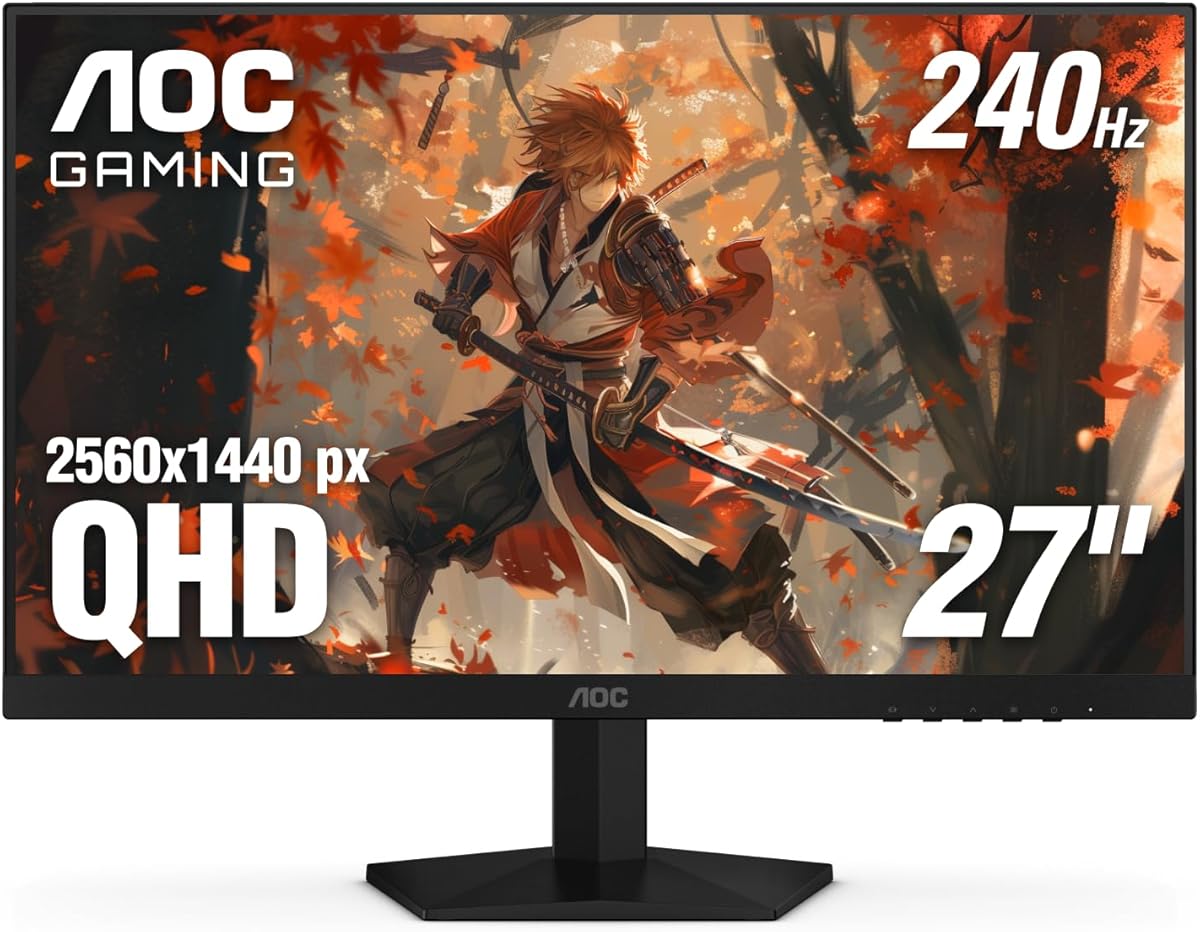
AOC Q27G41ZE
4.6Editor score
QHD resolution with 240Hz
0.3ms MPRT response time
Adaptive-Sync and versatile ports
A 1440p gaming monitor at 240Hz offers a compelling balance for competitive and enthusiast play. The higher resolution reveals more detail than 1080p, while a 240Hz refresh rate can present fast movement with exceptional clarity. The right model also needs responsive pixels, adaptive synchronization, useful ports, and an adjustable stand.
This guide compares ten 27-inch-class monitors using the specifications and features supplied for each model. We examine panel type, native and overclocked refresh rates, response time, adaptive-sync support, color coverage, HDR capabilities, connectivity, and ergonomic adjustments. The result covers fast IPS options, QD-OLED displays, and more specialized gaming designs.
Each selection reveals what distinguishes it from the alternatives, from practical everyday performance to premium image quality. We use the supplied ratings and product information without claiming personal testing. Prices and promotions can change at any time, so check the current listing and confirm that your graphics card and cables support the intended resolution and refresh rate.
4.6Editor score

4.4Editor score

4.6Editor score
As an Amazon Associate we earn from qualifying purchases.
The comparison covers ten 27-inch-class QHD gaming monitors across traditional IPS, fast IPS, and QD-OLED technologies, with most reaching 240Hz through DisplayPort and some through HDMI as well. Specifications below highlight the differences most likely to affect competitive play, image quality, connectivity, and everyday usability.


The AOC Q27G41ZE combines a 2560 x 1440 IPS panel with a 240Hz refresh rate over DisplayPort, making it a practical high-speed choice for competitive gamers. Its supplied rating is 4.6, and the specification list combines rapid motion handling with practical features such as Adaptive-Sync, Shadow Control, Game Mode presets, and a graphical on-screen display. The title also identifies 260Hz overclocked operation, giving buyers the option to push beyond the standard 240Hz mode when their graphics hardware and games allow it.
We may earn a commission when you buy through this link, at no additional cost to you.
The standout strength is its combination of resolution, speed, and price-conscious positioning without relying on an OLED panel. A 0.3ms MPRT figure emphasizes its focus on minimizing visible blur, while 300-nit brightness and a 1000:1 contrast ratio provide a conventional IPS balance for indoor gaming. Connectivity is also strong: one DisplayPort 1.4 connection, two HDMI 2.0 inputs, and audio output give a desktop PC or console setup several options. The three-sided frameless design and textured black-and-red finish add a gaming-oriented appearance without taking space away from the image.
The main limitation is the stand. Tilt adjustment from -3 to +21 degrees is useful, but there is no listed height, swivel, or pivot movement, so getting the screen precisely aligned may take more effort. The supplied information also does not identify the maximum refresh rate over HDMI or list specific NVIDIA G-SYNC certification details, despite G-SYNC appearing in the product title. Adaptive-Sync support is confirmed, making the display broadly compatible, but buyers should verify exact mode behavior in the current product documentation.
This is an easy recommendation for a gamer who wants 1440p detail and a true high-refresh target without moving into the premium OLED category. It should suit competitive shooters, racing games, and action-heavy titles where fast pixel response matters. For users who require a fully adjustable stand, broad HDR specifications, or maximum flexibility over every connection, one of the more ergonomic alternatives may be worth considering.
The QHD panel, 240Hz DisplayPort mode, 0.3ms MPRT response, and Adaptive-Sync support cover the core requirements of a modern competitive gaming display. It delivers the important features without requiring users to compromise resolution for a simpler panel.
DisplayPort 1.4, dual HDMI 2.0, and audio output provide a practical selection for PCs, consoles, and external audio. The included gaming presets and Shadow Control add further convenience for quick setup.
We may earn a commission when you buy through this link, at no additional cost to you.
The Acer Nitro XV272U is a 27-inch WQHD IPS gaming monitor built around a 240Hz DisplayPort mode, 144Hz HDMI mode, and response time listed as 1ms GtG with up to 0.5ms GtG. Its 4.2 rating is lower than several alternatives in this guide, but the underlying specification is well suited to fast multiplayer gaming. AMD FreeSync Premium adds synchronization support, while the 16:9 panel maintains the familiar desktop proportions of a conventional 1440p display.
We may earn a commission when you buy through this link, at no additional cost to you.
Its defining advantage is physical adjustability. The supplied stand specification includes 4.7 inches of height adjustment, 360-degree swivel, plus-or-minus 90-degree pivot, and tilt from -5 to 15 degrees. That makes it easier to position the screen comfortably, align it with a multi-monitor arrangement, or rotate it when working with portrait-oriented content. VESA 100 x 100mm mounting support is also listed. Two 2-watt speakers provide basic sound without requiring separate desktop speakers for casual system audio.
The important trade-off appears in connectivity. DisplayPort 1.4 supports the full 240Hz target, while HDMI 2.0 is listed at 144Hz. That distinction matters for console users or anyone considering a laptop with only HDMI. It also means buyers should connect a gaming PC through DisplayPort when they want to make full use of the display's headline refresh rate. The response-time description is complex, presenting both a standard 1ms GtG and an up-to-0.5ms GtG claim, so users should understand that measured results can vary by mode.
The Acer Nitro XV272U is a strong recommendation for gamers who value a flexible, ergonomic setup at least as much as a premium panel. Its height, swivel, and pivot controls offer more freedom than the AOC Q27G41ZE, and the built-in speakers make it convenient for a mixed gaming and productivity desk. It is less suitable for buyers who require 240Hz over HDMI or want the deeper blacks and exceptionally quick native response of a QD-OLED model.
Height, swivel, pivot, and tilt adjustments make this one of the most ergonomic monitors in the roundup. Those controls can reduce neck and shoulder strain during long sessions and simplify multi-monitor alignment.
A 240Hz DisplayPort mode, fast GtG response, and AMD FreeSync Premium target motion clarity and synchronization. The included DisplayPort and HDMI cables also help users connect the monitor immediately.
We may earn a commission when you buy through this link, at no additional cost to you.
The LG 27GR83Q-B is one of the most complete conventional gaming monitors in this guide. It combines a 27-inch 2560 x 1440 IPS panel, a 240Hz refresh rate through both DisplayPort and HDMI 2.1, and a 1ms GtG response time. Its supplied rating is 4.4, which reflects a generally well-rounded specification sheet. The ability to reach 240Hz over either major connection gives it unusual flexibility for a PC gamer, console user, or laptop owner.
We may earn a commission when you buy through this link, at no additional cost to you.
Adaptive synchronization is another major strength. The display is officially validated as NVIDIA G-SYNC Compatible and supports AMD FreeSync Premium, making it a sensible choice for users across both major graphics-card ecosystems. Its gaming tools include Dynamic Action Sync, Black Stabilizer, an on-screen FPS counter, a crosshair, and dedicated Gamer, FPS, and RTS modes. These features simplify setup, while Black Stabilizer can make dim areas easier to distinguish in shadow-heavy games.
Image features make the monitor useful beyond competitive play. The panel covers up to 95% of the DCI-P3 gamut on a typical basis and supports VESA DisplayHDR 400, combining more color and contrast range than a standard SDR display. DTS Headphone:X support and a four-pole headphone output add another layer for compatible headsets, although the exact spatial-audio experience depends on the game, software, and headset configuration. The stand provides tilt, height, and pivot adjustment, though the supplied data does not list a swivel range.
This is a particularly balanced recommendation for a gamer who wants 240Hz without needing to compromise on connection choice, synchronization support, color, or ergonomic adjustment. It may not be the ideal choice for someone seeking near-instant QD-OLED response and true-black contrast, nor does DisplayHDR 400 promise a dramatic HDR upgrade. Even so, the LG combines the essential competitive specifications with useful gaming features in a package suited to both fast matches and extended play.
Unlike several competitors whose HDMI modes refresh more slowly, this model supports 240Hz through both DisplayPort and HDMI 2.1. That makes the display easier to pair with different gaming systems.
Black Stabilizer, Dynamic Action Sync, a frame-rate counter, and crosshair support target common competitive needs. Preset Gamer, FPS, and RTS modes offer a convenient starting point for different genres.
We may earn a commission when you buy through this link, at no additional cost to you.
The Acer Predator X27U combines a 26.5-inch WQHD quantum dot OLED panel with a 240Hz refresh rate and a listed 0.03ms GtG response time. Its 4.5 rating places it among the strongest-rated products in this guide. Unlike a conventional IPS monitor, the self-emissive OLED technology is designed to deliver exceptional contrast and cinematic color, making the X27U a natural choice for gamers who want both competitive speed and a more immersive image.
We may earn a commission when you buy through this link, at no additional cost to you.
Color specifications are particularly impressive. The monitor supports true ten-bit color, a 99% DCI-P3 gamut, a Delta E below two, and HDR10. Those figures suggest that it can produce a broad range of colors with a high degree of precision, a benefit for both richly art-directed games and mixed creative work. The 0.03ms GtG response and 240Hz refresh rate make it particularly compelling for shooters, racing games, and other titles in which motion clarity carries substantial weight.
AMD FreeSync Premium provides variable-refresh synchronization, while the ZeroFrame design reduces the visual presence of the bezel to keep attention on the action. Image-retention-refresh functionality is included to help keep images from sticking, an important consideration with OLED displays. Nevertheless, OLED users should still understand that static desktop elements, long sessions, and improper settings can contribute to uneven aging. The product information does not specify every stand adjustment, port, or brightness detail, so buyers should check the listing for fit and installation requirements.
The Acer Predator X27U is an excellent high-end choice for a buyer who wants one monitor to handle competitive gaming, cinematic games, and visually rich content. Its 26.5-inch size preserves the practical footprint associated with 27-inch gaming displays while benefiting from OLED contrast. It is less appropriate for users who are highly sensitive to possible burn-in or who need a fully documented range of connectivity and ergonomic controls. Within those constraints, it is a standout premium performance option.
A 0.03ms GtG response complements the 240Hz refresh rate, giving fast motion a high priority. OLED technology then adds strong contrast and rich color that conventional IPS panels cannot match.
True ten-bit color, 99% DCI-P3 coverage, Delta E under two, and HDR10 make the panel suitable for visually detailed games. The result can look impressive in both dark and colorful scenes.
We may earn a commission when you buy through this link, at no additional cost to you.
The KTC H27E6S is a 27-inch Fast IPS monitor with a native 240Hz refresh rate that can overclock to 275Hz. Its response time is listed at 1ms MPRT, and Adaptive Sync is included. The model stands out for combining a high upper refresh target with a broad set of everyday features, including two HDMI 2.0 ports, two DisplayPort 1.4 ports, built-in speakers, and a 3.5mm headphone connection. No customer rating was supplied, so its reputation cannot be compared numerically with the rated products.
We may earn a commission when you buy through this link, at no additional cost to you.
Image specifications lean toward a mix of gaming and general use. The panel covers 123% of the sRGB gamut and supports HDR400, while 400cd/m² brightness and a 1000:1 contrast ratio should suit a typical indoor environment. The product is also positioned for users who may edit photos, create designs, watch media, or play games on different systems. Four video inputs make it easy to connect a PC, PS5, Xbox, or Switch, although the exact maximum console resolution and refresh rate are not stated in the supplied information.
Its ergonomic specification is particularly strong for a model in this category. The stand offers 130mm of height adjustment, -5 to 20 degrees of tilt, plus-or-minus 45-degree swivel, and 90-degree pivot rotation for portrait use. A 100 x 100mm VESA mount is supported. Low blue light and flicker-free technology are also listed, and the supplied information states that the monitor is backed by a three-year warranty with responsive customer support.
The KTC is worth considering for buyers who want many ports, an adjustable stand, and an overclocked refresh rate without moving to QD-OLED. Because there is no supplied rating and limited information is provided about specific adaptive-sync standards, warranty conditions in different regions, or exact console bandwidth, potential buyers should verify those details in the current listing. Subject to that check, it appears to be a feature-rich Fast IPS option with unusually broad connectivity for the class.
The native 240Hz mode meets the central target, while the stated 275Hz overclock offers additional headroom for compatible systems. Users should confirm that their graphics card, game, and connection can reliably drive the higher mode.
Two DisplayPort and two HDMI inputs support a varied mix of devices. Built-in speakers and a headphone jack reduce the need for extra desk audio hardware when casual sound is enough.
We may earn a commission when you buy through this link, at no additional cost to you.
The ASUS ROG XG27ACMG targets gamers who want more than the standard 240Hz target without stepping into OLED pricing. It combines a 27-inch 2560 x 1440 panel, an overclocked 270Hz refresh rate, and ASUS Fast IPS technology with a 1ms GTG response time. Its supplied rating is 4.3. The title also highlights USB-C support and G-SYNC, while the feature list adds support for ASUS Extreme Low Motion Blur Sync with variable refresh rate.
We may earn a commission when you buy through this link, at no additional cost to you.
The USB-C connection is one of the display's most distinctive features. Its DisplayPort Alternate Mode allows a compatible laptop or other device to be connected with a single cable, simplifying a compact setup. A full range of legacy ports is not specified in the supplied material, so buyers should verify the exact port inventory before purchasing, particularly if they need multiple DisplayPort or HDMI connections for a console, desktop, and portable device.
Image quality specifications center on ASUS Fast IPS, 95% DCI-P3 coverage, and advanced grayscale tracking for smoother tonal gradation. HDR is supported, although a specific certification level and brightness figure are not included in the supplied facts. ROG Gaming A.I. features are intended to enhance the gaming experience, and DisplayWidget Center allows settings to be adjusted with a mouse, reducing the need to navigate a conventional on-screen menu. The package includes a DisplayPort cable, power cord, ROG pouch, sticker, warranty card, and quick-start guide.
This monitor is a good fit for a high-end laptop user, competitive PC gamer, or anyone attracted to the ROG platform and its feature set. The three-year warranty with advanced replacement and repair service adds reassurance, and the supplied offer of a three-month Adobe Creative Cloud subscription is useful for buyers who need creative software. Its 270Hz ceiling provides a modest boost over 240Hz, but the lack of more detailed connectivity and brightness information makes careful listing review important.
USB-C with DisplayPort Alternate Mode can simplify a portable gaming setup while reducing cable clutter. The exact supported resolution and refresh rate should be confirmed for the specific host device.
Fast IPS technology, 1ms GTG response, and ELMB SYNC place motion clarity at the center of the design. A 95% DCI-P3 gamut and grayscale tracking support more refined color and tonal transitions.
We may earn a commission when you buy through this link, at no additional cost to you.
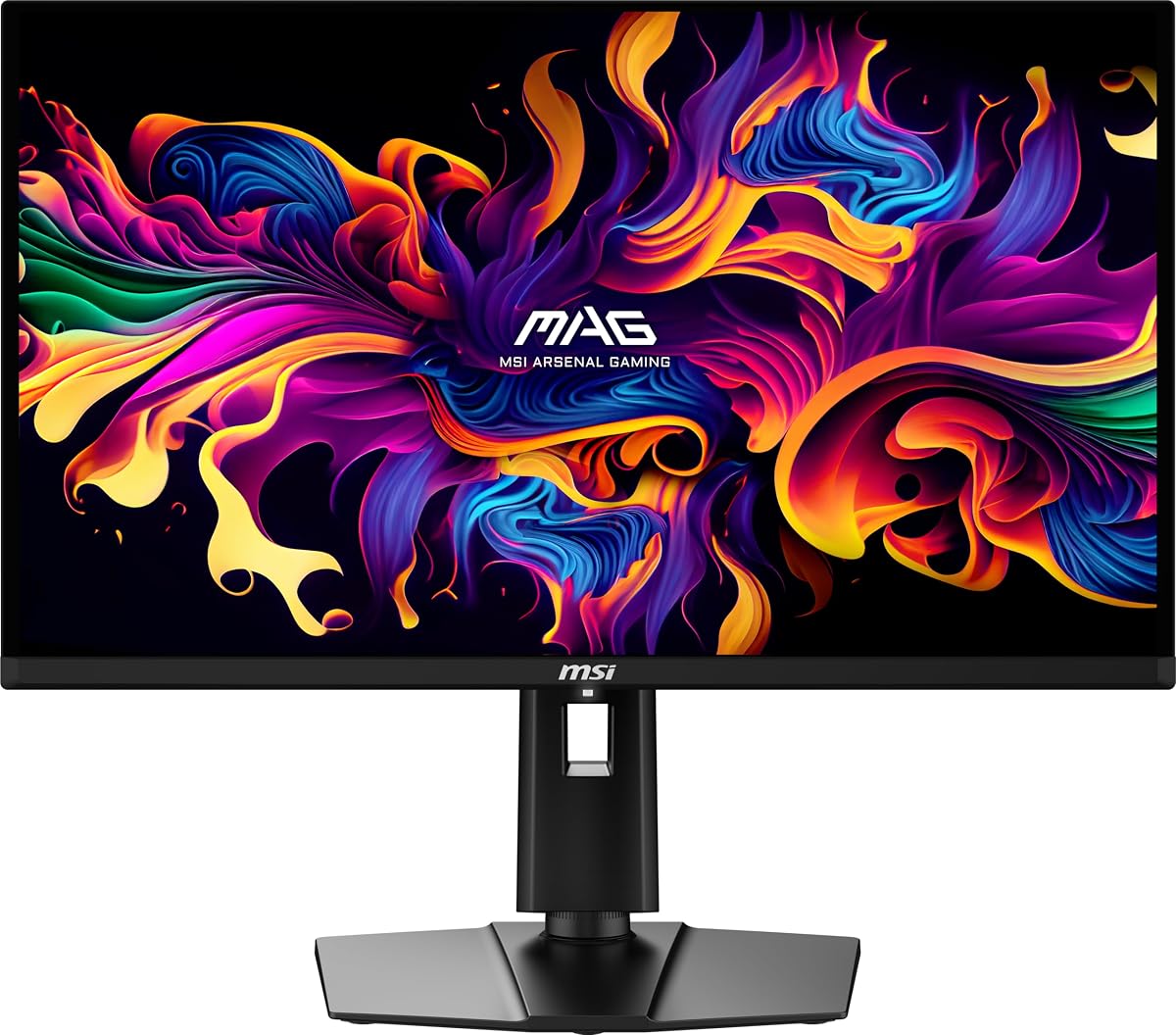
The MSI MAG 274QP QD-OLED X24 is a 27-inch WQHD quantum dot OLED monitor built for gamers who want exceptional motion response and strong image quality at a 240Hz refresh rate. Its supplied rating is 4.6, matching the strongest numerical rating in the guide. The 0.03ms GtG response time, enhanced sub-pixel arrangement, and VESA ClearMR 13000 rating emphasize a design focused on fast competitive motion and clear imagery.
We may earn a commission when you buy through this link, at no additional cost to you.
Color is a major strength. Ten-bit color conversion provides 1.07 billion colors, and the panel is specified at 99% DCI-P3 coverage with a Delta E of two or better. Its native contrast ratio of 1,500,000:1 produces deep blacks, while peak brightness reaches 400 nits. The result should be particularly effective in dark games, cinematic titles, and content with broad color variation, although 400 nits is modest compared with some high-end HDR displays.
The monitor includes MSI Gaming Intelligence software with OLED Care 2.0, AI-supported crosshair functionality, console modes, and game-assistance tools. A four-way adjustable stand and VESA 100mm compatibility offer more positional flexibility than a basic tilt-only design, though the supplied information does not enumerate the exact ranges. Connectivity includes DisplayPort 1.4a and HDMI 2.1, and the listed PC, Mac, console, and laptop options support the full WQHD 240Hz target.
The MSI MAG 274QP is an excellent top choice for a buyer who values response time, color accuracy, and deep contrast equally. It is well suited to competitive and single-player gaming, while a fanless graphene heatsink supports silent operation and panel durability. As with any OLED display, users should manage static content carefully and understand that long-term image retention is an important consideration. Within those normal OLED caveats, its combination of 240Hz speed and high-end image quality is especially compelling.
The 0.03ms GtG figure and high native contrast make this display well suited to both fast action and dark scenes. Quantum Dot technology adds broad, precise color without changing the monitor's 240Hz focus.
OLED Care 2.0 provides tools intended to reduce the chances of screen aging, while the graphene heatsink supports fanless heat dispersion. These features complement the high-refresh design rather than adding unnecessary desk noise.
We may earn a commission when you buy through this link, at no additional cost to you.
The Alienware AW2723DF combines a 27-inch 2560 x 1440 Fast IPS panel with a native 240Hz refresh rate and an optional overclocked mode of up to 280Hz. Its 1ms GtG response time targets quick transitions and competitive clarity. The supplied rating is 4.3. It also carries NVIDIA G-SYNC Compatible and VESA Adaptive Sync certification, giving it variable-refresh support for both major GPU ecosystems.
We may earn a commission when you buy through this link, at no additional cost to you.
Visual quality is a key part of the appeal. The InfinityEdge screen, IPS Nano Color technology, 95% DCI-P3 coverage, and VESA DisplayHDR 600 certification provide a more advanced image specification than many conventional 240Hz IPS models. Preset on-screen display modes make it easy to select a suitable look for different games. The listed 280Hz ceiling gives the monitor additional headroom, although the standard 240Hz mode remains the core target for this roundup.
The physical design is equally distinctive. Alienware's Legend 2.0 aesthetic appears in the Lunar Light finish, while AlienFX lighting adds a signature effect to a gaming setup. The design also includes 360-degree ventilation and improved cable management. Height, tilt, swivel, and pivot adjustments are all supported by the stand, which makes it easier to optimize the viewing angle and free desk space. The complete port list is not included in the supplied information, so buyers should verify connectors before installation.
The AW2723DF is a strong all-around choice for a gamer who wants competitive speed, a polished desk aesthetic, and a certified HDR feature set without moving to QD-OLED. Its 280Hz overclock may appeal to users with capable graphics hardware, while the 240Hz native mode remains broadly practical. The optional lighting is more of an aesthetic feature than a performance benefit, and buyers should balance that against the monitor's physical footprint and connectivity needs.
The monitor combines a native 240Hz mode, up-to-280Hz overclocking, and 1ms GtG response. G-SYNC Compatible and Adaptive Sync certification support smooth variable-refresh operation across different hardware.
Adjustable height, tilt, swivel, and pivot support comfortable positioning. AlienFX lighting, 360-degree ventilation, and cable management reinforce the monitor's gaming-oriented design.
We may earn a commission when you buy through this link, at no additional cost to you.
The Acer Nitro KG271U is a 27-inch IPS gaming monitor with a native 2560 x 1440 resolution and a 240Hz refresh rate. Its supplied rating is 4.4, placing it among the better-rated models in the guide. The monitor uses a zero-frame design to reduce the visual bulk of traditional borders, while AMD FreeSync Premium handles variable-refresh synchronization. A response time of up to 0.5ms GTG places it among the faster conventional IPS options.
We may earn a commission when you buy through this link, at no additional cost to you.
The design emphasizes smooth 2D motion and lower input lag. For fast-moving games, the combination of 240Hz and a low GtG response should appeal to players who want quick visual updates without moving to an OLED panel. The 16:9 aspect ratio provides a familiar canvas, and the 2560 x 1440 resolution offers more working space than 1080p while remaining manageable for many graphics cards and desk arrangements.
The product information also positions the KG271U for color-critical work. It supports 99% of the sRGB gamut, which is useful for graphic design, photography, and video editing as well as gaming. However, the supplied facts do not mention HDR support, a specific brightness rating, a contrast ratio, or a detailed stand adjustment range. It is therefore difficult to compare every aspect of its physical setup and imaging with the more extensively specified entries in this roundup.
The KG271U is a straightforward recommendation for a buyer who prioritizes a high-refresh IPS panel, a clean border design, and strong general-purpose color support. It avoids the complexity and potential image-retention concerns of OLED. It may be especially appropriate for competitive players who want a fast 240Hz experience and do not need the deepest blacks or a high-end HDR specification. Buyers should still check the current listing for stand movement, ports, and brightness details.
A native 240Hz refresh rate and up-to-0.5ms GTG response provide the central performance benefits. FreeSync Premium adds synchronization support for compatible graphics cards.
The 2560 x 1440 workspace and 99% sRGB support make the monitor relevant for editing and everyday productivity. Its narrow-looking border treatment also keeps a multi-monitor arrangement visually clean.
We may earn a commission when you buy through this link, at no additional cost to you.
The MSI MAG 271QPX QD-OLED E2 combines a 27-inch 2560 x 1440 QD-OLED panel with a 240Hz refresh rate and a listed 0.03ms GtG response time. Its 4.6 rating places it alongside the highest-rated products here. The central appeal is the combination of true-black OLED rendering and high-speed gaming, two qualities that often appear on monitors designed for enthusiasts rather than basic desktop use.
We may earn a commission when you buy through this link, at no additional cost to you.
The QD-OLED panel is presented as offering exceptional picture quality and strong contrast, which is particularly noticeable in dark scenes, menus, and cinematic games. The 240Hz rate and 0.03ms response target fast action, making the display relevant to competitive shooters and racing games as well as single-player titles. True Black HDR 400 support adds an HDR pathway, though the entry-level certification means the display should not be compared directly with more advanced HDR600 or HDR1000 specifications.
MSI's OLED Care 2.0 includes several care services intended to reduce the chances of OLED screen aging. A custom graphene film and heatsink work together to dissipate heat without an active cooling fan. This fanless approach supports quiet operation, and the absence of fan noise is useful in a gaming environment where every distracting sound can matter. Tilt and height adjustment are listed, but swivel and pivot are not confirmed in the supplied information.
This monitor is best suited to a buyer who wants a high-end image and extremely fast response without moving beyond 27 inches. It can serve competitive and immersive gaming, although the HDR400 specification may disappoint someone whose priority is the highest peak brightness. OLED longevity practices should also be considered. Used with the supplied care features and sensible desktop habits, the MSI MAG 271QPX QD-OLED E2 is a compelling top-tier option for QHD gaming.
OLED self-emissive pixels create deep blacks, while the 0.03ms GtG response keeps transitions extremely quick. The pairing makes the monitor well suited to dark, fast-moving competitive games.
Graphene film and a custom heatsink provide passive heat dispersion. The fanless design keeps the monitor silent and avoids adding another moving component to a focused gaming setup.
We may earn a commission when you buy through this link, at no additional cost to you.
A good 1440p gaming monitor at 240Hz should combine a high-refresh panel with low response time, reliable synchronization, suitable color performance, and an ergonomic design. The following factors help narrow the field based on your hardware, games, desk space, and preferred balance between speed and image quality.
A 240Hz refresh rate gives the monitor more opportunities to display new frames, but it only creates a visible benefit when the connected graphics card, game, and display output can supply enough frames. At 1440p, a capable modern system is important, especially in demanding titles. Also confirm whether 240Hz is native or available only through an overclocked mode. Among the featured models, most use DisplayPort for the full 240Hz target, while the LG supports 240Hz through both DisplayPort and HDMI 2.1.
Choose a monitor whose full-resolution, full-refresh combination is available through a port your hardware supports. Check the graphics card outputs, adapter requirements, and cable standards rather than relying only on the marketing name on the box.
Fast response is essential when characters, vehicles, and interface elements move across a high-refresh screen. A 0.03ms GtG claim on an OLED panel describes a fundamentally different response profile from a 0.3ms MPRT figure on an IPS monitor, and 1ms GtG is another common method of measurement. MPRT, GtG, and any overdrive behavior should not be compared as though they are identical. Manufacturer specifications also provide a useful reference rather than a guarantee of identical results in every setting.
Prioritize the panel technology and synchronization behavior first. Then use response-time figures to understand each monitor's intended performance class, while avoiding the assumption that every advertised millisecond value will appear in normal use.
Fast IPS monitors are often the straightforward all-rounders in this category. They tend to support high refresh rates, provide bright and conventional SDR performance, and avoid the image-retention concerns associated with OLED. QD-OLED models offer exceptionally quick pixel response, deep blacks, and higher native contrast. That makes them compelling for dark competitive maps and cinematic games, but they require greater care with static content and deserve attention to panel-maintenance features.
Choose IPS when you want a conventional, bright gaming display with a broad set of features. Choose QD-OLED when contrast, color depth, and near-instant response matter enough to justify the premium and the additional care considerations.
Variable refresh is one of the most important features for a smooth high-refresh experience. Some models support AMD FreeSync Premium, while the LG and ASUS also advertise NVIDIA G-SYNC-related support. The Alienware is specifically listed as NVIDIA G-SYNC Compatible and VESA Adaptive Sync certified. Adaptive Sync on the AOC and KTC indicates broader synchronization support, but buyers using a particular GPU ecosystem should verify the exact certification and operating range on the current listing.
Use the display's native range with its supported synchronization standard, and check whether the stated maximum refresh rate falls within the usable variable-refresh window. This helps prevent subtle flickering or unstable synchronization outside the intended range.
Competitive gaming and entertainment place different demands on color. DCI-P3 coverage is useful for modern games, HDR scenes, and creative work, while 99% sRGB is more directly relevant to standard web and office color. Among the models here, the Acer Predator and MSI MAG 274QP claim 99% DCI-P3 coverage, the LG lists 95% DCI-P3, and the Alienware includes 95% DCI-P3 with DisplayHDR 600 certification. DisplayHDR 400 models offer a more basic HDR experience than higher-tier certifications.
Look for a monitor whose color and HDR specifications match your main use. Competitive players may prioritize brightness and consistency, while cinematic gaming and content creation benefit from broad gamut coverage, high precision, and stronger contrast.
A 27-inch monitor normally fits a conventional gaming desk, but a stand with limited movement can still be frustrating. The Acer Nitro XV272U and Alienware AW2723DF support comprehensive height, tilt, swivel, and pivot adjustment. The LG lists tilt, height, and pivot, the KTC offers a particularly broad adjustment set, and the MSI MAG 274QP is described as four-way adjustable. The AOC provides tilt only, so users who changes desk height or seating position frequently may prefer more flexible hardware.
Measure the available area, check the included base footprint, and consider the height of nearby shelves or desks. VESA compatibility provides an alternative mounting route for anyone who uses an arm or wants a different viewing position.
The number and type of ports determine how easily a monitor can serve a desktop, laptop, and console. DisplayPort 1.4 is central to the full 240Hz target for many of these models, while HDMI support can be helpful for living-room or console setups. The KTC includes two DisplayPort 1.4 and two HDMI 2.0 inputs, the Alienware lists DisplayPort 1.4 but does not provide a complete port inventory in the supplied facts, and the ASUS emphasizes USB-C with DisplayPort Alternate Mode. Check cable requirements as well as connector counts.
Choose enough inputs to avoid constant reconnection, and confirm that the exact mode you want is available on the relevant port. A USB-C connection may streamline a laptop setup, but compatibility should be verified with the exact host device.
Gaming-specific menus can make a new monitor easier to tune. The LG includes Black Stabilizer, Dynamic Action Sync, an FPS counter, a crosshair, and genre presets. ASUS provides DisplayWidget Center and ROG Gaming A.I. features. MSI adds console modes, game-assistance tools, and AI-supported crosshair functions. The Acer Predator X27U includes image-retention-refresh functionality, while the KTC adds low-blue-light and flicker-free features. These tools do not replace good core specifications, but they can make everyday tuning more convenient.
Prioritize synchronization, response, and resolution before minor on-screen features. Once those fundamentals meet your needs, use the included utilities to refine brightness, contrast, color, and motion settings for your preferred games.
Begin by connecting the monitor with the correct cable and selecting the appropriate high-refresh mode in the operating system's display settings. For most of the featured models, DisplayPort is the primary route to 240Hz, although the LG also supports that rate over HDMI 2.1. After installation, use the monitor's on-screen menu to set the resolution to 2560 x 1440, choose the highest stable refresh rate, and confirm that synchronization is enabled. Run a game or a motion test at the intended settings rather than judging the display from the desktop alone.
Adjust brightness and contrast according to your room rather than relying blindly on a preset. Competitive players may find a brighter, sharper image useful, while cinematic play often benefits from lower brightness, controlled contrast, and room lighting suited to the display. Use Game Mode, FPS, RTS, Gamer, or similar presets as a starting point, then make small adjustments. Avoid excessive sharpening or overdrive settings, which can create flickering, overshoot, or visual instability rather than meaningful clarity.
Care differs by panel type. Fast IPS screens can be maintained with sensible brightness settings and regular cleaning, while OLED benefits from dark desktop themes, hidden taskbars, and avoidance of prolonged static bright elements. Use OLED Care tools where supplied, keep the ventilation area unobstructed, and power the display down when it will not be used for long periods. Clean with a soft, lint-free cloth, avoid liquid directly on the panel, and do not use abrasive or ammonia-based cleaners.
A 240Hz 1440p monitor can be worthwhile when your games regularly reach high frame rates and you value faster visual updates. The extra resolution shows more detail than 1080p, while the higher refresh rate can make movement and aiming feel more fluid. The benefit is smaller in games that remain below the target frame rate, so hardware capability and game selection still matter.
You need a GPU and output combination capable of driving 2560 x 1440 at the target refresh rate. The exact requirement varies greatly by game, resolution, graphics settings, and whether upscaling or frame generation is used. Verify that your card has a suitable DisplayPort or HDMI connection and that the game can maintain a high frame rate at the desired settings.
IPS is the more conventional all-round choice, with strong refresh performance and no OLED-specific image-retention concerns. QD-OLED offers extremely fast response, deep blacks, and exceptional contrast, making it excellent for fast and dark games. QD-OLED buyers should understand the need for panel-care habits, while IPS buyers may prefer a broader or more predictable upgrade path.
An overclocked mode above 240Hz may provide a small improvement if your graphics hardware, game, and connection can consistently support it. It is not automatically better, because stability, frame rate, latency, and image quality matter more than a higher headline number. Treat 240Hz as the reliable baseline and the overclock as an optional extra.
DisplayPort is the most common choice for high-refresh PC gaming and supports 240Hz across most models in this guide. The LG is notable because its HDMI 2.1 connection also supports 240Hz. For other models, check the listed maximum HDMI refresh rate, because a connector supporting HDMI 2.0 does not automatically guarantee the same high-refresh mode as DisplayPort.
Response time becomes increasingly relevant at high refresh rates because the display has less time to render each new frame. Fast GtG and MPRT figures are useful indicators of each panel's design target, but they are measured differently and do not guarantee identical real-world results. Adaptive synchronization, frame pacing, and your actual game frame rate also influence perceived clarity.
Modern OLED panels can still be affected by image retention, although careful use and built-in maintenance features can reduce the risk. Avoid keeping bright static interfaces on screen for long periods, use dark desktop elements, enable screen savers, and follow the manufacturer's care guidance. The risk should be weighed against the major benefits of deep contrast and extremely fast pixel response.
Check your desk size, preferred stand adjustment, complete port list, HDR certification, brightness, color gamut, and the exact refresh-rate limits for every connection you plan to use. For OLED models, also review image-retention guidance and panel-care tools. Finally, confirm that your PC can deliver high frame rates at 2560 x 1440 in the games you play most.
The AOC Q27G41ZE stands out as the best overall pick because it combines 1440p resolution, 240Hz DisplayPort operation, Adaptive-Sync, and a 0.3ms MPRT response specification in a practical package. The LG 27GR83Q-B earns the Editor's Choice position for its balanced feature set, including 240Hz over HDMI and DisplayPort, G-SYNC and FreeSync Premium support, useful gaming tools, and a flexible stand. For the best premium experience, the MSI MAG 274QP QD-OLED X24 delivers exceptional 0.03ms response, deep contrast, and wide color coverage.
Your priorities should determine the alternative that suits you best. Choose an IPS option for bright, conventional gaming and fewer OLED considerations; select the Acer Predator X27U or MSI MAG 271QPX QD-OLED E2 for cinematic contrast and true blacks; favor the Acer Nitro XV272U or Alienware AW2723DF for extensive stand adjustment; and look to the KTC H27E6S for multiple video inputs, speakers, and a 275Hz overclocked mode.
Finally, check the current listing before purchasing because prices, promotions, included accessories, and product details can change. Confirm the monitor's supported resolution and refresh rate over the exact connection you plan to use, check desk clearance and stand adjustment, and review the manufacturer's current gaming and panel-care guidance. Those final checks can make the difference between a technically capable monitor and one that fits your setup perfectly.