
meross Presence Sensor MS605
3.1Editor score
Battery-powered Matter over Thread
IP67 waterproof housing
Three customizable detection zones
Matter compatible motion sensor guide comparing detection range, occupancy sensing, protocols, installation options, ecosystem support, and key buying factors.
A Matter compatible motion sensor can bring occupancy-based lighting, security alerts, and energy-saving automations to a broad range of smart home platforms. The best choice depends on whether you need simple motion detection, stationary presence recognition, ambient light measurement, or a combination of those functions.
This guide compares ten motion and presence sensors based on sensing technology, detection range, viewing angle, connectivity, power requirements, installation flexibility, and compatibility with leading smart home ecosystems. It includes native Matter models as well as two alternatives that use Zigbee or Tapo Sub-1G networks.
Each review explains the product’s strongest features, practical limitations, and ideal installation setting. Ratings reflect the supplied customer feedback, while feature recommendations are based on the documented specifications. Availability and pricing can change, so confirm current details before buying.
3.1Editor score

3.8Editor score

3.7Editor score
The table below compares all ten sensors by sensing method, connectivity, detection reach, and practical setup considerations, making it easier to identify the right model for a particular room and smart home platform.




The meross Presence Sensor MS600 is a three-in-one presence and motion sensor with a 3.8 customer rating. It combines millimeter-wave radar, PIR detection, and a light sensor, allowing it to distinguish movement from continued human presence while also measuring ambient conditions.
We may earn a commission when you buy through this link, at no additional cost to you.
Its primary advantage is the breadth of Matter support. The documentation lists Meross, HomeKit, Alexa, Home Assistant, and Google Home as compatible platforms, while Matter local control is intended to reduce cloud dependence and improve responsiveness. The adjustable base pivots 180 degrees and rotates through 360 degrees, making it practical for walls, corners, ceilings, and other elevated positions.
The MS600 reaches up to 12 meters for motion and up to 6 meters for effective presence detection. These are generous figures for a home sensor, although real results depend on room geometry and installation. Continuous power is required, and Matter compatibility requires a hub, which reduces the convenience offered by battery-powered Thread models.
This is the strongest overall recommendation for buyers who want true stationary-presence sensing and broad ecosystem support. It suits living rooms, home offices, bedrooms, and spaces where lights should remain on while someone sits still. Install it carefully, use the included pet shield when necessary, and confirm that a suitable Matter hub is already available.
Unlike a basic PIR sensor that may report an empty room when a person stops moving, the MS600 combines radar and PIR information. This makes it better suited to reading, desk work, and other sedentary activities where occupancy is more meaningful than movement alone.
The rotating and pivoting base allows the detection field to be aimed away from high-traffic areas. A removable pet-proof shield can also reduce accidental activation by pets or robot vacuums, making the sensor more useful in open-plan homes.
We may earn a commission when you buy through this link, at no additional cost to you.
The Aqara Motion and Light Sensor P2 carries a 3.5 customer rating and combines PIR motion detection with a separate ambient light sensor. Unlike the earlier P1, its light-sensing function can operate independently, opening more possibilities for daytime and nighttime automation.
We may earn a commission when you buy through this link, at no additional cost to you.
Native Matter support over Thread makes the P2 a sensible choice for Apple Home, Alexa, and other Matter-based platforms. Its documented detection reach extends to 7 meters with a horizontal angle of up to 170 degrees and a vertical angle of up to 45 degrees. A 360-degree stand helps installers refine the aim after mounting.
The sensor uses two CR2450 batteries and is documented to deliver up to two years of operation. Aqara also states that automations can run without cloud access, preserving useful local behavior if the internet is unavailable. A separate Matter Controller and Thread Border Router are required, and Alexa does not support the light-sensor function.
The P2 is a good fit for conventional motion-triggered lighting, room-level alarms, and brightness-aware scenes. Choose it when Thread is already part of your home and you need a dependable PIR sensor rather than radar-based presence detection. Check the supported hub list and keep the sensor within the documented distance of the controller.
The separate light sensor can trigger automations based on room brightness rather than occupancy alone. This is useful for dimming lighting at sunset, activating night lights, or avoiding unnecessary illumination when daylight is already sufficient.
Because it communicates over Thread, the P2 suits homes with an established Matter and Thread infrastructure. Its adjustable stand and wall, ceiling, or zone mounting options make it easier to position than many fixed PIR sensors.
We may earn a commission when you buy through this link, at no additional cost to you.
The meross Presence Sensor MS605 is a battery-powered Matter over Thread model rated 3.8? No: its supplied customer rating is 3.1, making its selection a feature-based budget recommendation rather than a rating-led choice. It combines millimeter-wave radar, PIR, and light sensing to recognize people who are present but largely motionless.
We may earn a commission when you buy through this link, at no additional cost to you.
The MS605 differentiates itself with an IP67 waterproof enclosure, a three-year battery life using an included CR123A cell, and a mount that folds 90 degrees and rotates 360 degrees. Those traits make it unusually versatile for bathrooms, basements, attics, exterior areas, and other locations where a basic indoor PIR sensor may be unsuitable.
Its app allows the detection area to be divided into three customizable zones. Each zone can have separate presence and absence conditions and can appear as an individual sensor on third-party platforms. That makes the device more useful than a simple binary motion detector for targeted lighting and climate automations.
The lower rating reflects the importance of checking ecosystem and installation compatibility before buying. A hub supporting both Matter and Thread is needed for third-party platforms, and remote access requires pairing with that hub. For buyers who want battery-powered radar presence detection without a cord, the MS605 offers an unusually capable and flexible package.
Separate near, middle, and far conditions can prevent an entire room from behaving as a single switch. For example, different zones can activate a night light, main bathroom light, or ventilation equipment according to where someone is located.
The IP67 housing and included three-year battery support use in humid or exposed locations. A 90-degree folding and 360-degree rotating stand also allows the sensor to be mounted on walls, ceilings, or in corners without complex wall work.
We may earn a commission when you buy through this link, at no additional cost to you.
The Eve Motion Matter 3-Pack includes three wireless motion and light sensors, each with a 3.5 customer rating reflected in the supplied data. The set provides a 120-degree field of view and detection reach of up to 9 meters, with IPX3 water resistance for indoor and outdoor placement.
We may earn a commission when you buy through this link, at no additional cost to you.
Eve emphasizes local communication without cloud dependency, no registration, and no tracking. Matter and Thread support allow the sensors to work with major platforms including Apple Home, Alexa, Google Home, and SmartThings, subject to using one of the listed compatible hubs or border routers.
The light-sensing function can refine automations in the Eve app for iOS, while motion events can activate lights, appliances, and selected notifications. It is still fundamentally a motion sensor rather than a radar presence detector, so prolonged stillness may not keep an occupancy scene active.
This three-pack is most useful for buyers who want to cover several rooms consistently without selecting three unrelated devices. It works well for hallways, entry areas, bedrooms, and exterior paths where wireless installation is preferred. Thread infrastructure and mobile operating-system requirements should be confirmed before installation.
A matched set can provide similar sensing behavior throughout several areas of a home. This is helpful for whole-home lighting, arrival routines, and security notifications that benefit from a consistent response.
The absence of an Eve cloud, registration, and tracking reduces the need for a direct service relationship. Local communication can also help automations remain useful when cloud access is temporarily unavailable.
We may earn a commission when you buy through this link, at no additional cost to you.
The TP-Link Tapo Motion Sensor T100 has a 4.5 customer rating, the highest among the supplied products. It is a compact PIR sensor designed for the Tapo ecosystem, using the Sub-1G low-power wireless protocol to communicate with a Tapo H100 hub.
We may earn a commission when you buy through this link, at no additional cost to you.
The T100 detects motion across a 120-degree angle and up to 7 meters. Its detection range can be set to 3, 5, or 7 meters, helping prevent nearby traffic from activating an entire room. A single included CR2450 battery is documented to operate for up to two years when motion is detected fewer than 100 times per day.
Its key limitation is that the sensor is not a native Matter device. It requires the Tapo H100 hub and a secured 2.4 GHz Wi-Fi network, making it less attractive for a mixed-ecosystem home. The hub can support up to 64 sensors, operate local Smart Actions, and include an audible ringer with multiple tones.
The T100 is a solid choice for a Tapo-focused household that does not require Matter interoperability. It is particularly suitable for indoor entry points, hallways, and utility areas where adhesive or magnetic placement is convenient. Its strong rating, simple configuration, and adjustable range compensate for its closed ecosystem limitation.
Selecting a 3-meter, 5-meter, or 7-meter range makes it possible to tailor the sensor to a room rather than relying on one fixed trigger distance. This can reduce unwanted activations from people passing outside the intended area.
The dedicated low-power protocol provides broad coverage and supports extended battery life. Because the sensor communicates through a hub, it can also participate in responsive Smart Actions even when the wider network is disconnected.
We may earn a commission when you buy through this link, at no additional cost to you.
The Aqara Presence Sensor FP300 carries a 3.7 customer rating and combines 60GHz millimeter-wave radar, PIR, light, temperature, and humidity sensing in one wireless unit. It is the most feature-dense environmental sensor in this group and offers both Matter over Thread and Zigbee connectivity.
We may earn a commission when you buy through this link, at no additional cost to you.
Adaptive AI helps the sensor learn occupancy patterns and reduce false triggers while retaining lights and appliances for people who are present but still. The broad ecosystem list includes Apple Home, Home Assistant, Alexa, Google Home, SmartThings, and Homey through Matter, with compatible Aqara hubs also supporting the Zigbee side.
Its battery configuration consists of two replaceable CR2450 cells. The documented operating life is up to three years in Zigbee mode and up to two years in Thread mode. A 120-degree field of view, six-meter detection range, and multi-axis mount provide flexible positioning, while optional sensor deactivation can conserve power.
The FP300 is the premium recommendation for buyers who want one device to inform lighting, climate, and security automations rather than simply detect motion. The trade-off is ecosystem setup complexity: third-party Matter platforms require a Thread Border Router and Matter Controller, and Aqara’s hub options have their own firmware and model requirements.
Combining radar, PIR, light, temperature, and humidity data enables more nuanced automations. A room can respond to human occupancy, daylight levels, and environmental changes without requiring several separate devices.
Supporting both Matter and Zigbee gives the FP300 more route options within a mixed smart home. Buyers can use Matter with major platforms or employ a compatible Aqara hub and Zigbee mode when that better fits their installation.
We may earn a commission when you buy through this link, at no additional cost to you.
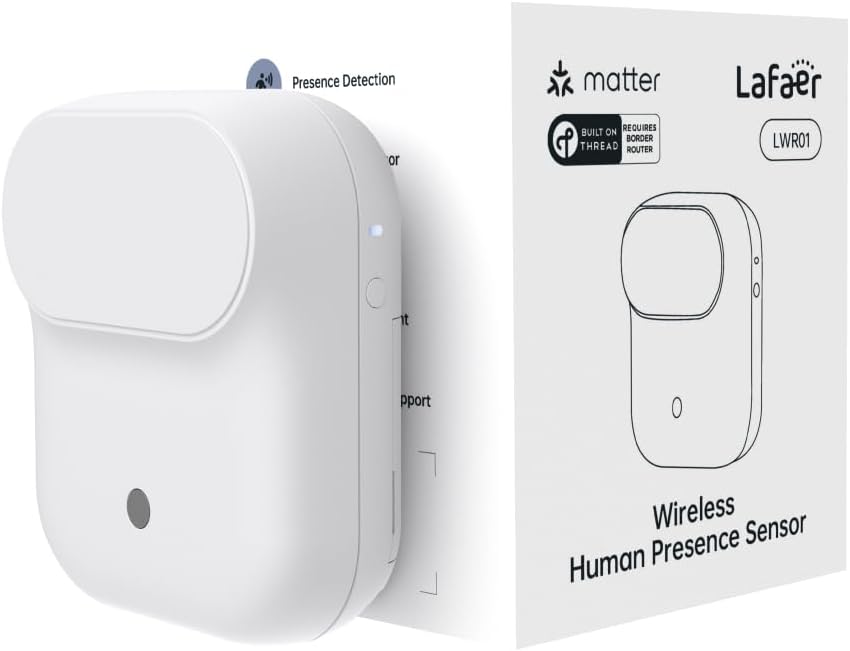
The Wireless Human Presence Sensor LWR01 has a 3.3 customer rating and uses millimeter-wave radar to detect both movement and subtle signs of stillness. The documented range is up to 3.5 meters for stationary detection and 6 meters for movement.
We may earn a commission when you buy through this link, at no additional cost to you.
It operates over Matter with Thread and is listed for Apple Home, Amazon Alexa, Google Home, Samsung SmartThings, Home Assistant, and Homey through compatible hubs. An IPX3 water-resistance rating makes it suitable for bathrooms and other splash-prone environments, while a built-in light sensor supports brightness-aware lighting scenes.
Power can come from a battery or a Type-C DC connection, offering an easy wireless start and a path to continuous operation. The product documentation lists a battery life of over one year, although using the wired option can suit users who prioritize uninterrupted performance.
The LWR01 is a practical choice for desks, bathrooms, reading areas, and rooms where ordinary PIR timeouts are inconvenient. Its lower rating gives less certainty about long-term user satisfaction, so buyers should verify the mobile app, hub model, and local automation behavior before committing to a larger installation.
The radar approach extends beyond abrupt body movement to identify subtle motion while a person sits, reads, or watches television. That makes it more suitable for occupancy lighting than a sensor that only reacts to room entry.
Battery operation keeps installation simple, while optional Type-C power supports continuous use. Buyers can start without wiring and move to a permanent supply if battery maintenance becomes inconvenient.
We may earn a commission when you buy through this link, at no additional cost to you.
The Aqara Zigbee Motion Sensor P1 has a 4.2 customer rating and focuses on reliable, long-duration PIR detection. It uses Aqara’s Zigbee 3.0 implementation and requires a compatible Aqara hub rather than a generic Matter controller.
We may earn a commission when you buy through this link, at no additional cost to you.
Its standout specification is a stated five-year battery life. The timeout can be adjusted from 1 to 200 seconds, allowing users to balance energy conservation with prompt responses. Sensitivity has high, medium, and low levels, while the documented field of view reaches 170 degrees at four meters or 150 degrees at seven meters.
The sensor can be used with Aqara Home, HomeKit, Alexa, IFTTT, and Home Assistant, but the light-sensitivity function is not available in HomeKit or Alexa. Full functionality may also be limited with third-party Zigbee tools, and Aqara does not officially support Zigbee2MQTT-style USB dongles for the complete feature set.
The P1 is an excellent option for an Aqara-centric home that values battery longevity and mature automations more than native Matter portability. It is useful for hallways, closets, and rooms where entry-based lighting and alerts are enough. Buyers using mixed ecosystems should verify that a compatible Aqara hub bridges the required platform.
A five-year stated battery life minimizes routine maintenance. It is particularly attractive in hard-to-reach locations where replacing batteries frequently would be inconvenient.
Configurable timeouts and three sensitivity levels let users control how quickly and how far the sensor responds. These settings can be adjusted through the Aqara Home app without moving or modifying the hardware.
We may earn a commission when you buy through this link, at no additional cost to you.
The SwitchBot Smart mmWave Radar Motion Sensor has a 3.6 customer rating and combines radar, PIR, and light sensing. Its radar can recognize subtle chest movement from a stationary person, supporting lighting behavior in bathrooms, offices, reading areas, and other occupied spaces.
We may earn a commission when you buy through this link, at no additional cost to you.
The sensor supports Apple Home through a SwitchBot Matter Hub, along with Home Assistant, Alexa, and Google Home. A magnetic base allows flat placement, wall mounting, and adjustable detection angles. This makes the unit straightforward to reposition as room layouts or furniture arrangements change.
The AI self-learning feature is intended to filter disturbances from fans, air conditioners, and similar sources. Detection reaches up to 8 meters for moving people and 5 meters for stationary people, while the stated battery life is up to two years. Buyers must account for the separate hub needed for the supported Matter connection.
This sensor is a good match for users who want SwitchBot’s physical sensor in a broader Matter-based home. It is less appropriate if avoiding vendor-specific hub hardware is a primary requirement. Position the magnetic base away from moving objects and test the AI learning behavior before creating critical automations.
Self-learning can reduce false activations caused by recurring environmental motion such as fans or air conditioning. The filtering should still be evaluated in the actual room because reflective surfaces and layout can influence radar performance.
The magnetic base supports several mounting arrangements and allows easy angle changes. A user can move the sensor to optimize a reading corner, office, or wall position without installing permanent hardware.
We may earn a commission when you buy through this link, at no additional cost to you.
The SONOFF SNZB-03P Motion Sensor carries a 4.2 customer rating and offers an inexpensive, practical approach to Zigbee-based motion automation. It is designed to work with a Zigbee hub and includes its CR2477 battery, making setup straightforward for compatible SONOFF and other supported systems.
We may earn a commission when you buy through this link, at no additional cost to you.
Its shortest configurable response reaches five seconds, allowing lights to activate quickly when someone passes. The stated battery life extends beyond three years, reducing replacement frequency. Local smart scenes can continue to operate when the Wi-Fi network is unavailable, provided the relevant Zigbee devices remain powered.
For security use, the sensor can trigger camera recording, activate a gateway sound alarm, and send app notifications. It supports Zigbee 3.0 hubs such as SONOFF NSPanel Pro, iHost, ZB Bridge Pro, and ZBDongle-E, with Echo Plus 2nd generation also listed. It does not offer native Matter compatibility.
The SNZB-03P is best for builders already using Zigbee and wanting responsive entry detection without a continuous power connection. It works well for hallways, closets, and secondary security zones. Prospective Matter users should treat it as an ecosystem-specific alternative rather than a direct Matter option.
A minimum timeout of five seconds is useful for entryway lighting where a delayed response would undermine the automation. Longer settings can still be used for occupancy areas that need more stability.
The sensor can support local Zigbee scenes when the wider Wi-Fi network crashes. This makes the automation more resilient, provided the hub and connected scene devices remain supplied with power.
We may earn a commission when you buy through this link, at no additional cost to you.
The right sensor depends on the room, the ecosystem already in place, and the type of automation you want. Review connectivity, sensing method, power, range, and installation requirements before making a selection.
A device labeled Matter compatible still needs a functioning Matter Controller, and many Thread-based sensors also require a Thread Border Router. Apple Home, Alexa, Google Home, SmartThings, Home Assistant, and other ecosystems can expose different supported models, so verify the exact hub list rather than assuming every branded device works.
A PIR sensor usually responds when it detects movement and may eventually report an empty room if no new motion occurs. Radar-based presence sensors can maintain occupancy status for a stationary person, making them better for reading rooms, offices, bedrooms, and other sedentary settings.
Matter over Thread offers low-power wireless operation but depends on a Thread-capable hub. Matter over Wi-Fi can simplify some setups, while Zigbee and Tapo Sub-1G products provide mature non-Matter alternatives. The Tapo T100, Aqara P1, and SONOFF SNZB-03P in this list are ecosystem-specific rather than native Matter devices.
Range figures are useful for initial planning, but room geometry, furniture, wall materials, and sensor height can alter actual results. Wide-angle sensors can cover open rooms, while narrow or adjustable fields are helpful in hallways. Presence sensors may also specify separate ranges for movement and stationary detection.
Corded sensors avoid battery replacement and suit high-traffic areas, but they require a nearby outlet and cable planning. Battery models are easier to reposition and often more suitable for retrofit installations. Check the stated battery duration, battery type, and whether Thread mode reduces operating life.
A built-in light sensor can help automations respond to daylight rather than switching lights on unnecessarily. Multi-sensors may also measure temperature and humidity, enabling climate and energy controls. Remember that some platforms support motion functions without exposing every light or environmental function.
Wall, ceiling, corner, shelf, and adhesive mounting options affect placement flexibility. Adjustable bases or stands are useful when sensors need to be aimed around furniture. Water-resistance ratings such as IPX3 or IP67 can make a model more appropriate for bathrooms, basements, exterior paths, and other damp locations.
Look for adjustable sensitivity, trigger timeouts, detection zones, brightness rules, and local scene support. Zone-based sensors can trigger different lights at different distances, while local control may keep essential automations working during an internet outage. Apps and supported hubs also determine which advanced controls are available.
Begin by identifying the automation goal and the platforms involved. Install the required Matter controller or Thread Border Router, update its firmware, and confirm that the sensor is recognized before placing it permanently. This avoids the common mistake of mounting a sensor in an inaccessible location only to discover that the hub or app cannot expose the desired functions.
Mount the sensor at a height and angle appropriate to its sensing method. PIR sensors generally benefit from a clear line of sight, while radar sensors should be positioned away from large moving objects and reflective surfaces. Use the supplied adjustable stand or mount, set the initial sensitivity conservatively, and allow time for AI-assisted models to adapt if the manufacturer recommends it.
For ongoing care, clean the sensing window gently and keep it free of dust, paint, cobwebs, stickers, and condensation. Replace batteries according to the stated interval, especially when using high-sensitivity settings or Thread mode. Periodically test the response after firmware updates, hub changes, furniture movement, or seasonal shifts in temperature and daylight.
It depends on the product and protocol. The meross MS600 can use some platforms directly over Wi-Fi, but its documentation states that a hub is required for Matter compatibility. Thread-based models such as the MS605, Aqara P2, Eve Motion, and LWR01 require compatible Matter and Thread infrastructure. Check the exact product and ecosystem before installation.
A conventional motion sensor responds to detected movement and may time out after a period of inactivity. A presence sensor can continue recognizing that a person remains in the room even when they are sitting still. Radar-based models are generally better for occupancy lighting, whereas PIR models are often sufficient for entry alerts and basic lighting control.
No. The meross, Aqara, Eve, LWR01, and SwitchBot models include native Matter support. The Tapo T100, Aqara Zigbee P1, and SONOFF SNZB-03P use dedicated or general Zigbee-based systems and are included as ecosystem-specific alternatives. They may suit established installations but should not be treated as direct Matter devices.
Yes, when they control lights, fans, heating, or cooling based on actual room use. Light-level sensing can improve results further by preventing unnecessary activation in bright rooms. Proper placement and conservative sensitivity settings are important because overly narrow zones or false triggers can reduce the energy-saving benefit.
A Thread-capable ecosystem usually provides a central Thread Border Router, so one compatible hub can often serve several Thread accessories. Individual sensor models may still have minimum hub or controller requirements. The Aqara P2 documentation, for example, calls for a two-in-one Matter Controller and Thread Border Router, while other products list specific compatible hubs.
Place it where it can observe the main occupied area without being blocked by furniture, cabinets, or reflective surfaces. Avoid positioning it directly toward doors, moving curtains, fans, or robot vacuums that could create false activity. Use the available rotation or folding mount to shape the detection zone and test the response before finalizing automations.
Local behavior depends on the product, hub, and automation platform. Several devices support local or local-control features, while others may still require cloud connectivity for some functions. Buyers who prioritize outage resilience should look specifically for local execution and verify that their chosen hub supports the relevant scenes.
Replacement intervals vary considerably by model, radio protocol, trigger frequency, sensitivity, and features in use. The documented figures range from roughly one year to five years under particular conditions. Treat those figures as estimates, monitor device alerts, and replace batteries sooner if the sensor becomes slow, produces repeated activations, or changes behavior unexpectedly.
The meross MS600 stands out as the most complete overall choice because it combines radar, PIR, and light sensing with broad Matter support and long detection reach. The meross MS605 is the best budget-oriented route to battery-powered presence detection, while the Aqara FP300 is the premium option for buyers who want five sensing functions and both Matter and Zigbee options.
Prioritize the protocol and hub you already use before comparing range or battery life. True stationary-presence detection matters in offices and living spaces, while simpler PIR sensing is often enough for entry alerts. Also consider power, mounting, environmental resistance, app controls, and whether the functions you want remain available in your chosen ecosystem.
Finally, confirm the current specifications, supported hub models, and availability before purchasing. Matter compatibility continues to evolve by platform and firmware version, and customer ratings can change over time. Checking current product details will help ensure that the selected sensor fits both the intended room and the automation platform you actually operate.