
GQ GMC-300S
4.6Editor score
One-second internal data logging
Rechargeable long-life battery
Dosimeter CPM and graph modes
Our Nuclear Radiation Detector guide compares 10 Geiger counters and EMF meters for accuracy, alerts, data logging, portability, displays, and specialized uses.
A useful nuclear radiation detector should identify ionizing radiation quickly, present readings clearly, and provide alerts that remain noticeable in real-world conditions. The best models add thoughtful features such as data logging, multiple alarm modes, compact construction, and readable color displays for home, laboratory, industrial, and environmental monitoring.
This guide compares ten products based on the published specifications, including supported radiation types, measurement ranges, alarm systems, power options, recording functions, display quality, and intended applications. It covers compact Geiger counters, personal monitors, scintillation-based instruments, professional data recorders, and one electromagnetic field meter included for comparison.
Each review highlights the strongest reasons to consider a model, along with its practical limitations and ideal buyer. The top picks represent the most compelling options for different priorities, while prices and availability can change, so readers should confirm current product details before making a purchase.
4.6Editor score

4.6Editor score

4.5Editor score
This side-by-side comparison evaluates the ten products by sensor type, supported radiation, alarm behavior, data functions, and portability, helping distinguish personal monitors from professional survey instruments and EMF-only meters.




The GQ GMC-300S is a compact digital Geiger counter and radiation monitor with a 4.6 rating. Its strongest feature is the combination of real-time monitoring and internal data logging: readings are recorded every second, and the stored history can later be downloaded to a computer. That makes the device more useful than a basic instantaneous meter without adding unnecessary complexity.
We may earn a commission when you buy through this link, at no additional cost to you.
It supports dosimeter, CPM count, and graph modes, giving users different ways to interpret radiation activity. The included data-viewing software for a computer helps organize recorded data, while the rechargeable battery is appropriate for repeated home checks, inspections, or monitoring sessions. A swiveling display is not listed for this model, so its viewing angle may be less adaptable than that of the GQ 320S.
Its main limitation is that the GMC-300S is a basic instrument rather than a color-screen, multi-alarm professional model. It does not offer the broader unit selection, surface-contamination mode, or large graphical display found on more advanced products. Nevertheless, the specified logging, graph mode, rechargeable power, and free PC software make it unusually capable for a budget-oriented buyer.
This is the best overall choice for readers who want authentic data-recording features without moving to a premium professional system. It suits home radiation screening, collecting samples, checking building materials, and recording changing readings over time. Buyers who only need a colorful display or telescopic probe may prefer a more advanced model, but the GMC-300S delivers the most practical balance of capability and affordability in this roundup.
Recording data once per second turns the detector into more than an instantaneous meter. Users can download the history to a computer, compare trends, and preserve measurements for later documentation.
Dosimeter, CPM, and graph modes support several common workflows. The cumulative dosimeter view is useful for exposure tracking, while CPM offers activity counts and the graph mode makes changes easier to recognize.
We may earn a commission when you buy through this link, at no additional cost to you.
The FNIRSI GC-01 is a portable Geiger counter with a built-in GM sensor, a curve display, and a 4.2 rating. It detects gamma, beta, and X-ray radiation, making it a broadly applicable choice for home projects, geological surveying, vehicle inspection, nuclear facilities, industrial work, radiology, and laboratory environments.
We may earn a commission when you buy through this link, at no additional cost to you.
The alarm system is one of its most attractive features. Users can choose light, vibration, or sound alerts, and both the instantaneous and cumulative dose alarm thresholds can be configured. The cumulative dose equivalent range extends from 0.00 μSv to 500.0 mSv, while the stated energy range is 48 KeV to 1.5 MeV with a tolerance of plus or minus 30 percent for the specified cesium-137 gamma source.
The curve display makes short-term changes easier to observe than a bare numeric screen, and the device supports English and Chinese operation. Its 4.2 rating is lower than those of several competitors, however, and the supplied specifications do not mention downloadable PC logging. Users who need a formal measurement trail, broad professional display, or documented surface-contamination procedure may need to look elsewhere.
The GC-01 is best for buyers who prioritize visible trends, flexible alarm modes, and a geiger counter that can handle several radiation types in one device. It is particularly useful when audible alerts would be intrusive, such as in a home or workplace where vibration or light feedback is preferable. For basic inspections, sample screening, and general awareness, it offers a broad and approachable feature set.
Light, vibration, and sound modes allow users to select feedback appropriate for the setting. A silent visual mode can work in meetings, while vibration or sound can provide stronger prompts during hands-on work.
The built-in GM sensor is specified for gamma, beta, and X-ray radiation. That versatility makes the counter useful for building-material checks, geological samples, vehicles, and controlled industrial or laboratory environments.
We may earn a commission when you buy through this link, at no additional cost to you.
The HFS-50-CsI is a portable personal dosimeter with a 4.6 rating and a color display. It uses a cesium iodide scintillator sensor, a design described as less susceptible to interference and more stable than traditional Geiger-Müller tubes. The stated measurement range is 0.01 μSv/h to 20 mSv/h with an error of plus or minus 10 percent.
We may earn a commission when you buy through this link, at no additional cost to you.
Its display is unusually informative, combining a 200-second dynamic waveform with a colorful dose-rate bar. The device reports dose rate, total dose, staged dose, average dose rate, and maximum dose rate. It refreshes measurements every second, stores up to 100 recent records, retains total-dose and cumulative-time information after power-off, and supports timed measurements.
The alert system combines sound, flashing indicator lights, and on-screen numerical warnings, with a stated response time below three seconds. Thresholds and sounds are adjustable, including an option to disable particle-count sound. The main limitation is that the product title and description specifically identify gamma and X-ray detection; beta coverage is not clearly specified, so it should not be treated as a universal multi-ray meter.
This is the strongest pick for users who want detailed, visually intuitive readings and reliable personal monitoring. It is particularly suitable for home, laboratory, and environmental work, including monitoring around hospital X-ray and CT equipment. The included telescopic rod helps maintain distance, and the long standby time makes the instrument practical for extended monitoring projects.
The dynamic curve, dose-rate bar, and multiple statistics make changes and cumulative exposure easier to interpret than on a device that only shows a current number. Color cues also help users recognize status quickly.
The built-in battery can support up to 1700 hours in screen sleep mode and recharges through a Type-C connection. Stored totals and cumulative time remain available after shutdown, helping preserve continuity between sessions.
We may earn a commission when you buy through this link, at no additional cost to you.
The ND01 Geiger Counter is a portable, color-coded radiation detector with a 3.7 rating. It uses a Geiger-Müller counter for beta, gamma, and X-ray detection and presents immediate results in a compact, pocket-friendly form. Its defining feature is a three-color status system: green for the listed safe range, yellow for a reminder level, and red for danger.
We may earn a commission when you buy through this link, at no additional cost to you.
The stated dose-rate range is 0.00 to 50000 μSv/h, while cumulative dose equivalent extends from 0.00 μSv to 5000 mSv. Three detection approaches are described: a value for immediate awareness, an average for filtering interference, and a real-time mode for prompt warnings. The device also provides a three-level alarm with rapid response.
Its 3.7 rating is the lowest among the ten products listed, so buyers should interpret its specification claims and expected performance carefully. The product description also contains technical inconsistencies around the stated relative intrinsic error and background-radiation handling. Two AAA batteries and automatic power-off offer convenient operation, but they do not provide the rechargeable convenience of several alternatives.
The ND01 is most appropriate for users who value an immediately understandable safety display and a pocketable format. Its listed applications include laboratories, radiology departments, nuclear facilities, customs work, and checks involving marble, antiques, jewelry, or seafood. Those needing a more established data-recording workflow or longer-term battery convenience may favor a better-rated model.
Green, yellow, and red display zones reduce the need to interpret every number. The thresholds are listed in the product information, giving users a clear visual framework during a survey.
Instantaneous, average, and real-time modes serve different purposes. Averaging can reduce short-lived interference, while immediate and real-time views support faster awareness of changing conditions.
We may earn a commission when you buy through this link, at no additional cost to you.
The Radar-9989 is the most specialized instrument in this roundup, combining a 4.5 rating with a U.S.-made LND7311 mica window sensor. The sensor is specified for alpha, beta, gamma, and X-ray radiation, and the instrument also offers a dedicated surface-contamination measurement mode. Those capabilities make it a compelling option for industrial safety, laboratories, and professional personal monitoring.
We may earn a commission when you buy through this link, at no additional cost to you.
Real-time information is shown on a 3.5-inch color LCD. Users can select six units: μSv/h, μR/h, CPS, CPM, μSv, and Bq/cm². A 270-second dose-rate waveform provides a clear view of radiation trends. The visible and audible alarm system operates while the screen is active or asleep, and the alert threshold can be customized.
The broad feature set comes with trade-offs. It is more specialized than a simple personal monitor, and buyers who require the smallest possible device may find other options easier to carry. Sensor claims, compensation, and unit selection are compelling, but accurate radiation assessment still depends on correct placement, suitable operating conditions, and any required calibration procedures.
The Radar-9989 is best for serious users who need alpha and beta coverage in addition to penetrating radiation, multiple units, trend graphs, and contamination surveying. The package includes a storage box, telescopic rod, Type-C charging cable, lanyard, and manual, creating a more complete kit than most alternatives. It is the premium choice when sensor capability and surface measurements matter more than minimal size.
The mica window sensor is designed to detect alpha, beta, gamma, and X-ray radiation. A dedicated contamination mode adds a useful layer for industrial and laboratory work where deposited material is a concern.
Six units allow users to match the display to dose rate, count rate, accumulated dose, and surface contamination work. The 270-second graph helps reveal whether a reading is stable, changing, or responding to a nearby source.
We may earn a commission when you buy through this link, at no additional cost to you.
This Portable Geiger Counter is a slim, rechargeable meter designed for gamma, beta, and X-ray detection. It has a 4.0 rating and emphasizes practical handling, immediate readings, and clear visibility in both indoor and outdoor environments. The screen is stated to remain readable in direct sunlight.
We may earn a commission when you buy through this link, at no additional cost to you.
Light, vibration, and sound alarms provide several ways to receive a threshold warning. Users can set separate limits for instantaneous and cumulative dose rates, making the instrument useful for both a quick local survey and longer exposure tracking. It also supports real-time, timed, dosimeter, and radiation-monitoring functions, giving it several useful ways to organize a session.
The included Type-C cable handles charging and data transfer, while the battery is described as rechargeable and replaceable. Compared with the HFS-50-CsI, the display is less information-rich, and compared with the GQ models, the product data does not clearly describe a waveform, stored record count, or downloadable history. Those omissions may matter for users who need a formal audit trail.
The meter is a strong fit for general-purpose users who want several radiation types, selectable alert types, and rechargeable operation without a complicated instrument. It suits home renovation checks, vehicle inspection, industrial work, radiology departments, and radiation laboratories. Buyers focused on professional data analysis should consider a model whose logging and export functions are documented more clearly.
The choice of light, vibration, or sound feedback makes the meter adaptable to noisy jobsites, quiet offices, and situations where a silent visual warning is preferable. Separate threshold settings add further flexibility.
Real-time, timed, dosimeter, and monitoring modes support quick checks and extended observations. The replaceable rechargeable battery is particularly convenient when the instrument is used away from an outlet.
We may earn a commission when you buy through this link, at no additional cost to you.
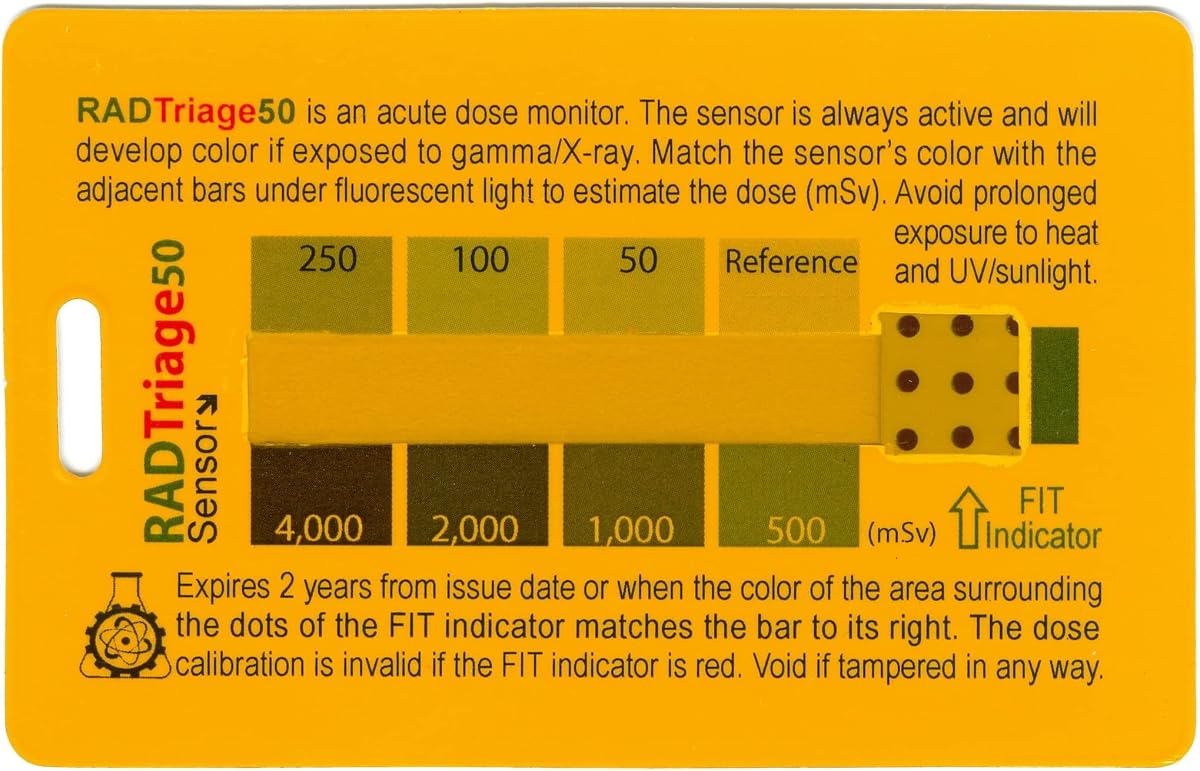
The Rad Triage 50 is a personal radiation detector designed to fit in a wallet or badge holder. Its 4.4 rating reflects a different proposition from the larger survey instruments: an always-carried, battery-free monitor for beta, gamma, and X-ray detection. It may also function as an electromagnetic field detector according to the product title.
We may earn a commission when you buy through this link, at no additional cost to you.
The strongest advantages are simplicity and readiness. No batteries are required, and the product information says no calibration is needed. Its shelf life may be extended by storing it in a freezer, after which the manufacturer states it remains usable for at least two years. The detector is also described as impervious to an electromagnetic pulse bomb, making it suitable for preparedness-oriented users.
Compared with the HFS-50-CsI, Radar-9989, and other electronic meters, the Rad Triage 50 offers fewer documented functions. There is no listed color display, alarm threshold system, waveform, rechargeable battery, or PC logging. Its title also groups together ionizing radiation and electromagnetic fields, but these are physically different phenomena, so buyers should not treat it as a substitute for a laboratory-grade survey instrument.
This detector is best for travelers, emergency-preparedness buyers, and people who want a discreet personal indicator. Its small size makes it easier to carry consistently than a handheld Geiger counter. For quantitative professional surveys, detailed trends, or specialized contamination measurements, a full-size electronic detector is the more appropriate choice.
Because it needs no batteries or routine calibration, the device can remain stored for long periods and still be available when needed. That simplicity is valuable for emergency kits and travel.
A wallet-sized format is easy to carry without dominating a pocket or badge holder. Continuous portability may encourage more frequent checks than a larger instrument kept in a toolbox.
We may earn a commission when you buy through this link, at no additional cost to you.
The GQ GMC-320 Plus is a professional digital Geiger counter and data recorder with a 4.6 rating. Its primary focus is capturing radiation data for later review rather than serving only as a quick handheld meter. Recorded information can be played back on a computer, making it useful for studies, inspections, and other situations where the sequence of measurements matters.
We may earn a commission when you buy through this link, at no additional cost to you.
Automatic recording reduces the need to watch and manually note every value. The open communication protocol is intended to make integration with a wider radiation monitoring network easier, which is a meaningful advantage for technical users who may need to combine the meter with other systems. Support through the GQ Electronics technical forum provides an additional avenue for setup and troubleshooting assistance.
This is a specialized instrument, and its professional positioning comes with a much higher financial commitment than the compact consumer meters in the roundup. The supplied product information gives less detail about display size, sensor type, alert styles, and exact measurement ranges than some competing listings. Prospective buyers should therefore confirm current specifications rather than assume it matches every feature of the GMC-300S or 320S.
The GMC-320 Plus is best for users who need recorded radiation histories and possible network integration. It is particularly relevant to professional monitoring programs, technical demonstrations, and environments where later playback and analysis are more important than minimal size. Buyers who only need a simple current reading can find a less specialized meter, while serious data-oriented users will appreciate the recorder-focused design.
Automatic recording captures the progression of a survey without requiring constant manual notes. PC playback then allows users to review those measurements after the monitoring session.
The open communication protocol supports broader radiation-network use. This is especially relevant to technical users who may connect the meter to monitoring or data-collection equipment.
We may earn a commission when you buy through this link, at no additional cost to you.
The GQ 320S is a premium digital radiation monitor with a 4.5 rating. It combines the core strengths of the GMC-300S—automatic logging, PC downloads, a rechargeable battery, and multiple operating modes—with a swivel display. That movable screen is a practical improvement when the meter is placed on a desk, held at different angles, or used during a survey.
We may earn a commission when you buy through this link, at no additional cost to you.
Readings are logged to internal memory every second, and the history can be downloaded to a computer. Dosimeter mode, CPM count mode, and graph mode provide distinct views of exposure and activity, while the swivel display makes the instrument easier to operate without repeatedly picking it up. The free PC data-viewing software supports a consistent workflow for organizing exported records.
The GQ 320S sits at the premium end of the roundup, and its concise listing does not advertise the large color screen, multiple alert modes, surface-contamination function, or extended unit selection available on some competitors. It is therefore best judged as a capable logger with a flexible display rather than as a complete laboratory platform. Buyers should confirm current sensor and measurement details for their intended application.
This model suits users who want a dedicated radiation meter for repeated monitoring and a clear digital record. It is a good option for home radiation projects, environmental sampling, and professional work that benefits from a rotating screen. Choose it over a basic pocket meter when downloadable history and a more adaptable viewing angle are central to the task.
The swivel screen makes the meter easier to view in multiple working positions. It is useful on a work surface and can reduce the need to bend or pick up the instrument during an extended survey.
One-second internal records create a detailed history automatically. Downloading that data to a computer allows users to preserve and compare measurements after the fact.
We may earn a commission when you buy through this link, at no additional cost to you.
The ERICKHILL EMF Meter is a handheld detector for electric and magnetic fields, with a 4.4 rating. It is included to clarify an important category difference: this product does not measure gamma, beta, or X-ray ionizing radiation. Instead, it is designed for low-frequency electromagnetic fields around household appliances, computers, televisions, induction cookers, refrigerators, and power lines.
We may earn a commission when you buy through this link, at no additional cost to you.
The LCD displays magnetic-field readings in μT or mG and electric-field readings in V/m. The specified magnetic range is 0.01 to 99.99 μT, while the electric range is 1 to 1999 V/m. A visual and audible alarm activates above thresholds of 0.4 μT and 40 V/m, and a mute option supports quiet environments.
Data hold freezes the display for easier recording, and the meter automatically powers off after five minutes of inactivity. A stated measurement limitation is that magnetic readings may display zero when the tested device is off or below the meter's detection range. The 0.4 μT threshold is also presented as a reference point, but it should not be confused with the dose-rate or cumulative-dose limits used by ionizing-radiation instruments.
The ERICKHILL is best for home inspections, office checks, appliance comparisons, and evaluating whether EMF shielding changes a reading. It is a useful companion to a Geiger counter, not a replacement. Anyone specifically seeking a nuclear radiation detector should choose one of the ionizing-radiation instruments in this guide instead.
The meter measures both field types and presents them in familiar units. This makes it useful for comparing locations, appliances, and before-and-after conditions around suspected sources.
The data-hold function makes it easier to record a value in a cramped or busy environment. Rechargeable power and automatic shutdown help support routine use without frequent battery replacement.
We may earn a commission when you buy through this link, at no additional cost to you.
The right nuclear radiation detector depends on the radiation types you need to identify, the environment, the required precision, and whether you value logging, portability, or a visual trend display. Review the following factors before choosing a model.
Geiger counters and scintillation detectors do not all cover the same forms of radiation. The FNIRSI GC-01, ND01, portable Geiger counter, and Radar-9989 are specified for beta and gamma radiation, with the ND01 and Radar-9989 also naming X-rays and the Radar-9989 additionally identifying alpha. The Rad Triage 50 covers beta, gamma, and X-ray radiation, while the HFS-50-CsI is specifically described as a gamma and X-ray personal monitor. Match the detector to the expected source rather than assuming every radiation type is interchangeable.
Choose a model that explicitly supports the radiation relevant to your task. Do not substitute an EMF meter, which measures non-ionizing electric and magnetic fields, for an ionizing-radiation instrument.
A Geiger-Müller sensor counts ionization events and is common in compact survey meters, while the HFS-50-CsI uses a cesium iodide scintillator described as more resistant to interference and more stable. The Radar-9989 uses a mica window LND7311 sensor and adds an energy-compensation sliding cap. Sensor choice affects supported radiation, energy response, directional sensitivity, and how carefully the instrument must be positioned.
For a general-purpose check, a recognizable multi-type Geiger counter may be enough. For stable personal readings or professional work, favor a model with a clearly specified sensor, response range, and measurement error.
Dose rate, cumulative dose, count rate, and surface contamination are different measurements. The ND01 lists a broad dose-rate range of 0.00 to 50000 μSv/h, the HFS-50-CsI specifies 0.01 μSv/h to 20 mSv/h, and the Radar-9989 supports six units including CPS, CPM, μSv/h, μR/h, μSv, and Bq/cm². A broad range is useful across different environments, but the listed boundaries should be checked against the radiation levels expected in normal use.
Choose the units and range that match the job. Quick household screening may only require dose rate, while a formal survey or contamination assessment benefits from count and surface-concentration modes.
Alerts should be noticeable under the conditions in which the detector will be used. The FNIRSI GC-01 and portable Geiger counter support light, vibration, and sound modes. The HFS-50-CsI combines sound, flashing lights, and numerical warnings with a response time below three seconds, while the Radar-9989 uses visible and audible alarms that continue to function during screen sleep. The ND01 adds green, yellow, and red safety zones.
Prioritize multiple alert types if you work in noisy areas, need silent operation, or may not always be looking at the screen. Confirm that thresholds are adjustable and understand the display state in which warnings remain active.
If a survey must be repeated, reviewed, or shared, logging can be more important than a colorful display. The GQ GMC-300S and GQ 320S record once per second and permit PC downloads, while the GQ GMC-320 Plus is designed as an automatic data recorder with PC playback. The HFS-50-CsI stores up to 100 recent records and retains total-dose and cumulative-time data. The portable Geiger counter includes logging functions, but the supplied details are less specific about storage and export.
Look for downloadable files, software compatibility, record capacity, and clear export formats. A documented workflow is more useful than an unspecified claim that a device can log data.
A numeric reading answers a simple question, while a graph or waveform reveals stability and short-term changes. The HFS-50-CsI provides a 200-second dynamic curve and a color dose-rate bar, the Radar-9989 offers a 270-second graph on a 3.5-inch color LCD, and the FNIRSI GC-01 includes a curve display. The GQ models use graph modes, while the GQ 320S adds a swivel screen for more flexible viewing.
For regular trend monitoring, favor a readable graph and clear status colors. For occasional point checks, a simpler display may be sufficient and can reduce distractions.
The Rad Triage 50 fits in a wallet and needs no battery, making it ideal for emergency preparedness and travel. The GQ GMC-300S, GQ 320S, HFS-50-CsI, and Radar-9989 use rechargeable batteries. The ND01 uses two AAA batteries, while the ERICKHILL meter is rechargeable and shuts down after five minutes of inactivity. Battery life can determine whether a device is practical for a long survey or merely a quick inspection.
Choose power arrangements that match the setting. A rechargeable model is convenient for routine work, disposable cells simplify long-term storage, and a personal alert card remains available without charging.
Professional and environmental work may require a telescopic rod, storage case, calibration documentation, or a measurable surface-contamination procedure. The HFS-50-CsI and Radar-9989 both include telescopic rods and storage cases. The Radar-9989 additionally includes a Type-C charging cable and lanyard. Other listed uses include home renovation, geological surveying, vehicle inspection, radiology departments, nuclear facilities, and laboratory sample screening.
Consider where the detector will be used, how far you must remain from a possible source, and whether protective or measurement accessories are needed. A device intended for personal awareness should not be confused with a certified instrument for regulated occupational assessment.
Before taking measurements, read the included manual and identify the sensor location, required startup period, units, alarm defaults, and battery procedure. For a Geiger counter, place the detector in the orientation recommended by the manufacturer: the ND01 instructions specify keeping the screen toward the user and the sensor facing away from the source while holding the device parallel to the measurement area for 15 seconds. Allow enough time for readings to stabilize before recording a value.
Start with a baseline in a known ordinary environment, then make comparisons rather than relying on a single isolated number. Hold the detector at a consistent distance and angle, keep the sensor away from its body, and use the telescopic rod supplied with the HFS-50-CsI or Radar-9989 when distance helps. For timed or long-term checks, use graph and logging modes, set appropriate instantaneous and cumulative thresholds, and save or download the records before powering down.
Care for the instrument by keeping the sensing window free of dust, moisture, scratches, and fingerprints, using the supplied case during storage, and following the charging guidance for rechargeable models. Replace disposable batteries promptly when the low-battery warning appears. Do not open or modify the sensor assembly, and use devices only within their specified measurement ranges. Any instrument intended for formal workplace, medical, regulatory, or forensic reporting should be selected and used according to the manufacturer's calibration and quality-assurance requirements.
A multi-type Geiger counter that measures beta, gamma, and X-ray radiation is generally the most versatile option for common home checks. The GQ GMC-300S adds data logging, while the FNIRSI GC-01 offers selectable alarms and a curve display. Buyers should also consider whether they need cumulative dose tracking, PC records, or only a simple current reading.
The Radar-9989 is the clearest choice in this roundup because its LND7311 mica window sensor is specified for all four radiation types and the device includes a surface-contamination mode. Other products cover different combinations, so their listings should be checked carefully before use. Alpha particles have limited penetration and require especially close, controlled placement.
A Geiger counter uses a Geiger-Müller tube to count ionization events, while a scintillation detector such as the HFS-50-CsI uses a cesium iodide crystal and associated electronics to measure radiation. The latter is described as more stable and resistant to interference, while Geiger counters are common in portable and cost-effective survey instruments.
No. The ERICKHILL meter in this guide detects low-frequency electric and magnetic fields, which are non-ionizing electromagnetic fields. It does not detect gamma rays, beta particles, X-rays, or alpha radiation. It is useful for checking household appliance fields but cannot replace a Geiger counter or scintillation dosimeter.
Most electronic models do, although they may use rechargeable or replaceable cells rather than disposable batteries. The GQ GMC-300S, GQ 320S, HFS-50-CsI, and Radar-9989 list rechargeable power, while the ND01 uses two AAA batteries. The Rad Triage 50 is a notable exception because it requires no battery and no routine calibration.
A higher reading is not automatically an emergency because natural background radiation varies by location and measurement conditions. The result should be compared with the instrument's baseline, the manufacturer's guidance, and relevant local information. If a device repeatedly shows a high level or alarming pattern, move away from the potential source and consult a qualified radiation-safety professional.
Data logging, downloadable records, graph or waveform displays, and accurate cumulative-dose tracking are the most valuable features for extended work. The HFS-50-CsI combines stored records with a dynamic curve, while the GQ GMC-300S and GQ 320S provide one-second logging and PC downloads. The GQ GMC-320 Plus focuses specifically on automatic recording and later playback.
It should not automatically be treated as a substitute for certified occupational or medical dosimetry. Consumer instruments can be helpful for screening, education, sample checks, and general awareness, but formal compliance work may require calibrated equipment, documented procedures, and quality controls. Check the intended use, calibration status, and applicable requirements before relying on a reading for official purposes.
The GQ GMC-300S stands out as the best overall option because it combines a 4.6 rating with one-second logging, downloadable history, graph and dosimeter modes, and a rechargeable battery. It offers the most convincing balance of useful functions for a buyer who wants more than a momentary reading without moving into specialized professional equipment.
Prioritize according to the job. Choose the HFS-50-CsI for detailed color graphs, stable scintillator measurements, personal dose statistics, and long standby time. Choose the Radar-9989 when alpha and beta coverage, surface-contamination measurement, a high-sensitivity mica sensor, or multiple professional units are important. For the smallest personal format, the Rad Triage 50 offers a battery-free alternative, while the FNIRSI GC-01 and ND01 provide accessible Geiger-counter options for general screening.
Before purchasing, verify the current specification, radiation coverage, measurement range, included accessories, power requirements, and warranty. Prices, availability, and manufacturer details can change, so checking the latest listing will help ensure that the selected nuclear radiation detector still fits the intended application and budget.