
1000W Power Inverter 2000W Peak
4.7Editor score
1000W continuous power
Three 120V AC outlets
Mounting hardware included
This 1000W Inverter guide compares 10 leading models for pure and modified sine wave output, power, safety, connectivity, and portability.
A 1000W inverter converts 12-volt DC battery power into 110- or 120-volt AC power, making it useful for vehicles, campsites, emergency kits, RVs, work vehicles, and small off-grid systems. The right model depends heavily on waveform quality, surge capacity, available battery connections, and the types of devices you plan to power.
This guide compares ten 1000-watt inverters using the specifications and feature details supplied for each product. It covers pure sine wave and modified sine wave designs, continuous and surge output, AC and USB connections, displays, remotes, protection systems, and intended use environments. It also distinguishes battery-connected units from models designed around a cigarette-lighter socket.
Each review explains where the inverter stands out, what compromises buyers should consider, and which users it is best suited for. The shortlist includes general-purpose power converters, vehicle-focused models, and units with a remote controller or advanced charging ports. Product ratings and availability can change, so check the latest listing details and current price before purchasing.
4.7Editor score

4.8Editor score

4.5Editor score
The comparison table highlights the key differences among all ten inverters, including waveform type, connection method, continuous output, surge capability, and monitoring features, so buyers can quickly narrow the field before reading the full reviews.
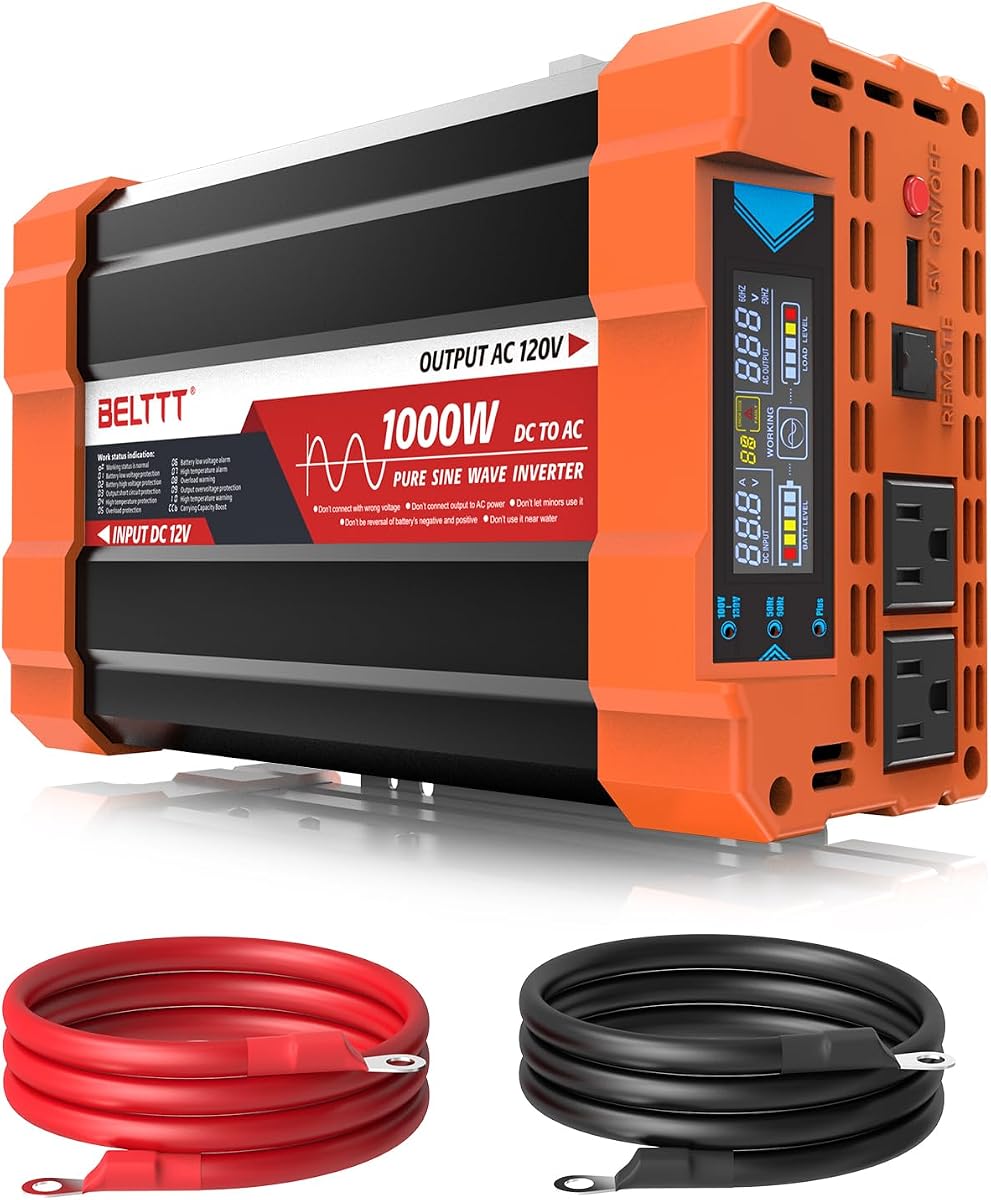


The BELTTT 1000Watt Pure Sine Wave Inverter combines a 1000W continuous rating with 2000W of peak startup capacity, giving it broad utility across vehicles, RVs, emergency kits, and small solar arrangements. Its 4.4 rating reflects a generally favorable balance of performance, features, and value, while the real-time LCD gives users unusually clear visibility into operating conditions.
We may earn a commission when you buy through this link, at no additional cost to you.
The pure sine wave output is the model's defining strength. It is designed for sensitive electronics such as televisions, home theaters, computers, and other devices that may behave erratically with a harsher waveform. Conversion efficiency above 90% reduces energy loss, while the adjustable output voltage and screen provide additional flexibility. Dual AC receptacles, a 5V 2.1A USB port, thicker battery cables, and installation tools make it a practical all-in-one package.
The safety system is comprehensive, covering undervoltage, overvoltage, overload, overtemperature, short circuit, and reverse connection. Aluminum and sturdy plastic form the housing, which should suit mobile use better than a unit with no physical reinforcement. The trade-offs are that it does not include a remote control, and its two AC outlets may be restrictive when several household-style devices need to be connected at once.
This is a strong recommendation for users who want pure sine wave quality without moving to a more elaborate permanent installation. It is especially appropriate for sensitive electronics in an RV, truck, van, or backup-power cabinet. Buyers should match the inverter to a suitably substantial battery and confirm that startup loads remain under its surge capacity.
The pure sine wave format closely approximates utility-grid AC, making this inverter better suited than modified sine wave alternatives to laptops, audio equipment, televisions, and other electronics with sensitive power supplies.
The high-brightness LCD reports input voltage, output voltage, battery status, load information, and operating conditions, although controlling or viewing those readings remotely is not part of the package.
We may earn a commission when you buy through this link, at no additional cost to you.
Renogy's Inverter P2 is designed for users who need more than a plug-in vehicle converter. It delivers 1000W continuously, supports a 2000W startup surge, and uses pure sine wave output rated above 90% conversion efficiency. Its 4.3 rating is supported by a broad feature set that includes a wired remote, a hardwire terminal, multiple AC receptacles, and a built-in USB port.
We may earn a commission when you buy through this link, at no additional cost to you.
The most useful feature for an RV, van, work truck, or compact off-grid system is the combination of two AC outlets, one AC terminal block, and a 16.4-foot wired remote. Buyers can check status or operate the inverter from a more convenient location, while the terminal block provides a path toward a fixed installation. Two three-foot 4AWG cables support direct battery connection.
Protection features include LED indicators for undervoltage, overvoltage, overtemperature, overload, and short circuit, along with cooling fans and GFCI protection. The product is also described as UL 458 and CSA C22.2 No. 107.1 certified. The main constraints are practical rather than fundamental: the included USB port is 5V/2.1A, and the instructions specifically call for a deep-cycle battery with an 80% discharge depth or greater.
Choose this inverter when remote operation, hardwiring flexibility, and recognized certification matter more than having newer USB-C charging. It is well suited to a carefully planned mobile installation or emergency power package where operators need both AC plugs and a fixed terminal.
A 16.4-foot wired controller lets users monitor and control an inverter installed away from the immediate seating or working area, adding convenience to RV, truck, and cabin systems.
Two AC outlets, a dedicated hardwire terminal, and the built-in USB port provide several ways to connect devices, while the included heavy-gauge cables support direct battery hookup.
We may earn a commission when you buy through this link, at no additional cost to you.
This vehicle-focused 1000W inverter combines full 1000W continuous output with 2000W peak surge and a modified sine wave signal. Its 4.3 rating makes it a credible option for road trips, camping, van life, tailgating, and job sites where the goal is to power common electronics rather than operate a fully permanent off-grid system.
We may earn a commission when you buy through this link, at no additional cost to you.
Its standout feature is the charging selection. Two AC outlets are joined by a 36W Type-C port and a 5V/3A USB port, making it particularly convenient for phones, tablets, and laptops. The LCD simultaneously presents input voltage, output voltage, battery status, and fault indicators such as OL, HI, LO, and OH, which can simplify troubleshooting in a vehicle.
The product can draw from a vehicle battery through alligator clips or connect through the cigarette-lighter socket for smaller loads. That latter connection is limited to 150W, so higher-draw equipment should use the direct battery method. Because the output is modified rather than pure sine wave, the manufacturer does not recommend it for refrigerators, microwaves, air conditioners, laser printers, or sensitive medical devices.
This inverter is best for travelers who prioritize USB-C charging, visible fault codes, and a straightforward vehicle installation. It is less appropriate when the load includes motors, compressors, medical equipment, or other devices that benefit from cleaner power. Direct battery wiring also requires attention to cable routing, polarity, and battery drain.
The 36W Type-C connection adds meaningful value for frequent travelers who want to replenish compatible laptops, tablets, and phones without relying on separate wall adapters.
Protection codes shown on the LCD make common operating problems easier to identify, helping users distinguish overloads, voltage conditions, and overheating before troubleshooting deeper.
We may earn a commission when you buy through this link, at no additional cost to you.
The LANDERPOW 1000 Watt Car Power Inverter combines pure sine wave output, 1000W continuous capacity, and 2000W surge capability. Its listed efficiency exceeds 91%, and its 4.4 rating places it among the stronger all-around options in the group. It is positioned for RV travel, mobile work, emergency use, and home or solar arrangements.
We may earn a commission when you buy through this link, at no additional cost to you.
Pure sine wave output gives it an advantage for CPAP machines, computers, home theaters, car audio, and other sensitive loads. Three AC outlets provide more household-style connectivity than most competitors. Fast charging is handled through a 5V/3.1A USB connection and a 30W PD port, while a 15-foot remote with an LED screen lets users inspect battery level, output, and errors from the cab or campsite.
The included battery cables are described as two 7AWG, two-foot leads, and the full-metal housing is intended to aid heat dissipation and durability. Protection covers undervoltage, overvoltage, overload, overheating, short circuits, and reverse connection. Its three-year coverage arrangement includes a one-year replacement period and two additional years of support, which is more elaborate than the warranty language supplied for several alternatives.
LANDERPOW is a strong candidate for RV owners and mobile workers who want clean output, numerous outlets, fast charging, and remote monitoring. It may feel excessive for someone who only needs to recharge a phone, but its broader connection set helps justify the design for multi-device travel and brief power outages.
Three AC receptacles make it easier to run several low-to-moderate loads simultaneously without requiring an additional outlet splitter, which can also reduce strain on the inverter's output capacity.
The 15-foot remote controller places key status information within reach of a driver or campsite, helping users monitor battery condition and errors without opening an equipment compartment.
We may earn a commission when you buy through this link, at no additional cost to you.
The ALLWEI 1000W Pure Sine Wave Power Inverter is a 1000W continuous unit with 2000W of peak surge, ETL listing to UL 458, and a 4.5 rating. It combines efficient pure sine wave conversion with a rugged aluminum housing, making it appealing for RV, truck, camping, solar, and remote off-grid users.
We may earn a commission when you buy through this link, at no additional cost to you.
Its protection system is one of the strongest selling points. The listed safeguards include low and high voltage, over- and under-temperature conditions, overload, over-current, reverse polarity, and short circuit. Audible buzzer alerts provide immediate warning, while intelligent fans adjust their speed according to load and temperature. A stated operating range of 14 to 104 degrees Fahrenheit broadens its usefulness in variable environments.
The inverter is designed for sensitive and motor-driven loads, including CPAP equipment, televisions, laptops, projectors, tools, fans, kettles, electric blankets, and mini refrigerators. Efficiency above 91% and low no-load loss are favorable for battery-powered systems. At 3.53 pounds, it also remains portable enough for short camping trips while being more substantial than a lightweight car adapter.
Buyers who prioritize certification, thermal management, and broad protection should give this model serious consideration. The absence of a remote controller is the main tradeoff for installations where the inverter is mounted out of sight. Otherwise, it is a confident premium-oriented recommendation for users who need dependable output rather than maximum convenience features.
Eight categories of protection cover the common electrical and thermal faults encountered in mobile power systems, while buzzer alerts provide prompt feedback when a condition needs attention.
Temperature-responsive cooling and a broad specified operating range support dependable use in hot vehicles, outdoor work areas, and seasonally changing campsite conditions.
We may earn a commission when you buy through this link, at no additional cost to you.
BESTEK's 1000W Power Inverter provides 1000W of continuous 12V-to-110V conversion and up to 2000W of surge power during startup. Its 4.3 rating reflects a versatile feature set aimed at car trips, vacations, camping, emergency outages, remote work, and mobile AC power needs.
We may earn a commission when you buy through this link, at no additional cost to you.
The enclosure measures 9.13 by 4.72 by 2.71 inches, making it easy to store compared with larger fixed-system inverters. Two AC receptacles, a 30W USB-C PD port, and an 18W USB-A QC port cover both conventional household-style devices and modern charging needs. A smart chip and built-in fuse shut down operation when a fault is detected, and a red warning light indicates the interruption.
Thermal management receives particular attention. One intelligent fan on the input side changes speed with temperature, while a second fan on the output side runs at low speed after startup and increases as conditions demand. The product is ETL certified and supported by the stated 180-day refund process and 18-month product replacement warranty.
This inverter is a good fit for travelers who want substantial continuous output in a relatively compact package. It lacks a remote controller, so it is better for accessible installations than for enclosed vehicle compartments. Buyers using it with refrigerators, tools, or other inductive loads should verify startup demand and confirm that their device is compatible with the inverter's output waveform.
The compact enclosure is easier to pack than larger inverter systems and still offers two AC outlets plus dedicated fast-charging ports for common travel devices.
Separately managed input and output fans respond to temperature rather than running at one fixed speed, helping control heat within a device that may operate in a hot vehicle.
We may earn a commission when you buy through this link, at no additional cost to you.
The TWING Car 1000W Inverter is a modified sine wave vehicle converter with a 4.2 rating and a design centered on portability. Despite its name and peak output of 1000W, the stated continuous capacity is 750W, making that distinction especially important when comparing it with products that sustain a full 1000W.
We may earn a commission when you buy through this link, at no additional cost to you.
Two 110V AC outlets serve larger devices such as laptops and tablets. USB-A and Type-C connections provide up to 50 watts of surge charging capacity, while the cigarette-lighter adapter supports loads up to 150 watts. A digital display, cooling fan, mini slip fuse, and insulated ABS construction accompany protections for overvoltage, undervoltage, overload, short circuit, and overheating.
The inverter can support phones, laptops, lights, cameras, breast pumps, portable audio, camping lamps, and other compatible electronics during emergencies or outdoor travel. Direct 12V battery connection is also possible. Its CE, FCC, and RoHS certifications are listed, and the manufacturer emphasizes use in a dry, well-ventilated area.
This model makes sense for campers and drivers who need a lightweight inverter for charging and modest electronics rather than full household loads. The lower continuous rating and modified output are meaningful limitations. It should not be treated as equal to a true 1000W continuous unit, particularly when powering motors, compressors, medical equipment, or other sensitive products.
The included adapter makes this inverter approachable for temporary vehicle use, allowing compatible electronics to be powered without running heavy cables through the cabin.
The 750W continuous rating is the number to use when planning loads, while the 1000W figure represents peak capability and should not be treated as sustained capacity.
We may earn a commission when you buy through this link, at no additional cost to you.
The 1000 Watt Pure Sine Wave Inverter has the highest listed rating in this group at 4.8, supported by 1000W continuous output, 2000W peak capacity, and pure sine wave electricity. It is an especially well-rounded selection for RV trips, trucks, cabins, camping, work vans, solar setups, and emergency power.
We may earn a commission when you buy through this link, at no additional cost to you.
Dual LCD displays are a distinctive feature, allowing battery voltage, output power, and protection alerts to be checked in real time. A 16.4-foot wired remote adds remote operation and monitoring, which is valuable when the inverter is mounted near a battery bank or inside a storage compartment. The output section includes two AC outlets, 18W USB-A fast charging, and 30W USB-C PD charging.
Its protection system covers overvoltage, undervoltage, overload, overheating, short circuit, and reverse polarity. Isolated input and output design and an aluminum housing add to the construction story, while included battery cables, a wired remote, and replacement fuses help complete the package. The waveform is appropriate for CPAP machines, laptops, televisions, and other sensitive electronics.
This is the strongest overall recommendation for buyers who want clean power, clear status information, and remote control without giving up fast USB charging. Its main limitations are the two-outlet layout and the absence of a stated third-party safety certification in the supplied details. Even so, the combination of pure sine wave output and dual-screen monitoring makes it exceptionally practical.
Dual screens make it easier to see operating information from different positions, while the separate wired remote allows monitoring when the main inverter is tucked away from the user.
Two AC outlets and modern USB-A and USB-C ports cover both household-style equipment and daily charging needs without forcing users to rely on a separate adapter.
We may earn a commission when you buy through this link, at no additional cost to you.
This Renogy Inverter P2 model delivers 1000W continuously and 2000W during load startup, with pure sine wave output and a listed rating of 4.3. It is intended for RV, truck, camping, home backup, solar, outdoor, emergency, and off-grid applications where multiple connection methods are useful.
We may earn a commission when you buy through this link, at no additional cost to you.
Its standout feature is the broad output selection: three AC receptacles, one AC terminal block, and a built-in 5V/2.1A USB port. Two three-foot 1/0AWG cables and a 16.4-foot wired remote are included. The remote is particularly helpful in a truck cab, RV interior, or cabin where the inverter itself may be positioned near the battery bank.
Pure sine wave output is intended to support electronics such as floodlights, televisions, freezers, laptops, and tablets with less noise and smoother operation. LED indicators identify undervoltage, overvoltage, overtemperature, overload, and short circuit conditions, while cooling fans and GFCI protection add further safeguards. UL 458 and CSA C22.2 No. 107.1 certification support its suitability for fixed or mobile installations.
This Renogy is a compelling option for buyers who need more outlets than the typical two and value certification alongside remote control. Its USB port is less advanced than USB-C alternatives, but that limitation is minor for a system whose main purpose is AC power. The deep-cycle battery recommendation and substantial cabling deserve attention before installation.
Three AC outlets, a terminal block, and USB create one of the broadest interface selections here, supporting both temporary devices and a more permanent connection strategy.
UL 458 and CSA C22.2 No. 107.1 certification provides useful assurance when the inverter will serve as part of a vehicle, RV, or carefully engineered off-grid power arrangement.
We may earn a commission when you buy through this link, at no additional cost to you.
The 1000W Power Inverter 2000W Peak provides 1000W of continuous output and 2000W of surge capacity across three 120V AC outlets. Its 4.7 rating is the second-highest in the group, and the included installation hardware gives it a strong appeal for buyers who want a ready-to-mount unit.
We may earn a commission when you buy through this link, at no additional cost to you.
Three AC receptacles allow several devices to be connected at once, and two 2.4A USB ports cover conventional charging. The product is also listed for electronics such as smartphones, drones, cameras, televisions, game consoles, power drills, blenders, and portable kettles, provided the combined load remains within the inverter's limits.
Protection covers overload, overheating, short circuit, high and low voltage, and external reverse polarity. Four preinstalled fuses and four spare fuses are included, adding redundancy for a unit likely to encounter vibration, changing temperatures, and repeated use. Four heavy-duty mounting brackets support secure placement in a vehicle, RV, garage, or worksite.
This is the budget recommendation for users seeking full 1000W continuous output, three AC outlets, and installation accessories without paying for a remote controller or advanced display. The supplied details do not identify the waveform, so buyers powering highly sensitive electronics should verify compatibility on the listing. For ordinary travel equipment, tools, and mixed household loads, the core package is well suited.
Four heavy-duty brackets let users secure the inverter in a vehicle or fixed work area, reducing the looseness associated with an inverter simply resting on a surface.
Four installed and four spare fuses provide a practical maintenance kit, useful for replacing a blown fuse without interrupting a mobile installation.
We may earn a commission when you buy through this link, at no additional cost to you.
A useful 1000W inverter must fit the battery, connection method, load type, and installation environment. Comparing those factors before shopping prevents most disappointments, especially when a listing emphasizes peak output instead of sustained capacity.
Waveform quality determines how smoothly an inverter reproduces household AC. Pure sine wave output is closer to utility-grid electricity and is generally the safer choice for laptops, CPAP machines, audio systems, TVs, medical equipment, and appliances with sensitive motors or power supplies. Modified sine wave units can be adequate for simpler electronics, but they may cause buzzing, heat, unusual noise, or poor performance in some loads. The product details in this guide identify several pure sine wave models and explicitly identify others as modified sine wave.
Continuous output is the amount a model can sustain without being overloaded, while peak or surge output is intended for brief startup events. Most products here provide 1000W continuously and 2000W at peak, but one TWING model is rated at 750W continuous and 1000W peak. Always total the running power of connected devices and add extra allowance for motors, compressors, and other high-startup loads. A device that runs at 700W may require more than 700W momentarily when its compressor or motor starts.
Cigarette-lighter connections are convenient but usually support much less than a full 1000W. One product explicitly limits that method to 150W, while others provide alligator clips for direct battery connection. Permanent or high-output use generally requires substantial cables, correct polarity, a suitable battery, and often a fuse close to the battery. Reviewing the included wire gauge is important because undersized or long leads can produce voltage drop, heat, and inconsistent operation.
The inverter changes DC into AC, but it does not create energy. Runtime depends on battery capacity, inverter efficiency, cable losses, and the draw of connected equipment. Deep-cycle or deep-discharge batteries are generally more appropriate than standard starting batteries for repeated discharge, and Renogy specifically recommends a deep-cycle battery with at least 80% discharge depth in the supplied details. A vehicle starter battery can support an emergency device briefly, but prolonged use may leave the vehicle unable to start.
AC outlet count affects how many conventional devices can run simultaneously without adding an extension block or power strip. Most models provide two outlets, while the TWING and Renogy P2 models offer three. USB ports add convenience, but specifications differ substantially: some feature 30W USB-C PD and 18W USB-A, while Renogy's listed USB port is 5V/2.1A. Consider connector types and charging standards instead of relying on the total number of ports.
A display can reveal input voltage, output voltage, battery status, load information, and protection codes. A wired remote extends those functions when the inverter is mounted in a compartment, under a cabinet, beside a battery bank, or near the rear of a truck. The LANDERPOW, Renogy, and highest-rated dual-display model include remotes. For an accessible plug-in unit, an on-device LCD may be sufficient and can reduce installation complexity.
Inverters encounter unstable battery voltage, reverse polarity, overloads, short circuits, excess heat, and fluctuating ambient temperatures. Good models provide undervoltage, overvoltage, overload, over-temperature, short-circuit, and reverse-polarity protection, sometimes with audible or visual fault indication. Active cooling is particularly useful in hot vehicles and enclosed installations. Models such as ALLWEI add over-current and under-temperature protection, while BELTTT and several competitors cover the core electrical fault categories.
A complete package can simplify setup. Included battery clamps or heavy-gauge cables help with direct connection, while mounting brackets make a permanent installation more secure. Some models also include a wired remote, replacement fuses, and installation tools. Buyers planning a permanent system should verify whether they need a hardwire terminal, fusing near the battery, ventilation space, strain relief, and a disconnect mechanism. Portable camping users may value compact storage more than extensive mounting hardware.
Before connecting anything, identify the inverter's input voltage, confirm that the battery is 12V, and calculate the running wattage of every device you intend to connect. Keep total continuous load at or below 1000W, leave some operational headroom, and verify that motors, compressors, kettles, and power tools have startup demand below the available surge rating. Place the inverter on a stable, dry, ventilated surface rather than inside a sealed compartment.
For direct battery installation, switch the inverter off, disconnect the battery, identify polarity, and route appropriately rated cables with the positive and negative connections correctly oriented. Add a suitable fuse near the positive battery terminal if one is not already part of the system, and prevent bare terminals from contacting metal. Follow the manufacturer instructions for the cigarette-lighter adapter or clips, and remember that socket connections may have a substantially lower power limit than direct battery wiring.
After startup, confirm that the display shows the expected input and output voltages and that no fault indicator is active. Test the remote and outlets before relying on the system during travel or an outage. Keep air paths unobstructed, inspect cables for looseness or damage, and do not exceed the rated load. Shut the inverter down when it will be unused for an extended period, especially when running from the vehicle's starting battery, and periodically check battery condition and fuse integrity.
It depends on the refrigerator's running draw and startup surge, as well as the inverter's waveform. A refrigerator that stays below 1000W may work with a pure sine wave inverter that also supplies enough surge power for the compressor to start. Modified sine wave models are less appropriate for some compressors because they may produce noise, heat, or unreliable starting. Check the appliance's label and the inverter's continuous and surge ratings before connecting it.
Runtime depends on battery capacity, the inverter's efficiency, and the connected load. Drawing 100W continuously from a fully charged 100Ah 12V battery for one hour would require more than its nominal capacity after conversion losses and should not be treated as a guaranteed runtime. A vehicle starting battery is better suited to short emergency use, while deep-cycle batteries support repeated or extended discharge. Always leave enough starting power for the vehicle.
Continuous output is the level the inverter can sustain for normal operation. Peak output is a short-duration allowance intended to help start devices with high inrush demand, such as compressors, fans, kettles, and some power tools. The 2000W figure should not be treated as a sustained 2000W supply. Size the inverter primarily by the combined running load and confirm that any one startup surge remains within its limits.
Pure sine wave is generally better for sensitive electronics, motors, medical devices, and higher-end household equipment because its output more closely resembles utility power. Modified sine wave can work for basic chargers, lights, and some resistive loads while costing less or offering a simpler design. The tradeoff is that some appliances may buzz, run hotter, or fail to start reliably. The supplied product data explicitly identifies two modified sine wave options among the ten models.
Only if the inverter and socket adapter are rated for the intended draw. The product that expressly supports this method limits the cigarette-lighter connection to 150W, even though the inverter can deliver much more when connected directly to a battery. For loads from 150W to the full inverter capacity, use appropriately rated clips or permanent battery wiring. Exceeding the socket's rating can overheat the plug, wiring, or fuse.
A remote is helpful when the inverter is mounted out of sight, near a battery bank, behind a cabinet, or outside a passenger compartment. It lets users check input voltage, output, battery status, and fault alerts without reaching into a compartment. If the inverter remains accessible and simple to observe, the on-device LCD may be enough. A remote is convenient rather than mandatory, provided the installation remains safe and well ventilated.
Look for protection against undervoltage, overvoltage, overload, overtemperature, short circuit, and reverse battery polarity.
A clearly illuminated or audible fault indicator is also helpful because it explains why power stopped.
Temperature-controlled fans and an undamaged housing help maintain safe operation in hot vehicles and outdoor installations.
Some models add over-current, under-temperature, and ground-fault protection for broader failure coverage.
Yes, provided the solar system includes an appropriate 12V battery or controller arrangement that can supply the inverter's input.
The inverter converts stored DC energy into AC; it does not directly regulate or maximize solar production.
A sufficiently large deep-cycle battery bank is important because the inverter may draw more current than the panels can provide at a given moment.
Check voltage compatibility, charging controls, cable sizing, and the total load before connecting a solar setup.
The 1000 Watt Pure Sine Wave Inverter with dual LCD displays and a remote is the strongest overall choice because it combines clean output, strong monitoring, modern charging, and flexible monitoring in one package. The 1000W Power Inverter 2000W Peak is the budget leader for buyers who want three outlets and mounting hardware, while the ETL-listed ALLWEI model is a premium pick for certified safety, broad protection, and thermal management.
The right inverter depends on what you will actually run. Pure sine wave output is the priority for sensitive electronics, while direct battery wiring becomes increasingly important as the required load rises. Outlet count, remote access, hardwire options, battery type, and the size of startup surges should all be considered before buying. A lower-cost unit with enough clean output and proper protection may serve the user better than a feature-heavy model with unnecessary capabilities.
Ratings, specifications, promotions, and availability can change over time, so check the current listing before making a final decision. Also verify the latest continuous-output figure, waveform, included cables, socket limitations, warranty terms, and protection details. Those details should be matched against the devices you plan to power and the battery system that will support the inverter.