
Large Key Wired Telephone
4.2Editor score
Oversized one-inch-wide number keys
Adjustable ringer and earpiece volume
Large warning light for calls
Operates during power failures
Discover the best large button phones for seniors, comparing photo speed dial buttons, loud ringers, speakerphones, visual alerts, simplicity, and ease of use.
Large button phones for seniors combine oversized keys, adjustable audio, visual call alerts, and straightforward controls to make everyday calling easier. The right model can support limited vision, hearing loss, reduced dexterity, or memory challenges while remaining comfortable for everyday use.
We compared the ten featured phones by examining button size and contrast, speed-dial options, ringer and earpiece volume, speakerphone support, visual indicators, corded reliability, and the presence of advanced features. The list covers simple landlines, amplified models, picture-button phones, and answering-machine systems.
Each review identifies the features that set a model apart and also notes practical limitations. Ratings reflect the supplied customer feedback, while feature descriptions are based on manufacturer information. Product details and prices can change, so readers should confirm current specifications and listings before purchasing.
4.2Editor score

4.5Editor score
3.9Editor score
The comparison below highlights the major differences among these senior-friendly landlines, including photo memory capacity, speakerphone availability, visual call alerts, volume controls, and extra calling features.




The Uvital Big Button Phone combines eight photo speed-dial buttons, a dedicated SOS key, one-touch speakerphone operation, and an exceptionally loud ringer. Its 4.1 rating reflects generally favorable feedback, while the feature set makes it especially relevant for seniors who want prominent controls and fast access to familiar contacts.
We may earn a commission when you buy through this link, at no additional cost to you.
The eight one-touch memory buttons can display photos of family members, friends, and caregivers. This visual approach reduces the need to memorize or manually enter telephone numbers, which can be valuable for users experiencing memory loss, poor vision, or cognitive impairment. A separate SOS button gives urgent access to a pre-programmed contact without navigating the keypad.
Audio performance is the phone's most distinctive feature. The ringer can reach 120 decibels, while the earpiece can reach 90 decibels, with independent settings for calls and incoming alerts. A flashing red LED offers another way to notice a ringing phone, and one-touch hands-free calling allows a user to talk without continuously holding the handset.
There are meaningful limitations. The product is designed for traditional PSTN service and does not support internet calling, answering machines, voicemail, caller ID, or a display screen. Wall mounting is also not recommended. Even so, users seeking loud, visual, and hands-free assistance may find these trade-offs acceptable.
This is a strong recommendation for a senior who lives alone, has difficulty hearing, needs hands-free calling, or benefits from photo-based contacts. It is less suitable for someone who depends on voicemail, caller identification, or internet service. Confirm that the household has a compatible RJ11 telephone line and that the user is comfortable operating a simple, screen-free phone.
The combination of a 120-decibel ringer, adjustable earpiece volume, and a flashing red LED gives the user several ways to recognize an incoming call. This redundancy is helpful in noisy rooms, at night, or whenever hearing alone may not be reliable.
Eight customizable photo buttons and a separate emergency key make frequently called people easy to reach. The interface rewards recognition rather than recall, which can simplify routine communication for users with memory or vision challenges.
We may earn a commission when you buy through this link, at no additional cost to you.
The SWISSVOICE Xtra TMAX10 is a well-rounded senior phone with a 4.5 rating, the highest customer rating among the ten models. It offers six customizable photo memory keys, large separated number buttons, adjustable listening controls, a separate ringer adjustment, and a visual incoming-call indicator.
We may earn a commission when you buy through this link, at no additional cost to you.
Its strongest feature is the balance between accessibility and simplicity. Each photo key connects directly to a familiar person, allowing the user to make a call without remembering or entering a full number. The number keys are also oversized and clearly separated, which supports accurate dialing for people with reduced eyesight or limited hand dexterity.
The phone provides dedicated plus and minus controls for four volume levels on both handset and speakerphone calls. Its ringer can be adjusted separately, while the visible ring indicator provides an additional cue when the phone is ringing. These controls make it easier to create a comfortable listening environment without navigating complicated menus.
The model is intentionally simple and does not offer a display, caller identification, voicemail, or an answering machine. Six photo keys may also be fewer than a household with many frequent contacts would like. Those limitations are reasonable for buyers who prioritize fast calling, clear controls, and dependable basic operation.
We recommend the Xtra TMAX10 for seniors who want a balanced, uncomplicated home phone with helpful photo shortcuts and clear volume controls. It is particularly attractive for users who can manage six key contacts but do not need the additional calling features found in more advanced systems.
Six dedicated photo keys make the most important contacts visible at a glance. The layout supports quick recognition without requiring the user to search through a conventional list of stored numbers.
Separate volume settings for the handset, speakerphone, and ringer allow users to tailor incoming and outgoing audio. A visual ring indicator further reduces the chance that a call will go unnoticed.
We may earn a commission when you buy through this link, at no additional cost to you.
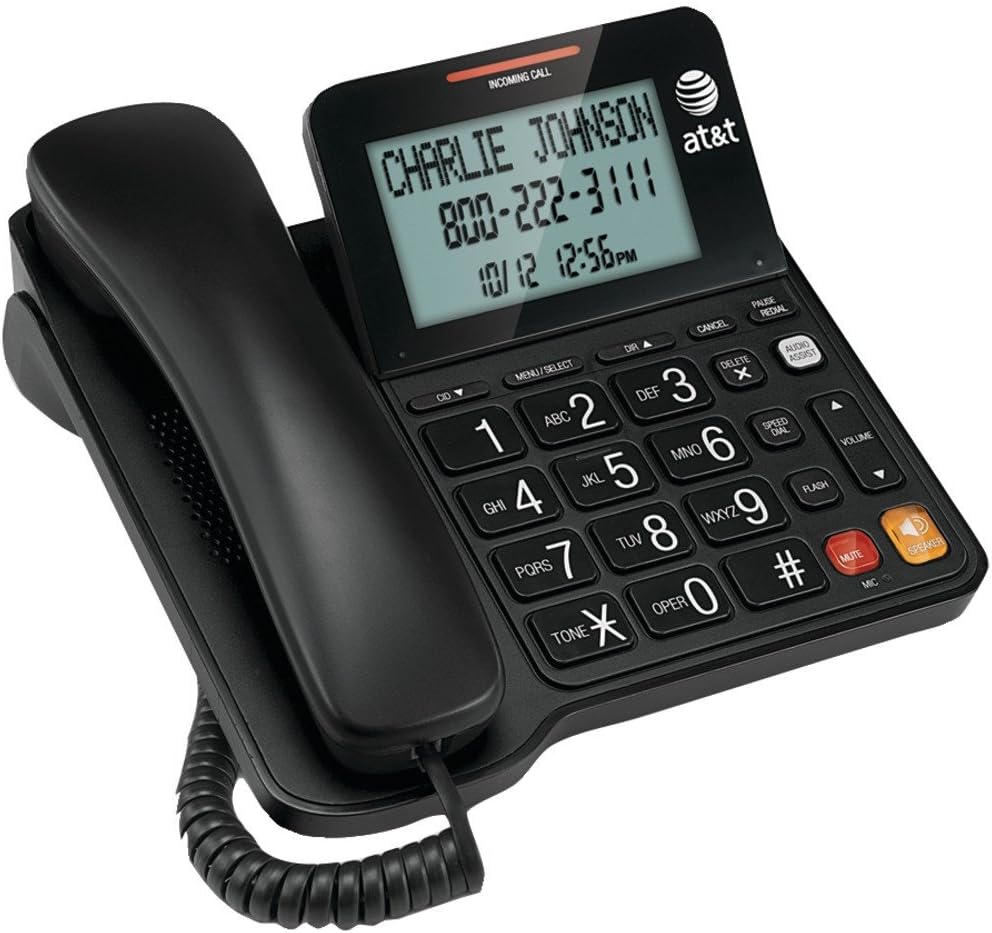
The AT&T CL2940 is a conventional corded telephone upgraded for easier reading, dialing, and listening. It has a 4.2 rating and combines extra-large buttons, a tiltable display, a speakerphone, an extra-loud ringer, Audio Assist volume boost, caller identification, and call waiting.
We may earn a commission when you buy through this link, at no additional cost to you.
The tiltable display is its defining convenience feature. Incoming names and numbers appear on a screen that can be angled for easier viewing, and the phone maintains a 50-name and number history. This makes the model a better fit for users who can read a display but still prefer large physical controls over a smartphone.
The Audio Assist feature amplifies incoming sound, while the adjustable extra-loud ringer helps users notice calls. A hands-free speakerphone supports conversations without holding the receiver, and the large keypad reduces accidental presses. Wall mounting and desktop placement are both supported.
Its more advanced features bring added requirements. Caller ID and call waiting require four AA batteries, which are not included. Although basic calling can work without household electrical power, buyers should not interpret the corded design as having every advanced feature available during an outage.
The CL2940 suits seniors who want recognizable telephone behavior with added caller information. It is a sensible choice when answering unwanted calls matters, the user benefits from a readable display, and a trusted household telephone line is available.
The 50-entry caller history and adjustable display make it easier to identify who is calling before answering. This adds useful call management for users who remain comfortable with conventional telephone menus.
Audio Assist boosts incoming sound, and the extra-loud ringer improves call awareness. The speakerphone adds another listening option for longer conversations or users who find holding the handset tiring.
We may earn a commission when you buy through this link, at no additional cost to you.
The Large Key Wired Telephone focuses on the fundamentals: oversized keys, adjustable audio, a prominent warning light, and dependable line-powered operation. Its 4.2 rating places it alongside several stronger-rated options, but its direct approach makes it a practical choice for uncomplicated daily calling.
We may earn a commission when you buy through this link, at no additional cost to you.
Each oversized key measures approximately one inch wide by 0.7 inches long. These physically substantial buttons are intended to reduce misdials for older adults with limited vision. The housing uses ABS material for a durable, comfortable shape, while the straightforward design avoids complicated setup routines.
Call awareness is handled through an adjustable ringtone and a large warning light positioned near the bottom. Earpiece volume can also be raised or lowered, giving users some control over conversations. Because the telephone draws power from the line, it can continue to operate during a household power failure.
The trade-offs are clear: there are no photo memory keys, display, speakerphone, or caller information features. Someone who benefits from photo-based contacts may find repeated number entry inconvenient. However, those limitations help keep the operating process approachable and the physical design focused.
This model is a good match for a senior who mainly wants to make and receive calls, needs substantially larger keys, and prefers minimal controls. It also works well as a secondary telephone in a bedroom, care facility, or other location where uninterrupted basic calling is more important than advanced features.
The unusually broad physical keys are easy to locate and press. Their size can reduce accidental selections while also making standard number entry more comfortable for users with limited vision or reduced dexterity.
The phone receives operating power from the telephone line rather than an external adapter. That makes it a dependable communication option during outages when cellular service or powered home equipment may be unavailable.
We may earn a commission when you buy through this link, at no additional cost to you.
The Large Button Landline Phone is designed around visibility, speed, and emergency access. It has a 4.2 rating, 1.06-by-1.18-inch high-contrast keys, two memory buttons, a red SOS key, a ringer above 110 decibels, and a flashing visual alert.
We may earn a commission when you buy through this link, at no additional cost to you.
Black numbers on a white background make the keypad easier to interpret. Raised keys are designed to accommodate stiff hands and reduce incorrect entries, while the larger M1 and M2 buttons give quick access to important contacts. The red SOS key adds a clearly identifiable emergency option.
For users with hearing loss, the phone offers a powerful incoming ringer, adjustable handset volume up to 80 decibels, and a flashing light. A nine-foot coiled cord provides room to move during a call, and standard RJ11 line power means the phone can continue operating during outages.
The phone does not include a speakerphone, answering machine, voicemail, or internet support. Those are meaningful omissions for people who want hands-free conversations or depend on a recorded-message system. On the other hand, its limited feature set makes it easier to learn.
This model is best for users who prioritize very large, high-contrast keys and a loud ringer, especially if an emergency shortcut and two general speed-dial numbers are sufficient. Families seeking a highly visual and easy-to-operate basic telephone will find its design well aligned with those needs.
High-contrast numbering and raised, oversized keys improve the chance that users will locate and press the intended number. This is a more substantial visual design than a standard compact home telephone.
The red SOS button separates emergency access from the two general memory keys. Its distinct color and position can make it easier to identify when a user is rushed or uncertain.
We may earn a commission when you buy through this link, at no additional cost to you.
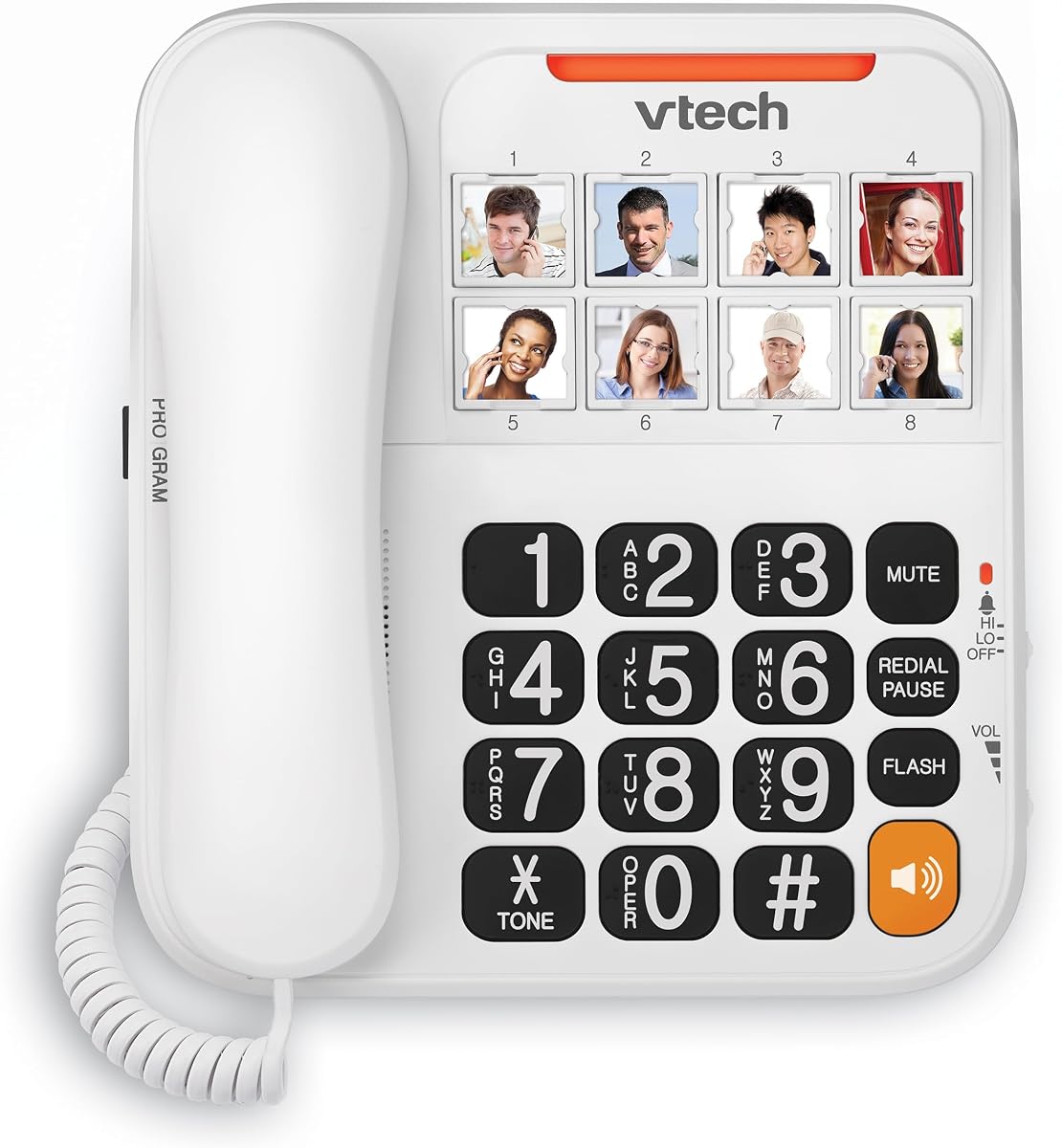
The VTech SN1117 adds spoken dialing feedback to an already senior-friendly feature set. With a 4.0 rating, it offers eight photo speed-dial keys, high-contrast oversized buttons, a bright flashing visual ringer, a full-duplex speakerphone, and adjustable listening levels.
We may earn a commission when you buy through this link, at no additional cost to you.
The talking-digit feature announces numbers as they are pressed. This feedback is particularly useful for a user who cannot comfortably verify a dialed number by sight. Eight photo keys provide enough room for several family members, caregivers, or service providers, while their familiar images reduce dependence on stored-number recall.
The full-duplex speakerphone allows users to talk and listen at the same time, creating a more natural hands-free conversation than a one-way speaker system. A bright flashing light provides a visual incoming-call signal, and both earpiece and speakerphone volume can be adjusted.
The model maintains a relatively simple layout without a screen, caller identification, answering machine, or voicemail. Its 4.0 rating is lower than that of many alternatives, and the lack of a display may not suit users who want call information at a glance.
The SN1117 is a good choice for a senior who benefits from both spoken and visual feedback, especially when a person occasionally forgets which number was pressed. It offers an effective mix of photo shortcuts, hands-free calling, and clear call alerts without becoming overly complicated.
Spoken digit announcements give the user immediate confirmation of a number during dialing. This can prevent a mistyped entry from becoming a failed or unintended call.
A full-duplex speakerphone supports natural two-way conversation, while eight photo keys make important contacts easy to select. These two features cover different accessibility needs within the same uncomplicated interface.
We may earn a commission when you buy through this link, at no additional cost to you.
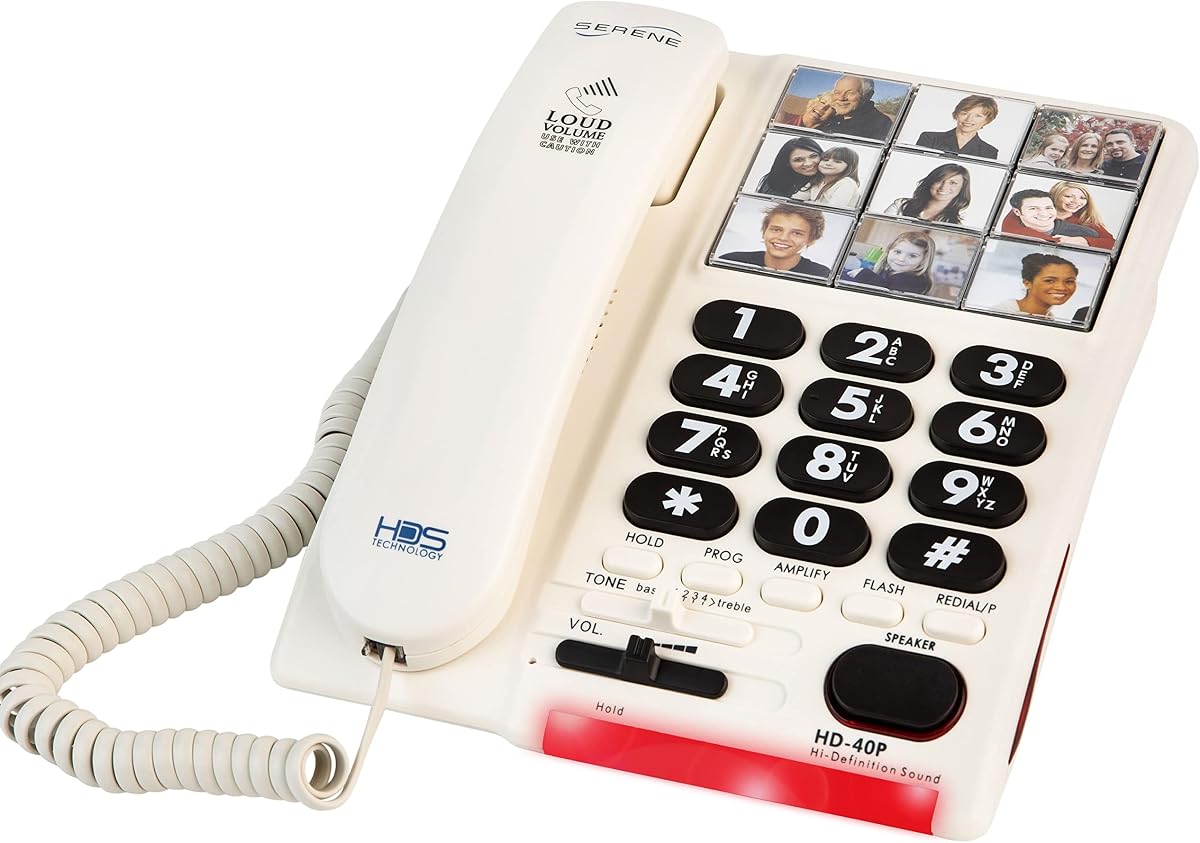
The Serene Innovations Amplified Big Button Landline Phone is a purpose-built assistive telephone for people facing visual, auditory, or memory impairment. Its 3.9 rating is among the lower scores in the group, but the specification sheet highlights a powerful ringer, photo buttons, and persistent line-powered operation.
We may earn a commission when you buy through this link, at no additional cost to you.
Portrait photos placed on speed-dial buttons provide visual prompts for family members, friends, and medical professionals. A user can recognize the intended contact and place a call with one touch, reducing the need to read, remember, and enter telephone numbers.
Its 85-decibel ringer is designed to cut through significant background noise. The phone is powered by the telephone line, so it does not depend on household electrical mains for continued operation. Simple, intuitive controls support users who may find menus and dense layouts difficult to navigate.
The product information is less comprehensive than that for several newer alternatives, and its customer rating trails the field. It also lacks details about a display, speakerphone, or other contemporary features, so buyers should confirm the complete specification set before purchase.
This phone is best suited to someone with substantial hearing loss and memory or vision challenges who values a very loud, photo-oriented design over advanced telephone features. Its focus on amplified alerts and persistent operation makes it a specialized but potentially valuable premium choice.
The 85-decibel incoming ringer is the product's signature feature. Its greater output is intended to help users hear calls across demanding listening environments without relying on additional equipment.
Portrait photographs turn the speed-dial keys into visual prompts. That direct association can make contacting a caregiver or loved one easier for a person with dementia or another memory-related condition.
We may earn a commission when you buy through this link, at no additional cost to you.
The Big Button Speakerphone combines extra-large keys, hands-free calling, memory, and multiple call alerts. It carries a 4.0 rating and supports both wall and desk placement, making it a flexible choice for homes, bedrooms, offices, and care environments.
We may earn a commission when you buy through this link, at no additional cost to you.
Its number keys are extra-large and designed to be easy to press for visually impaired users or people with limited finger dexterity. A hands-free speaker with volume control lets users continue other activities while talking, and the phone can remain mounted where it is most convenient.
The model provides ten two-touch memory options for family members and emergency contacts. Although each memory entry takes two touches rather than one dedicated key, the large number of entries allows a household to store more contacts. A switchable high-low ringer and LED indicator provide audible and visual alerts.
The telephone receives power from the landline and retains previously stored numbers during a power outage. Its limitations are the absence of photo buttons, a screen, caller identification, and a dedicated one-touch emergency key. Some users may also find two-touch memory less immediate than the photo layouts on other models.
This phone is a strong option for a senior who needs many stored contacts, hands-free conversations, and reliable operation during outages. It is especially suitable for installation on a desk or table within easy reach, avoiding the need to repeatedly lift and lower a handset.
Ten two-touch memory options provide room for an extensive network of relatives, caregivers, and service contacts. The arrangement is useful for households that want several numbers available without relying on a display.
A switchable high-low ringer adapts to different noise levels, while the LED indicator adds a visual signal. These parallel alerts help users notice calls even when one type of cue is easier to perceive.
We may earn a commission when you buy through this link, at no additional cost to you.
The Excelltel One-Touch Phone offers one of the most extensive memory arrangements in this guide. Its 4.1 rating comes with nine photo speed-dial keys, ten groups of two-button memories, a red SOS function, adjustable audio, hands-free calling, redial, and a flashing LED.
We may earn a commission when you buy through this link, at no additional cost to you.
The nine photo controls give users direct visual access to important contacts. These can be supplemented by the ten two-button memory groups, which are useful for additional numbers that do not need to occupy the most prominent part of the keypad. The red emergency control is visually distinct from the other keys.
Handset volume can be adjusted to a comfortable level, and the ringer volume is also customizable. When a call arrives, the LED flashes in sync with the ring, providing a clear visual notification for users with hearing difficulties or those in noisy environments.
The extensive set of controls can become a disadvantage for someone who values a minimal interface. There is also no display, caller identification, answering machine, or voicemail. The phone runs from standard telephone-line power without batteries, which supports long-term simplicity.
This model is a good match for a senior with a broad circle of frequent contacts who can benefit from both photo shortcuts and additional memory groups. It is particularly useful when several people need one-touch access but the household also wants more stored numbers than the photo section can hold.
Nine photo keys make the most important contacts immediate, while ten two-button memory groups extend the available contact list. This combination provides both speed and flexibility without requiring a screen.
The LED flashes in time with the incoming ring, creating a clear visual cue. This helps when the ringer is difficult to hear in a noisy room or at a time when the user is not focused on the telephone.
We may earn a commission when you buy through this link, at no additional cost to you.
The SWISSVOICE Premium 3355 is the most feature-rich system in the guide, combining a corded base, an additional cordless handset, an answering machine, photo memory buttons, call blocking, and hearing aid compatibility. Its 3.4 rating is the lowest in the lineup.
We may earn a commission when you buy through this link, at no additional cost to you.
Four large photo memory buttons, including an SOS button, make important contacts easy to identify. All photo and dialing keys are extra large, supporting users with low vision or unsteady hands. The telephone's ringer can reach 90 decibels, and its hearing aid compatibility makes it a relevant option for users with specific audio needs.
Two handsets are included: one corded handset attached to the base and one cordless handset. The base supports up to three additional handsets, allowing the system to expand across rooms. The built-in answering machine is useful for users who cannot answer promptly, while call blocking provides control over unwanted calls.
The additional functionality also introduces compromises. The cordless handset needs a charged battery, the answering machine requires setup, and only four photo memory buttons are included. Its lower rating suggests that some buyers may find the overall system less aligned with their needs than a simpler model.
This system is best for households that want multiple locations connected through one telephone system and value an answering machine. It is less appropriate for a senior who needs the simplest possible controls or does not want to manage a cordless handset and its charging routine.
The included cordless handset allows a user to move away from the base while remaining connected. Additional compatible handsets can extend the system to other parts of the home.
An integrated answering machine can capture messages when no one is available to answer, while call blocking helps users avoid unwanted interruptions. These features provide more control than a basic one-line telephone.
We may earn a commission when you buy through this link, at no additional cost to you.
The most useful senior phone is not necessarily the one with the most features. Start with the user's specific vision, hearing, dexterity, and memory needs, then consider the telephone line, available space, and willingness to maintain additional equipment.
Large button phones should offer visibly oversized keys, clear separation between neighboring buttons, and high-contrast numbers. The Large Key Wired Telephone uses keys measuring about one inch wide by 0.7 inches long, while the Large Button Landline Phone uses approximately 1.06-by-1.18-inch keys with black numbers on white. These dimensions matter because a button that is technically large but tightly packed can still be difficult to identify accurately.
Raised or shaped keys can further help users with limited dexterity or vision. Spacing gives a fingertip room to settle before pressing, and contrast reduces the effort required to distinguish one number from another. A tiltable display is useful for readable information, but it should complement rather than replace a comfortable keypad.
Photo buttons turn contact recognition into a one-press action. They are especially helpful for seniors with memory loss, dementia, poor vision, or difficulty remembering telephone numbers. Available capacities range from four photo buttons on the SWISSVOICE Premium 3355 to eight on the Uvital and VTech models, with the SWISSVOICE Xtra TMAX10 providing six.
A dedicated SOS key is worth considering for someone living alone, but families should program it carefully and explain when to use it. Photo labels are only useful if they are clear, correctly attached, and updated when a contact's details change. Confirm how the programming process works before committing to a model.
Hearing support should include both incoming and outgoing audio. A strong ringer helps users notice a call, while adjustable earpiece or speakerphone volume makes conversations more comfortable. The Uvital offers the highest stated maximum ringer output at 120 decibels, the Large Button Landline Phone exceeds 110 decibels, and the Serene Innovations model has an 85-decibel ringer.
Volume should be adjustable rather than simply fixed at maximum. A permanently loud ringer may be overwhelming at night or in a shared home. The AT&T CL2940 adds Audio Assist to amplify incoming sound, while several other models provide separate controls for ringer and listening volume.
A flashing light provides an important alternative to sound. It is useful in noisy environments, at night, for users with hearing loss, or whenever the telephone is not in the user's direct line of sight. The Uvital has a bright red flashing LED, the VTech SN1117 has a bright visual ringer, and the Excelltel phone flashes its LED in sync with the incoming ring.
Position matters. A light at the top may be more visible across a room, while a low warning light can help someone seated close to the phone. Buyers should ask where the telephone will be placed and whether the user will see the alert from normal sitting or standing positions.
Speakerphone support can make longer conversations more comfortable for users with limited mobility, fatigue, or difficulty holding a handset steadily. The Uvital, SWISSVOICE Xtra TMAX10, AT&T CL2940, VTech SN1117, Big Button Speakerphone, and Excelltel model include speakerphone capability.
A full-duplex speakerphone, as offered by the VTech SN1117, lets both parties speak and hear at the same time. That is more natural for a conversation, although background noise can still make the feature less useful. The Large Button Landline Phone explicitly lacks a speakerphone, so buyers should treat this as a required feature if hands-free use matters.
A corded landline can remain useful during a household power failure because many models receive operating power from the telephone line. The Large Key Wired Telephone, Large Button Landline Phone, and SWISSVOICE Xtra TMAX10 are designed around this line-powered approach. The AT&T CL2940 can also support basic calls without AC power, although its caller ID requires four AA batteries.
Cordless convenience comes with charging and battery management. The SWISSVOICE Premium 3355 includes a cordless handset, so a charged battery and a clear place to return it are required. A family should compare the reliability benefit of a permanently connected phone with the convenience of moving around a home.
Displays, caller identification, call waiting, answering machines, call blocking, redial, flash, and multiple memory groups can make a phone more useful or more intimidating. The AT&T CL2940 offers a tilt display and 50-entry caller history for users who appreciate conventional call screening. The SWISSVOICE Premium 3355 adds an answering machine, call blocking, and a cordless handset.
A simple model may be better for a senior with dementia or a strong preference for uncomplicated controls. Feature count should follow the user's abilities rather than a checklist. A senior who cannot comfortably navigate settings, recharge a handset, or use a display may benefit more from prominent photo keys and clear physical controls.
Check the telephone line before ordering. Several models are intended for traditional PSTN service and do not support internet calling. The Uvital, for example, does not support answering machines, voicemail, caller identification, or a display screen. Confirm whether the home uses an analog line, a compatible landline service, or a different connection.
Next, consider where the phone will live. A phone for a bedside table needs easy nighttime visibility and a ringer that is not excessively disruptive. A phone for a common room may benefit from louder alerts, a speakerphone, and a visual light visible from across the space. Wall mounting, cord reach, and stable desktop placement should also be considered.
Begin by installing the phone near the primary calling area and within comfortable reach of the user. Connect the corded line to an RJ11 jack, place the handset securely, and test the keypad. If the model is designed for wall or desktop use, choose the location according to the manufacturer's guidance. Avoid stretching a coiled handset cord across a walkway, and ensure that the receiver can be returned to its cradle after every call.
Program the most important contacts before the phone is put into regular use. Clear the assigned photo spaces, attach each photograph directly beneath or above its corresponding button, and dial each entry to confirm that it reaches the intended person. Test the SOS function only in the manner recommended by the manufacturer. Keep a written list of programmed numbers somewhere discreet but accessible to a caregiver, and revisit the setup whenever a contact changes.
For daily care, gently wipe the keypad, handset, and receiver opening with a soft, slightly damp cloth, then allow the surfaces to dry fully. Do not spray liquid directly onto the phone, and avoid harsh chemicals that could damage the plastic or printed labels. Keep the line connection secure, clean the warning light so it remains visible, and check that the cordless handset is charged regularly if the system includes one.
No. Oversized buttons can also help people with arthritis, tremors, limited dexterity, memory concerns, or a general preference for easier controls. Many models add adjustable ringer and earpiece volume, photo speed dialing, speakerphone capability, and visual alerts, so they can support several different needs at once.
Many corded models receive operating power from the telephone line and can continue handling basic calls during an outage. Advanced functions may behave differently. The AT&T CL2940, for example, requires four AA batteries for caller ID, and cordless handsets need their own charged batteries.
The process varies by model, but photo buttons generally use the same basic programming method as ordinary speed dial. A family member or caregiver can usually set them up more easily than the intended user, and every contact should be tested afterward to confirm that the right person is assigned to each button.
They serve the same general purpose by signaling an incoming call without relying on sound. A visual ringer may use a bright lamp that flashes or illuminates, while a flashing LED usually produces a smaller, distinct light. Placement and brightness determine how easily the alert can be noticed.
That depends on the model and telephone service. Several products listed here are traditional PSTN corded phones and do not support internet connections. The AT&T CL2940 includes conventional caller ID and call waiting, while the SWISSVOICE Premium 3355 adds an answering machine and cordless handset, but compatibility should still be confirmed with the provider.
It depends on mobility, dexterity, and conversation habits. A speakerphone is helpful for users who cannot comfortably hold the receiver or want hands-free calling, though a full-duplex model offers more natural two-way conversation. Users who may be confused by extra controls might prefer a simpler phone without one.
The goal is a level that can be heard in the intended environment without being distressing at night or in a shared home. Adjustable ringer volume is preferable to a permanently fixed setting. Many phones in this guide also provide visual alerts, giving users a quieter alternative when maximum audio is inappropriate.
It can serve a primary user well when the layout, contacts, and features match that person's needs. Families seeking calls in several rooms may prefer a system with multiple handsets, such as the SWISSVOICE Premium 3355, while a single-user household may find one of the simpler corded models easier to maintain.
The SWISSVOICE Xtra TMAX10 offers the strongest overall balance with six photo keys, large separated controls, adjustable listening and ringer levels, and a visual call indicator. The Large Key Wired Telephone stands out for affordability and oversized keys, while the Serene Innovations Amplified Big Button Landline Phone serves users who prioritize a powerful ringer and photo-assisted calling.
The right choice should be tied to the user's specific needs. Photo buttons benefit memory and vision support, a strong adjustable ringer helps with hearing loss, a speakerphone improves hands-free use, and a flashing light adds a valuable visual cue. Households should also verify telephone service, power behavior, available space, and whether advanced features such as caller ID or an answering machine are genuinely useful.
Customer ratings and product configurations can change over time, as can promotions and retailer availability. Before purchasing, confirm the current listing, complete specifications, compatibility, and included accessories. Those checks help ensure that the chosen phone remains comfortable, understandable, and genuinely useful for everyday communication.