
LFSYS Yellow Fruit Fly Traps
4.6Editor score
Chemical-free double-sided adhesive
Simple soil insertion
Indoor and outdoor versatility
Bright yellow insect attraction
Thrips traps are compared across ten sticky plant-pest options for gardens, greenhouses, and houseplants, helping you choose the right trap.
Thrips are small, elusive pests that can damage flowers, vegetables, houseplants, and greenhouse crops. The right sticky trap helps intercept adults while you monitor activity, reduce pest pressure, and identify where an infestation is concentrated. Effectiveness depends on placement, coverage, color, and ease of use.
We compared ten traps for thrips and related plant pests using their listed dimensions, adhesive surfaces, mounting options, intended settings, and target insects. The list includes blue monitoring boards, yellow attractant traps, double-sided cards, soil-insert designs, and weather-resistant options for both indoor and outdoor plant care.
Each review explains where a product stands out, where it falls short, and who is most likely to benefit from it. The first three receive editorial awards, while the remaining entries provide detailed buying context. Availability and prices change, so confirm the current listing before purchasing.
4.6Editor score

4.4Editor score

4.1Editor score
This side-by-side comparison evaluates all ten traps by color, adhesive design, mounting method, coverage, and the plant-pest applications described in their product information.



Catchmaster GRO Blue Regular Double Sided Sticky Traps is the most versatile option in this guide, earning a 4.4 rating. It uses a double-sided sticky surface without requiring fly bait and is listed for fungus gnats, whiteflies, fruit flies, aphids, thrips, leaf miners, sciarid flies, and other crawling insects. Its standout feature is the recommended three-zone placement strategy, which helps cover the base, middle, and upper portions of plant canopies.
We may earn a commission when you buy through this link, at no additional cost to you.
The traps can be placed against walls and pathways, staked into the ground, or tied around plants and trees. This flexibility makes the product suitable for houseplants, outdoor gardens, farms, hydroponic systems, greenhouses, and composting areas. The listed water-resistant and UV-resistant construction is especially useful for growers that need a trap to remain outdoors. A large 72-pack also gives users enough cards to establish consistent coverage across multiple plants rather than concentrating every trap in one location.
The principal trade-off is that the catch can remain effective for up to one year only while the surface stays clean. Outdoor cards may become dirty sooner, particularly in dusty areas or where they contact foliage, so regular inspection is necessary. The bait-free design is convenient, but it also means the traps work through physical interception rather than a separately identified attractant. Users should position them where flying pests actually travel.
This is the strongest choice for gardeners, houseplant owners, and greenhouse growers who want a broad monitoring system rather than a narrow solution for one insect. The combination of double-sided adhesion, flexible placement, environmental resistance, and three-zone guidance makes it the best overall thrips traps choice in this roundup.
The recommended base, middle, and top placement pattern improves interception by addressing the different locations where small flying insects move around a plant. For larger gardens or greenhouses, distributing traps vertically is more useful than concentrating every card at soil level.
Stakes, wall placement, pathway placement, and plant ties allow the same trap format to serve indoor pots, raised beds, farms, and hydroponics. This flexibility also makes it easier to increase or reduce coverage as the growing season changes.
We may earn a commission when you buy through this link, at no additional cost to you.
The Seabright HGSLTLT is a compact, plant-mounted trap with a 4.1 rating. It is explicitly marketed for thrips and leaf miners and also attracts aphids, whiteflies, leafhoppers, and moths. Rather than relying on a soil stake or freestanding support, the trap can be attached directly to a plant, making it easy to position within the foliage where adult thrips are likely to travel.
We may earn a commission when you buy through this link, at no additional cost to you.
Weatherproof construction is one of its most useful qualities. A trap that can remain attached outdoors without requiring a separate stake is convenient for container plants, hanging baskets, greenhouse benches, and small garden groupings. The included wire twist provides a straightforward way to secure the card to a stem or branch, while the sticky surface is designed to intercept a broad spectrum of flying insects.
The five-trap pack is much smaller than the bulk options in this guide. That makes sense for a single plant, a compact greenhouse section, or a targeted treatment area, but it may not be enough for broad garden coverage. Because the trap is not limited exclusively to thrips, users may also capture other flying insects, which is helpful for monitoring but means the card is not a species-specific diagnostic tool.
Choose this product when direct plant placement, weather resistance, and a compact format matter more than having a large monitoring inventory. It is our best premium thrips traps pick because it offers focused, flexible deployment in a small, attractive package without relying on a separate mounting stand.
Attaching the trap to a stem or branch brings the adhesive surface closer to the insects than a card placed on the floor. That makes direct plant mounting useful when damage appears primarily in the upper canopy.
The stated weatherproof construction supports continued outdoor placement through changing conditions. Users should still inspect the surface periodically because debris can reduce exposed adhesive and visible catches.
We may earn a commission when you buy through this link, at no additional cost to you.
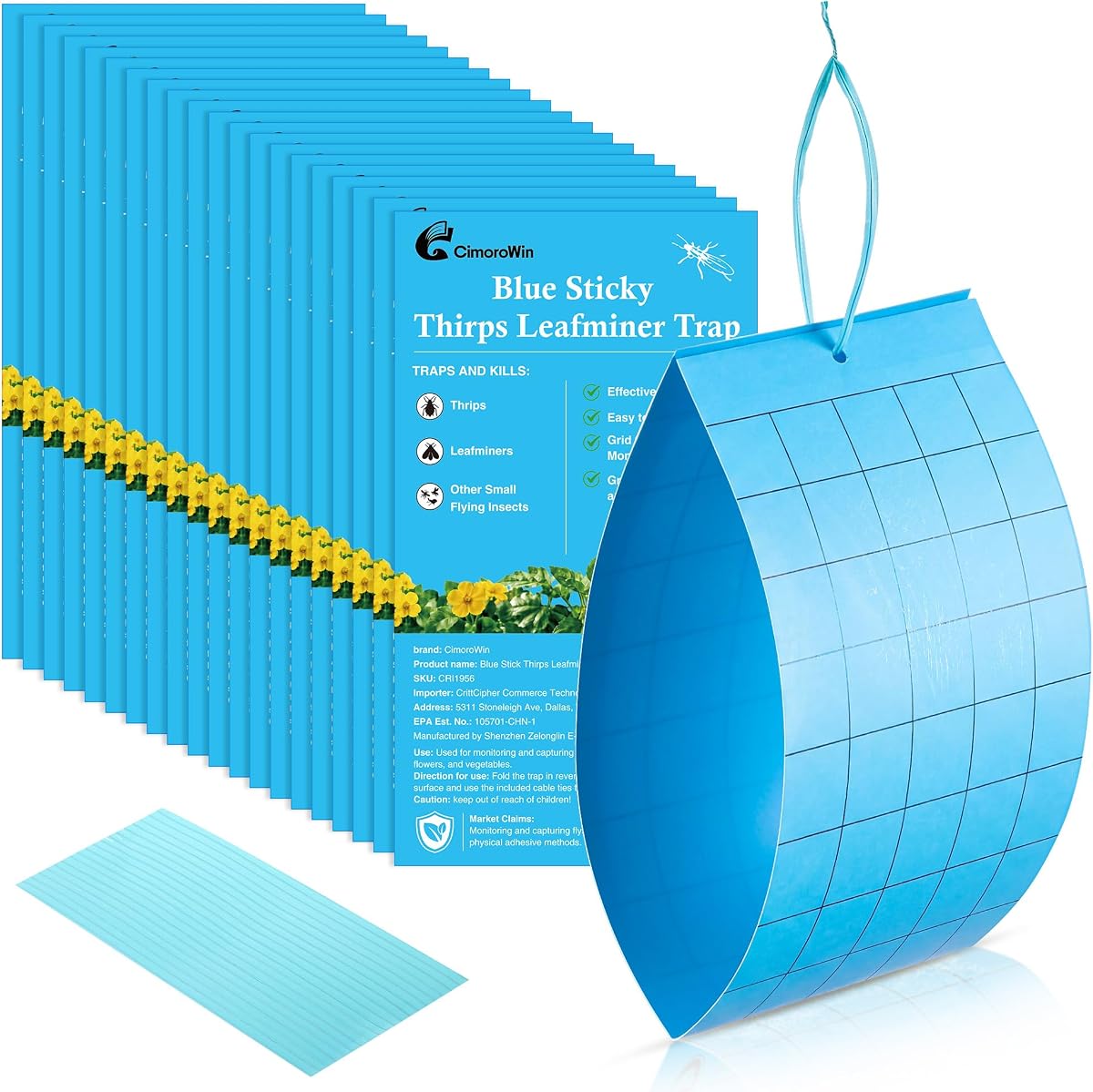
The 20 Pack Sticky Traps for Plants is a blue, bait-free monitoring system designed for thrips, leafminers, and other small flying insects. It does not have a supplied customer rating, so its appeal comes from its clearly described design rather than a measurable rating history. Its most distinctive feature is a grid printed onto the surface to simplify monitoring and counting.
We may earn a commission when you buy through this link, at no additional cost to you.
Each card folds so that it presents a double-sided adhesive measuring 3.94 by 14.17 inches. The larger covered area increases exposure without requiring an additional card, while the included grid gives users a convenient way to estimate catches. Twenty metal twist ties support hanging the traps near leaves, stems, or growing areas, and the waterproof material is suitable for humid greenhouses, hydroponic systems, and outdoor gardens.
The product is designed for monitoring rather than treatment of an entire infestation. Grid lines can also serve as cutting guides when a custom size is more appropriate, although cutting adds handling and may make management less tidy. Because no lure is used, placement remains the primary factor determining success; a card hidden behind foliage or positioned far from active traffic may catch very little.
This is a strong pick for growers who want to count thrips or leafminer activity, compare sections of a greenhouse, or document changes over time. It is especially useful in professional or educational settings where consistent sampling matters more than having dozens of disposable cards.
The built-in grid makes it easier to divide a card into consistent sections and compare catches between plants, rows, or greenhouse zones. That repeatability is particularly valuable when deciding whether a treatment plan is reducing activity.
The reverse-fold format exposes a substantial double-sided surface while remaining easy to hang. It can provide useful interception coverage without the footprint of a rigid, full-size board.
We may earn a commission when you buy through this link, at no additional cost to you.
The Qualirey 100 Pcs Blue Sticky Traps for Thrips has a 3.9 rating and offers a compact card with double-sided adhesion. It targets thrips, leaf miners, aphids, black flies, fungus gnats, and other small flying insects. The stated blue color is presented as more effective for attracting thrips than yellow traps, making the format particularly relevant for rose gardens, flowering plants, Monstera, and indoor green areas.
We may earn a commission when you buy through this link, at no additional cost to you.
Each trap measures 7.87 by 3.9 inches, a narrow size intended to fit around standard houseplant pots without dominating the display. The package includes 100 cards and 100 twist ties. Users can hang the traps near plants or secure them with cable ties, while the smaller dimensions make the product easier to fit into crowded indoor plant groups.
The main drawback is that paper construction may not offer the same long-term resilience as a sturdier card, even though it is described as waterproof and fade resistant. The rating is also the lowest among the rated products in the list, which may make buyers cautious. The recommendation to replace only when fully covered should be balanced against the possibility that damaged or soiled cards need earlier removal.
This product fits buyers who want a large inventory of compact blue traps for multiple houseplants or a modest garden. It is also attractive for roses and other plants where thrips are a primary concern. Compared with larger boards, the cards are discreet, flexible, and easy to distribute through a collection of pots.
The narrow dimensions allow a trap to sit close to a pot without consuming much visual or physical space. This makes the format convenient for windowsills, plant shelves, and indoor displays where larger boards would be intrusive.
The stated ability to cut the card without affecting its stickiness helps it fit smaller pots, seedling trays, or irregular spaces. Clean, straight cuts will make the final placement neater.
We may earn a commission when you buy through this link, at no additional cost to you.
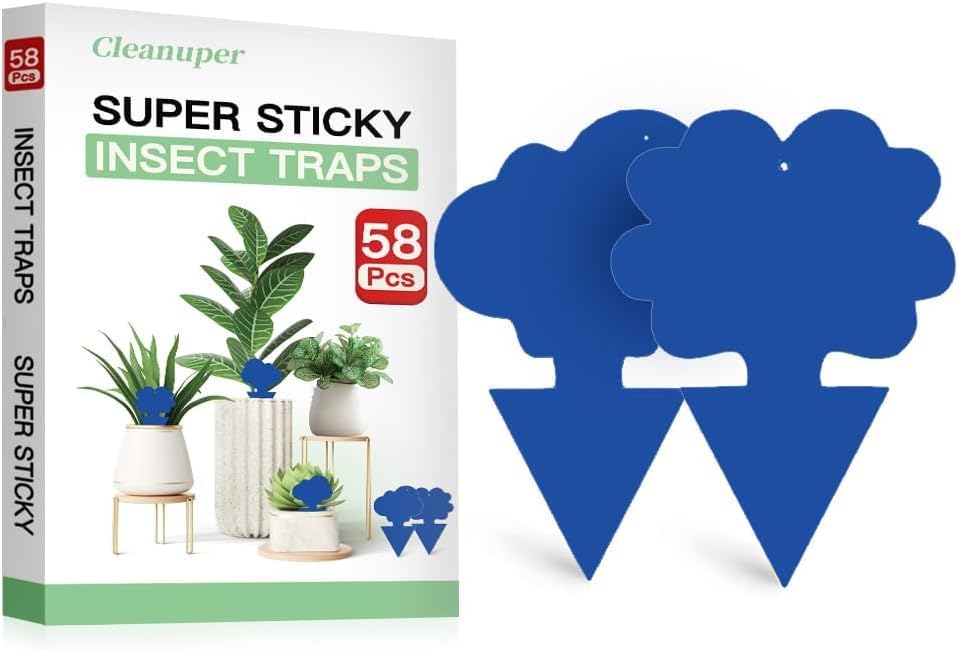
The 58 Pack Gnat Killer Sticky Traps combines pest monitoring with decorative flower and cloud shapes, and it carries a 4.5 rating. Although marketed mainly for fungus gnats, its double-sided adhesive is also listed for fruit flies, whiteflies, aphids, thrips, and midges. The bait-free physical trap uses no batteries and releases no scent into the surrounding air.
We may earn a commission when you buy through this link, at no additional cost to you.
Each card has a pointed stake intended for insertion into potting soil. The product guidance recommends removing both protective liners before placement, ensuring that the complete double-sided adhesive is exposed. Its waterproof and UV-resistant construction is listed for indoor rooms, outdoor beds, patios, windowsills, and greenhouses, giving it more environmental flexibility than a basic disposable indoor card.
The stakes can bend in compact or rocky soil. The suggested remedy is to moisten dense soil or make a small pilot hole first, which adds a preparation step but protects the trap from damage. The decorative shapes may also distract from a formal garden aesthetic, although their blue palette is intentionally softer than bright yellow cards.
This is a good choice for houseplant owners who want an unobtrusive-looking solution that can remain in the pot. It is particularly useful for collections containing several plants that need continuous monitoring. The 58-card inventory offers broad coverage without requiring separate mounting ties.
The flower and cloud forms help the traps blend into common houseplant displays. That makes them more suitable for living rooms and kitchens than standard rectangular cards that look purely utilitarian.
Removing both liners before pushing the stake into soil activates the full adhesive surface and avoids an awkward final step. It is a small preparation habit that improves the odds of using the trap as intended.
We may earn a commission when you buy through this link, at no additional cost to you.
The 100 Pack Gnat Killer is an expanded version of the 58-card format, offering 50 flower-shaped traps and 50 cloud-shaped traps. Its 4.5 rating reflects a well-received product concept: odorless, bait-free, double-sided cards that can be inserted directly into plant soil. It captures fungus gnats and is also listed for fruit flies, whiteflies, aphids, thrips, and midges.
We may earn a commission when you buy through this link, at no additional cost to you.
The pointed stakes make the traps easy to position among roots and stems without requiring twist ties. Waterproof and UV-resistant construction supports use in a greenhouse, outdoor container garden, patio, kitchen, or plant room. As with the smaller pack, both protective liners should be removed before insertion so that the complete adhesive surface is active.
Buyers who have only a few houseplants may end up with more inventory than they can immediately use, although the cards can remain in place as long as their surfaces stay usable. Compact or rocky potting mix may resist the stake and could bend it. A pilot hole or slightly moistened soil is the safer approach.
This is the better choice than the 58-card version for large collections, numerous pots, or a garden requiring broad distribution. Its decorative shapes and familiar stake format make routine monitoring easy, while the larger inventory supports replacing dirty or heavily covered cards.
One hundred cards make it practical to place several traps in each affected area or to rotate cards regularly. Broad distribution reduces the chance that concentrated populations remain unnoticed.
Because the design relies on physical adhesion rather than a scent or lure, nothing is released into the room. That can be appealing in kitchens, living areas, and other spaces where an odor would be intrusive.
We may earn a commission when you buy through this link, at no additional cost to you.
The Gideal 20-Pack is a yellow, dual-sided trap system with a 4.2 rating. It catches or attracts whiteflies, fungus gnats, blackflies, thrips, fruit flies, midges, and other flying plant insects. The bright yellow surface uses color attraction, and the product description states that it is non-toxic and suitable for both indoor and outdoor placement.
We may earn a commission when you buy through this link, at no additional cost to you.
The package goes beyond the basic cards by including 20 twist ties and two trap stands. Those accessories make it possible to hang a trap from a plant, suspend it in another location, or position it on a stand. Every card measures 6 by 8 inches, providing a moderately large surface that remains easy to handle and position around a plant.
Yellow traps are more general-purpose than blue options in this roundup. That makes them useful when several flying pests may be present, but it can be less advantageous when the objective is to focus specifically on thrips. The included stands add convenience, though users must choose which mounting method works best in each location.
This product is a strong all-around choice for patios, balconies, windowsills, greenhouses, and outdoor gardens where a mixture of flying pests is suspected. The combination of cards, ties, and stands gives it better mounting completeness than most competitors, while the stated waterproof construction and temperature tolerance support outdoor use.
The cards can be hung with twist ties, placed on one of the two included stands, or arranged according to the user's setup. That range is useful when moving between indoor and outdoor plant areas.
Bright yellow helps draw flying insects toward the adhesive surface. It is a practical general-purpose color for gardens where thrips may be accompanied by whiteflies, gnats, or fruit flies.
We may earn a commission when you buy through this link, at no additional cost to you.
The LFSYS 64 Pcs Yellow Sticky Fruit Fly Traps has a 4.6 rating, making it one of the strongest-rated products in this guide. It uses double-sided cards with a chemical-free, odorless adhesive and is listed as safe for humans and pets. Although its title emphasizes fruit flies, the product information also identifies mosquitoes, aphids, and other flying insects as targets.
We may earn a commission when you buy through this link, at no additional cost to you.
Installation is straightforward: the cards insert into soil without separate ties or stands. The bright yellow surface attracts a variety of flying insects, while the trap can be used in potted plants, gardens, kitchens, and greenhouses. Its material is described as environmentally friendly and free from chemical odors, reducing concerns about noticeable smells in occupied indoor spaces.
The product guidance recommends cooling the cards before use in warmer weather, which is a distinctive preparation step. The card's primary positioning is also around fruit flies and general flying pests rather than thrips-specific monitoring. Users should account for both factors when deciding whether it fits their needs.
For budget-conscious shoppers who want a simple, high-volume way to catch flying plant pests, this pack offers excellent utility. The 64-card quantity is large enough for repeated placement, while the soil-insert format makes setup quick. It is our best budget thrips traps selection for practical, no-fuss monitoring.
The lack of ties, wire, or separate stands simplifies setup. Users can push a card into a pot or garden bed and begin monitoring without assembling additional components.
The adhesive is described as odorless and chemical-free, making it suitable for kitchens and living spaces. It captures pests physically without adding a fragrance to the air.
We may earn a commission when you buy through this link, at no additional cost to you.
The Fruit Fly Traps 100 Pack is a high-volume yellow trap system with a 4.4 rating. It is designed for indoor and outdoor plant protection, using double-sided, thickened adhesive that is described as UV resistant and waterproof. The intended applications include greenhouses, orchards, tea gardens, and backyard gardens, making it a practical choice for broader outdoor use.
We may earn a commission when you buy through this link, at no additional cost to you.
Its adhesive is odorless and non-toxic, and no chemicals are said to be released. Cards are inserted into soil after both protective covers are removed. The large count supports widespread deployment, frequent replacement, or simultaneous coverage across multiple beds without requiring frequent additional purchases.
The principal limitation is that the product is centered on fruit flies and fungus gnats rather than thrips specifically. It may still catch flying insects in a treated area, but buyers seeking a more species-focused or blue monitoring approach should look elsewhere. Yellow color can also produce a mixed catch, which makes identification more difficult when several small pests are present.
This pack suits gardeners with orchards, greenhouses, tea gardens, or many outdoor containers who want a large stock of straightforward cards. It is also useful for combining with other pest-control methods because the physical traps do not require bait, electricity, or spraying.
The stated UV resistance and waterproof construction help the cards remain usable through sunlight, rain, and changing weather. Even so, surfaces should be checked for dirt or damage.
One hundred cards make routine rotation and broad coverage easier. They can also be divided among several gardens, greenhouses, or indoor growing zones.
We may earn a commission when you buy through this link, at no additional cost to you.
The Qualirey 100 Pcs 6×8 Inch Blue Sticky Traps are sized for flexible monitoring around plants, grow lights, greenhouse benches, and garden structures. The product has a 4.1 rating and uses double-sided blue adhesive to target thrips, leaf miners, aphids, black flies, fungus gnats, and other small flying insects.
We may earn a commission when you buy through this link, at no additional cost to you.
Each 6-by-8-inch card provides more surface area than the narrower Qualirey format while remaining light enough to hang from slender stems. The package includes 100 cards and 100 twist ties. Cards can be tied to flower pots, placed near grow-light stands, positioned on greenhouse workbenches, or installed near kitchen sinks, trash cans, trellises, and garden beds.
The paper material may show wear sooner than rigid plastic alternatives, although the product states that it will not melt in sunlight, lose stickiness in rain, or crack under grow lights. Users are advised to replace cards only after they are fully covered. The 100-card quantity can also create visual clutter if every card is displayed at once, so organized spacing is important.
This is a practical option for greenhouse operators and indoor growers who want substantial blue trap coverage without paying for specialized monitoring boards. Its cut-to-fit capability makes it useful around small succulents and seedling trays, while the included ties allow placement near nearly any growing area.
The 6-by-8-inch format offers a larger adhesive area without requiring a rigid frame. It can hang from plant supports or grow-light structures while remaining practical for smaller indoor setups.
The stated ability to cut the card while maintaining adhesion allows gardeners to resize traps for seedling trays, succulents, or tight greenhouse spaces. Standard-sized cards remain useful for larger pots and benches.
We may earn a commission when you buy through this link, at no additional cost to you.
The right thrips trap depends on where you grow plants, how much area you need to monitor, and whether you prioritize broad interception, visible counting, decorative appearance, or compact installation. Evaluate color, adhesive coverage, mounting method, environmental resistance, and pack quantity together rather than focusing on a single feature.
Blue traps are emphasized in the product information for attracting thrips, making them a sensible first choice when thrips are the confirmed or likely target. Blue cards can also make small catches easier to notice against some backgrounds, although lighting and plant color still influence visibility. Yellow traps use bright color to attract a broader range of flying insects, including thrips, whiteflies, fungus gnats, fruit flies, and midges. Yellow may therefore be more useful for general pest monitoring or mixed infestations.
Larger cards expose more adhesive and may intercept insects moving across a wider area, while smaller cards fit neatly around pots and crowded plant shelves. Folded formats can provide a broad surface without the footprint of a rigid board. Consider both the stated dimensions and how the trap will actually be positioned. A card large enough for a greenhouse bench may be excessive for one houseplant, while a narrow card can disappear among dense foliage if it is not placed carefully.
Available arrangements include pointed soil stakes, twist ties, wire twists, stands, wall placement, and direct attachment to stems or branches. Soil stakes are convenient for potted plants but may bend in dense or rocky mix. Twist ties offer flexible positioning but require a suitable support point. Stakes create a stable freestanding trap, while plant-mounted cards sit closer to active foliage. Follow any liner-removal instructions before installation so the full adhesive surface is exposed.
For indoor use, odorless adhesive and a discreet shape may matter more than heavy weather resistance. Outdoor traps should be evaluated for waterproofing, UV resistance, and ability to remain attached through wind and watering. Several products explicitly list both water and UV resistance. Regardless of material claims, inspect cards often because dirt, dust, watering, physical damage, or foliage contact can conceal catches and reduce the exposed adhesive area.
Pack quantity should reflect the number of plants, the area being monitored, and how often you want to rotate dirty cards. A five-pack can be sufficient for targeted use, while 20-, 58-, 64-, or 100-card inventories suit broader deployment or frequent replacement. Do not equate quantity with effectiveness: one well-positioned trap near an active infestation can be more useful than many cards placed randomly. Large packs are best when they can be distributed across several plants or monitored zones.
Bait-free physical traps intercept insects that contact the adhesive, while color-bright cards may attract a wider range of flying pests. Monitoring-oriented products can include grids that make counting easier or distinctive colors that help separate catches. If you need to measure activity across rows or greenhouse sections, prioritize grid lines and consistent placement. If your priority is simply reducing flies around fruit or vegetables, a general yellow trap may be sufficient.
Thrips often share growing spaces with whiteflies, fungus gnats, aphids, leaf miners, fruit flies, midges, and other small insects. Several traps in this guide target multiple species, which can be useful when the infestation has not been identified. A broader target list means the card may catch insects beyond the original problem, so inspect and identify catches accurately. If specific identification matters, combine color choice and placement with careful examination rather than assuming every captured insect is a thrip.
Sticky traps are best viewed as one part of an integrated pest-management approach. Position them near affected stems and leaf undersides, maintain plant health, remove heavily infested material when appropriate, and follow proven treatment practices for the identified pest. Avoid placing a card where it blocks watering, rubs against foliage, or makes routine plant care difficult. Traps reveal activity and provide physical interception, but they do not replace inspection or a complete management plan.
Begin by identifying the affected plants and inspecting leaves, stems, flowers, and growing areas. Look for the plant-pest signs described for your chosen trap and identify where insects congregate, especially near stems, leaf undersides, flowers, or the soil surface. Position multiple traps around the active area rather than placing every card in a single location. Blue cards work well for thrips-focused monitoring, while yellow cards are useful when several flying pests may be present.
Prepare each trap according to its design. Remove all protective liners, especially on double-sided cards, before inserting or hanging it. For pointed stakes, loosen compact potting mix or create a small pilot hole instead of forcing the stake into rocky soil. Hang twist-tied or wire-mounted cards near foliage without tying tightly enough to damage stems. Keep the exposed surface away from wet leaves where possible, and maintain enough space for later inspection.
Inspect traps regularly and record what you find. Replace a card when its usable adhesive area is covered, dirty, damaged, or no longer holding insects. In warm weather, follow any cooling guidance supplied with the product. Clean or reposition cards if surrounding conditions changed, because a trap can become ineffective even if it still contains a catch. After removal, wash your hands and keep used adhesive cards away from children and pets.
Blue traps are generally the more focused choice for thrips because the product information in this roundup specifically describes blue surfaces as more effective at attracting thrips than yellow ones. Yellow traps remain useful for a broader mix of flying insects, including whiteflies, fungus gnats, fruit flies, and aphids. The best color depends on whether thrips are the confirmed target or you are monitoring several pests at once.
Start with at least one trap near the affected plant and add more when the canopy or growing area is large. A vertical arrangement can be more useful because insects may move around several canopy levels. For larger gardens or greenhouses, distribute traps across rows, benches, or plant groups rather than clustering them in the hottest infestation area. Frequent inspection is more valuable than simply increasing the number of cards.
Several products in this guide describe their adhesives as odorless, non-toxic, or family friendly, making them suitable for indoor plant care. As with any pest-control product, follow the manufacturer's directions and keep used traps inaccessible to children and animals. Do not allow access to the adhesive surface, and wash your hands after handling a removed card.
Sticky traps can intercept adults and reveal pest activity, but they should not be treated as a complete standalone solution for every infestation. Pair monitoring with regular plant inspection and suitable treatment for the confirmed pest. Thrips can hide in flowers, leaf folds, soil, and protected canopy areas, so a trap may catch very few insects while damage continues elsewhere.
Hang blue traps close to affected stems, flowers, or leaf undersides and vary the height across the canopy. The Catchmaster guide recommends placing traps below, within, and above the canopy, which helps cover vertical movement patterns. Avoid burying cards behind dense foliage or placing them far from the plant, because insects must encounter the adhesive surface for interception to occur.
Replace a trap when the exposed adhesive is fully covered, heavily dirty, wet, torn, or otherwise unable to catch insects. Some products state that traps can remain effective for up to one year if the surface stays clean, but outdoor conditions may shorten that period. Check cards frequently during warm or humid weather because insects accumulate quickly and debris can conceal the remaining adhesive area.
Yes, sticky traps can be useful in greenhouses because they intercept adults without releasing a scent or chemical into the growing environment. Blue options are especially relevant for thrips-focused monitoring, while the Catchmaster three-zone strategy can help cover the full plant height. Combine traps with regular crop inspection and appropriate pest management for reliable results.
Cutting is acceptable for products whose information specifically says it will not reduce adhesion. Use clean scissors, cut away from the adhesive surface, and leave enough material to hang or stake the remaining card securely. For other designs, follow the listed dimensions and mounting instructions because cutting may affect the stability or intended use.
The Catchmaster GRO Blue is the most versatile overall choice because it combines double-sided adhesion, flexible mounting, broad pest coverage, and a helpful three-zone placement strategy. The LFSYS Yellow 64-Pack stands out for straightforward installation, a strong customer rating, and a large inventory, while the compact Seabright trap is well suited to direct plant attachment and targeted outdoor monitoring.
For most buyers, prioritize the color and size that match the pest and space, then choose a mounting method you will actually use. Blue cards suit thrips-focused efforts, yellow cards suit broader insect monitoring, and large packs make sense when they can be distributed across multiple plants. Placement and inspection ultimately matter as much as the product itself, so avoid trapping insects without checking the results.
Product availability, seller details, and prices can change over time, so verify the current listing and product information before buying. Comparing the current package contents, dimensions, mounting accessories, and target pests will help ensure that the selected thrips traps fit your plants and monitoring plan.
