
K-Type Temp Clamp Probe
5.0Editor score
Type-K device compatibility
Thirty-two-inch flexible cable
Wide 392°F maximum range
Compare the 10 best Temperature Clamp for HVAC options, including wired, wireless, dual-channel, and app-connected pipe thermometers for professionals.
A temperature clamp for HVAC attaches to a pipe without requiring technicians to cut refrigerant lines, puncture components, or hold a probe in place. The best models combine secure contact, useful temperature ranges, readable displays, and dependable compatibility with the meters and workflows used in professional heating and cooling service.
The products in this guide include integrated digital pipe thermometers, wireless clamp probes, thermocouple adapters, and dual-channel meter kits. We compared their stated ranges, accuracy, display features, pipe-contact designs, power options, and intended HVAC, refrigeration, plumbing, and industrial applications to identify the strongest choices for different jobs.
Each review explains what distinguishes the clamp, where it fits best in a service toolkit, and which compromises deserve consideration. Ratings reflect the available customer feedback, while product availability and selling prices can change, so readers should confirm current specifications and the latest listing details before purchasing.
5.0Editor score

4.3Editor score
4.6Editor score
This side-by-side comparison covers standalone digital clamp thermometers, wireless probes, thermocouple adapters, and complete dual-channel instrument kits. The specifications below highlight the most important differences in operating method, measurement range, pipe compatibility, and included components.


This standalone digital pipe thermometer combines an integrated clamp, broad measurement range, and one of the more field-friendly control layouts in the group. Its 4.4 rating reflects generally favorable customer feedback, while its stated accuracy of ±0.3°C, equivalent to ±0.54°F, makes it a credible option for routine pipe-temperature checks in residential, commercial, automotive, and light industrial environments.
We may earn a commission when you buy through this link, at no additional cost to you.
The spring-loaded jaw is designed to grip pipes of various diameters and maintain sensor contact without requiring the technician to hold the instrument in place. Its -50°C to 150°C range covers low-temperature cooling lines as well as substantially hotter pipe surfaces, making the clamp useful for superheat, subcooling, surface-temperature, and general diagnostic tasks. The included AAA batteries and visible battery indicator help reduce the chance of discovering an empty meter only after positioning it in an awkward service area.
Display usability is a major strength. The LCD has a short-press backlight for dark equipment rooms, a long-press control for switching between Celsius and Fahrenheit, and a separate directional control that rotates the screen 180 degrees. The latter is particularly helpful when the clamp is installed beneath a line, beside a wall, or in a vehicle engine bay where the technician cannot easily turn the body.
The main limitation is that this is a focused, single-purpose instrument rather than a connected logger or multi-probe system. It has no documented app, data-export capability, or simultaneous comparison function. Even so, its combination of secure contact, broad range, and straightforward controls makes it the strongest all-around option for a technician who wants a dependable dedicated pipe thermometer without carrying a separate meter.
Buy this model when fast standalone readings, readable controls, and a wide range matter more than multi-channel data or smartphone integration. It suits service technicians, facilities maintenance teams, automotive air-conditioning work, and advanced DIY users who want a feature-complete clamp without the complexity of a general-purpose thermocouple meter.
The spring-loaded mechanism provides a practical advantage over exposed thermocouple probes: the sensor remains positioned while the technician reads the display or performs another task. This stable contact is valuable when pipe size changes or when the work area offers limited hand access.
The short-press backlight, dedicated unit toggle, and rotating display reduce unnecessary menu navigation. These details make the clamp easier to operate with gloves, in a dark mechanical room, or from a position where the technician can see only one side of the instrument.
We may earn a commission when you buy through this link, at no additional cost to you.
The WISSCOOL clamp-on probe is built for technicians who want to monitor a pipe without managing a lead between the sensor and a meter. Its 4.2 rating indicates positive customer feedback overall, and the listed features cover the core needs of a portable HVAC and refrigeration diagnostic instrument: a broad range, backlit screen, and stable spring clamp.
We may earn a commission when you buy through this link, at no additional cost to you.
Its stated measurement range extends from -58°F to 302°F, equivalent to -50°C to 150°C. That makes it suitable for refrigerant lines, copper pipes, air-conditioning equipment, and refrigeration systems where the technician may need to check both cooling-side and hotter pipe temperatures. The wireless format can also improve access in tightly packed compressor racks because there is no cable competing for space around the pipe.
The spring clamp secures the probe to the pipe without the need to hold it by hand. A backlit LCD improves visibility in equipment rooms, attics, basements, and other service locations where lighting may be inconsistent. The compact format also makes the instrument relatively easy to carry alongside a manifold, recovery machine, or standard diagnostic toolkit.
Compared with more advanced options, the supplied information does not state a numeric accuracy specification, and it does not describe app connectivity, data storage, or trend logging. Those omissions matter if the task requires a documented troubleshooting history or a high level of measurement traceability. The word wireless should also be understood in the context of the supplied listing, which emphasizes a wireless clamp probe but does not describe a separate receiver or phone connection.
This is a good selection for routine service work where fast pipe readings, compact construction, and freedom from a probe cable are the priorities. It is less convincing for technicians who require published accuracy figures or integrated documentation. Buyers should therefore check the final package details, power source, wireless behavior, and any included receiver information before ordering.
Removing a sensor lead from the immediate work area can make it easier to reach lines behind a compressor, inside a cabinet, or near crowded fittings. The clamp can remain attached while the user checks the display and moves around the equipment.
The stated -58°F to 302°F range aligns with common heating and cooling diagnostics. The backlit display and simple clamp format make the probe approachable while still targeting the pipe checks technicians perform most often.
We may earn a commission when you buy through this link, at no additional cost to you.
This K-type clamp serves as a sensor accessory for technicians who already own a suitable digital multimeter or clamp meter. It earns a 4.4 rating and stands out for a -40°C to 200°C range, a 40-inch lead, and an included banana plug adapter. Rather than duplicating meter functions, it turns compatible test equipment into a pipe-temperature instrument.
We may earn a commission when you buy through this link, at no additional cost to you.
The included adapter is important because the clamp does not present a conventional built-in meter body. Once connected to a compatible instrument, the user can read pipe temperature through that device. This arrangement can be economical and practical for a service vehicle that already carries several thermometers, especially if one supports temperature measurements and Type-K thermocouples.
The flexible 102-centimeter cable provides enough reach to place the sensor on a pipe while the meter remains in a more comfortable viewing position. Its 4.5-centimeter jaw opening fits within the stated range of common pipe and tube sizes. The clamp design secures the sensor without special tools and avoids the need to make invasive connections to the system.
Its key limitation is that accuracy depends on the precision of the meter being used, as stated in the product information. Compatibility is also not universal: a meter must accept Type-K thermocouples and be able to use the supplied adapter. A technician with a meter that lacks those capabilities would need a different sensor arrangement.
Choose this product when you already own a capable meter and want a pipe clamp for line-temperature checks, superheat-related work, subcooling-related work, plumbing, or industrial temperature measurement. Verify connector type, input capability, and range before purchase. For users who need a self-contained display, one of the integrated digital models will be a better fit.
The clamp acts as a specialized temperature sensor for compatible meters. That design can reduce duplicated equipment and is especially attractive for technicians who prefer to manage readings through a familiar multimeter interface.
The 40-inch lead offers useful separation between the pipe and the meter, while the 1.8-inch opening accommodates the stated pipe range. These details improve access in equipment areas where the meter cannot be positioned directly against the sensor.
We may earn a commission when you buy through this link, at no additional cost to you.
The UEi Test Instruments ATTPC3 is a purpose-built K-type pipe clamp for HVAC and boiler-related measurements. Its 4.3 rating reflects solid customer feedback, and the product is particularly attractive to technicians who use UEi clamp meters or other instruments with compatible K-type jacks. The design emphasizes durability, straightforward setup, and reliable contact.
We may earn a commission when you buy through this link, at no additional cost to you.
The stated operating range is -40°F to 250°F. While that is narrower at the upper end than several digital clamp thermometers in this guide, it covers many common AC line and boiler applications. The jaw fits pipes from one-quarter inch to one and one-half inches, giving the probe broad applicability across small refrigerant lines and larger hydronic or boiler pipes.
A 5.5-foot cable provides substantial reach, and the ends feature metal reinforcement for strain relief. That durability detail is relevant because cable connections are often the first point to fail when accessories are repeatedly wrapped, pulled, or stored under stress. The plug-and-play Type-K connection further simplifies use with compatible meters, while the wide thermocouple contacts are designed to support consistent readings.
The main trade-off is compatibility. This is an adapter and sensor rather than a self-displaying thermometer, so a suitable K-type meter is required. The maximum listed temperature of 250°F is also lower than the 392°F maximum associated with several thermocouple clamp options, which may limit its usefulness for very hot industrial pipes or certain furnace work.
This ATTPC3 is best for HVACR technicians who value a durable, long-cabled Type-K probe and already own compatible equipment. Its one-year limited warranty adds some reassurance, although warranty terms may vary by region. Buyers should confirm the meter connection and the required pipe range before ordering.
Metal-reinforced cable ends and a rugged construction focus on the durability demanded by service work. Those details are more meaningful than premium styling when a probe is routinely connected, disconnected, coiled, and carried between job sites.
The quarter-inch to 1.5-inch jaw range allows the probe to move from small refrigerant lines to larger heating-system pipes. This versatility makes it useful for technicians who want one pipe sensor across varied residential and light-commercial work.
We may earn a commission when you buy through this link, at no additional cost to you.
This dual-channel K-type thermometer is one of the most complete HVAC-oriented kits in the guide. It combines a digital meter, two wired thermocouple probes, and two pipe clamps, allowing technicians to measure two points at the same time. Its 4.3 rating and broad feature set make it our Editor's Choice for users who want a flexible instrument rather than a single-purpose clamp.
We may earn a commission when you buy through this link, at no additional cost to you.
The meter itself covers -328°F to 2501°F, or -200°C to 1372°C. The included K-type probes cover -4°F to 392°F, and the HVAC clamps cover -104°F to 392°F, equivalent to -40°C to 200°C. This distinction matters because a meter's theoretical range does not guarantee that every connected sensor can operate across the same limits.
Dual channels allow the technician to view T1, T2, and the difference between them. That is particularly useful for comparative troubleshooting, where one line serves as a reference and another is being evaluated. The product also includes maximum, minimum, and average modes, data hold, Fahrenheit and Celsius selection, a large HD screen, and an LED backlight that turns red when an alarm threshold is exceeded.
ADJ compensation provides an adjustment range of -9°C to 9°C, and the high and low limits can be set manually. These controls make the unit more useful for repeatable work than a simple meter with a single live reading. A long-press calculation also allows the user to switch between T1 minus T2 and T2 minus T1 without manually re-entering values.
The trade-off is complexity compared with a dedicated clamp thermometer. The unit supports K/J switching rather than every thermocouple type, and its auto power-off behavior may require adjustment for some workflows. Even so, the combination of two clamps, two wired probes, differential readings, and alarms gives this kit exceptional versatility for HVAC, refrigeration, heating, and broader temperature-testing work.
Simultaneous readings can shorten comparisons involving a suspected line and a reference location. The ability to calculate a temperature difference turns the meter into more than a pair of independent readouts and helps organize the technician's diagnostic information.
Manually adjustable high and low thresholds provide immediate visual notification when a reading leaves the desired band. ADJ compensation and the documented adjustment range offer additional control when aligning the instrument with established procedures or reference readings.
We may earn a commission when you buy through this link, at no additional cost to you.
This multitype dual-channel thermometer has a 4.7 rating, the highest customer rating among the products presented, and offers exceptional sensor compatibility. It supports K, J, T, E, R, S, and N thermocouples, making it a strong choice for technicians who may encounter more than one probe standard in HVAC, engines, liquids, laboratories, or industrial maintenance.
We may earn a commission when you buy through this link, at no additional cost to you.
The main meter range is -238°F to 3212°F. The listed temperature clamp covers -40°F to 392°F, while the thermocouple probe range is -58°F to 572°F. As with all universal meters, the display can advertise a broad range while the attached sensor has a narrower operating range. Users must select a sensor suitable for the expected conditions rather than treating the meter headline as the clamp's limit.
The package includes two wired K-type thermocouple probes and two temperature clamps, creating a flexible bench-to-field kit. The two channels can display T1, T2, their difference, maximum, minimum, average, and held values. Those functions support repeated testing and side-by-side evaluation, while the large backlit LCD helps preserve visibility in low-light work areas.
Operational features include Celsius and Fahrenheit switching, automatic power-off, and battery operation. The stated uses extend beyond HVAC to liquids, air, engines, and molten materials, although the actual result still depends on the selected sensor, connection, operating environment, and application. No personal testing is claimed here, and the rating should be considered alongside the product's stated versatility rather than as a guarantee of accuracy in every configuration.
This thermometer is ideal for a technician who wants one dual-channel meter to support several thermocouple families. It is also a logical pick for service organizations that already use mixed probe types or need a broader instrumentation set for occasional non-HVAC work. Buyers should verify the included sensor ranges and confirm the correct thermocouple type before connecting a clamp or wired probe.
Seven supported thermocouple types reduce the need to carry separate meters for different sensors. That flexibility is valuable for mixed maintenance work or technicians who service both HVAC equipment and broader industrial or experimental systems.
T1, T2, differential, maximum, minimum, average, and hold modes give the display more diagnostic depth than a single-value pipe thermometer. A large backlit screen keeps those functions legible in mechanical rooms and other poorly illuminated workspaces.
We may earn a commission when you buy through this link, at no additional cost to you.
This wireless pipe thermometer is a portable option for HVAC, refrigeration, automotive air-conditioning, and general maintenance. Its 3.9 rating is the lowest among the selected products, but the supplied feature description gives it several useful attributes: a stated ±0.3°C accuracy, a -50°C to 150°C range, a backlit directional display, and included AAA batteries.
We may earn a commission when you buy through this link, at no additional cost to you.
The clamp attaches securely without tools and avoids invasive probe installation. That makes it suitable for checking pipe surface temperatures while a system remains assembled. Its stated range covers both low-temperature cooling lines and hotter discharge pipes, while the advertised precision provides a useful baseline for comparing readings with other equipment.
Simple button controls handle power, backlight, and unit switching. The directional display can be viewed from different angles, an advantage beneath pipes or inside a vehicle engine compartment. A visible battery indicator and three included AAA batteries help users plan field use, and the wireless design removes any lead that might restrict access to a line.
The main drawback is the 3.9 customer rating, which is lower than those of the other nine products in the guide. In addition, the supplied information does not describe smartphone connectivity, stored trend history, or file export. The product is therefore best viewed as a convenient direct-reading instrument rather than a professional documentation platform. The listing's wireless behavior should be confirmed before purchase so buyers know whether the display is self-contained or requires another device.
Choose this clamp for quick, cable-free readings in constrained spaces, especially if a technician values a stated accuracy figure and clear battery awareness over advanced logging. It may be particularly useful for maintenance teams that need a simple dedicated thermometer for cooling systems, plumbing, heating equipment, and engine-bay diagnostics.
The cord-free design allows the clamp to stay on a line while the user checks the display or observes the equipment. It reduces cable management in engine bays, crawl spaces, and around tightly grouped compressor components.
Three included AAA batteries and an on-screen indicator help users manage operating readiness. The backlight and directional display address two recurring field problems: poor lighting and an inconvenient viewing angle.
We may earn a commission when you buy through this link, at no additional cost to you.
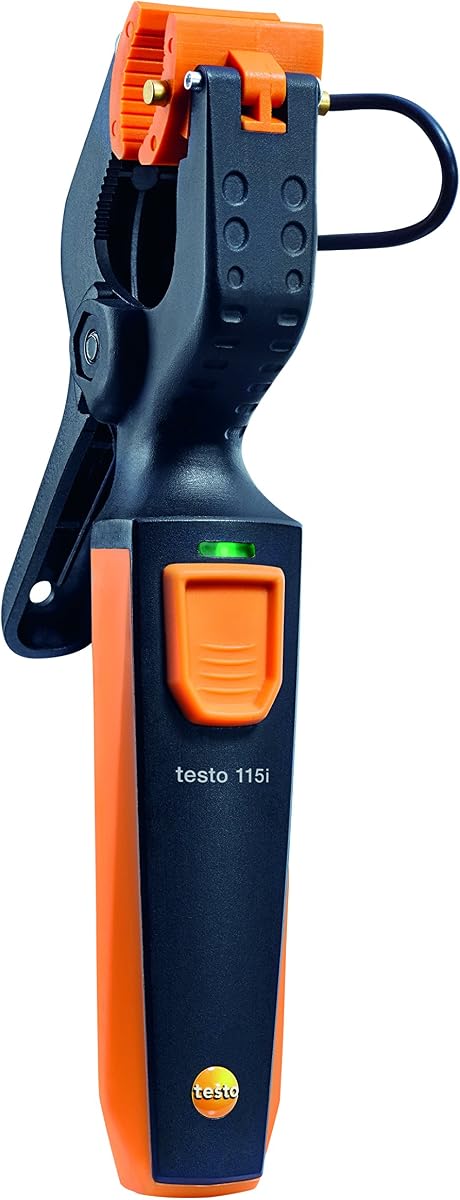
The testo 115i stands apart as a connected, professional HVAC thermometer designed around mobile documentation. Its 4.6 rating is among the strongest in the group, and its key advantage is not merely the pipe clamp but the ability to display, store, graph, and export measurements through compatible mobile devices.
We may earn a commission when you buy through this link, at no additional cost to you.
The instrument measures from -58°F to 302°F and grips pipes up to 1.5 inches. Its NTC temperature sensor technology is described as delivering fast, accurate readings and as more accurate than thermocouples within this product's intended application. It is built for in-pipe measurements in heating and cooling systems, where consistent attachment and rapid results are essential.
Bluetooth integration is the defining feature. Readings can be viewed on a smartphone or tablet, graph history can be reviewed, and measured values can be stored and documented. The supplied information also notes that data can be displayed and saved in PDF and Excel files, which can simplify recordkeeping and reduce the manual work involved in creating service reports.
Compared with a standalone clamp, the testo 115i asks more of the user in terms of device pairing and app workflow, and it occupies a higher cost category. It is most valuable when documentation is part of the job, such as troubleshooting, commissioning, maintenance history, or customer reports. A technician doing a single quick line check may find a simpler digital clamp more direct.
This is our Best Premium recommendation for service professionals who want temperature readings connected to a repeatable digital record. It suits HVACR contractors, commissioning teams, and maintenance departments that value mobile access, exportable files, and fast NTC-based pipe measurements over the lowest possible equipment cost.
Bluetooth graphing and mobile storage transform isolated temperature readings into a documented sequence. PDF and Excel export also gives offices a practical way to retain, review, and communicate results after a field visit.
The 1.5-inch pipe capacity and NTC sensor technology support common heating and cooling line checks. Rapid readings help technicians move through a diagnostic sequence without waiting for the measurement to stabilize.
We may earn a commission when you buy through this link, at no additional cost to you.
The K-Type Temp Clamp Probe is a straightforward sensor accessory with a perfect 5.0 listed customer rating, the highest rating in this guide. It offers a -40°F to 392°F range, a 32.7-inch cable, and a 1.8-inch opening, giving it useful capacity for HVAC, laboratory, workshop, and industrial pipe-temperature tasks.
We may earn a commission when you buy through this link, at no additional cost to you.
Because it works with multimeters, clamp meters, and thermometers that accept Type-K probes, it can fit into an existing diagnostic setup without a dedicated meter body. The 32.7-inch flexible lead gives the user room to clamp the sensor onto a line while keeping the connected instrument visible, and the quick-release mechanism supports fast attachment and removal.
Stable direct contact is the clamp's main purpose. A firm grip against a pipe or tube helps keep the thermocouple in position during the reading, reducing the chance that movement will cause an inconsistent result. The stated 1.8-inch opening can accommodate a range of pipe sizes, although users should still confirm the dimensions of the lines they expect to measure.
There is no integrated screen, wireless connection, alarm, or data export, and no numerical accuracy is stated in the supplied description. As a sensor-only product, its actual measurement performance depends on the connected meter, thermocouple inputs, cable condition, and installation. The 5.0 rating is encouraging, but it should not be interpreted as a guarantee of total-system accuracy.
This is our Best Budget pick for technicians who already own compatible Type-K equipment or need an inexpensive second pipe sensor. It is also a practical choice for workshops and maintenance teams that want a removable clamp without a dedicated display. Verify input compatibility, meter range, and pipe dimensions before ordering.
The probe works with any listed device that accepts Type-K connections. This makes it a straightforward way to add pipe-contact measurement without replacing an entire meter or carrying a separate integrated thermometer.
The 32.7-inch cable provides useful working distance between the sensor and the meter. Technicians can reach a concealed line while keeping the display at a comfortable angle for reading.
We may earn a commission when you buy through this link, at no additional cost to you.
This dual-channel thermocouple meter combines a digital thermometer, two wired probes, and two pipe clamps. Its 4.0 rating places it near the lower end of the group, but the feature set is substantial for HVAC, food service, laboratory, kiln, and manufacturing work. The two-channel design and alarm function make it particularly useful when two temperatures need to be watched independently.
We may earn a commission when you buy through this link, at no additional cost to you.
The meter has a listed range of -328°F to 2501°F, or -200°C to 1372°C, but the included sensors have their own limits. Users must treat the meter range and sensor range as separate specifications. The package supports dual readings, differential temperature calculations, and interchangeable probes, allowing the instrument to be adapted to different measurement positions.
A high and low temperature alarm provides a clear way to monitor conditions without watching the display continuously. Data hold, maximum, minimum, and average functions help preserve important readings during a test. The inclusion of ADJ compensation offers a calibration-related control, while automatic power-off and the ability to cancel that function add flexibility for different service habits.
The product's 4.0 rating indicates that customer experiences are less uniformly favorable than the leading products in the guide. The listing also uses broad application language, including cooking, kilns, laboratories, and industrial processes. Such uses may be possible with the meter, but the appropriate probe, temperature range, and process requirements must be verified for each scenario.
Choose this model when a technician wants a complete dual-channel thermocouple kit with clamps, wired probes, alarms, and differential measurement in one package. It is a stronger fit for users who value the included accessories and monitoring functions than for those who want a compact dedicated pipe clamp or a fully documented app workflow.
The two channels permit simultaneous measurements and differential calculations, reducing the need to swap sensors manually. That makes the meter more practical for comparisons and processes where one reading is expected to change relative to another.
High and low alarms draw attention when a value leaves a user-defined range. This is useful for monitoring trends, while data hold and maximum, minimum, and average functions help retain the results of each test.
We may earn a commission when you buy through this link, at no additional cost to you.
The right temperature clamp depends on the meter you already own, the lines you routinely inspect, the accuracy documentation you need, and whether your workflow requires alarms, multiple channels, wireless operation, or app-based recordkeeping.
In short, choose a standalone model for immediate readings or an accessory model when expanding compatible existing equipment.
Match the actual clamp range to the intended pipes, and treat the main-unit range as a separate specification.
Verify connector, input type, and adapter requirements before ordering any probe-only model.
Confirm jaw capacity, sensor placement, and available working room around the pipe.
Evaluate accuracy across the full sensor-to-display chain, especially when using a separate meter.
Choose multiple channels and alarms for comparisons or sustained monitoring; keep a simple clamp for routine spot checks.
Prioritize documented connectivity only when records, graphs, or exports are central to your workflow.
Prioritize clear controls, stable attachment, battery awareness, and durability over decorative extras.
Before taking a reading, inspect the clamp, cable, display, and connectors. For a thermocouple accessory, confirm that the meter is powered, set to temperature mode, configured for the correct thermocouple type, and connected through the proper adapter. Clean the pipe surface and let it reach a stable condition. Secure the clamp so the sensor maintains broad, direct contact without crushing or deforming the line.
Read the value on the display and wait for it to stabilize. Use the unit controls to select Celsius or Fahrenheit, illuminate the backlight, rotate the display when necessary, or activate a hold function if supported. For a dual-channel meter, label the two positions clearly and note whether the displayed difference is T1 minus T2 or T2 minus T1. If alarms are configured, make sure the threshold values are appropriate before relying on them.
After the diagnostic, switch off the instrument, remove the clamp, and compare the pipe reading with the expected system behavior and other relevant measurements. Coil sensor cables loosely rather than sharply, keep thermocouple connections dry and free of debris, and replace batteries before prolonged storage. A dedicated case helps protect the display and clamp, while routine checks of jaw tension, cable insulation, and sensor contact help preserve dependable performance.
A temperature clamp measures the surface temperature of a pipe while remaining attached to the line. It is commonly used during refrigerant charging, superheat and subcooling checks, boiler inspections, and general system troubleshooting. Because the clamp maintains contact, the technician can read the value without holding a probe against the pipe, which is helpful in crowded equipment areas.
A K-type clamp is a sensor that requires a compatible meter, while a built-in digital thermometer has its own display, controls, and power. The accessory approach can be convenient for technicians with a suitable meter already in their toolkit. A standalone instrument is usually easier for quick checks because it reduces setup and avoids connector compatibility concerns.
Check the input labels and manual for the digital meter or clamp meter you plan to use. Most HVAC products in this guide use Type-K, but some universal meters also support J, T, E, R, S, and N. The clamp and meter must use compatible sensor types, and any required banana plug or proprietary adapter must be included or available separately.
The selected clamp should open wide enough to contact the pipe fully and remain stable without slipping. Listed jaw capacities vary from one-quarter inch to 1.5 inches for the UEi ATTPC3, while several thermocouple clamps have a 1.8-inch opening. Always compare the manufacturer's dimensions with the smallest and largest lines in your typical service workload.
No. These products are normally attached temporarily during a test. A spring clamp or screw-style jaw grips the pipe and can be removed when the reading is complete. Permanent installation would generally call for a dedicated surface or process-temperature sensor designed and rated for long-term attachment.
You can use a compatible clamp across both applications when its operating range covers the temperatures involved. Many products cover approximately -50°C to 150°C or -40°C to 200°C, which supports many cooling and heating pipe checks. Always verify the clamp's stated limits, the connected meter's range, and the system's expected operating temperatures before relying on a result.
Wireless clamps can be easier to position when a cable would obstruct access or become tangled around fittings. They may also leave more room for the user to move around the equipment. Wired thermocouple accessories can be more universally compatible with existing meters and may provide a clearer connection path, so the better choice depends on the tools and documentation workflow already in use.
Clean the contact area, attach the clamp firmly, and allow enough time for the displayed value to stabilize. Avoid readings taken immediately after a pipe has been physically disturbed or before the system has reached a steady condition. For important checks, compare the result with a known reference, confirm the correct sensor type and unit, and record the measurement location for future troubleshooting.
The Digital K Type Thermocouple Thermometer is the strongest all-around package for technicians who value two channels, included clamps, wired probes, alarms, and differential readings. The K-Type Temp Clamp Probe is an economical sensor choice for professionals who already have compatible Type-K equipment, while the testo 115i is the premium option for connected measurements, mobile trend review, and exportable service documentation.
Prioritize the details that match your actual workflow. A standalone digital model is convenient for immediate readings, a Type-K clamp accessory can expand an existing meter setup, and a dual-channel instrument is more useful when two locations or temperatures must be compared. Pipe diameter, sensor range, connector compatibility, and required documentation should take priority over secondary menu features.
Product availability, included accessories, specifications, and selling prices can change over time. Before purchasing, confirm that the clamp fits the lines you service, the measurement range covers expected conditions, and any required meter or adapter is compatible. Checking the latest listing details will help ensure that the selected temperature clamp is ready for the job at hand.