
E-outstanding Heating Assist Repair Tool
4.7Editor score
Six double-sided assist tools
Carbon steel working ends
Twelve common repair functions
Our soldering assist tools guide compares 10 double-sided picks, tweezers, and helping-hand stations for precision electronics repair, PCB work, and clean
Soldering assist tools make delicate electronics work steadier by helping position components, control hot solder, clean boards, and hold small parts in place. The most useful products combine durable working ends, comfortable handles, and enough tip variety to handle common PCB repair, assembly, and desoldering tasks.
We compared the ten products in this guide by examining their included components, tip functions, construction, handling features, and stated repair applications. The list covers handheld double-sided assists, precision tweezers, and magnifying helping-hand stations for different workspace and project requirements.
Each review identifies the product's strongest contribution, along with any practical limitations visible in its specifications. Ratings reflect the supplied customer feedback where available, and product availability, configurations, and prices can change, so readers should verify current details before buying.
4.7Editor score
4.7Editor score

4.5Editor score
This side-by-side comparison highlights each kit's core format, included accessories, working-tip construction, and most useful application so readers can distinguish handheld assists from precision tweezers and magnifying helping-hand stations.


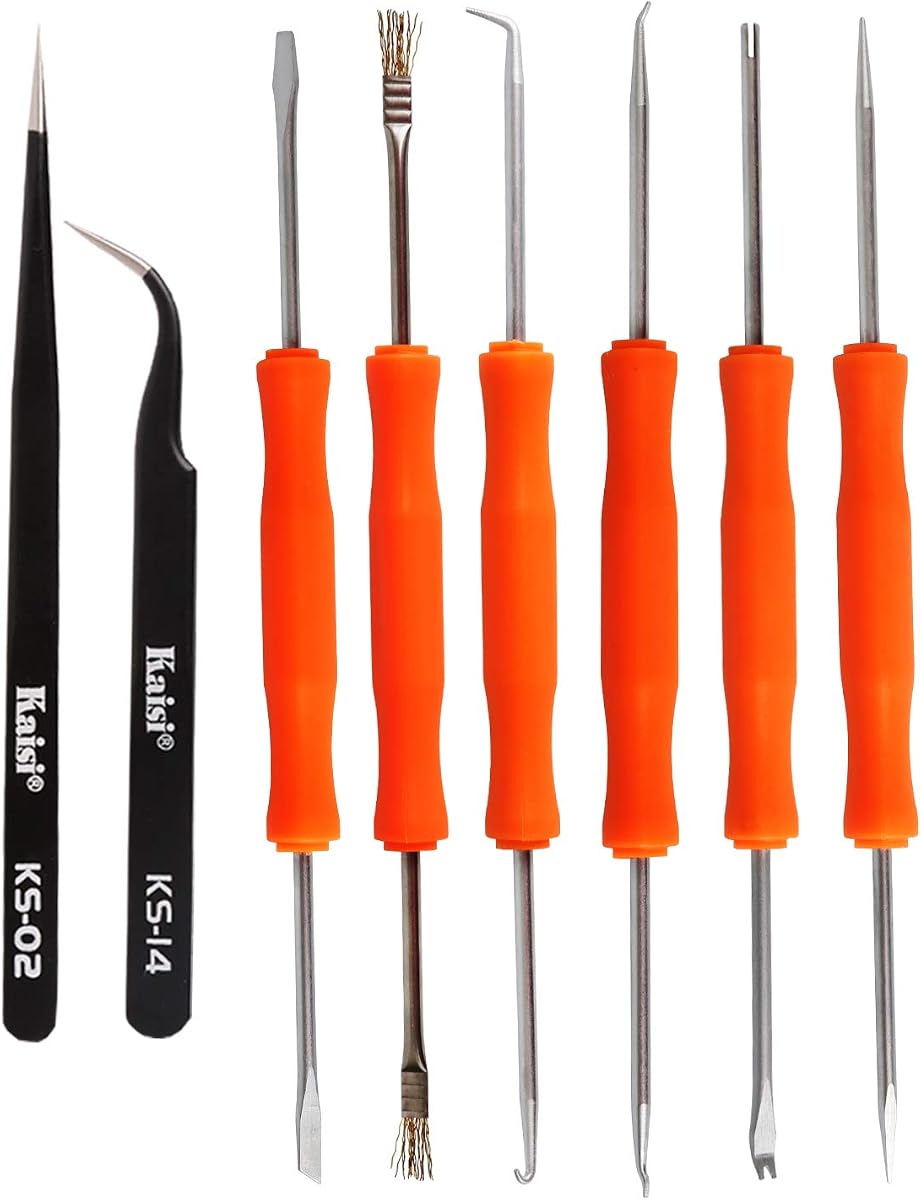
This is the strongest all-around soldering assist set in the group because it combines six double-sided tools with two precision tweezers. Its 4.7 rating reflects positive customer feedback, while the stated tip capabilities cover pressing, cutting, scraping, hooking, and brushing. That mix gives it broader usefulness than a product designed around only one or two common repairs.
We may earn a commission when you buy through this link, at no additional cost to you.
The specially hardened working ends are intended to control solder while it remains hot and to assist with other heat-adjacent operations. Ergonomic handles are also highlighted, which is important because an assist tool often functions as a third hand during repetitive board work. The included tweezers are described as stainless steel, anti-acid, anti-corrosion, non-magnetic, and non-sticky, with precision-machined tips for handling small components.
The main trade-off is that this is a collection of individual implements rather than a magnifying station with fixed arms. Users must choose the correct tip for each operation and may need to organize the eight pieces to keep them readily accessible. Also, the set does not include a soldering iron, magnifier, work light, or dedicated board holder, so it complements rather than replaces those tools.
It is a practical recommendation for hobbyists, students, repair technicians, and anyone who wants one portable kit for general PCB work. The combination of multiple double-ended assists and finely aligned tweezers covers positioning, lifting, cleaning, and detailed handling without requiring several unrelated accessories. For broad functionality at a manageable entry point, this set is the guide's most complete handheld choice.
Rather than limiting users to a single pick or hook, the six double-sided tools cover several common workshop operations. The two precision tweezers add another way to position tiny parts, making the package useful for board assembly, desoldering, jewelry projects, and general electronic maintenance.
The stainless steel tweezers are specifically described as anti-static-compatible through their anti-static properties, corrosion resistance, and precision-machined alignment. They can hold small items while both of the operator's hands remain occupied with the iron or another repair tool.
We may earn a commission when you buy through this link, at no additional cost to you.
This 12-piece package is built for users who want a soldering station's essential hand helpers gathered in one set. It includes six double-sided soldering assists, five precision tweezers, and a blue flush cutter. The supplied 4.5 rating is favorable, although it does not place the product above the highest-rated kits in this guide.
We may earn a commission when you buy through this link, at no additional cost to you.
Its defining advantage is the wire cutter. The cutter is made from stainless steel and is described as hardened through heating and quenching, with induction hardening intended to preserve the sharpness of its cutting edge. The five tweezers provide multiple options for holding components, while the assist tools support pressing, scraping, hooking, and related precision operations.
That many accessories can create storage and selection challenges. Five tweezers may be helpful for users who work with different component sizes, yet the need to distinguish similar pieces at the bench is less convenient than a smaller specialized set. The package also does not provide magnification, flexible holding arms, or illumination, which are important for very small board work.
Choose this kit when your projects span soldering, desoldering, light wire trimming, jewelry making, stamping, and precision electronic repair. It is especially useful for a technician building a broad portable toolkit rather than optimizing one narrow function. The extra cutter and multiple tweezers make it more versatile than many simple six-tool assortments, provided the collection is kept organized.
A flush cutter gives the kit a useful capability beyond positioning and component handling. Its stated heat treatment and induction hardening are intended to maintain cutting performance, making it more convenient than stretching a soldering assist tip to trim thin wire.
Five precision tweezers offer more gripping options than most handheld kits in the comparison. They can support the fine positioning required for precision components, electronics maintenance, jewelry making, and other detailed craft or repair work.
We may earn a commission when you buy through this link, at no additional cost to you.
This compact kit combines six double-sided soldering assists and two precision tweezers in an orange and black color scheme. No customer rating is supplied, so the strongest basis for evaluation is its documented configuration and intended use. It is especially relevant to PCB assembly, desoldering, jewelry making, and repair of mobile phones, radios, televisions, and headphones.
We may earn a commission when you buy through this link, at no additional cost to you.
Each assist has two working ends, allowing users to move between pressing, cutting, scraping, hooking, and brushing without replacing the entire tool. The working tips are described as hardened for durability, while the handles are shaped for a secure grip during small-component work. The tweezers provide a second means of controlling tiny parts or lifting items from a crowded board.
A limitation is that this product does not offer a magnifier, flexible third-hand arms, or a light. Those features can make a major difference when inspecting solder joints under magnification, but they are not necessary for every repair. The absence of a supplied rating also means buyers cannot use its feedback history as a direct quality signal.
This set is a sensible option for mobile-device repair, electronics hobbies, and users who value portable, easy-to-recognize implements. The orange and black handles may help separate the tools quickly on a busy bench. If those visual cues and the eight-piece format align with your needs, it offers a focused way to cover common soldering assistance tasks.
Each of the six assist implements carries two different working functions. That arrangement lets a technician keep a familiar grip while changing between scraping, hooking, pressing, cutting, or brushing actions during a repair.
The lightweight tools are described as easy to store and suitable for on-the-go repair work. Their compact format is helpful for field technicians, hobby benches with limited space, and repair kits assembled for mobile electronics.
We may earn a commission when you buy through this link, at no additional cost to you.
This six-piece set is tightly focused on electronics repair rather than broad workshop tasks. It earns a 4.4 rating and includes six carbon-steel tools with two functional ends apiece. The stated operations cover pressing, drilling, prying, cutting, scraping, hooking, pulling, and brushing, giving users a particularly broad selection of board-oriented shapes.
We may earn a commission when you buy through this link, at no additional cost to you.
The carbon steel construction is intended to provide hardness for repeated PCB soldering and desoldering work, and the black coated finish gives the tools a uniform appearance. Different tip shapes can be selected for assembly, component removal, board cleaning, hole processing, and positioning of small parts. Storing the tools together also makes the set easier to locate at a repair bench.
The trade-off is that the package does not include tweezers, a wire cutter, magnification, or helping-hand arms. Users handling extremely small components may need separate precision tools. As with any coated steel implement, the finish may eventually show marks from repeated contact with solder, flux, and work surfaces, so care matters during storage.
This set is a good fit for PCB builders, electronics repair hobbyists, and technicians who want dedicated working shapes at hand without carrying a larger mixed toolkit. Its strongest case is the range of double-ended functions within a compact six-piece format. Choose it when board assembly, desoldering, cleaning, and component positioning are the primary parts of the job.
The varied working ends cover jobs that often require different contact points, from scraping residue to nudging a component into alignment. Switching ends while retaining a similar handle position can improve workflow on crowded boards.
Carbon steel provides the hardness the manufacturer cites for repeated soldering and desoldering applications. The black coating helps the implements appear consistent as a set and can be wiped clean between carefully controlled bench tasks.
We may earn a commission when you buy through this link, at no additional cost to you.
This is the largest collection of double-headed handheld soldering assists in the comparison, with twelve tools rather than the six commonly offered by the other pick sets. No customer rating is supplied, but the product descriptions clearly identify the included shapes: scraper, awl, brush, fork, hook, and presser bar.
We may earn a commission when you buy through this link, at no additional cost to you.
Two length specifications help distinguish the implements. The scraper, awl, fork, hook, and presser bar are listed at 165 millimeters, or 6.5 inches, while the brush is 185 millimeters, or 7.28 inches. That longer brush may be useful for reaching across a board or cleaning a wider area, while the double working ends let users change tasks without changing grip.
The shaped handles are intended to provide steady control when positioning, lifting, or adjusting parts. Nevertheless, twelve similarly categorized tools can be cumbersome to organize, and this set does not include precision tweezers, a wire cutter, a magnifying lens, or a holder. Users may need to pair it with other bench accessories for complete micro-soldering setups.
The set is most appropriate for electronics enthusiasts and repair technicians who repeatedly perform varied board tasks and prefer having multiple copies of familiar shapes. It can also help prevent tool swapping when several similar operations occur in succession. For a user who wants a focused set of six pieces, another kit in this guide may be easier to manage.
Having twelve implements allows multiple tip shapes to remain within easy reach during a repair session. This can be useful in a busy workshop where brushes, hooks, and positioning picks are repeatedly needed for different circuit-board tasks.
The stated dimensions distinguish the longer brush from the other working tools. Reach may be valuable on larger boards, while the common length of the remaining implements can support consistent handling on smaller assemblies.
We may earn a commission when you buy through this link, at no additional cost to you.
This professional-style set pairs six double-sided soldering auxiliary tools with two stainless steel ESD tweezers. Its 4.5 rating indicates solid customer feedback, and the package is aimed at electronic maintenance, precision components, soldering, grinding, desoldering, and detailed DIY work.
We may earn a commission when you buy through this link, at no additional cost to you.
The anti-static tweezers are the standout feature for users concerned about handling sensitive parts. They are described as anti-static and non-sticky, while their precision form supports picking up small objects and working around circuit boards. The six assist tools cover stamping, cutting, scraping, hooking, brushing, and related repair operations.
The product still lacks a magnifying lens and flexible holding arms, so it may need to be combined with a helping-hands station for very fine work. The supplied information offers fewer details about the assist handles and working-tip materials than some competing listings. That makes it harder to compare fine details such as grip texture or exact tip geometry before purchase.
It is a solid choice for mobile-phone motherboard work, headphone repair, radios, televisions, stereos, toys, and other electronics. Buyers particularly concerned about component handling may appreciate the explicitly ESD-oriented tweezer pair. Compared with basic pick sets, the additional tweezers create a more complete and specialized repair package.
Anti-static and non-sticky tweezers can provide a controlled way to lift or position delicate parts. The properties are particularly relevant when working around precision electronic assemblies where residue or uncontrolled handling could interfere with a repair.
The six double-sided tools are intended for stamping, cutting, scraping, hooking, and brushing. Together, they cover several stages of board repair and general soldering assistance without requiring a separate implement for each basic operation.
We may earn a commission when you buy through this link, at no additional cost to you.
The E-outstanding set offers an effective balance of tip variety, customer feedback, and a focused six-tool format. Its 4.7 rating ties the highest rating among products with a supplied score. Each of the six double-sided tools consolidates multiple operations, making the set more versatile than a collection of single-ended picks.
We may earn a commission when you buy through this link, at no additional cost to you.
The listed functions include pressing, drilling, prying, cutting, scraping, hooking, pulling, and brushing, as well as stamping and similar maintenance actions. Carbon steel construction and a black finish support durability and consistent handling. The tools are specifically described for PCB assembly, maintenance, cleaning, component removal, replacement, and hole-surface work.
This is a handheld repair set rather than a complete visual workstation. It contains no tweezers, illuminated magnifier, flexible arms, or clip-on board holder. Users working with extremely small surface-mount parts may need at least one of those additional tools, and the lack of tweezers makes the overall package less versatile than the Kaisiking and Professional 12-Piece options.
It is an appealing recommendation for electronics hobbyists and technicians who want many common tip functions without purchasing a large assortment. The high rating, durable construction, and compact format make it especially useful for general PCB maintenance. Choose it when the priority is functional tip coverage and dependable handheld assistance rather than magnification.
Each double-ended implement concentrates several common repair actions into one handle. This arrangement provides useful versatility while keeping the collection small enough for straightforward storage and transport.
The stated applications directly support component replacement, board cleaning, and assembly work. These are practical tasks for anyone maintaining mobile electronics, radios, or other compact circuit assemblies.
We may earn a commission when you buy through this link, at no additional cost to you.
The Kaisiking Helping Hands station is a substantially different type of soldering assist tool. Instead of handheld picks, it provides four flexible metal arms, four alligator clips, and a 2.5-times magnifying glass on a weighted steel base. Its 4.5 rating makes it one of the stronger-rated purpose-built stations in the comparison.
We may earn a commission when you buy through this link, at no additional cost to you.
The arms are each described as 8.34 inches and locked to the base with screws. Alligator clips rotate through 360 degrees so they can approach a workpiece from useful angles, while rubber boots help avoid scratching polished jewelry and may reduce the likelihood of short circuits. The rectangular steel base measures 7.87 by 5.51 inches and is supported by five anti-slip pads.
The product listing includes a specific adjustment note: users should turn the rotating arm counterclockwise, opposite the screw-tightening direction, when repositioning it. This helps the arm remain secure and addresses loosening concerns mentioned in reviews. Even so, a multi-arm station occupies more space than a compact hand-tool set, and the magnifier must be placed carefully around the work.
This station is ideal for jewelers, electronics hobbyists, and repair workers who regularly need both hands free. It can hold a workpiece while the magnifier enlarges fine details, reducing the need to hunch over a tiny joint. For compact, portable repair work, a handheld set may be easier; for a permanent bench, the stability and four-clip layout make this an excellent choice.
Four independently adjustable clips allow several parts of a project to remain in position at once. This is useful when the job requires holding a board, positioning a wire, and stabilizing another small component while both hands remain available.
The 2.5-times lens enlarges tiny solder joints and component markings for closer inspection. It is a meaningful improvement over working from a sharply angled bench view, particularly for delicate electronics and jewelry assembly.
We may earn a commission when you buy through this link, at no additional cost to you.
The AORAEM station is a compact magnifying helper designed around two alligator clips and a 2.5-times glass lens. Its 4.4 rating is slightly below the leading products, but the configuration is attractive for users who need a stable third hand without a large multi-arm footprint.
We may earn a commission when you buy through this link, at no additional cost to you.
Both clips use four-way swivels and can be adjusted to different angles, while the lens rotates a total of 360 degrees to position the view where it is needed. The cast-iron base is described as heavy and stable, helping prevent movement when a small craft project, circuit board, or other light workpiece is clipped in place. The lens has a stated diameter of 63 millimeters.
Compared with the four-arm Kaisiking station and illuminated five-times model, this product provides fewer holding points and no integrated light. That limits its usefulness for very dim workbenches or complicated assemblies that need several objects stabilized. It also cannot match the higher magnification offered by the illuminated station.
It works well for soldering, circuit-board repair, jewelry design, sewing, crafts, inspection, and other detailed tasks. Choose it when a compact, stable magnifier and two flexible clips are sufficient. Its value lies in bringing the workpiece and inspection lens into a more useful position without occupying as much space as a four-arm station.
The cast-iron base is intended to resist movement while the clips hold a workpiece. That stability is valuable when the operator is applying heat or working with very small parts and cannot easily steady the project by hand.
The 360-degree rotating lens can move away from the clips or swing toward the operator's preferred line of sight. This flexibility makes the station useful for inspection, soldering, jewelry work, and other close-detail tasks.
We may earn a commission when you buy through this link, at no additional cost to you.
The illuminated Helping Hands station is the most visually capable product in the guide, combining four flexible arms with a 5-times magnifying glass and an integrated LED light. Its 4.5 rating is solid, and the combination of magnification, lighting, and multiple holding points targets detailed electronics, crafting, assembly, and jewelry work.
We may earn a commission when you buy through this link, at no additional cost to you.
The magnifier offers ten brightness levels and three light colors: white, warm, and yellow. Those settings can adapt to different tasks, while the stated five-times magnification enlarges tiny components for closer work. Each alligator clip rotates 360 degrees and is positioned on a flexible gooseneck arm, allowing users to place components in several locations around the base.
The 9.76 by 8.07-inch painted steel base is larger than those of the other stations and is supported by four non-slip rubber pads. Its size improves stability while also taking up more bench space. The lighting and adjustable magnifier add mechanical complexity, and users still need to position the arms carefully around the workpiece.
This station is best for technicians, jewelers, model builders, and serious hobbyists who work on very small parts and want the clearest view available in this comparison. It is less necessary for simple through-hole soldering or occasional repairs. When magnification, illumination, and four flexible holding points can solve several problems at once, however, it offers the strongest integrated workstation.
The built-in LED system addresses two common obstacles at once: seeing tiny joints and inspecting them without shadows. Adjustable brightness and three color choices offer more control than an unlit magnifier for different bench conditions.
Four independently positionable clips can stabilize a PCB, leads, tools, or small craft components. The screw-locked arms and rotating clips make it possible to create a practical arrangement without asking a colleague to hold the workpiece.
We may earn a commission when you buy through this link, at no additional cost to you.
The right soldering assist tool depends on the kind of work you perform, the components involved, and whether you prioritize portable handling, magnification, lighting, or a complete set of precision accessories.
Handheld double-sided tools are portable, quick to retrieve, and well suited to scraping, hooking, cleaning, positioning, and other tasks performed directly beside an iron. Helping-hand stations are larger but keep a PCB or small assembly fixed while magnifying and, in some models, illuminating it. Choose handheld picks when workspace is limited and your repair sequence involves frequent tool changes. Choose a station when you need both hands, want a stable workpiece, or regularly inspect very small joints.
Double-ended tools offer several useful functions without multiplying the number of handles in your kit. Look for clearly defined shapes such as a scraper, hook, fork, awl, brush, presser, cutting edge, prying edge, or puller. The value of a tip depends on your typical work: cleaning benefits from a brush or scraper, component placement benefits from a fine hook or fork, and removing parts may require a prying or pulling shape.
Carbon steel and hardened working ends are common choices because they can withstand repeated contact during soldering and desoldering tasks. A coated finish can help tools look consistent and may simplify wiping between jobs, but it does not replace proper care. Users should avoid striking brittle tips, forcing them into components, or using them as general-purpose pry bars. For demanding repair schedules, durability matters more than owning a large number of nearly identical implements.
Precision tweezers are essential when a part is too small to position reliably with a soldering-assist pick. Look for straight, carefully aligned tips and useful properties such as anti-static construction, corrosion resistance, and low residue or sticking. The guide includes kits with one, two, or five tweezers, reflecting different levels of specialization. A stainless steel ESD pair can be valuable for motherboard work, while a larger collection may help users who work with varied component sizes.
A 2.5-times lens is useful for general close inspection, while a 5-times lens provides a larger view of tiny solder joints and component markings. Illumination is especially valuable in enclosed electronics cases or on cluttered benches. When comparing stations, consider whether the lens can rotate independently and whether its focal position stays comfortable during extended work. A well-positioned 2.5-times magnifier may be more useful than a stronger lens placed awkwardly.
A helping-hand station should remain still while the workpiece is heated, clipped, and inspected. A weighted metal or cast-iron base reduces movement, while non-slip pads protect the bench and improve stability. The larger base on the illuminated station provides room for four arms and more even support, but it occupies more space. Smaller stations are easier to store and reposition, although they may offer fewer clips and less margin around the work area.
Alligator clips should rotate to the angle required by the project, and flexible arms should hold their position after adjustment. Rubber boots can reduce scratches on polished surfaces and help avoid direct metal contact that could contribute to a short circuit. Also consider whether two clips are enough for the task. Two-arm stations suit simple single-board work, while four-arm stations can hold a board, wires, and multiple small components at once.
Small handheld kits are easier to organize, transport, and use across multiple locations. Larger mixed sets provide more functions but create more selection and storage demands. A simple case, labeled compartments, or a dedicated tool roll can keep sharp tips from contacting one another. Frequent mobile technicians may favor compact eight-piece kits, while users who remain at one bench can benefit from a station and a separate collection of handheld implements.
Before beginning a repair, organize the selected implements by function and inspect each tip for bends, nicks, or loose damage. Place helping-hand stations on a level surface and tighten the arm screws while the workpiece is supported. Position the PCB or component where it will not rest against a hot iron, and adjust the magnifier and light before applying heat rather than moving them around a live soldering area.
Use a double-ended assist tool only for the operation its tip is designed to perform. A hook can guide a wire, a scraper can remove residue, a fork can hold a component, and tweezers can provide light placement. Keep the iron and assistance tools moving only when the specific task requires it, maintain a safe distance between hot working ends, and never use a precision tweezer as a lever against a component that could be damaged.
After use, allow hot tools to cool in a safe location, then wipe removable solder and flux from working ends with an appropriate method. Do not plunge a hot implement into solvent or cold water. Store dry handheld tools in a compartmented container, keep metal tips from colliding, and wipe the station base and clips as needed. Periodically check arm tension, screw security, rubber feet, clip boots, and magnifier movement so the tools remain dependable for the next job.
A soldering assist tool is a hand implement or workstation that helps control components, solder, tools, or the workpiece while an iron is in use. Double-ended picks commonly provide scraping, hooking, pressing, cutting, prying, pulling, or brushing functions. Helping-hand stations add adjustable clips and often magnification or lighting for detailed work.
They are designed to assist with hot-soldering tasks, but users should still maintain a safe distance between hot tips and non heat-resistant handles. Keep the tool moving when its intended use requires it, and place heated implements on a proper surface to cool. Do not use tweezers or delicate tips to force a component in ways that could damage the board.
Precision tweezers are highly useful when placing small surface-mount parts, removing tiny components, or working with wire leads. The guide includes sets with two or five precision tweezers for this reason. If your work mostly involves scraping, cleaning, or larger component positioning, a set without tweezers may be sufficient, but it will be less versatile.
A helping-hands station is better when you need to stabilize a PCB, inspect a joint under magnification, or keep both hands available. Handheld picks are better for portable work, rapid tool changes, and detailed scraping or prying. Many technicians use both categories because stations hold the project while picks perform the fine manipulation.
The 2.5-times magnifiers in this guide provide close inspection for many components and solder joints. The 5-times illuminated option offers greater enlargement for very small parts and dense boards. Magnification should be paired with correct positioning and adequate lighting to reduce eye strain and improve inspection accuracy.
Position the arm while supporting it, then tighten the relevant screws firmly without forcing the mechanism. The Kaisiking station's instructions specifically recommend turning its rotating arm counterclockwise during adjustment, opposite the tightening direction, so the arm tightens rather than loosening. Check the screws periodically during use, especially when the arms carry noticeable weight.
The most useful assortment includes a scraper for board cleaning, a hook or fork for positioning, a brush for debris removal, and a presser or prying end for component work. Some kits also provide cutting, pulling, drilling, or awl shapes. Choose according to your usual tasks rather than simply selecting the set with the longest printed feature list.
No. Soldering assist tools support the operator by holding, positioning, cleaning, or inspecting the work, but they do not heat and melt solder. A soldering iron, suitable solder, and supporting supplies are still required. The best assist setup reduces fumbling and improves control while the actual soldering operation is performed.
The Kaisiking six-piece double-sided set stands out as the best overall option because it combines 4.7-rated customer feedback, hardened multi-function tips, and two precision tweezers in one portable package. The E-outstanding set delivers similar functional coverage in a focused six-tool format, while the illuminated Helping Hands station leads the group for advanced magnification, lighting, and four-arm workpiece control.
Prioritize the working functions and accessories that match your actual repairs. Portable PCB work may call for a double-ended handheld kit, extremely small components justify precision tweezers, and recurring fine-detail jobs benefit from a weighted helping-hand station. Buying only the necessary type can prevent an overcrowded bench while leaving the most important capabilities close at hand.
Product configurations, availability, customer ratings, and prices can change over time, so check the current listing before ordering. Compare the included components, tip functions, materials, magnification, lighting, and stability against the projects you expect to perform rather than relying on the number of pieces alone.