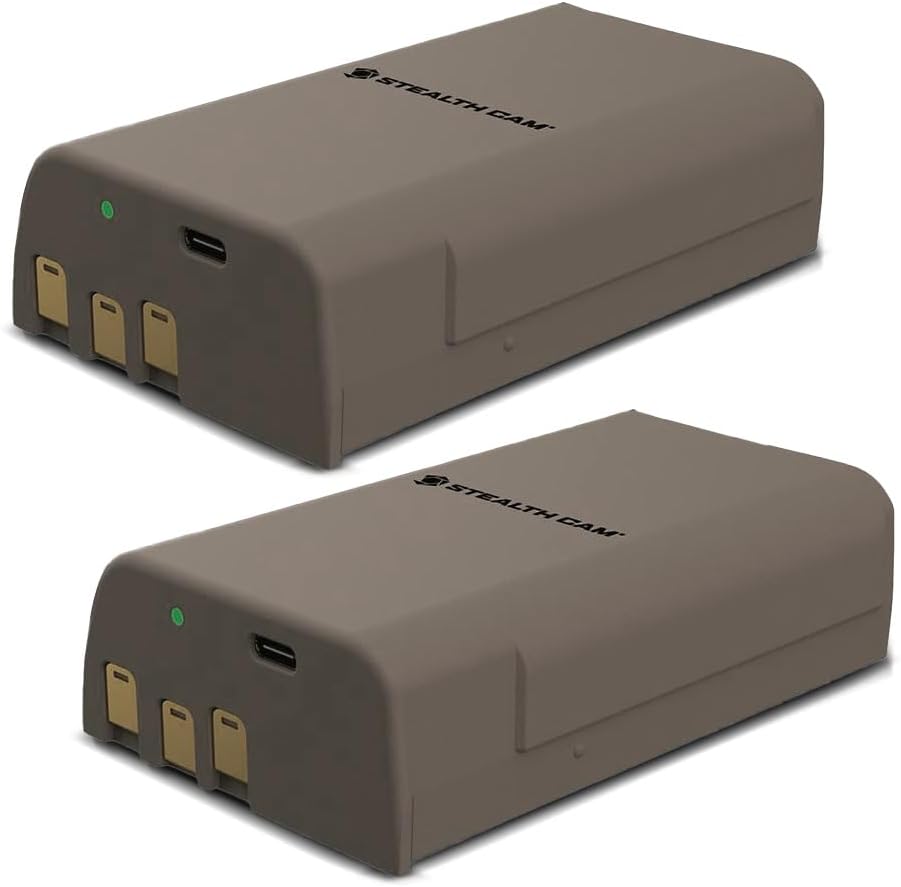
Stealth Cam FieldMax MAX-PAK
4.6Editor score
12V 5,000mAh capacity
Two battery cartridges
USB cable included
Weather-resistant construction
Compare the best rechargeable lithium batteries for trail cameras, including capacity, compatibility, charging method, runtime, and outdoor durability.
Rechargeable lithium batteries can reduce battery changes, disposable waste, and maintenance trips while keeping trail cameras ready for extended monitoring. The right pack depends on camera compatibility, usable capacity, charging convenience, cold-weather performance, and how the battery fits into a solar or off-grid power setup.
This guide compares ten relevant products using the supplied specifications, including capacity, voltage, charging options, supported camera models, and environmental features. It covers purpose-built camera packs, rechargeable AA alternatives, complete trail cameras with built-in batteries, and conventional batteries included for comparison.
Each review explains the product's strongest attributes, practical trade-offs, and ideal deployment. The three leading picks are highlighted separately, while every listed item appears in the side-by-side comparison. Product availability and prices can change, so confirm the camera compatibility and current listing details before purchasing.
4.6Editor score
4.8Editor score

5.0Editor score
The comparison below highlights the major differences in energy capacity, charging design, camera compatibility, and outdoor suitability. It also identifies the four products that are not dedicated rechargeable trail-camera batteries so readers can distinguish purpose-built options from general-purpose alternatives.


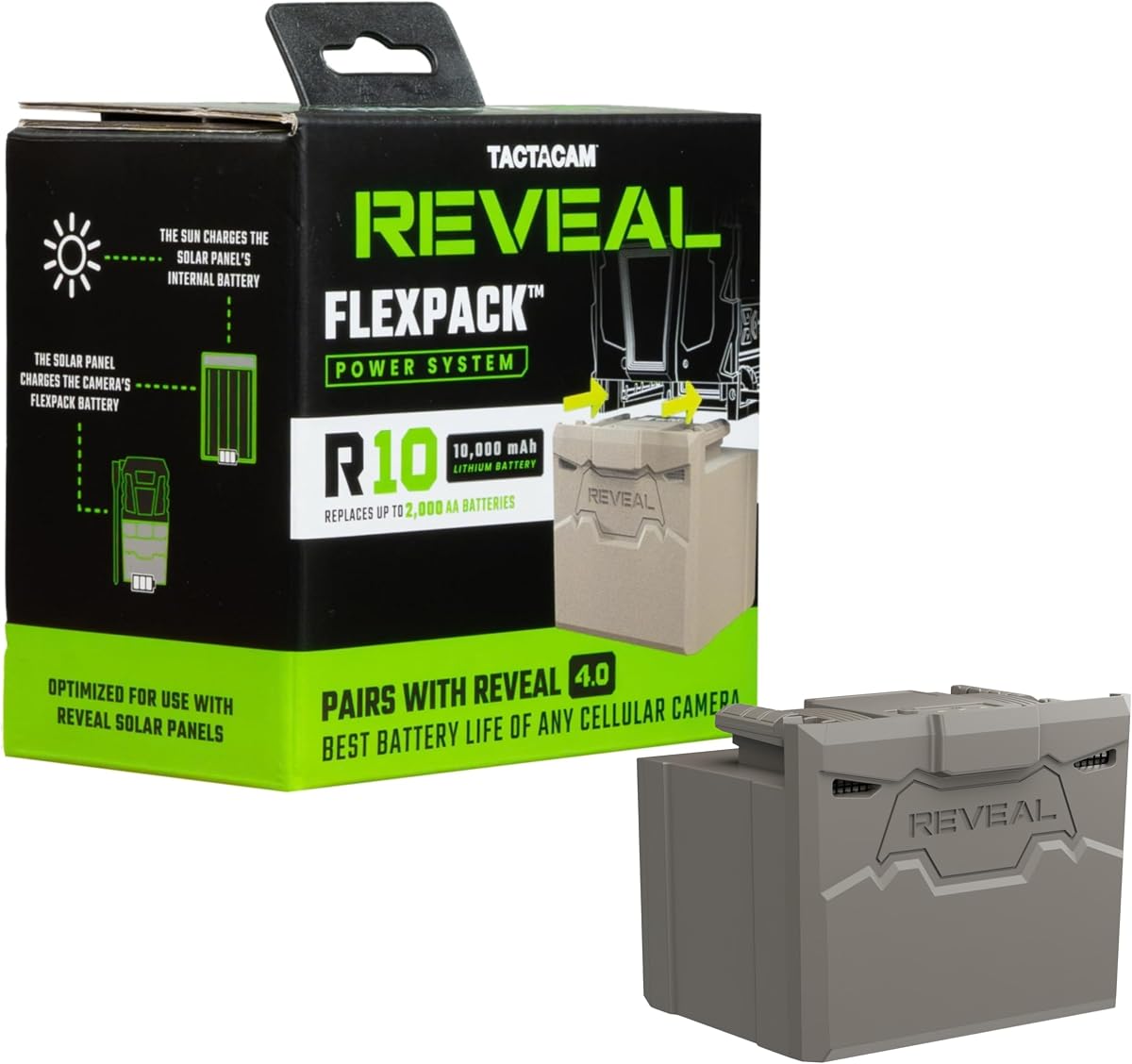
The TACTACAM Reveal FlexPack R10 is a high-capacity rechargeable lithium battery pack with a 10,000mAh rating, making it the most ambitious power product in this group. Its 4.8 rating reflects a strong customer reception, while the emphasis on extended field deployment and fewer swaps makes it particularly relevant to hunters and wildlife observers who cannot easily reach cameras.
We may earn a commission when you buy through this link, at no additional cost to you.
The standout feature is the combination of usable capacity and operational convenience. TACTACAM describes the pack as the most powerful rechargeable battery it offers for REVEAL systems. It is designed for straightforward installation and removal, which matters when a camera is mounted in an awkward location or exposed to weather. Its integration with the Solar Panel R5 and other power accessories also creates a path toward a more self-sustaining installation.
The primary trade-off is model-specific applicability. Buyers should confirm that their camera accepts the FlexPack R10 rather than assuming every REVEAL camera uses the same battery. A single-pack configuration may also be less convenient than a multi-battery kit for users who want immediate rotation between a charged and deployed pack. Nevertheless, the 10,000mAh rating and solar compatibility make this a compelling long-deployment option.
This is the strongest recommendation for owners of compatible REVEAL cameras who prioritize long intervals between maintenance visits. It is especially attractive for remote properties, extended hunting seasons, and setups where a solar panel can keep the camera's power loop active. Verify the camera model and connection, then confirm the complete power arrangement before deploying it.
The 10,000mAh capacity is designed to reduce the frequency of disposable-cell changes and physical trips into the field. That makes the R10 appealing when travel time, muddy access, or deep snow makes battery maintenance inconvenient.
Compatibility with the Solar Panel R5 and other accessories gives users a way to build a more sustainable power loop. Solar support does not eliminate the need for sound placement and weather exposure, but it can help reduce manual charging.
We may earn a commission when you buy through this link, at no additional cost to you.
The Stealth Cam FieldMax MAX-PAK is a purpose-built 12V, 5,000mAh rechargeable battery cartridge sold as a two-pack. It carries a 4.6 rating and is tailored to several Stealth Cam models, including the Flashback, Deceptor MAX, Fusion MAX, and Connect MAX. The included pair gives users an immediate rotation option.
We may earn a commission when you buy through this link, at no additional cost to you.
Its biggest practical benefit is the combination of rechargeable design and cartridge convenience. The pack charges through an included USB cable and is intended to replace the regular disposable power units used by compatible cameras. The construction is described as capable of withstanding temperature swings, a useful characteristic for wooded sites where direct sun is limited and seasonal temperatures vary widely.
Compatibility is narrower than the name might suggest. The listing identifies specific compatible Stealth Cam models, so owners of other brands or older versions should not assume this cartridge fits. The 5,000mAh rating is substantial, but the R10 carries a higher stated capacity. In this two-pack configuration, however, MAX-PAK offers the convenience of having two complete cartridges rather than relying on a single high-capacity unit.
The MAX-PAK is our premium pick for compatible Stealth Cam users who want a ready rotation pair and a straightforward USB charging process. It suits low-light woods and extended installations where disposable battery logistics are inconvenient. Match the exact camera model first, then use the two cartridges to streamline charging and field changes.
Two cartridges provide a practical advantage over a single battery: one can remain in service while the other is charged or carried as a backup. This is useful during busy monitoring periods and whenever access to the camera is limited.
The low-light positioning of this pack is noteworthy. Its rechargeable design is intended for places where solar-only alternatives may struggle, allowing users to replenish stored energy before returning to the camera.
We may earn a commission when you buy through this link, at no additional cost to you.
The LIT-10 Pro battery is a 3.85V rechargeable pack rated at 10,500mAh, or 40.42Wh, and carries a 5.0 rating. It is designed for SPYPOINT cameras including Link-Micro, Cell-Link, LM2, and Link-Micro-S-LTE models. The high rating and unusually large stated capacity make it an attractive budget-oriented choice for compatible cellular cameras.
We may earn a commission when you buy through this link, at no additional cost to you.
The pack is built to supply camera energy in the field without frequent cell replacement. Its listed specifications say it can reach a full charge within five hours, which is helpful when preparing batteries for a multi-camera deployment. A built-in smart chip supports protection against overcharging, over-discharging, over-voltage, over-current, and overheating, adding useful safeguards for repeated charging cycles.
The key limitation is compatibility, and buyers should also note that the supplied information does not specify the connector or charging protocol in detail. Its listed 3.85V profile is appropriate to the named camera models, but it should not be treated as a universal trail-camera battery. The five-star rating is favorable, though ratings should not substitute for checking the physical fit and required power standard.
This battery is our budget pick because it combines a high 10,500mAh rating with broad support among several SPYPOINT cellular models at a comparatively accessible listing. It is a strong fit for Link-Micro and Cell-Link owners who want long runtime and a five-hour recharge. Confirm the camera model and charging requirements before ordering.
At 10,500mAh and 40.42Wh, the LIT-10 Pro is among the highest-capacity products listed. That energy reserve can reduce maintenance frequency when the camera is used for still photography, time-lapse, or recording schedules that consume power steadily.
The listed over-charge, over-discharge, over-voltage, over-current, and over-heat protections are meaningful for a pack expected to cycle repeatedly. They help establish safer operating limits, although users should still use a suitable charging source.
We may earn a commission when you buy through this link, at no additional cost to you.
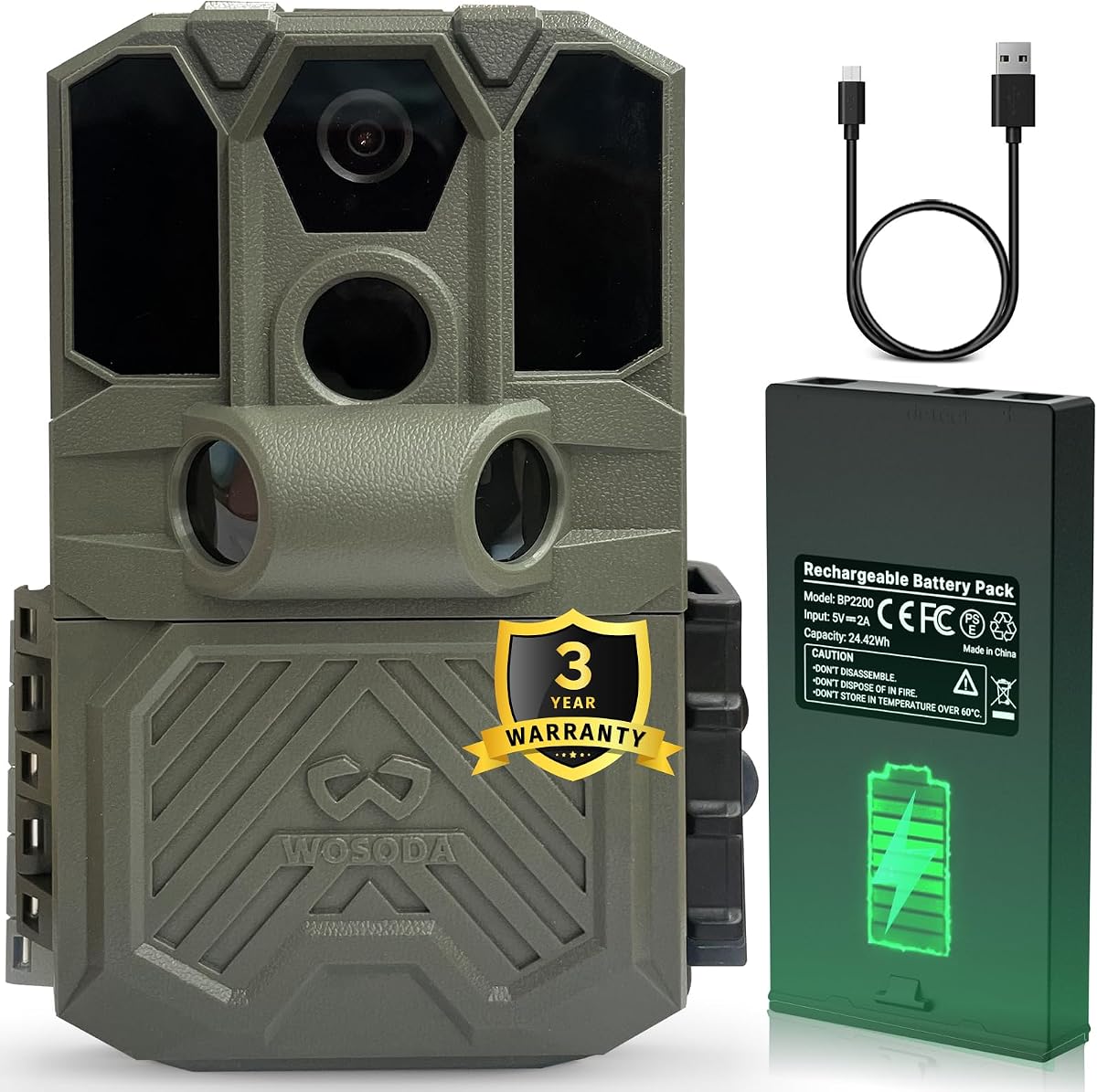
The WOSODA Rechargeable Trail Camera is not a replacement battery pack; it is a complete non-cellular, non-Wi-Fi game camera with a built-in 2,200mAh lithium battery. Its 4.3 rating and extensive feature set make it a useful alternative for buyers who want a complete monitoring solution rather than an upgrade for an existing camera.
We may earn a commission when you buy through this link, at no additional cost to you.
The removable battery must be taken out and charged separately, so users cannot recharge the entire camera while it remains mounted. On the positive side, the camera captures adjustable 8, 8, 16, 32, or 40MP still images and 2K HD video. It offers a 0.2-second trigger speed, an 80-foot detection range, a 120-degree viewing angle, and one-to-three-shot burst modes.
Its 2,200mAh battery is considerably smaller than the dedicated packs in this roundup, so runtime should not be compared directly without considering the complete camera's consumption. The IP66 housing addresses dust and water exposure, while local SD-card storage avoids dependence on cloud services. The SD card is not included, and there is no cellular or Wi-Fi connectivity.
This camera makes the most sense for a new setup that does not require remote connectivity. It avoids the need to source a separate compatible battery and gives the buyer integrated detection, night-vision, and recording features. Existing-camera owners looking for a spare pack should choose a dedicated battery instead.
The integrated camera and battery remove the initial task of finding a compatible power source. That convenience can outweigh the limitations of a smaller pack for users starting from scratch with modest monitoring requirements.
Because footage remains on a local SD card and the camera has no internet connection, users avoid cloud access requirements. The card itself is not included, so capacity and format compatibility should be confirmed before deployment.
We may earn a commission when you buy through this link, at no additional cost to you.
This eight-pack of rechargeable lithium AA batteries combines a 1.5V output with a stated 3,800mWh capacity and an LCD-equipped charging case. It has a 4.5 rating and is marketed for trail cameras, Blink outdoor cameras, game controllers, and other AA-powered electronics. It offers a general-purpose option when a proprietary camera pack is unavailable.
We may earn a commission when you buy through this link, at no additional cost to you.
The charger holds eight batteries simultaneously and displays charging progress for each position. The batteries are described as cold- and heat-resistant within a range of -20°F to 131°F, which is a helpful attribute for outdoor equipment. A two-year warranty and a complete package add practical value, while the claimed cycle count of up to 2,500 suggests a long intended service life.
Compatibility requires care. The listing explicitly warns that these batteries are not suitable for smoke alarms, Nest Protect, solar lights, or camera flashes. It also notes that some Blink models may display a low-battery warning even while operating normally. A trail camera that expects a different voltage, chemistry, or battery profile may not be suitable, so the camera manual should be checked first.
This set is best for users whose camera explicitly accepts standard 1.5V lithium AA cells and who also want batteries for other devices. The large eight-cell count and integrated charger make it convenient, but a purpose-built pack is generally easier to deploy and less likely to produce warning messages. Treat it as a compatibility-dependent alternative rather than a universal answer.
The same eight batteries can serve trail cameras, supported Blink cameras, controllers, radios, flashlights, and other AA-powered equipment. That flexibility can make the charger and organizer useful beyond a single monitoring station.
The flip-top case combines storage and charging, while individual LCD indicators make it easier to see progress. This is particularly useful when managing several camera batteries at once and preparing a rotation before field deployment.
We may earn a commission when you buy through this link, at no additional cost to you.
The Burflo three-pack is a rechargeable replacement system for LIT-22-style batteries used by SPYPOINT Flex-series cellular trail cameras. Each pack is rated at 7,000mAh with an upgraded 7.7V output and a stated six-hour charging time. The product has no supplied customer rating, so its evaluation here rests entirely on the listed specifications.
We may earn a commission when you buy through this link, at no additional cost to you.
Compatibility covers Flex-M, Flex-S, Flex Plus, Flex G-36, and related naming variations. The three-pack format gives users a useful rotation pool for deployment. Integrated USB-C charging and an LED status indicator simplify replenishment, while the supplied information says the included 5V/3A UL-certified wall plug is recommended for stable charging.
The most notable caution concerns charging equipment. Burflo warns against using a 2A plug because it can cause unstable charging with this battery. Users should also verify the precise camera model and physical fit, as crowded model names can conceal differences. A replacement battery without a customer rating should be chosen with attention to connector design, charging protocol, and warranty support.
This pack is a strong option for SPYPOINT Flex owners who want three high-capacity batteries and straightforward USB-C charging. The three included units offer more deployment flexibility than a single battery, although buyers may eventually need additional charging capacity to keep all three ready. It is recommended for users who can follow the specified charging guidance and confirm exact model compatibility.
Keeping several batteries available simplifies rotation and provides a contingency when one pack is being charged. The three-pack format is especially helpful for owners of multiple cameras or for pre-season inventory.
The manufacturer's recommendation against a 2A wall plug deserves attention. Stable charging helps protect the pack's operating life and makes the LED indicator more useful for monitoring the transition from low to full charge.
We may earn a commission when you buy through this link, at no additional cost to you.
The Stealth Cam FieldMax 5000mAh External Battery Combo combines a 5,000mAh internal lithium rechargeable battery with support for a separately sold external solar charging pack. Its 1.0 rating is the lowest in the roundup, making buyer caution essential, although the listed design offers a potentially useful combination of onboard and field charging.
We may earn a commission when you buy through this link, at no additional cost to you.
The product supports USB charging at home, in a vehicle, or in a remote location. When paired with a compatible external solar pack, it can charge the camera directly in the field. Compatibility is listed across MAX, Fusion, Deceptor, and Revolver series, giving the concept broader reach than the specific model list attached to the MAX-PAK product.
The very low customer rating is the principal drawback. The supplied description does not clarify the complete contents as precisely as the two-pack listing, and the external solar accessory is not included. It also uses an internal battery architecture, so buyers should understand installation and replacement expectations before choosing it over a removable cartridge.
This option is most appropriate for a Stealth Cam owner committed to building a solar-assisted system and comfortable validating the setup before leaving it unattended. It is less appealing to users who prioritize broad customer feedback, a ready-made multi-pack, or straightforward battery replacement. The concept is relevant, but the low rating and separate solar accessory reduce confidence.
USB charging provides a familiar method of replenishment, while the optional external solar pack extends the opportunity to maintain power away from a vehicle or building. The camera can remain deployed as part of a more continuous power system.
A 1.0 rating signals that the available customer feedback is unfavorable or limited. The stated solar capability can still be relevant, but it should be considered alongside real-world fit, charging, and durability concerns before a long deployment.
We may earn a commission when you buy through this link, at no additional cost to you.
The Artman Power Mag three-pack is designed as a rechargeable replacement for batteries used in the Moultrie Edge, Edge PRO, Edge 2, and Edge 2 PRO trail cameras. Each pack is rated at 6,700mAh. No customer rating is supplied, so the product is assessed here using its stated compatibility, charging time, temperature range, and safety features.
We may earn a commission when you buy through this link, at no additional cost to you.
Its plug-and-play approach is designed to simplify installation, and the listing says the pack uses the same chip as the original battery. It can be fully charged in approximately four hours with the included USB-C cable. An LED system shows status through green lights, with all lights switching off when charging is complete.
The stated operating range of -20°C to 60°C supports use across cold and hot seasons. Protection against overcharging, over-discharging, and short circuits adds safeguards, while the described rugged, weather-resistant construction suits outdoor use. As with any replacement pack, however, users should check physical clearance and the camera's power requirements before installing it.
This is a well-specified option for Moultrie Edge owners who want three interchangeable packs and quick USB-C charging. It is particularly useful for building a rotation system across one or more cameras. The absence of a customer rating makes it harder to assess long-term consistency, so owners should confirm fit, warranty terms, and charger requirements before making it a primary deployment battery.
The stated four-hour recharge time offers a practical balance between capacity and preparation time. Owners can recharge a pack before an outing, swap it into a camera, and keep another charged pack ready for the next rotation.
A -20°C to 60°C operating range is useful for hunting and wildlife cameras exposed to seasonal extremes. Actual performance still depends on charging practices, camera demand, and environmental conditions, but the specification is reassuring for year-round use.
We may earn a commission when you buy through this link, at no additional cost to you.
The Trail Camera AA Alkaline Batteries pack contains eight disposable alkaline batteries, making it a conventional backup rather than a rechargeable solution. It has a 4.5 rating and is marketed with mercury- and cadmium-free construction. For users who need immediate, uncomplicated power, this remains a simple option when their camera uses standard AA cells.
We may earn a commission when you buy through this link, at no additional cost to you.
The primary benefit is convenience. There is no charging process, battery-health management, or specialized charger to manage. Alkaline cells are widely familiar, which can make them useful as emergency reserves, for a temporary installation, or for cameras that are not operated continuously enough to justify a dedicated rechargeable pack.
The disadvantages are substantial in a category centered on rechargeable power. Disposable cells must be replaced as they discharge, create recurring waste, and offer no direct path to a lower-maintenance deployment. The supplied information is also sparse, so buyers cannot assess rechargeability, leak resistance, shelf life, or performance across extreme temperatures from the listed details.
This pack is not our recommendation for the core goal of finding the best rechargeable lithium battery for trail cameras. It earns a place as a backup for users who temporarily need standard cells or whose equipment lacks rechargeable support. For regular long-term monitoring, a purpose-built lithium pack is generally more efficient and convenient.
Disposable AA cells can be valuable when a camera must start operating immediately and a dedicated pack is not charged. Keeping a small reserve can prevent a monitoring gap during travel or a setup error.
Repeated visits to replace discharged cells consume time and create waste. A rechargeable battery usually provides a better long-term workflow once compatibility, charging, and rotation have been established.
We may earn a commission when you buy through this link, at no additional cost to you.
The Surefire six-pack of 123A lithium batteries is optimized for high-drain flashlights rather than trail cameras. It holds a 4.7 rating and includes a stated ten-year shelf life, wide temperature tolerance, and built-in heat and short-circuit protection. Its quality-focused construction is evident, but its intended electrical format is not a normal camera battery solution.
We may earn a commission when you buy through this link, at no additional cost to you.
The ten-year shelf life makes these cells interesting for long-term storage or emergency equipment. They are also made in the United States to Surefire specifications and include fault protection. These characteristics can appeal to a camper or hunter who wants durable cells for a flashlight kept alongside a trail camera.
They should not be treated as a rechargeable AA substitute. The 123A format is physically and electrically different from the AA batteries commonly used by trail cameras, and the listing does not describe a rechargeable product. Attempting to adapt them through an unsuitable holder or connector would undermine both safety and device compatibility.
This product is included as a clearly labeled non-trail-camera comparison. It may complement a camping kit, but it is not a credible answer for powering a trail camera. Buyers should choose one of the dedicated rechargeable packs or confirmed rechargeable AA batteries instead. Its strong rating applies to its intended flashlight role, not to camera use.
The ten-year shelf life and wide temperature tolerance make the cells appropriate for equipment that may remain in storage for extended periods. That same value does not transfer directly to cameras requiring rechargeable AA or proprietary battery formats.
Lithium chemistry alone does not make a battery compatible. Size, voltage, contacts, and expected discharge behavior must all align with the camera's requirements, and 123A cells do not meet the ordinary AA replacement standard.
We may earn a commission when you buy through this link, at no additional cost to you.
A useful trail-camera battery is not simply the one with the largest capacity. Compatibility, voltage, charging speed, temperature behavior, and the number of serviceable packs determine whether the battery will work reliably in the field.
Begin with the camera's battery requirements rather than the chemistry label. Some cameras use proprietary lithium packs, some accept standard AA cells, and others use a rechargeable cartridge designed around a specific voltage and connector. The supported list should include the exact model, regional version, and model year when those details are relevant. Similar camera names can conceal different battery arrangements, so a close visual comparison of shape, polarity, and terminal placement is sensible.
Capacity is commonly expressed in mAh, but watt-hours can be more useful when voltage differs among products. A 10,000mAh pack at 3.85V, for example, is listed as a 40.42Wh LIT-10 Pro battery. Higher energy can extend runtime, but actual camera consumption depends on recording mode, day and night capture, motion activity, temperature, transmission, and how often the unit wakes. Capacity should therefore be compared within compatible systems rather than treated as a universal runtime promise.
A rechargeable pack is only useful if it can be recharged conveniently and reliably. USB-C charging, a proprietary cable, and a dedicated multi-slot charger each have advantages. Consider charging time, included accessories, cable length, wall-plug requirements, and whether a status indicator shows when the battery is ready. A charger case can also double as organized storage for several camera batteries, which is useful for rotating packs between deployments.
Multiple batteries can substantially reduce downtime. A two-pack allows one cartridge to remain deployed while another charges, while a three-pack creates a larger reserve for multiple cameras. For remote installations, the ability to carry charged spares is often more valuable than owning only one very large pack. Buyers should also consider storage space, charging case size, and whether every pack uses the same charger.
Trail cameras are exposed to large temperature changes, especially in northern climates, high elevations, and desert areas. Rechargeable lithium chemistry can lose performance or become difficult to charge when cold. Some products state broad operating ranges, such as -20°C to 60°C for the Artman pack, while the Stealth Cam MAX-PAK emphasizes resistance to temperature swings. These claims are useful screening points, but they do not mean every camera performs identically throughout the stated range.
A rechargeable battery can be part of a larger off-grid system, but only if its charging system works with the intended solar accessory. The TACTACAM R10 is explicitly described as compatible with the Solar Panel R5 and other power accessories, while the Stealth Cam FieldMax Combo supports a separately sold external solar pack. Confirm connector, voltage, charge control, and weather exposure. Solar capability is most valuable when the panel receives adequate direct sunlight.
A camera battery is subject to repeated charge cycles and prolonged environmental stress. Look for protections against overcharging, over-discharging, over-current, over-voltage, overheating, and short circuits. The LIT-10 Pro and Artman pack both list several layers of protection. These features reduce risk but do not replace correct chargers, compatible cables, and careful storage. Follow the manufacturer's instructions and avoid using damaged or swollen cells.
The battery may live inside a weather-resistant camera housing, but the cell and its contacts still experience heat, moisture, vibration, and temperature swings. Rugged or weather-resistant construction is beneficial, though it should not be confused with waterproofing. For a complete camera product such as the WOSODA model, an IP66 enclosure rating applies to the camera housing as a whole. For removable packs, protect exposed contacts and follow the camera manufacturer's storage guidance.
Before the first deployment, confirm the battery's exact model compatibility, voltage, connector, and charging requirements. Charge the pack fully using the specified cable and power source, then check the camera's battery-status indication. If the camera includes a removable battery compartment, install the charged pack with power disconnected and observe the correct polarity. For the WOSODA complete camera, remove the battery for charging rather than attempting to charge the entire mounted unit.
For regular field use, keep one or more packs in rotation. Remove a depleted battery, place it in the charger, and install a charged spare before leaving the monitoring area. Treat the battery as a serviceable power reserve rather than something to drain indefinitely. Do not use a pack that is swollen, physically damaged, leaking, unusually hot, or showing signs of corrosion, and avoid exposing charging equipment to rain unless it is designed for that environment.
Store charged batteries in a dry, temperature-appropriate place and use the original case or another protective container. For prolonged off-season storage, follow the manufacturer's instructions regarding charge level and periodic inspection. Clean battery contacts and camera compartments with a dry cloth, and keep dirt, moisture, and metal objects away from exposed terminals. Before returning a camera to service, verify the battery locks into place, the camera powers on, and the status display reports no fault.
No. The battery must match the camera's required voltage, connector, polarity, dimensions, and charging protocol. Even batteries with similar capacity can be unsafe or ineffective if their electrical and physical specifications differ. Check the exact camera model and the battery compartment documentation before purchasing.
Higher capacity generally provides more stored energy, but it does not guarantee proportional runtime. Camera settings, wireless transmission, recording frequency, temperature, and standby demand all affect consumption. Compare capacity among compatible packs and consider the complete power system, including charger and solar accessories.
Only when the camera manufacturer or battery listing explicitly confirms compatibility. Some devices will operate with 1.5V lithium AA cells, while others may display low-battery warnings or use chemistry-dependent voltage sensing. Verify the camera manual and avoid using the batteries in devices that require a higher voltage profile.
Keep a rotation system with one pack in the camera, one charging, and any remaining packs stored fully charged. A multi-slot charger with individual status indicators is useful for this approach. Record each battery's condition and replace a pack that charges abnormally, overheats, or develops physical damage.
They can, but charging speed and available capacity may decline in cold conditions. Choose a product with a stated temperature range, keep stored batteries from freezing while charging, and allow a cold pack to return toward a suitable temperature before use. Camera demand can also rise during colder weather as more activity is detected.
Only if the panel, cable, and battery support a compatible charging arrangement. The TACTACAM R10 is described as compatible with the Solar Panel R5 and other power accessories, while the Stealth Cam FieldMax Combo supports a compatible external solar pack. Confirm voltage and connector requirements before connecting any system.
The best practice depends on the camera and battery manufacturer, but removing the pack can prevent accidental drain, contact corrosion, or an unintended power state. Store the battery according to the instructions, generally in a dry location at a moderate temperature, and inspect it periodically for swelling or damage.
No. Lithium describes the chemistry, while suitability also depends on form factor, voltage, charger, contacts, and camera support. The Surefire 123A cells in this roundup illustrate the distinction: they are high-quality flashlight batteries, not trail-camera replacements. Always confirm device compatibility first.
The TACTACAM Reveal FlexPack R10 leads for compatible REVEAL users seeking 10,000mAh of capacity and solar integration. The Stealth Cam FieldMax MAX-PAK stands out as a premium two-pack for supported Stealth Cam models, while the LIT-10 Pro offers a high-capacity, well-protected budget option for several SPYPOINT cellular cameras.
Prioritize exact camera compatibility, a complete and reliable charging arrangement, and enough packs to rotate without interrupting a deployment. Outdoor temperature performance, protection circuitry, and solar integration are especially valuable for cameras installed in remote locations. General-purpose rechargeable AA cells can work only when the camera explicitly supports them, and the disposable alkaline and 123A products should be treated as non-rechargeable alternatives.
Current prices and availability change, so check the latest listing and accessory requirements before ordering. Also verify the camera model, battery dimensions, charging connector, and any manufacturer warnings. Those checks are essential for turning a technically capable battery into a dependable long-term trail-camera power source.