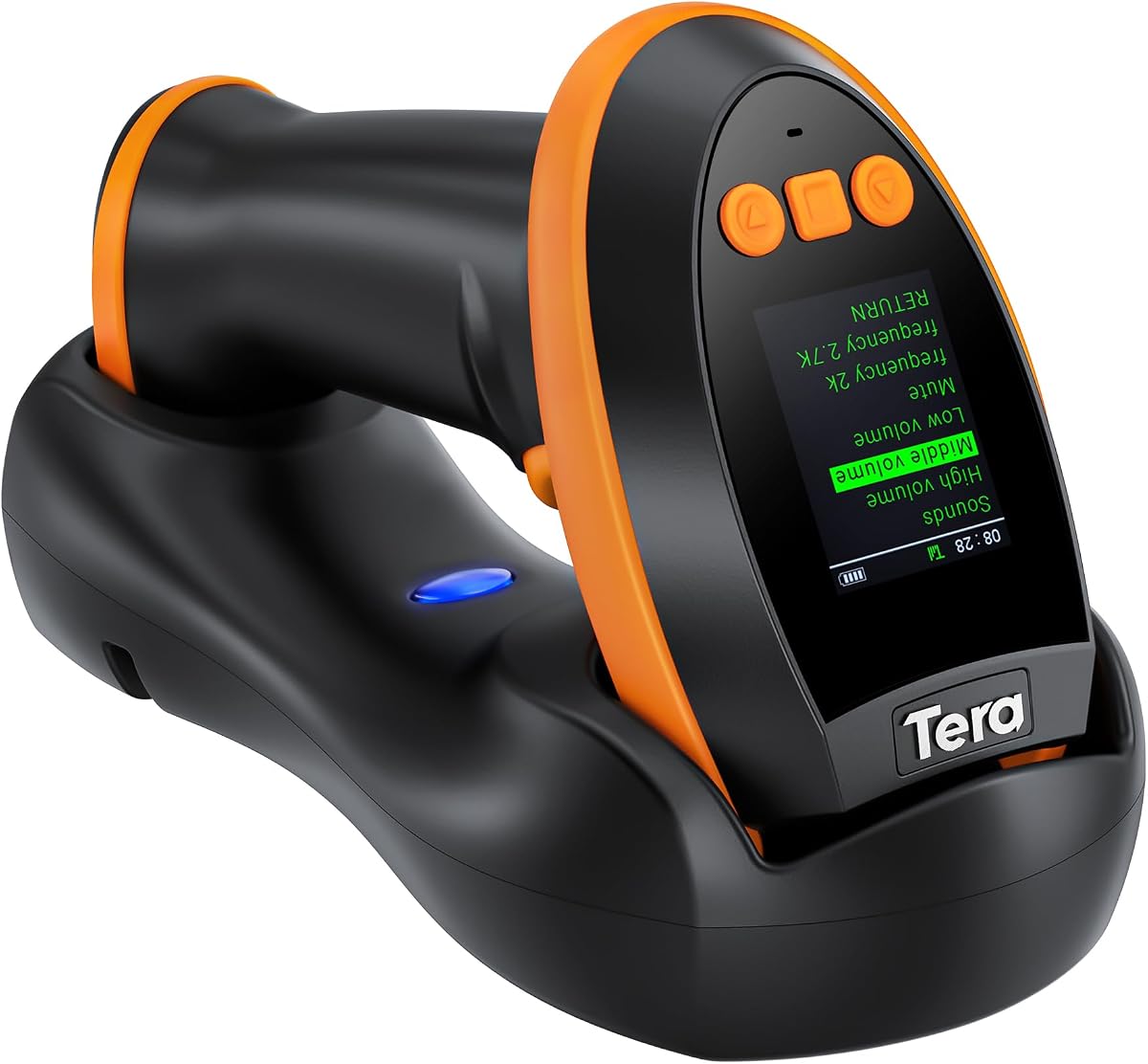
Tera HW0009 Wireless Scanner
4.3Editor score
Built-in screen controls
2500mAh rechargeable battery
Bluetooth, 2.4G, and USB
Extensive 1D and 2D support
Explore the best Pos System for Retail with Barcode Scanner options, comparing 1D, 2D, wired, wireless, desktop, and hands-free models for modern checkout.
A dependable retail barcode scanner turns product lookup, checkout, and inventory work into a faster, more consistent process. The right device should match your POS software, read the barcode formats you actually use, provide comfortable daily operation, and require minimal setup. Corded, wireless, handheld, and desktop designs each serve different retail workflows.
This guide compares ten barcode scanners based on the supplied product specifications, including supported code types, connection methods, scanning modes, platform compatibility, mobility, charging options, and physical design. It covers traditional 1D retail labels as well as 2D, QR, PDF417, and mobile-screen barcodes, with special attention to compatibility limitations that can affect point-of-sale use.
The list begins with general-purpose scanners and then highlights options for mobile checkout, fixed counters, shared workstations, and high-volume environments. Each pick shows why its feature set suits particular retail needs. Product availability, bundle contents, software requirements, and current prices can change, so confirm the latest listing and POS compatibility before purchasing.
4.3Editor score

4.4Editor score

4.7Editor score
The comparison below organizes each scanner by connection style, supported barcode formats, scanning behavior, and key compatibility considerations, making it easier to match a device to a fixed checkout counter, mobile cart, inventory station, or shared retail workstation.


The Tera Wireless 1D Scanner is a flexible option for retailers that primarily read conventional product barcodes and want freedom between a tethered checkout and a movable scanning workflow. Its supplied rating is 4.4, and its strongest combination is a 2.4GHz wireless connection, USB 2.0 wired operation, and a battery level indicator that helps staff avoid unexpected shutdowns during a shift.
We may earn a commission when you buy through this link, at no additional cost to you.
The scanner supports an extensive collection of 1D formats, including UPC-A, EAN-8, EAN-13, EAN-128, Code 128, Code 39, Code 11, Code 93, Codabar, MSI, ISBN, Industrial 25, Interleaved 25, Standard 25, and Matrix. According to the supplied information, it can also read damaged, fuzzy, reflective, and smudged codes, making it more adaptable to imperfect retail labels than a basic entry-level reader.
The curved and widened handle is paired with a smooth, flat trigger intended to improve grip. An orange anti-shock silicone cover helps protect against scratches and friction, while the stated drop protection extends to 6.56 feet and IP54 protection guards against dust. Plug-and-play setup means the USB receiver or cable can be connected without installing a driver, reducing initial configuration time.
This is a sensible choice for a conventional retail counter focused on UPC and EAN labels, particularly when staff need both fixed and mobile operation. It is less suitable when QR codes, PDF417, Data Matrix, or other 2D symbologies are central to the workflow. Buyers should also verify that their POS software accepts the scanner's keyboard-style HID input and the desired 1D code types.
Overall, this Tera model offers a practical balance of mobility, durability, and simple operation. Its lack of 2D imaging is the main limitation, but for businesses that only need dependable wireless 1D scanning, it remains a focused and versatile contender.
A battery indicator removes one common source of checkout interruption. Staff can check remaining capacity between transactions and return the scanner to its wired mode when necessary, helping preserve work during long or busy trading periods.
The 2-in-1 connection design is particularly helpful at shared counters. A fixed lane can use the USB cable, while mobile checkout, stock taking, or receiving can use the receiver, reducing the need for separate devices across different retail tasks.
The broad 1D library covers common grocery and general-merchandise formats, including UPC, EAN, Code 128, and ISBN. This makes the scanner relevant where shelf labels remain the primary source of product data.
Plug-and-play operation with a USB receiver keeps setup uncomplicated. The same device can move away from the counter for line-busting, receiving, or inventory work when its operating system recognizes standard keyboard input.
We may earn a commission when you buy through this link, at no additional cost to you.
The ScanAvenger Wireless 1D&2D is the most adaptable all-around scanner in this guide, earning a 4.4 supplied rating. It combines handheld mobility, desktop-style charging, 1D and 2D decoding, and three connection methods in one package. That balance makes it well suited to retail counters that need to scan shelf labels, printed QR codes, mobile displays, and inventory records without maintaining separate hardware.
We may earn a commission when you buy through this link, at no additional cost to you.
The scanner connects through Bluetooth, a 2.4GHz wireless link, or USB, and can work with Mac and Windows computers, Android and Apple mobile devices, and compatible POS systems. It offers manual, continuous, and auto-sense scan modes, allowing staff to choose deliberate trigger-based reading, a continuous workflow, or detection-driven scanning. Vibration feedback is also available for noisy environments where an audible confirmation may be missed.
Its next-generation smart charging stand stores and charges the handheld unit through lighting connectors. That design encourages a shared-counter routine: the scanner can be returned to its base after each transaction, while the wireless connection gives staff freedom to move away when needed. The supplied information also states that no separate software or app download is required for basic use.
Code coverage is another major strength. It reads UPC, EAN, Code 128, Code 39, Code 11, Codabar, PDF417, Aztec, Data Matrix, QR, Micro PDF, and Interleaved 2D codes. Maxicode is not supported, and the scanner is not intended for POS systems that require proprietary hardware integrations or direct app-level integration. Those caveats deserve careful review before buying for a specialized platform.
This is the best general recommendation for a retailer seeking one scanner to cover checkout, inventory, receiving, and mobile tasks. It is especially compelling when a charging stand and multi-device connectivity matter more than having a permanently fixed reader. Confirm your POS's accepted input method and ensure that the 2D formats you use are included in the supported list.
The combination of wireless, wired, and Bluetooth connectivity gives the device a useful role in several departments. It can work as a tethered checkout reader, a paired mobile scanner, or a portable inventory tool without changing the core hardware.
The smart stand supports an efficient shared workflow. Keeping the scanner charged and immediately available reduces the chance that a cashier must wait for another device during a busy period.
The handheld format and rechargeable stand suit checkout, stock counting, receiving, and mobile-device workflows. A business can standardize around one decoding platform while retaining flexible connection options.
Support for QR, Data Matrix, Aztec, PDF417, and other common 2D formats prepares the scanner for digital receipts, loyalty screens, packaged goods, and shipping labels. Maxicode users should look elsewhere.
We may earn a commission when you buy through this link, at no additional cost to you.
The NetumScan Desktop Barcode Scanner is a focused fixed-counter solution with a 4.5 supplied rating. Its defining feature is automatic, hands-free operation: staff can pass a product through the reading window rather than lifting and aiming a handheld unit. That is useful at a busy checkout where speed, consistency, and freeing both hands matter.
We may earn a commission when you buy through this link, at no additional cost to you.
Induction-trigger technology activates the reader when a barcode approaches, after which the scanner captures 1D and 2D codes from labels, paper, phones, and computer displays. The supplied specifications state that it can handle damaged, distorted, colorful, and reflective barcodes. This broad reading profile is useful for retail environments where label quality is inconsistent or mobile coupons must be scanned from a customer's screen.
The base has a non-slip design, and the product information cites a built-in anti-vibration system with protection from falls of up to 4.92 feet. IP54 technology adds dust protection for store, stockroom, and warehouse settings. Because the scanner enters sleep mode when inactive, it can wake automatically as an item moves into the scan window, reducing manual interaction.
Connection is a simple USB cable, with support stated for Windows XP, 7, 8, and 10, Mac OS, and Linux. It works without extra software and is presented as suitable for common POS and office applications. However, the listing explicitly says it is not compatible with Square, Clover, or Shopify. Buyers using one of those ecosystems should not assume that standard USB keyboard input will be accepted.
This model is an excellent match for a single fixed lane that handles many standard retail labels and digital barcodes. It is less attractive for mobile checkout because it remains a desktop device, and its Square-family limitation may outweigh its otherwise attractive hands-free design in cloud-based or tablet-oriented stores.
Automatic sensing is especially helpful when employees are already handling payments, packaging, or customer receipts. The reader removes repeated aiming and trigger pressure, which can improve consistency during sustained checkout periods.
Its ability to read from a phone or computer display broadens the use beyond printed products. Mobile coupons, digital loyalty cards, and QR codes can be handled without changing scanners, provided the POS software and platform support the device.
Automatic activation allows cashiers to keep their attention on the transaction and merchandise. The design is particularly useful when one hand is occupied with payment terminals, bags, or customer items.
Although the scanner supports several desktop operating systems, the product listing excludes Square, Clover, and Shopify. Confirm hardware requirements before placing it at a counter tied to one of those systems.
We may earn a commission when you buy through this link, at no additional cost to you.
The NetumScan Handheld USB 1D Barcode Scanner is a straightforward wired reader for conventional retail labels. Its supplied rating is 4.3, and it focuses on fast 1D decoding rather than wireless flexibility or 2D imaging. For stores that primarily scan UPC, EAN, Code 128, and similar retail barcodes from a dedicated counter, that focus can be a practical advantage.
We may earn a commission when you buy through this link, at no additional cost to you.
Its CCD sensor captures 1D codes from both paper and screens, including UPC/EAN with 2 or 5 add-ons, Code 128, and damaged, smudged, fuzzy, or reflective labels. The supplied information describes its reading performance as faster and more accurate than laser scanning. It supports an extensive list that also includes GS1-128, Code 39, Code 93, Code 32, Code 11, Interleaved 2 of 5, Industrial 2 of 5, Codabar, MSI, Plessey, RSS, China Post, ISBN, and ISSN.
The scanner is built from ABS and is stated to withstand repeated drops from up to 2 meters onto concrete. An ergonomic housing supports extended use, and a stand is included for moments when a cashier wants to set the reader down. Its USB wired design eliminates battery management and radio-pairing steps, making deployment straightforward at a permanent station.
Compatibility includes Mac and several Windows versions, plus iOS and Linux according to the supplied specifications. It works with Word, Excel, Novell, and common software that accepts keyboard-style scanner input. Retail applications listed include supermarkets, convenience stores, warehouses, libraries, bookstores, drugstores, file management, inventory tracking, and point-of-sale use.
Choose this model when a fixed, reliable 1D reader is more important than mobility or QR support. It is a particularly natural fit for a counter where the cable can remain within reach and standard retail symbologies dominate. It should not be selected for a business whose inventory or customers routinely present Data Matrix, PDF417, or QR codes.
The included stand creates a useful hybrid workflow. Staff can hold the scanner for normal scanning and return it to the stand during customer interactions, counter maintenance, or brief pauses.
Broad format support reduces the chance that a store will encounter an unsupported 1D symbology. It also makes the scanner useful beyond checkout for receiving, stock counts, and library or back-office tasks.
A USB connection provides a stable, always-ready alternative to wireless pairing and battery management. For permanent checkout lanes, this can simplify daily routines and reduce the number of charging-related interruptions.
The scanner's extensive 1D library is its defining strength. Retailers that need QR, PDF417, or other 2D formats should select a 2D-capable model instead.
We may earn a commission when you buy through this link, at no additional cost to you.
The Tera HW0009 is the most feature-rich premium option here, with a supplied rating of 4.3. It combines a screen and setting keypad, a charging cradle, a 2500mAh rechargeable battery, 1D and 2D scanning, and three connection modes. Those features make it a strong option for retailers that want more control over device behavior without locking into a proprietary ecosystem.
We may earn a commission when you buy through this link, at no additional cost to you.
The screen can display language, volume, connection choices, stored barcodes, and total barcode counts. Staff can use it to adjust settings directly rather than relying entirely on configuration barcodes or host software. CMOS imaging is designed for ordinary and high-density formats, including PDF417 found on driver's licenses, as well as reflective materials, silver paper, and underwater scanning situations.
Connectivity includes Bluetooth, 2.4GHz wireless, and USB wired. The supplied information states that 2.4GHz transmission reaches 328 feet in a barrier-free environment and 114 feet where obstacles are present. Devices listed as compatible include smartphones, computers, POS terminals, and tablets, with support for Windows 11, 10, 8, 7, XP, Mac OS, iOS, Android, and Linux.
The 2.4GHz receiver is built into the charging cradle, eliminating the need to keep a separate USB dongle available. Pairing involves connecting the cradle with the supplied USB cable and scanning a pairing barcode from the cradle or manual. The package includes the scanner, cradle, charging cable, and user manual. The built-in battery and dedicated base make charging part of the normal desktop routine.
Its code support includes QR, Data Matrix, PDF417, Aztec, Maxicode, Micro QR, Micro PDF417, UPC/EAN, Code 128/EAN128, GS1-128, ISBT-128, ITF-14, Code 39, Codabar, and other listed formats. The trade-off is complexity: this is not as immediately minimalist as a basic USB reader, and configuration may take a little more time. Even so, the screen, long-range options, and cradle integration justify consideration for multi-department or multi-device retail operations.
The on-device display is a meaningful upgrade for high-volume teams. Different employees can quickly check connection status, volume, language, and scanning totals without opening a configuration file or navigating a computer menu.
The cradle simplifies both charging and wireless reception. One base can remain at the counter, reducing loose adapters and making it easier for staff to return the scanner to a known location after a transaction.
The display and keypad make connection mode, language, volume, and barcode information visible at a glance. This is helpful for staff turnover and for teams that need to verify configuration without opening host software.
Bluetooth, 2.4GHz, and USB wired modes let the scanner follow the user between a POS terminal, tablet, and mobile device. The supplied figures also indicate strong 2.4GHz range in unobstructed spaces.
We may earn a commission when you buy through this link, at no additional cost to you.
The NETUM NT-1228BC is a mobile-oriented barcode reader that supports Bluetooth, 2.4GHz wireless, and wired operation. Its supplied rating is 4.4, and its combination of platform support, high-resolution CCD sensing, and offline storage makes it well suited to inventory teams that move between a phone, tablet, and computer.
We may earn a commission when you buy through this link, at no additional cost to you.
Bluetooth can operate in HID, SPP, and BLE modes. The scanner is listed for Windows XP, 7, 8, and 10, Mac OS, Windows Mobile, Android, iOS, and Linux, allowing it to work with iPhone, iPad, Android tablets, PCs, and compatible POS systems. The 2500-pixel CCD sensor decodes 1D and stacked barcodes, including ISBN codes, and can read from paper, monitors, phones, tablets, and through glass or plastic wrap.
A particularly useful feature is storage mode. When the scanner moves out of Bluetooth or wireless range, it can retain up to 100,000 barcodes for later transfer. Staff can scan continuously in a stockroom or warehouse and synchronize the collected records when connectivity returns. Manual trigger, continuous scan, and auto-sense modes cover different working styles, while programmable prefixes, suffixes, character deletion, and keyboard terminators help tailor the data sent to the host.
The 2600mAh battery is stated to support up to 200,000 continuous scans on a full charge. The listing also says it can be used for at least one month under some conditions, though actual results will depend on the selected mode, connection, and scan volume. A programmable buzzer can be muted for quieter environments.
The main caution is compatibility. The supplied information explicitly says the scanner does not work with Square POS, Divalto, DoorDash, or Lightspeed POS. Those restrictions narrow its appeal for some modern retail stacks. For teams using standard keyboard-style input on supported mobile or desktop systems, however, the storage mode and cross-platform connections are compelling.
Offline collection makes the scanner valuable where wireless reception is unreliable. The ability to retain a large batch of scans prevents a dead connection from interrupting a lengthy inventory count.
Programmable output is important for POS and spreadsheet workflows. Prefix and suffix changes, deleted characters, and terminator settings can make the device fit a particular data field without changing every scan by hand.
Storage mode can retain up to 100,000 barcodes while the scanner is disconnected. This supports uninterrupted stock taking in large buildings, basements, warehouses, and other locations with uneven wireless coverage.
HID, SPP, and BLE support gives the scanner flexibility across iOS, Android, Mac, and Windows devices. Buyers should still verify the specific POS or mobile app's hardware requirements.
We may earn a commission when you buy through this link, at no additional cost to you.
The NetumScan 2D Desktop Barcode Scanner is built for fixed retail counters that value automatic detection, compact 2D imaging, and a stable scanning position. Its supplied rating is 4.2, while the specifications highlight a scan rate of up to 300 barcodes per minute and a 1280 by 800 CMOS sensor.
We may earn a commission when you buy through this link, at no additional cost to you.
Automatic hands-free operation allows users to pass labels through the reading area without handling a scanner. The high-resolution sensor is designed to recognize small, blurred, or damaged 1D and 2D codes on screens and paper. Supported formats include UPC/EAN, ISBN/ISSN, Code 128, GS1-128, GS1 DataBar, Code 39, Interleaved 2 of 5, Data Matrix, PDF417, QR, Aztec, Maxicode, and Han Xin Code.
The weighted base is intended to prevent tipping, and the scanner head can tilt from plus 25 degrees to minus 55 degrees. That adjustment allows staff to direct the reading window toward customers, items, or screens without repositioning the entire unit. The matte industrial finish is designed to resist scratches, and the shock-absorbing system is stated to protect against drops up to 5 feet.
USB wired connectivity provides plug-and-play operation on Windows, Mac, and Linux without complicated driver installation. The scanner is stated to work with common POS systems and office software, and a detailed manual explains settings such as prefixes, suffixes, and volume adjustment. Its fixed form, however, means it is not intended for mobile checkout or roaming stock taking.
This model is most compelling for a dedicated checkout lane handling a mixture of conventional labels and 2D formats. The 300-scans-per-minute figure and automatic sensing are attractive for sustained use, while the adjustable head helps maintain a natural scanning position. Confirm the required code types and POS platform before purchase.
The high-resolution sensor provides useful tolerance for small labels and imperfect printing. This is valuable for products with dense packaging, smaller identification areas, or screens that may not be held perfectly still.
The weighted, adjustable stand makes the scanner a permanent fixture rather than a loose peripheral. That stability supports consistent auto-sensing and reduces the need for staff to pick up and reposition the device during each transaction.
A stated capacity of 300 scans per minute and automatic detection align with high-throughput retail lanes. The scanner can remain ready for the next item without repeated manual activation.
The wide tilt range helps direct the scan window toward merchandise or customer-held screens. A weighted base keeps the unit stable while the head is repositioned.
We may earn a commission when you buy through this link, at no additional cost to you.
The Eyoyo EYH2 is a wired handheld scanner that handles both traditional 1D barcodes and common 2D formats. Its supplied rating is 4.3, and its ability to read smartphone displays makes it relevant for retail environments where customers present mobile coupons, digital wallets, or loyalty codes.
We may earn a commission when you buy through this link, at no additional cost to you.
The scanner connects by USB and does not require driver or software installation. It is listed for Windows, Mac, Android, and Linux, as well as common applications including QuickBooks, Word, Excel, and Novell. Its 1D library includes EAN, UPC, Code 39, Code 93, Code 128, UCC/EAN 128, Codabar, Interleaved 2 of 5, ITF-6, ITF-14, ISBN, ISSN, MSI-Plessey, GS1 DataBar, Code 11, Industrial 25, and Matrix 2 of 5. It also supports QR, Data Matrix, PDF417, and other 2D formats.
For screen scanning, the product information recommends increasing the display's brightness. The scanner can also be set to trigger mode or auto-sensing mode, allowing staff to choose intentional reading or automatic detection. Volume can be turned off for quieter work areas, and prefix, suffix, deleted-character, and terminator settings help control how data reaches the host application.
The ergonomic ABS housing is stated to withstand repeated drops from 5 feet, or 1.5 meters, onto concrete. This adds a useful level of physical resilience for a device that may be passed between staff or used in busy counters. Its wired format avoids charging and pairing, though it also means the scanner remains tethered to the workstation.
This is a good general-purpose option for a retailer that wants screen scanning and 2D support without a wireless setup. The limitations are important: very small Intel 2D barcodes and some blurry or dense PDF417 codes may not read, and the scanner is not compatible with Square POS or Square Register. Those restrictions should be checked against every product and payment workflow in the store.
Screen support extends the scanner beyond printed shelf labels. It can handle customer-generated mobile coupons and digital loyalty information without requiring staff to type codes manually.
The combination of auto-sensing and trigger modes supports different counter styles. Fixed lanes can use automatic detection, while staff handling irregular merchandise may prefer deliberate trigger-based scanning.
Reading barcodes from phone screens is valuable for mobile coupons, loyalty cards, and digital payment-related codes. A brighter screen can improve capture when necessary.
Prefix, suffix, character deletion, and terminator controls help shape scan data for the active application. These settings can reduce manual editing at the checkout.
We may earn a commission when you buy through this link, at no additional cost to you.
The Tera 9700 is a compact desktop reader for retailers that want a stationary, hands-free scanning station. Its supplied rating is 4.1, while the defining feature is 360-degree omnidirectional capture. Instead of requiring staff to align a label with a narrow line, the scanner's camera array is designed to capture codes presented from virtually any angle.
We may earn a commission when you buy through this link, at no additional cost to you.
It reads 1D and 2D barcodes from labels, paper, plastic cards, and mobile-phone or computer displays. Supported 1D types include Codabar, Code 11, Code 93, MSI, Code 128, UCC/EAN-128, Code 39, EAN-8, EAN-13, UPC-A, ISBN, Industrial 2 of 5, Interleaved 2 of 5, Standard 2 of 5, and Matrix 2 of 5. Its 2D support includes QR, PDF417, Data Matrix, Aztec, and MaxiCode.
The scanner is designed for hands-free use on a desk, allowing both hands to remain available for bulky goods, payment, and packaging. Omnidirectional sensing reduces the repeated adjustments of angle and distance that can slow down a traditional line scanner. Its small footprint also makes it more approachable than a full retail scanner assembly.
Setup is simple: a USB connection to a PC, laptop, or POS system is all that is required. The supplied information lists Windows XP, 7, 8, and 10, Mac OS, and Linux as compatible platforms, with no separate software requirement stated. The device is positioned for supermarkets, retail stores, libraries, logistics, healthcare, banking, checkout, and inventory management.
Its limitations are the fixed nature of the design and the lack of wireless mobility. It also lacks some of the adjustable stands, audio controls, and broader platform statements found in other models in this list. Still, for a single dedicated counter, the 9700 offers a clean way to scan both printed and displayed codes without handling a handheld reader.
The omnidirectional window is particularly useful for products that are difficult to orient. Staff can sweep an item through the reading area rather than carefully aligning a narrow barcode, improving the physical rhythm of checkout.
Digital display support allows the same station to handle printed inventory and customer-presented mobile codes. That makes the reader more versatile than a device restricted to one-dimensional labels.
The 360-degree camera arrangement allows staff to present a label from a natural angle. This can reduce alignment attempts and make checkout handling feel more fluid.
Support for printed labels, plastic cards, and phone or computer displays broadens the scanner's use at retail counters. It remains best suited to a stationary station.
We may earn a commission when you buy through this link, at no additional cost to you.
The Symcode Barcode Scanner combines an entry-level desktop format with a 4.7 supplied rating, the highest numerical rating in this list. It is a practical budget-oriented choice for small retailers, stockrooms, libraries, and service counters that need automatic 1D and 2D scanning without a complicated wireless setup.
We may earn a commission when you buy through this link, at no additional cost to you.
Its stand enables automatic hands-free operation, allowing staff to pass products through the scan window while continuing to handle payments or merchandise. The scanner reads 1D, 2D, QR, Data Matrix, PDF417, and other formats, including blurry or damaged codes according to the product information. That range covers ordinary shelf labels as well as many modern retail and shipping applications.
USB provides a simple plug-and-play link to computers, POS systems, and Mac devices. No elaborate software installation is indicated, making the reader accessible for a small business that wants a straightforward way to add barcode capture. Configuration options include customizable prefixes and suffixes, character deletion, and adjustable audio feedback with an on/off option.
The included stand and auto-scanning behavior make the device more convenient than a basic handheld reader for a fixed lane. The trade-offs are a wired cable, a stationary footprint, and an explicit Square compatibility limitation. A buyer using Square should choose another option after confirming platform requirements.
For a shop that wants 1D and 2D support in a small desktop package, this scanner offers a strong balance of useful features and simplicity. It is also appropriate for inventory work, document processing, and retail checkout where staff can keep the reader in one location. The rating should not be interpreted as a personal test result, but it is a favorable signal within the supplied catalog data.
Adjustable sound feedback lets a store align the scanner with its environment. A busy counter may benefit from audible confirmation, while a quiet library, clinic, or office can disable the beep.
The hands-free stand is the main workflow advantage. Rather than repeatedly lifting a device, staff can move merchandise through the reading window and keep their hands available for the customer.
The included stand removes the need to pick up a handheld reader for routine checkout. Automatic detection provides a simple, consistent routine for smaller counters.
Coverage of 1D, 2D, QR, Data Matrix, and PDF417 makes the scanner useful for printed products, digital codes, inventory labels, and shipping materials without moving to a different reader.
We may earn a commission when you buy through this link, at no additional cost to you.
Choosing a retail barcode scanner means balancing symbology support, connection method, mobility, counter workflow, and compatibility with the devices and software already used in the store. The following factors help narrow the options before purchase.
A 1D scanner reads the linear barcodes commonly printed on retail shelves, while a 2D scanner also handles square, matrix, stacked, and high-density symbols such as QR codes, Data Matrix, Aztec, PDF417, and Maxicode. The choice depends on what customers and staff actually scan. Conventional UPC and EAN labels are common in general retail, but packaged goods, identity documents, shipping labels, mobile coupons, and digital payment screens may require 2D capability. A 2D-capable model is the safer long-term choice when inventory or marketing materials may increasingly use dense symbols.
Choose 2D support for mixed-format retail, mobile coupons, loyalty screens, and package labels. Choose 1D only when every scanned item is limited to a known linear symbology.
A scanner can decode a code perfectly and still be unusable if the POS system does not accept its input method. Many general-purpose scanners operate as USB keyboard-style devices, which can work across Windows, Mac, and common software, but some retail ecosystems require proprietary integrations or direct app-level control. Several products in this guide explicitly exclude particular systems, including Square, Clover, Shopify, Divalto, DoorDash, or Lightspeed. Check the POS vendor's current hardware requirements, supported connection modes, and required scanner profiles before ordering.
Treat compatibility as a required filter rather than a final detail. Confirm the exact POS platform, operating system, and device input behavior with current documentation.
Wired USB scanners are dependable, always connected, and free of battery and pairing management. They suit a fixed checkout lane but restrict movement and place the workstation near the counter. Wireless 2.4GHz models support a dedicated receiver and can offer long range, making them useful for receiving, stock counts, and mobile checkout. Bluetooth is convenient for phones and tablets but depends on the host device's supported profiles and range. Some scanners support all three methods, which is valuable for shared or changing retail tasks.
Choose wired for a permanent counter, wireless for roaming work, and Bluetooth for mobile devices. Multi-mode scanners provide the most flexibility but may require separate pairing procedures.
A handheld scanner is familiar and easy to direct, which makes it appropriate for oversized items, irregular packages, inventory aisles, and mobile carts. A desktop reader sits on the counter and automatically detects codes, allowing staff to keep both hands available. Hands-free models are efficient when merchandise passes through a fixed window, but they can be less convenient when products must be lifted or oriented. Consider who uses the scanner, whether the lane has space, and how often the device changes position.
Use handheld models for mobile and irregular scanning. Use desktop stands for a stable, repeated checkout pass-through routine.
Wireless operation creates a new daily requirement: keeping the scanner charged and readily available. Some products use a built-in rechargeable battery, while others include a dedicated cradle that both charges the unit and stores it. Standby life, continuous scan capacity, and the time required to recharge can all affect shift planning. A station-based retail team benefits from a cradle that makes returning the scanner routine, while a roaming team may prioritize lightweight form, battery indicators, and reliable wireless range.
Compare stated battery capacity, scan endurance, standby behavior, and included charging equipment. A dedicated cradle is usually the most convenient fixed-counter solution.
The most important performance question is whether the scanner can read the codes your products actually present. CCD and CMOS imaging can read from screens and challenging labels, while laser scanners are designed primarily for printed 1D labels. Product information for several devices claims support for damaged, smudged, fuzzy, reflective, distorted, or small codes. These features can help in busy stores where labels become scratched or poorly aligned. Also consider screen brightness, plastic packaging, glass, distance, and the density of PDF417 data when assessing performance.
Choose an imaging scanner for difficult labels, screens, and dense 2D content. A conventional 1D laser reader remains sufficient for clean, standard shelf labels.
A scanner may be handled thousands of times during a busy week, so grip, trigger smoothness, weight, and drop protection are practical concerns. The supplied specifications describe curved or ergonomic handles, anti-shock housings, silicone covers, anti-slip bases, and protection from falls. Desktop readers also need a stable base and an adjustable head if the team scans from different positions. Look for physical features that fit the counter and work environment rather than relying on a generic durability claim.
Prioritize a comfortable grip for handheld use and a stable, adjustable stand for fixed operation. Match the stated drop protection to the realities of the store.
Useful configuration options can reduce the need to edit scanned data manually. Prefix and suffix rules, character deletion, keyboard terminators, and selectable code types help a scanner fit a POS field or spreadsheet. Manual, continuous, and auto-sense modes offer different control levels. Audio confirmation can assist busy staff, while mute settings are valuable in quiet environments. On-screen controls are easier for some teams than reading setup barcodes, but they also add complexity. Choose the level of control that matches the team's technical experience and staff turnover.
Basic users benefit from straightforward plug-and-play behavior. Advanced teams may prefer programmable output, mode selection, and on-screen or manual configuration.
Begin by identifying the barcode symbologies used on products, shelf labels, customer screens, and shipping materials. Confirm that the scanner supports those formats and that the POS accepts its connection method. For a USB reader, connect the cable and allow the computer to recognize the keyboard-style device. For wireless or Bluetooth models, charge the scanner, install or connect the appropriate receiver if required, and complete the pairing process described in the manual. Test several real labels before opening the lane for normal use.
Train staff to present the entire barcode within the scanner's reading area with adequate lighting. For mobile screens, increase brightness and hold the display steady. Use auto-sensing for routine pass-through checkout, manual trigger mode for deliberate or difficult scans, and continuous mode only when the workflow calls for it. If a code is not captured, check the supported symbology list, clean the reading window, and verify that the scanner is in the correct input or keyboard mode rather than repeatedly forcing a difficult scan.
Treat the reading window and charging contacts with care. Clean the scanner with a soft, lint-free cloth and avoid abrasive chemicals or excessive moisture. Store wireless units on their cradle or in a protected charging position, and do not leave a device in a hot vehicle or a dusty storage area. Inspect the cable, contacts, housing, and stand for wear, and follow the manufacturer's instructions for charging, pairing resets, firmware or configuration updates, and replacement accessories.
A 1D scanner is sufficient when your store only reads standard linear formats such as UPC and EAN. A 2D scanner is the better choice if customers present QR codes, staff scan Data Matrix or PDF417 labels, or your business handles digital coupons and mobile displays. Choosing a 2D-capable model now also gives the counter more flexibility as product packaging changes.
No. Most general-purpose scanners use standard USB keyboard-style input, but some POS platforms require proprietary hardware integrations or direct app-level support. The listings in this guide include several specific exclusions, such as Square, Clover, Shopify, DoorDash, and Lightspeed. Check the current hardware requirements of your exact POS before buying, especially if you use a tablet or mobile checkout setup.
A hands-free desktop scanner is often faster at a fixed checkout because staff can pass merchandise through the reading window and keep their hands available. A handheld scanner is more versatile for bulky products, mobile carts, stock taking, and scanning items from different shelves. The best choice depends on counter layout, merchandise handling, and how much the device needs to move.
Laser scanners use a moving light beam and are primarily suited to printed 1D barcodes. CCD and CMOS scanners capture barcode images, allowing them to read 1D codes and, depending on the model, 2D symbols from paper or screens. Imaging scanners are generally more useful in modern retail environments where mobile coupons, QR codes, and varied label quality are common.
Start by charging the scanner and connecting its USB receiver or cradle to the computer. Many models require the user to scan a pairing barcode from the receiver, cradle, or manual. Bluetooth scanners may also need a particular HID, SPP, or BLE mode selected on the device. Follow the supplied manual and confirm the connection before taking the scanner into live checkout service.
Several of the 2D-capable models in this guide are designed to read QR codes and other symbols from mobile-phone or computer displays. Increase screen brightness if a scan is difficult, keep the display steady, and place the entire code within the reading window. Very small, blurred, or unusually dense codes may still exceed the reading capability of some models.
Start with a compatible scanner that supports every symbology your store uses, then keep its reading window clean. Train staff to present labels squarely with adequate lighting and to wait for the confirmation tone or vibration before completing the transaction. For unreliable or damaged labels, compare a higher-resolution 2D model or a scanner with auto-sensing, and test the device using real products before deployment.
Many of the products listed are designed for plug-and-play USB keyboard-style operation and do not require a dedicated driver or app. Wireless pairing and configurable settings may still require a manual or configuration barcode. Some retailers also need scanner profiles or integration settings from their POS software, so verify the complete setup process before installation.
The ScanAvenger Wireless 1D&2D stands out as the best overall choice because it combines 1D and 2D decoding, three connection options, multiple scan modes, and a smart charging stand in one adaptable package. The Tera HW0009 is the premium option for teams that value an on-device screen, extensive configuration, strong 2D support, and a cradle with a built-in receiver. The Symcode scanner is the best budget pick, offering hands-free automatic scanning and broad format coverage in a straightforward wired package.
Prioritize compatibility before every other feature. Confirm the exact POS system, required connection method, barcode symbologies, and whether the store needs mobile operation. A fixed lane may benefit most from a hands-free desktop reader, while inventory and checkout teams often need a wireless handheld. Read difficult labels, mobile coupons, or dense PDF417 content only with a suitable imaging scanner rather than a 1D-only device.
Finally, check current pricing, package contents, availability, and the latest product documentation before ordering. Hardware bundles and retail listings can change, and compatibility exclusions or operating-system requirements may also evolve. The right scanner is the one that fits the store's present workflow while providing enough format and connection flexibility for the tasks expected next.