
Samson S-Patch Plus
4.8Editor score
Forty-eight balanced TRS points
Normalled and half-normalled modes
Front and rear access
A studio patchbay provides a central, organized point for connecting microphones, preamps, mixers, recorders, outboard gear, and other equipment. A well-chosen model reduces cable clutter, makes routing changes faster, and keeps critical connections accessible without reaching behind a rack or console.
The products in this guide were compared by connector format, channel capacity, signal-routing options, rack construction, mounting flexibility, and suitability for common studio tasks. The list covers XLR, 1/4-inch TRS, TT, and DB-25 designs, from compact panels to extensively equipped professional patchbays.
Each review explains the standout features, practical trade-offs, and ideal studio role of every model. Ratings reflect the supplied customer feedback, while specifications describe the available product information. Prices and availability can change, so confirm current listings before purchasing.
4.8Editor score

4.6Editor score

As an Amazon Associate we earn from qualifying purchases.
The comparison highlights connector type, channel count, routing flexibility, construction, and the studio jobs each patchbay is best equipped to handle. XLR models suit microphone-style balanced routing, while TRS, TT, and DB-25 options provide alternatives for line-level and high-density workflows.



The AA AUDIO ACCESSORY AP16 is a 16-channel balanced XLR patchbay with a 4.6 rating and a strong emphasis on modular construction. Its four independent four-channel blocks distinguish it from conventional fixed patch panels, while the full-steel chassis and gold-plated pins target dependable studio and live-performance use.
We may earn a commission when you buy through this link, at no additional cost to you.
The modular approach is the most interesting feature. Each four-channel block can serve a separate system zone, and blocks can be removed or replaced without modifying the main PCB. This makes the AP16 more adaptable than a basic 16-way panel, particularly for studios that periodically reconfigure signal flow or want separate routing for recording, monitoring, and outboard equipment.
The reversible rack ears also broaden installation options by allowing the unit to face forward or rearward. Its dual-layer PCB is designed to minimize leakage and interference, and the stated insulation resistance of more than 5.5GΩ supports the product's clean-routing claims. The trade-off is that the panel is larger and less connector-diverse than smaller or multi-format alternatives.
Choose the AP16 when balanced XLR routing, serviceable construction, and rack flexibility matter more than maximum point count. It is especially convincing for a growing studio that wants organized 16-channel zones without committing to a 48-point panel. For those needs, it is the most versatile overall selection in this guide.
Because the four-channel sections operate independently, a studio can assign separate blocks to different equipment groups and isolate one zone for servicing. This reduces the need to disturb an entire patchbay when a channel section needs attention.
The full-steel chassis, dual-layer PCB, and gold-plated XLR pins provide a reassuring foundation for balanced studio connections. Reversible rack ears make the same unit practical in racks with different front-panel and rear-access requirements.
We may earn a commission when you buy through this link, at no additional cost to you.
The ART P16 is a straightforward 16-point balanced XLR patchbay that carries a 4.8 rating, the highest listed score among products with an available numeric rating. It uses 32 XLR connectors in total, with 16 female connectors on the front and 16 male connectors on the rear.
We may earn a commission when you buy through this link, at no additional cost to you.
Its appeal lies in an uncomplicated rack design. The unit occupies one rack unit, uses reliable PCB wiring, and comes in a rugged, fully shielded black all-steel enclosure. Reversible rack ears offer installation flexibility, while the three-year warranty adds useful reassurance for a permanent piece of studio infrastructure.
Compared with the AP16, the P16 lacks modular channel blocks and the same described zone-management system. It also does not specify gold-plated pins in the supplied information. These omissions matter less for a studio seeking a direct, familiar XLR panel than for a user who expects serviceable modules or a broader connector selection.
The ART P16 is a strong choice for studios already using XLR cable and wanting a compact, balanced central routing panel. It is particularly suitable for live rooms, small production suites, and project racks where straightforward patch points matter more than configurable normalization modes.
Its one-unit format leaves valuable rack space for converters, compressors, interfaces, and power distribution. That makes it easy to introduce centralized routing without requiring a large dedicated rack section.
Female front and male rear connectors make the panel intuitive for patch cables. The reversible ears allow the orientation to suit the rack and the way cables enter the surrounding equipment.
We may earn a commission when you buy through this link, at no additional cost to you.
The Samson S-Patch Plus is a balanced 48-point patchbay with 1/4-inch TRS connectors on both the front and rear. Its 4.8 rating reflects strong customer approval, while the high channel count offers an efficient way to centralize a busy studio's line-level connections.
We may earn a commission when you buy through this link, at no additional cost to you.
The defining feature is the per-channel toggle control. Each channel can operate in normalled, half-normalled, or through mode, giving users meaningful routing flexibility without changing the fundamental wiring. In through mode, signal moves from the upper rear input to the upper front output, with the lower row following the opposite direction.
Its weakness is that TRS cables are not interchangeable with the XLR cables commonly used for microphones and many speaker or snake connections. A studio already built around TRS patch cords can use it efficiently, but an XLR-centered facility may need a different format. The 48-point layout also takes more rack space than a compact panel.
The Samson is an excellent choice for studios using balanced TRS workflows and needing many accessible line-level routes. It combines high capacity, straightforward operation, and a strong rating, making it a practical pick for control rooms, rehearsal spaces, and integrated production racks.
Normalled, half-normalled, and through settings allow the patchbay to behave differently according to the signal path. This makes the unit useful for temporary bypasses, direct routing, and semi-normalled studio connections.
Bringing many connections to the front of a rack minimizes the need to reach behind a mixer or equipment stack. The 96 total TRS connectors create a dense but organized central patching interface.
We may earn a commission when you buy through this link, at no additional cost to you.
The Behringer ULTRAPATCH PRO PX3000 is a 48-point balanced patchbay with a 4.6 rating. It stands apart from many competitors because each channel can be switched among parallel, half-normalled, normalled, and open functions, providing four operating choices for different routing situations.
We may earn a commission when you buy through this link, at no additional cost to you.
The patchbay is intended to eliminate cable clutter around mixers and equipment racks. Its large point count is useful for studios that route numerous line-level devices, while the multiple modes can support direct signal paths, semi-normalled connections, and bypass arrangements.
Its format is less convenient for studios standardized entirely around XLR. Users need to understand the exact signal flow of the selected mode, and the dense controls require clear labeling to prevent routing errors. The supplied information does not specify connector plating, enclosure details, or mounting orientation, so those aspects should be checked in the current product listing.
Choose the PX3000 when broad per-channel switching is more important than compactness or XLR convenience. It is a strong fit for permanent control-room racks, education facilities, and production rooms where operators need several patching behaviors from one panel.
Parallel, half-normalled, normalled, and open modes allow a single channel to serve several signal-flow requirements. This versatility is useful in rooms where sources are frequently routed, bypassed, or temporarily divided.
The stated rugged construction and high-quality components suit a permanent studio installation. Its 48-point density also gives an entire rack a cleaner and more systematic appearance.
We may earn a commission when you buy through this link, at no additional cost to you.
The Black Lion Audio PBR XLR is a 16-point patchbay built around 32 gold-plated XLR connectors. Its 4.4 rating indicates generally favorable customer feedback, while the familiar connector format makes it straightforward to integrate into a studio already using balanced XLR wiring.
We may earn a commission when you buy through this link, at no additional cost to you.
Sixteen points offer enough capacity for a focused microphone, preamp, or console routing section without the footprint of a 48-point panel. Gold-plated connectors are the headline construction detail, and the rack-oriented design supports centralized signal management rather than serving as a loose desktop adapter.
The supplied product information is limited, so details such as normalization behavior, chassis construction, dimensions, and mounting options should be verified before purchase. The absence of listed mode switches may also be an advantage for users who prefer a simpler straight-through panel, but it reduces flexibility compared with the Samson, Behringer, or ART TPatch.
This model is best suited to a studio that wants a compact, dedicated XLR patch point and values connector finish. It fits well as a dedicated mic or preamp hub, particularly when the user does not need a large number of alternate routing modes.
The plated XLR interfaces provide a practical contact surface for cables that will be connected and disconnected regularly. Their 32 total connectors support 16 front-to-back patch paths.
A 16-point section is large enough for a useful studio zone but more manageable than a 48-point panel. This makes the unit suitable for focused signal groups and smaller rack spaces.
We may earn a commission when you buy through this link, at no additional cost to you.
The Black Lion Audio PBR TRS is a high-density 48-point patchbay with 96 gold-plated TRS connectors and a 4.1 rating. Its strength is straightforward: it offers many balanced line-level patch points in one dedicated panel.
We may earn a commission when you buy through this link, at no additional cost to you.
For studios that already use TRS patch cables, the 48-point layout can consolidate a large amount of routing. The 96 connectors indicate front and rear access, allowing a user to reach connections without moving racks or tracing cables behind equipment.
Its 4.1 rating is the lowest numeric score in the group, which deserves attention. The supplied details do not clarify normalization modes, switch controls, or construction specifications, and the product may offer less operational flexibility than similarly sized alternatives. Buyers should therefore treat connector quality and density as the main attractions rather than assuming advanced routing behavior.
The PBR TRS is most appropriate for a studio with a substantial TRS-based infrastructure and a need for 48 accessible line-level paths. It can serve as a clean master routing panel, provided the buyer confirms the electrical behavior and physical dimensions needed for the installation.
Dual access across 48 points keeps a large routing network within a single unit. This can be more space-efficient than scattering small adapters across several rack spaces.
TRS connections suit studios already routing balanced line-level signals through 1/4-inch cable. Users coming from an XLR-based setup should confirm their cable and connector requirements before installation.
We may earn a commission when you buy through this link, at no additional cost to you.
The DIYTECH 16 Port XLR is a reversible 16-port rack patch panel with a 4.3 rating. Its heavy-duty steel chassis, black powder coat, and included mounting hardware make it look well suited to studios, live rigs, theaters, worship facilities, and broadcast carts.
We may earn a commission when you buy through this link, at no additional cost to you.
Reversible male and female connectors allow the panel to accommodate different input-output arrangements and panel swaps without rewiring. Balanced three-pin wiring supports standard XLR cables and is described as helping minimize noise or interference, particularly in high-gain or longer-run applications.
The product does not list the detailed normalization or switching behavior of the more specialized patchbays in this guide. Its 4.3 rating is respectable but trails the leading products, and buyers may need to confirm connector orientation, wiring details, and exact dimensions. The value of included mounting screws is clear for a faster installation, but it does not resolve any uncertainty about signal routing.
This panel is a practical option for a broad range of projects that need a rugged, reversible XLR hub. It is especially appealing when the same rack may be used with different equipment arrangements or when a straightforward balanced patch point is all the studio requires.
Reversible XLR connectors give the panel more flexibility than a fixed female or male arrangement. That is useful when equipment changes or when front and rear connector orientation must be adapted.
The supplied rack screws support a quick setup in a standard 19-inch rack. The powder-coated steel chassis is intended to withstand drops, scratches, and the wear associated with touring and repeated installation.
We may earn a commission when you buy through this link, at no additional cost to you.
The Black Lion Audio PBR TT LIT is a 96-point gold-plated TT and DB-25 patchbay with customizable LED displays. It occupies a specialized niche, offering much greater density than conventional XLR or TRS panels and adding visual status information for macOS or Windows systems.
We may earn a commission when you buy through this link, at no additional cost to you.
Its 96 TT connectors create a high-density routing surface, while 12 DB-25 ports provide consolidated connections for groups of signals. The customizable displays could help operators identify active or assigned routes more efficiently, reducing the cognitive load associated with a large patch network.
This complexity also creates a steeper learning curve. TT cabling is less universal than XLR or TRS, and the included rating is unavailable, so there is no numeric customer feedback to support the comparison. Buyers should verify software requirements, display behavior, connector standards, and compatibility with their existing infrastructure before committing.
The PBR TT LIT is the premium choice for a specialized, high-density studio environment that can support TT and DB-25 workflows. Its feature set is compelling for operators who value routing scale and visual guidance, but it is less approachable for a conventional project room built around standard XLR cable.
A 96-point TT layout supports studios with extensive multichannel routing needs. DB-25 connections further reduce the number of separate cables required when signals are organized in groups.
Customizable displays for macOS and Windows add a visual management layer to a very dense panel. They can make assigned paths easier to identify, particularly in a rack containing many similarly formatted connections.
We may earn a commission when you buy through this link, at no additional cost to you.
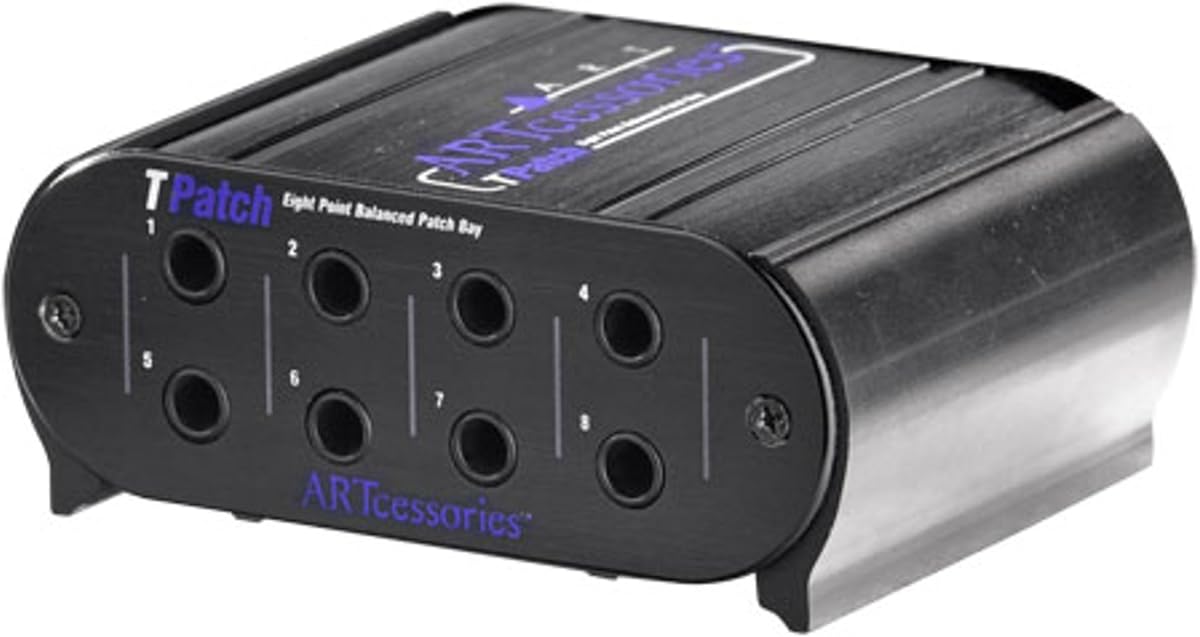
The Art Pro Audio TPatch is an eight-point balanced patch bay with a 4.6 rating. It uses four linked input-output pairs and 1/4-inch TRS connectors, making it a compact option for a small studio, project room, or a limited zone within a larger rack.
We may earn a commission when you buy through this link, at no additional cost to you.
The patchbay supports switchable half-normal and normal operating modes, including through-type connections. Those options let an operator temporarily interrupt or bypass a route without removing the entire patch panel or permanently changing the wiring.
Its main limitation is capacity. Eight points will not suit a control room that needs to centralize dozens of devices, and TRS connectors differ from the XLR connections used by many microphones and snake boxes. The rugged extruded aluminum case is a positive for portability, but buyers should confirm the physical fit for their rack and workflow.
The TPatch works best for small, focused signal groups, such as four stereo line-level paths or a compact mixer section. It is a sensible pick when a full 16- or 48-point panel would be excessive and the required mode changes justify a dedicated patch bay.
Four linked input-output pairs provide enough routing for a compact stereo or short multichannel section. This makes the TPatch more approachable than a large panel when only a few routes need frequent access.
Normal and half-normal modes offer useful control over signal interruption and bypass behavior. The through-type connections help integrate the panel into a broader studio signal chain.
We may earn a commission when you buy through this link, at no additional cost to you.
The Hosa PDR-369 is a reversible 12-point balanced XLR patchbay with a 4.4 rating. It fills the gap between compact eight-point panels and larger 16-point models, providing a focused hub for a studio that does not need dozens of accessible routes.
We may earn a commission when you buy through this link, at no additional cost to you.
XLR connectivity makes the PDR-369 straightforward to deploy in rooms already using balanced microphone or line-level cables. Reversibility allows the connector arrangement to adapt to different panel swaps and equipment configurations, adding flexibility without requiring a multi-format patchbay.
The supplied information contains very little detail, so confirmation of normalization, construction, dimensions, and included hardware is important. There is also no indication of per-channel mode controls, which may make the unit cleaner to operate but less flexible than specialized normalled patchbays.
Choose the PDR-369 for a compact, XLR-based routing section where reversible connections and balanced patching are the main priorities. It is well matched to mobile rigs, small project studios, and racks that need a moderate number of dedicated XLR paths.
The panel provides a useful middle ground between compact and high-density patchbays. It can support a dedicated preamp, converter, or console section without occupying as much rack space as a 16- or 48-point model.
A reversible XLR layout offers more freedom when the studio's equipment or connector orientation changes. This is helpful for rental rooms, mobile racks, and evolving production spaces.
We may earn a commission when you buy through this link, at no additional cost to you.
The right studio patchbay depends on your cable ecosystem, signal paths, rack space, and routing habits. Connector format and capacity establish the basic fit, while normalization, construction, and maintenance access determine how useful the panel will be day to day.
Choose the format already dominant in your rack, and buy patch cables that match it. A technically impressive panel is inconvenient if every existing cable must be replaced.
Choose a capacity that covers current needs with practical room for expansion. Avoid paying for unused points simply because a larger panel appears more professional.
Choose a panel whose mode behavior matches the signal flow you need. If bypassing or interruption is important, select a model with clearly documented and accessible mode controls.
Choose a solidly constructed panel with a rack footprint that matches your cabinet. Confirm that the mounting ears, included hardware, depth, and orientation suit the available space.
Choose reversible connectors when the rack may be reconfigured or when front and rear orientation is uncertain. Fixed layouts may be simpler when the installation is permanent.
Choose modular construction when frequent reconfiguration is likely. For a stable studio with a straightforward signal path, prioritize dependable fixed wiring and the required modes.
Choose a high-density system only when your cable inventory and technical workflow support it. For most conventional rooms, XLR or TRS offers a gentler learning curve.
Choose features that solve a recurring studio problem. Every extra mode, display, and connection standard should make a genuine difference in your daily workflow.
Begin by drawing the intended signal flow on paper, including every source, destination, default connection, and bypass route. Confirm connector formats and normalization behavior before moving equipment. Label both ends of every patch cable, and use consistent color or numbering conventions for related channel groups.
Install the patchbay in a ventilated, accessible rack position with enough depth for the connectors and cables to sit without strain. Connect the rear equipment first, then configure the front routing switches for the intended operating mode. Make small changes one at a time and listen to the signal path after each adjustment to isolate mistakes quickly.
Inspect connectors for dust, bent pins, loose hardware, and cable strain during routine maintenance. Avoid hanging heavy patch leads from the panel, and support cable bundles so they do not pull against the sockets. If a route develops noise, dropout, or unexpected signal behavior, test with a known-good cable and inspect the affected connector before assuming the patchbay has failed.
A studio patchbay centralizes connections among microphones, preamps, mixers, recorders, monitors, and outboard equipment. It makes common signal routes easier to reach and reduces the need to reconnect cables behind a console or rack. With the right normalization modes, it can also support temporary bypasses and alternate routing paths.
Choose XLR if your studio already uses XLR cables for balanced audio connections. Choose TRS if most of your line-level routing uses 1/4-inch balanced cable. The best option is usually the format already common in your rack, because switching formats can require new cables and additional adapters.
A normalled connection remains active by default and is usually broken when a patch cable is inserted. A half-normalled connection uses a second switching arrangement to allow the default signal to be interrupted or bypassed. Exact behavior can vary by model, so consult the current documentation before relying on either mode.
An eight- or 12-point panel may be enough for a focused collection of preamps, stereo paths, or console connections. Larger studios may prefer 16 points for a dedicated equipment zone or 48 points for comprehensive line-level routing. Count frequently changed connections rather than every cable in the facility.
Reversible connectors provide flexibility because the panel can adapt to different front and rear wiring arrangements. They are especially useful in rental rooms, mobile rigs, and changing production environments. In a fixed installation with a clearly defined signal flow, a conventional orientation may be simpler to label and operate.
A quality patchbay primarily improves organization, accessibility, and routing flexibility. It may support a clean signal path through balanced wiring, shielding, and dependable connectors, but it cannot correct a poor source, faulty cable, grounding issue, or badly designed studio. Audio quality also depends on the connected equipment and the overall signal chain.
A balanced XLR patchbay can be used with many studio sources, but connection format alone does not determine signal level or suitability. Some preamps, consoles, and interfaces use different input and output roles, and switchable mic-line inputs may require specific settings. Confirm the electrical requirements of every connected device before patching it.
Label every front and rear connector with a consistent source and destination system, such as source first and destination second. Use numbered tape or printed labels that will not fade under handling, and record the same information in a saved patch schedule. A clear diagram makes temporary changes easier to reverse and reduces accidental interruptions.
The AA AUDIO ACCESSORY AP16 stands out as the most versatile overall option because its modular four-channel blocks, balanced XLR connections, full-steel construction, and reversible rack ears support both current and future configurations. The Samson S-Patch Plus is a high-capacity, highly rated choice for balanced TRS workflows, while the Black Lion Audio PBR TT LIT is the premium option for specialized high-density routing with visual displays.
Prioritize connector compatibility, the number of routes you genuinely use, and the normalization behavior required by your signal flow. Construction and maintenance features become especially valuable in a permanent studio, while modularity is useful when equipment changes frequently. For most balanced XLR studios, the AP16 and ART P16 deserve close comparison; for TRS-based racks, the Samson and Behringer models offer more mode control.
Ratings, prices, and availability can change over time, so verify the current listing and product documentation before ordering. Also confirm rack dimensions, connector orientation, rear clearance, and included hardware. A carefully matched patchbay can make routing cleaner and faster while fitting naturally into the way your studio actually operates.