
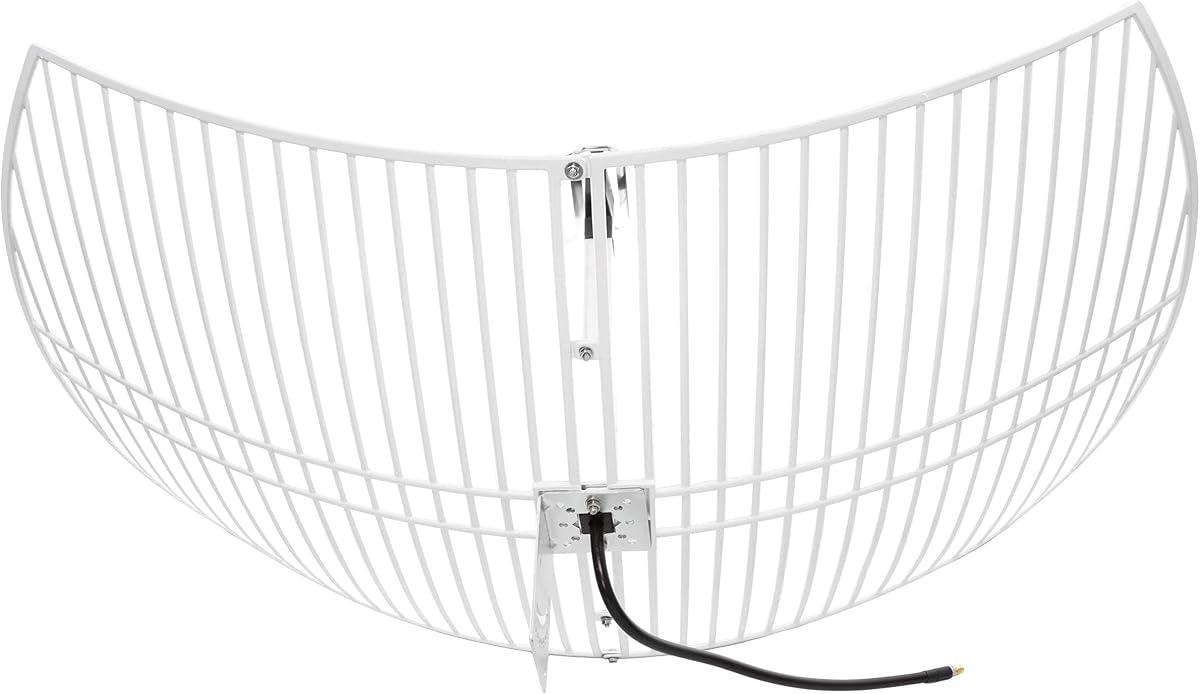
2.4GHz Outdoor Grid Parabolic Set
5.0Editor score
20 dBi directional 2.4GHz gain
Bracket and clamps included
RF400 cable and SMA adapter
Our Parabolic WiFi Antenna guide compares ten directional models for gain, frequency range, connectors, outdoor durability, WiFi performance, and setup needs.
A parabolic WiFi antenna can turn an ordinary router or USB adapter into a more focused, long-range system by concentrating radio energy toward a specific access point. The right model depends on frequency coverage, connector compatibility, gain, mounting requirements, and whether the installation has a clear line of sight.
This guide compares ten directional and grid-style antennas using the supplied specifications, customer ratings, included components, and intended applications. It covers WiFi, cellular, and satellite models so readers can distinguish true multi-purpose options from antennas designed for a narrower frequency band or specialist reception.
Each review explains the product's strongest qualities, practical trade-offs, and ideal installation. The comparisons highlight why line of sight, cable loss, connector type, and MIMO support can matter as much as headline gain. Product availability and pricing can change, so confirm current details before buying.
5.0Editor score

4.2Editor score

3.0Editor score
The table below compares the included antennas by application, gain, operating range, and practical hardware. It also separates dedicated WiFi models from cellular and satellite alternatives that may require additional receiver equipment.




The Griddy Grid Parabolic Antenna is the most adaptable option in this guide, combining a 600–6500 MHz operating range with band-specific gain for WiFi, LTE, and 5G applications. Its 4.2 rating reflects a useful balance of performance and customer satisfaction, while the antenna-only format keeps the core product focused for installers who already know their connector requirements.
We may earn a commission when you buy through this link, at no additional cost to you.
Its standout advantage is the breadth of the design. Griddy is specified to provide 12–17 dBi of gain from 600–960 MHz, 20–23 dBi from 1700–2700 MHz, and 23–26 dBi from 3000–6500 MHz. That makes it a practical choice when one directional antenna must handle several generations of wireless equipment rather than only a single 2.4 GHz WiFi band.
The trade-offs are mostly about installation discipline. The high gain concentrates energy into a narrow area, so trees, buildings, and other obstructions can sharply reduce effectiveness. This antenna also uses 50-ohm N-Type connectors, and the antenna-only version does not include the TS9 and SMA adapters supplied with the complete kit. Those requirements are manageable but must be addressed before installation.
This is the best overall choice for a technically confident buyer who needs one antenna to cover WiFi, cellular, and emerging 5G equipment. Buy the antenna-only version if the receiving device already uses N-Type connections or you already own suitable adapters. Choose the complete kit instead if you want greater flexibility across different router, booster, and modem connectors.
Rather than limiting performance to one WiFi channel, Griddy spans low cellular, mid-band cellular, and high-frequency wireless services. That makes it particularly useful for rural connectivity, cellular hotspot, and fixed wireless access projects where equipment requirements may evolve.
A directional grid antenna offers its greatest benefit when it can be aimed directly at the transmitter. Mount it where the path to the router, tower, or access point is as open and unobstructed as practical.
We may earn a commission when you buy through this link, at no additional cost to you.
The Griddy Complete Kit offers the same wideband parabolic design as the antenna-only model but adds the adapters that make it easier to connect to more equipment. Its 4.0 rating reflects a solid overall reception, and the package includes 50-ohm N-Type connections plus TS9 and SMA adapters for common cellular and WiFi devices.
We may earn a commission when you buy through this link, at no additional cost to you.
The key strength is readiness. Instead of requiring a separate trip to identify and purchase interface hardware, buyers receive several common connection options in the box. The antenna can therefore be integrated more efficiently with signal boosters, LTE routers, hotspots, and WiFi access points, particularly when a project involves more than one device type.
As with the antenna-only Griddy, performance depends heavily on alignment and line of sight. Its high gain will not compensate for placing the antenna behind a wall, inside foliage, or at an unrelated angle. The complete kit also does not include every conceivable cable or adapter, so installers should still verify the exact port on the receiving device.
This kit is best for buyers who want broad frequency support and included connector flexibility without assembling every part separately. It is an especially strong choice for cellular signal projects and mixed-device installations. Users who already own the right N-Type, TS9, or SMA connections may find the antenna-only version offers a more streamlined package.
The included TS9 and SMA adapters reduce the need for separate interface hardware. They are especially helpful for connecting cellular modems, boosters, and compatible WiFi equipment without compromising the antenna's directional design.
The 600–6500 MHz range allows the same antenna architecture to serve cellular and WiFi tasks. Multiple units can also be deployed for MIMO systems when the receiving hardware exposes multiple antenna ports.
We may earn a commission when you buy through this link, at no additional cost to you.
The Nooelec GOES Mesh Antenna is a 21 dBi parabolic antenna centered on 1.7 GHz, making it a specialist choice for receiving weather-satellite imagery. It is designed to work with an RF system containing suitable SDR, filtering, and low-noise amplification hardware, and it carries a 4.0 customer rating.
We may earn a commission when you buy through this link, at no additional cost to you.
Its 200 MHz-plus bandwidth covers applications around 1.6–1.8 GHz, including GOES HRIT and LRIT, NOAA HRPT, Meteor M2 HRPT, Metop, and FengYun. It can receive both linearly and circularly polarized signals, including right-hand and left-hand circular polarization, giving it broader relevance for different satellite transmission formats.
This is not a plug-and-play WiFi antenna. Decoding software is required, with SatDump identified as a recommended cross-platform option; XRIT Decoder is another available program, though its license is not included. The LMR400 feed cable, male SMA connector, mounting hardware, and two-year warranty make the physical package well supported, but the receiver chain remains essential.
Buy this model for satellite enthusiasts, remote sensing stations, and high-resolution weather-image reception. It is not the right purchase for a normal home WiFi network, even though both categories involve directional microwave-frequency signals. For those users, the dedicated 2.4 GHz grid models offer more appropriate frequency and connector choices.
The 1.7 GHz center frequency and broad bandwidth are tuned to weather-satellite transmission bands. That focus makes it more appropriate for HRIT, LRIT, and HRPT work than a generic WiFi dish.
The package includes a low-loss LMR400 feed cable and mounting hardware, but a compatible SDR, filter, low-noise amplifier, and decoding software remain necessary. Plan the full signal chain before purchasing.
We may earn a commission when you buy through this link, at no additional cost to you.
The 2.4GHz Outdoor High Gain External Kit is a focused, practical parabolic WiFi antenna for users who need a strong 2.4 GHz link. Its 5.0 rating is the highest listed among the ten products, and the supplied specifications clearly define its operating range, gain, impedance, and power handling.
We may earn a commission when you buy through this link, at no additional cost to you.
This grid parabolic antenna provides 20 dBi of gain across 2400–2500 MHz with vertical polarization, 50-ohm impedance, VSWR of 1.5 or lower, and maximum input power of 100 watts. The included RF400 cable, right-angle bracket, U-bolt clamps, and SMA male adapter make it a more complete installation package than a bare antenna.
The primary limitation is its narrow 2.4 GHz focus. It cannot be used for a 5 GHz WiFi link, and it offers no cellular-band flexibility. Although the gain figure suggests considerable range, the real benefit depends on clean alignment, a short or well-placed cable route, and the absence of trees or buildings between the two endpoints.
This is the best budget pick for a rural WiFi receiver, remote camera, point-to-point backhaul, or other 2.4 GHz installation where the transmitter is in a fixed direction. It is particularly attractive for first-time antenna buyers because the basic mounting and connection hardware is included. The complete Griddy remains preferable when multi-band flexibility is the priority.
The bracket, clamps, RF400 cable, and SMA adapter cover the principal installation components. This reduces the need to source separate mounting hardware and a basic interface cable for a straightforward 2.4 GHz link.
At 2.4 GHz, a lower-loss cable helps preserve the performance gained by the directional antenna. Place the radio device near the end of the run or use quality cable rather than adding avoidable length.
We may earn a commission when you buy through this link, at no additional cost to you.
The 5G 4G LTE Wide Band 2×2 MIMO Parabolic Antenna is the most ambitious cellular-focused product in the list. It advertises 34 dBi gain, 600–6000 MHz frequency coverage, and a dual-feed arrangement intended for 5G, 4G, LTE, and WiFi devices. Its 3.0 rating calls for more caution than the leading models.
We may earn a commission when you buy through this link, at no additional cost to you.
The package is designed for serious fixed-wireless installations. It includes one directional parabolic antenna, two 49-foot low-loss SMA cables, two TS9 cables, two N male adapters, and pole-mount brackets. Supporting 2×2 MIMO can help compatible cellular routers take advantage of multiple spatial streams, while the wide operating range can simplify equipment selection.
A crucial point of interpretation is that the headline 34 dBi is a maximum advertised figure, not a constant output across the entire 600–6000 MHz spectrum. Real gain varies by frequency, and system performance also depends on carrier compatibility, router antenna ports, cable placement, obstruction, and regulatory or device transmit-power limitations. The relatively low rating reinforces the need to verify the exact installation.
This antenna is best for a buyer building a dedicated 5G or LTE home-internet system with two external antenna ports and a clear view of a tower. It is less suitable for a simple single-antenna router or for users unwilling to optimize alignment and cable routing. Compared with Griddy, it offers a more explicitly cellular MIMO package but a less established customer-rating profile.
The two-lead arrangement is intended to support 2×2 MIMO equipment, allowing compatible devices to compare signals received through separate paths. The benefit depends on correct pairing and placement of the two feeds.
A 34 dBi maximum does not mean every frequency receives 34 dBi. Review the antenna's performance at the exact bands used by your carrier and keep the feed cables short, properly terminated, and free from sharp bends.
We may earn a commission when you buy through this link, at no additional cost to you.
The Eifagur Outdoor Dual-Band Directional Panel Antenna is a practical alternative for users who want both 2.4 GHz and 5 GHz WiFi coverage without moving to a very wideband cellular antenna. Its 4.3 rating indicates favorable customer feedback, while the 15 dBi gain and broad device compatibility make it relevant to several common networking tasks.
We may earn a commission when you buy through this link, at no additional cost to you.
The antenna covers 2400–2485 MHz and 5150–5850 MHz, allowing it to support 802.11 b, g, n, and ac equipment. A directional RP-SMA male connector and included ten-foot RG58 cable simplify connection to compatible routers, repeaters, access points, wireless cards, and IP cameras. Its outdoor waterproof panel construction is useful where the receiving device is not in direct line of sight.
This is not a parabolic grid dish, and it does not cover cellular frequencies. Its gain is lower than many of the grid models, but the dual-band capability and simple panel format can be more valuable for a typical dual-band WiFi installation. RG58 is also less ideal for long runs than lower-loss cable, so the ten-foot lead should not be unnecessarily extended.
Choose this model for a home, office, farm, or surveillance installation that needs one directional antenna across both WiFi bands. It is less appropriate for a long point-to-point link where maximum dish gain and low-loss feed cable are the main priorities. The 2.4 GHz grid options offer more focused gain, while Griddy offers a much broader cellular-and-WiFi range.
Dual-band coverage is useful when the target access point transmits on either 2.4 GHz or 5 GHz. This can simplify an installation without requiring a separate antenna for each band.
The RP-SMA male termination and ten-foot lead suit many routers, access points, and cameras. Confirm the device's antenna connector and supported frequency bands before installation.
We may earn a commission when you buy through this link, at no additional cost to you.
The Nooelec Satellite Mesh Antenna Bundle is a 20 dBi parabolic antenna optimized for L-band applications, with a 1.4 GHz center frequency and bandwidth greater than 300 MHz. Its 4.4 rating is among the strongest in the group, although its intended uses are satellite communication, remote sensing, and weather tracking rather than ordinary home WiFi.
We may earn a commission when you buy through this link, at no additional cost to you.
The stated applications include Inmarsat, Iridium, and Hydrogen Line signals. A sub-reflector is used to enhance performance, while the stationary nature of these installations makes a fixed high-gain dish a natural fit. The package includes an LMR400 feed cable attached to the arm, an SMA termination, and a mounting kit designed for different installation situations.
The tradeoff is specialization. A satellite mesh antenna centered at 1.4 GHz is not a substitute for a 2.4 or 5 GHz WiFi dish, and it may not suit every transmitter within the L-band range without considering polarization, feed characteristics, and receiver requirements. The included hardware is valuable, but a suitable radio and application-specific configuration are still necessary.
This bundle is recommended for satellite communication users, remote monitoring stations, and technically experienced operators working with supported L-band services. It is a strong specialist parabolic antenna, but it should not appear on a shortlist for a conventional WiFi router without an extremely specific reason. For weather imagery near 1.7 GHz, the GOES model is the more relevant alternative.
The 1.4 GHz center frequency and broad bandwidth target a distinct section of the radio spectrum. This concentration supports satellite and remote-sensing applications where predictable directional performance is valuable.
The arm, attached coaxial cable, sub-reflector, and versatile mounting hardware support a stationary setup. Alignment should be finalized before the assembly is tightened in place.
We may earn a commission when you buy through this link, at no additional cost to you.
The 2.4GHz 25dBi Yagi Directional Antenna is a high-gain alternative to a parabolic dish for point-to-point or fixed-direction 2.4 GHz WiFi. It has a 4.5 rating, a maximum gain of 25 dBi, a 50-centimeter antenna, and a 1.5-meter cable, making it a compact choice for routers, cameras, adapters, and industrial equipment.
We may earn a commission when you buy through this link, at no additional cost to you.
The supplied specification identifies a 2400–2483 MHz operating range, 50-ohm impedance, an RP-SMA male connector, and aluminum alloy construction. It is described as waterproof and suitable for outdoor use. Because the connector is attached to the included lead, the antenna can often be installed without adding another adapter when the receiving device uses RP-SMA.
The main limitation is that it supports only 2.4 GHz devices, not 5 GHz equipment. The stated 25 dBi is maximum gain, and a directional Yagi still needs accurate positioning toward the source. Its narrow beam and limited signal tolerance mean it is better suited to a clean link than to picking up a mobile transmitter from a changing direction.
Choose this antenna for a fixed WiFi camera, remote router, USB adapter, PCI Express card, or industrial link where the transmitter is stationary and 2.4 GHz is the correct band. It offers an attractive balance of gain, compact size, and simple installation. Users seeking dual-band support should look at the Eifagur panel instead.
A Yagi antenna can deliver strong directional performance in a smaller package than many dishes. The compact 50-centimeter element is easy to mount on a wall bracket or fixed structure.
Because directionality concentrates reception toward one target, this option works best when the access point remains stationary. Mobile devices that move around the coverage area may benefit more from an omnidirectional antenna.
We may earn a commission when you buy through this link, at no additional cost to you.
The 16dBi 2.4GHz Directional Yagi is a versatile antenna for WiFi adapters, routers, cameras, remote controls, and other equipment operating on 2.4 GHz. Its 3.9 rating is respectable but lower than most alternatives, and its 16 dBi gain offers a more moderate proposition than the 20 to 25 dBi models nearby.
We may earn a commission when you buy through this link, at no additional cost to you.
The antenna operates from 2400 to 2500 MHz and includes RP-SMA male and SMA male connector options. A two-meter extension cable and mounting accessories give installers some placement freedom, while the directional pattern is intended to strengthen a target while reducing interference arriving from other directions.
Compared with a 25 dBi Yagi, the lower gain may be easier to achieve and maintain in a real installation, particularly when alignment is not perfect. The tradeoff is less reach and less resistance to interference. As with any Yagi, the exact vertical and horizontal pattern, mounting orientation, and target direction matter more than the headline number alone.
This is a good match for drone controls, USB wireless adapters, cameras, routers, and other fixed or portable 2.4 GHz systems. It is particularly useful where the antenna must be separated from the device by a short extension while retaining a reasonably narrow beam. It is not suitable for 5 GHz networks and should not be selected for cellular or satellite reception.
The two-meter cable allows the antenna to sit near a window, wall, or elevated mounting point while the radio remains elsewhere. This can improve a weak link without relocating the primary device.
Concentrating the pattern toward a known source can improve signal purity in busy environments. Aim the antenna carefully and avoid placing unnecessary metal or obstructions immediately in front of the elements.
We may earn a commission when you buy through this link, at no additional cost to you.
The 2.4GHz Outdoor External Directional Grid Parabolic Antenna is a clean, dedicated option for long-range 2.4 GHz WiFi. It has no listed customer rating, so its evaluation relies on the stated 17 dBi gain, 2400–2500 MHz frequency range, 50-ohm impedance, and maximum input rating of 100 watts.
We may earn a commission when you buy through this link, at no additional cost to you.
The grid dish is vertically polarized and specified at VSWR of 1.5 or lower. The package includes a right-angle mounting bracket and two U-bolt clamps, allowing secure attachment to a pole or suitable support. Its weather-resistant construction and corrosion-resistant materials are designed for outdoor service.
The main installation detail is the N-Type female connector. The supplied package does not list a coaxial cable or adapter, so users need a compatible N-Type lead and any required interface to the router or adapter. Cable quality and length should be considered carefully because avoidable loss at the end of a long link reduces the benefit of the dish.
This model is best for installers who want a focused 2.4 GHz outdoor antenna and already have the appropriate N-Type cable. Its supplied specifications are straightforward and suitable for point-to-point backhaul or remote reception. Compared with the 20 dBi 2.4 GHz grid kit, it provides less gain and fewer included accessories but maintains the same 100-watt input capability.
The open grid design and weather-resistant materials suit permanent directional installations. A right-angle bracket and U-bolt clamps support repeatable positioning once the target direction has been established.
Because the package centers on the antenna and mounting hardware, verify that you have a suitable N-Type coax and any device-side adapter. Use the shortest practical high-quality run to limit signal loss.
We may earn a commission when you buy through this link, at no additional cost to you.
The best parabolic WiFi antenna is not simply the model with the largest gain number. Frequency range, radiation pattern, connector type, cable quality, mounting environment, and the receiving device must all align with the intended link.
Start by identifying every frequency the receiving equipment must handle. Most conventional WiFi installations involve 2.4 GHz, 2.4 GHz plus 5 GHz, or a newer multi-band router, while cellular and satellite systems occupy entirely different ranges. A 2.4 GHz-only antenna will not improve a 5 GHz link, and a satellite mesh antenna is not a substitute for a WiFi dish. Products in this guide span 2.4 GHz WiFi, dual-band WiFi, 600–6000 MHz cellular and WiFi, and specialist L-band applications. Confirm that the advertised operating range overlaps the exact bands your device uses.
Gain indicates how strongly an antenna concentrates energy in its intended direction, but more is not automatically better. A higher-gain dish can improve a long, clear link while making alignment more critical and the usable sector narrower. Compare maximum gain with the usable bandwidth, beam width, and actual coverage pattern. A modest panel antenna may provide a more forgiving installation than a 25 dBi Yagi, while a 34 dBi cellular dish can be excessive for a short indoor link. The most useful figure is one that matches the distance, target stability, and obstruction level of the real installation.
Parabolic and Yagi antennas are directional, so line of sight is often more important than the difference between two gain ratings. Trees, walls, terrain, glass, and metal can reflect or absorb the signal, leaving a nominal maximum gain largely unused. Identify the transmitter's location and select a mounting position that gives the clearest path. If the source moves or is hidden behind obstructions, an omnidirectional antenna may be more appropriate. For long rural links, test alignment gradually and secure the final position before tightening every bracket and clamp.
The connector must physically and electrically match the antenna port on the receiving device or its cable. Common choices in this category include N-Type, RP-SMA, SMA, and TS9. RP-SMA and SMA are visually similar but are not interchangeable in every installation, and a nominal connector match does not guarantee suitable impedance or frequency support. Some packages include adapters and feed cables, while others provide only the antenna and mounting hardware. Check the complete package list before ordering and avoid adapters that require poorly supported or avoidable cable extensions.
An external antenna only preserves its potential performance if the signal reaches the radio through a suitable cable. Longer runs, adapters, and lower-quality coax can erase meaningful gains, particularly across wide cellular and WiFi bands. The RF400 cable in the 2.4 GHz kit and LMR400 feeds in the satellite bundles are designed to reduce loss, but the routing still matters. Keep the run short, avoid tight bends and sharp angles, and secure it away from moisture and interference sources. Mounting the radio near the antenna may be more effective than using a long convenience cable.
MIMO equipment uses multiple antenna paths to improve resilience, throughput, and interference handling. A single antenna cannot provide a true multi-path MIMO arrangement, although one directional unit may still improve a single-input device. The 5G 4G LTE model explicitly includes a 2×2 MIMO configuration, while Griddy can be deployed in multiple units when the host device supports multiple external antenna ports. Check the number and type of external ports, supported antenna diversity, and cable identification before installing multiple leads. Correct pairing and physical separation can be as important as the antenna itself.
For exterior installations, weather resistance, corrosion resistance, secure mounting, and wind tolerance matter as much as electrical specifications. The grid models in this guide specify outdoor-oriented construction, and the included brackets or clamps simplify attachment to a pole or wall. The satellite products also include mounting systems designed for stationary installations. Account for UV exposure, standing water, cable entry points, and wind loading. Secure the antenna so it cannot rotate or shift, but avoid tightening fasteners to the point that the mounting surface deforms. Weatherproofing the connector and cable joints is as important as protecting the dish.
Finally, confirm that the antenna and any required receiver equipment form a complete working system. A dedicated WiFi model may connect directly to a compatible router, access point, camera, or USB adapter. Satellite products require suitable radios, filters, low-noise amplification, and decoding software. Cellular installations may require a booster, LTE router, or fixed-wireless device with the correct external ports. Read the included requirements, verify connector gender and polarity, and avoid buying a high-gain antenna for a device that lacks an antenna port or an application that requires a different frequency.
Begin by identifying the transmitter, confirming its frequency, and selecting a mounting point with the clearest possible view. Assemble the antenna according to its instructions, connect the appropriate low-loss feed cable, and make a preliminary power or signal-level adjustment before permanent tightening. Directional models work best when they point toward the source rather than merely toward the general direction of a building.
Mount the antenna securely on a rigid bracket, pole, wall, or other suitable support. Keep the feed cable away from sharp bends, metal structures, power cables, and known sources of interference. Seal exposed connections with a suitable weatherproof method, allow any drainage path to remain open, and inspect the installation after strong wind or a major weather event.
Test performance from the intended operating area and compare results at several distances. Fine-tune horizontal and vertical alignment, reposition the antenna higher, or reduce cable length if the signal is weaker than expected. If improvements are minimal, check for obstructions, connector mismatches, unsupported frequency bands, device-side limitations, or interference before assuming the antenna itself is defective.
A parabolic WiFi antenna concentrates radio energy toward a specific access point to improve reception or transmission over a directional link. It is especially useful for rural WiFi, point-to-point backhaul, remote cameras, and fixed wireless access. The gain is most useful when the antenna has a clear line of sight and is accurately aimed at the transmitter.
No. Higher gain can improve a clear directional link, but it also narrows the effective coverage area and makes alignment more sensitive. Trees, walls, and terrain may prevent the advertised performance from reaching the device. Match the gain to the distance and stability of the target rather than assuming the largest number is always best.
A dish designed only for 2400–2500 MHz cannot effectively serve a 5 GHz network. You need an antenna whose stated frequency range includes the 5 GHz band used by the router and access point. Dual-band panel antennas may cover both bands, while wideband cellular antennas can cover WiFi and cellular frequencies but require careful attention to their detailed specifications.
They can, but walls and furniture often prevent a meaningful line of sight. Indoor use is generally most effective for a specific nearby access point, especially when an external or better-positioned router antenna is the problem. If the transmitter is in another room or its location changes, a more moderate directional antenna or omnidirectional option may be easier to use.
A parabolic grid uses a dish-shaped reflector to focus energy into a directional beam, while a Yagi uses a driven element with reflectors and directors. Both can provide high gain in one direction, but their beam behavior, physical construction, and mounting characteristics differ. The grid often provides a compact dish form, whereas a Yagi can be especially effective for a fixed 2.4 GHz link.
You need a feed cable and adapter arrangement that matches both the antenna connector and the receiving device. N-Type, SMA, RP-SMA, and TS9 connections appear across these products and are not all interchangeable. Check the package list, use a low-loss cable, and avoid unnecessary adapters or long extension runs that can reduce signal quality.
Some very wideband models, such as Griddy, cover 600–6500 MHz and are designed for cellular, 5G, and WiFi applications. The gain varies by frequency, and the device must have compatible external antenna ports and connectors. A 2×2 MIMO cellular system may also require multiple antennas or a multi-feed arrangement to realize its full design.
Point the antenna toward the exact transmitter and adjust both horizontal and vertical angles while checking the signal or throughput. Secure the mounting only after finding the strongest stable result. If the target is difficult to identify, move the antenna gradually and monitor readings rather than making large changes based on direction alone.
The Griddy Grid Parabolic Antenna stands out as the strongest all-around recommendation because it combines broad 600–6500 MHz coverage with strong band-specific gain and support for WiFi, LTE, and 5G. The 2.4GHz Outdoor Grid Set is the best budget choice for a focused 2.4 GHz installation, while the dual-feed cellular model offers the most ambitious premium package for compatible 5G and LTE routers.
Prioritize frequency compatibility, line of sight, and the complete signal chain before focusing on a headline gain figure. Verify connector type, cable quality, MIMO requirements, and the need for a separate receiver. Satellite-focused options belong on a specialist shortlist rather than a conventional WiFi shortlist, and narrow-band Yagis can be effective when the target is fixed and only 2.4 GHz is required.
Product specifications, included accessories, ratings, and availability can change, so check the current listing before making a final purchase. Comparing the exact connector and frequency requirements against your own equipment will prevent an expensive mismatch and make the installation substantially easier.