
MARSENERGY 12V 100Ah Group 24
4.8Editor score
Up to 15,000 cycle claims
Lightweight Group 24 format
Comprehensive multi-layer protection
Our expert guide compares 10 lithium batteries for boats, covering marine protection, capacity, cold-weather performance, expandability, monitoring, and
Lithium batteries for boats can add usable capacity, reduce weight, and simplify maintenance compared with many traditional lead-acid installations. The right model depends on your boat layout, trolling motor, electronics, charging system, and exposure to cold, spray, vibration, and prolonged inactivity.
We compared all 10 featured batteries using the supplied specifications, including energy capacity, physical size, weight, BMS protection, temperature controls, cycle claims, monitoring features, expansion limits, and marine-specific safeguards. The list covers energy-storage batteries, trolling-motor batteries, and one dual-purpose cranking model.
Each review reveals which requirements the product addresses and where its compatibility details deserve attention. Our top selections include the Litime 12V 100Ah trolling-motor battery, the MARSENERGY Group 24 unit, and the SUPER EMPOWER Group 24 battery. Product availability and pricing can change over time.
4.8Editor score

4.7Editor score

4.6Editor score
This side-by-side comparison highlights the most important differences among the featured lithium marine batteries, including form factor, usable capacity, cold-weather controls, expansion options, monitoring functions, and whether a model supports engine cranking.




The SUPER EMPOWER 12V 100Ah Group 24 is a 12.8-volt lithium iron phosphate deep-cycle battery with a 4.6 customer rating. It combines a familiar BCI Group 24 format with an integrated 100A battery management system, making it a practical candidate for boat house loads, trolling systems, marine electronics, and broader off-grid energy storage.
We may earn a commission when you buy through this link, at no additional cost to you.
Its most useful feature is the straightforward physical transition from a standard lead-acid, AGM, or SLA installation. The listed dimensions are 6.49 inches deep, 10.24 inches wide, and 8.98 inches high, with M8 terminals and a 21.6-pound weight. That lets owners consider the unit in existing Group 24 boxes while gaining the lower weight and deeper usable capacity associated with LiFePO4 chemistry.
The battery supports up to four units in series and four in parallel, allowing a 51.2V, 400Ah, 20.48kWh configuration. Its BMS includes overcharge, over-discharge, overcurrent, short-circuit, and temperature protection, while charging pauses below 32°F and discharging stops around minus 4°F. These protections are important in marine environments, but the charging requirements are specific: a LiFePO4 charger operating at 14.4 to 14.6 volts is recommended.
This is a strong option for a boat owner who values familiar dimensions, expandable capacity, and a long warranty without needing Bluetooth monitoring. It is not a starter battery, and non-lithium chargers are not recommended. If your battery box has clearance and your charging equipment is lithium-compatible, it is a versatile and cost-conscious marine energy-storage choice.
Matching the common BCI Group 24 format reduces the physical modifications required during a conversion. The M8 terminal arrangement and stated dimensions make the battery attractive for standard battery boxes, although boaters should still measure their compartment and confirm cable reach before installation.
The supported 4S4P arrangement can scale one 100Ah unit into a much larger bank. Expansion should follow the manufacturer's instructions, and every battery in a connected bank should be compatible in age, capacity, and charge state to help the BMS manage the system effectively.
We may earn a commission when you buy through this link, at no additional cost to you.
The BUKNUWO 12V 100Ah is a 12.8-volt, 1.28kWh LiFePO4 battery with Bluetooth 5.0 monitoring and a 4.2 customer rating. Its standout feature is the companion app, which can display state of charge, voltage, current, power, temperature, charging status, discharging status, and protection status from a range of up to 33 feet.
We may earn a commission when you buy through this link, at no additional cost to you.
The battery is positioned as a high-utilization alternative to conventional lead-acid chemistry. Its published figures include up to 95% capacity utilization, 4,000 cycles at 100% depth of discharge, 6,000 at 80%, and 15,000 at 60%. A 100A BMS provides overcharge, over-discharge, short-circuit, overheating, and overcurrent protection, with temperature cutoffs for both charging and discharging.
For boat applications, the monitoring functions are especially useful because a remote installation can be difficult to inspect directly. The ABS casing is described as dustproof, weather-resistant, and lightly waterproof, while the 22-pound weight is substantially lower than a comparable 100Ah lead-acid battery. Expansion to 4S4P is also available for larger house and trolling-motor banks.
The main trade-off is its lower 4.2 rating compared with the stronger customer scores in this list. The specification also notes that voltage and current readings can vary by roughly 1% to 5% because of temperature, humidity, and measurement methods. It is best suited to owners who value remote diagnostics and will maintain the battery through periodic charge-and-discharge cycles during extended storage.
Bluetooth monitoring can reduce uncertainty when a battery is mounted in a sealed compartment or away from the helm. The app's charge, temperature, and protection information gives boaters a clearer view of system condition without requiring direct access to the battery.
The stated 95% utilization rate is meaningful for boaters who want more of the nominal capacity available for electronics and trolling motors. Actual results still depend on charger quality, temperature, current draw, wiring, and how deeply the battery is regularly discharged.
We may earn a commission when you buy through this link, at no additional cost to you.
The Litime 12V 100Ah Trolling Motor battery is a 4.7-rated deep-cycle LiFePO4 unit designed around marine electronics and trolling motors. It meets the ABYC E-13 standard and combines dust, water, and salt-spray shielding with BMS protection against overcharge, overheating, and short circuits, making it a particularly well-aligned choice for exposed boat installations.
We may earn a commission when you buy through this link, at no additional cost to you.
Built-in transient-voltage suppression is designed to protect compatible 12V to 36V trolling motors from voltage spikes. The battery weighs 22.16 pounds in a standard Group 31 format, and the manufacturer describes it as 64% lighter than a 12V 100Ah lead-acid battery. That reduction can help boat handling while preserving enough nominal capacity for all-day fishing use.
Temperature management stops charging below 32°F and discharging below minus 4°F. The battery can expand to 4P4S, producing a listed 51.2V, 400Ah, 20.48kWh configuration, and the manufacturer claims more than 4,000 cycles at 100% depth of discharge. These are useful specifications for owners planning a larger trolling or house-load bank.
The crucial limitation is that it is not intended for engine starting, golf carts, or powered jacks. It also uses a Group 31 case rather than the Group 24 format found in many boat compartments. Subject to those constraints, it offers one of the most marine-specific feature sets in this roundup and is our strongest general choice for a trolling-focused installation.
Salt spray, moisture, and dust are constant concerns around a battery compartment. The battery's triple BMS shielding and ABYC E-13 compliance make it a more purpose-specific choice for marine use than a general-purpose energy-storage unit without stated marine certification.
At 22.16 pounds, the Group 31 battery can make a trolling setup easier to install and service. The lower weight also matters on smaller boats where every saved pound can influence loading, balance, and the effort required to move equipment.
We may earn a commission when you buy through this link, at no additional cost to you.
The DC HOUSE 12V 100Ah Bluetooth battery combines a trolling-motor focus with cell-level remote monitoring and a 4.5 customer rating. The DC HOUSE app displays state of charge, voltage, current, and other battery information through Bluetooth 5.1 over a stated range of five to ten meters.
We may earn a commission when you buy through this link, at no additional cost to you.
Unlike a simple app that only shows a percentage, this system includes cell-specific data, a dedicated fault page, and push notifications for detected anomalies. Those tools can help an owner identify an imbalance, abnormal voltage, or operating condition before a battery issue becomes a trip-ending problem.
The case is described as close to BCI Group 24 size but approximately 0.32 inches taller than the standard specification. It supports a maximum of eight batteries in a system, with up to four in series or four in parallel, but a full 4P4S arrangement is not allowed. Low-temperature controls halt charging below about 19.4°F, stop discharge below minus 4°F, and restore operation after the battery warms to 32°F.
The manufacturer cites up to 15,000 cycles and a 10-year service life under appropriate use, along with UL and UN38.3 test certification for its cells. It is not a cranking battery, and the Group 24 height difference may require box clearance checks. For owners who prioritize diagnostics over Bluetooth range, it is a particularly attractive marine battery.
A dedicated fault page and immediate anomaly notifications make the monitoring system more useful than a basic fuel-gauge display. These features can help a boater decide whether a charging, connection, or battery problem needs attention before heading back to shore.
The near-Group 24 format can simplify a conversion, but the extra height deserves attention in tight compartments. Measure from the battery base to the lid and allow room for terminals, ventilation, cable movement, and any tray or restraint required by the installation.
We may earn a commission when you buy through this link, at no additional cost to you.
The Hey Future 12V 100Ah Bluetooth battery is a standard-size Group 24 deep-cycle lithium iron phosphate battery with a 4.4 rating. It targets boats, trolling motors, RVs, yachts, solar storage, and other mobile energy systems, combining a 100Ah capacity with a smart BMS and remote battery visibility.
We may earn a commission when you buy through this link, at no additional cost to you.
The BMS is described as protecting against overcharge, over-discharge, overcurrent, and overheating. Its dustproof, waterproof, and low-temperature cutoff functions are particularly relevant for humid or exposed marine environments. The product also uses Bluetooth monitoring, although the supplied information does not detail the app's range or exact set of displays.
A maximum 4S4P configuration supports a listed 48V, 400Ah storage system, giving owners room to expand a bank for heavier electrical loads. The manufacturer recommends professional assembly and following the instructions strictly, which is sensible advice for a multi-battery installation involving high current and series voltage.
The Group 24 format makes the battery appealing as a lead-acid replacement, but the listing warns that some older lead-acid charging systems are not compatible without upgrades. That qualification matters more than the physical fit because LiFePO4 batteries require an appropriate charge profile. It is a flexible option for owners prepared to use compatible charging equipment and follow the manufacturer's connection guidance.
The stated protection against dust, water, humidity, and temperature extremes reflects the environments common to boat use. It remains important to secure the battery, maintain cable connections, and use a charging system configured specifically for lithium chemistry.
The 4S4P capability supports a much larger energy-storage system than a single unit. Expansion is not entirely automatic, however, so matching batteries, checking polarity, and following the specified wiring sequence are essential parts of a safe installation.
We may earn a commission when you buy through this link, at no additional cost to you.
The Lithova 12V 100Ah Group 24 is a 22.57-pound LiFePO4 energy-storage battery with a 4.4 customer rating. It is built around a standard BCI Group 24 case and presents an appealing option for owners replacing lead-acid, AGM, or SLA batteries in marine, RV, solar, and off-grid installations.
We may earn a commission when you buy through this link, at no additional cost to you.
Its most distinctive feature is the stated list of compatible chargers, including Ionic, Noco Gen Pro, Dual Pro PS/Auto, Minn Kota Precision, Pro Mariner, Pro Tournament Elite, Stealth, Troll Bridge DC, and Power Pole models. Because charger compatibility is often more restrictive with lithium chemistry, this broad list can simplify an upgrade when the selected charger is on the list.
Cycle claims vary by depth of discharge: more than 4,000 at 100%, 6,000 at 80%, and 15,000 at 60%. The smart BMS provides balancing, overcharge, cold-weather, over-discharge, overcurrent, and short-circuit protection. The battery does not require Bluetooth, which may appeal to owners who prefer a simpler installation with fewer app-related concerns.
The manufacturer recommends a 14.6-volt charge voltage and 20A charging current and estimates about five hours for a full charge. It also describes a 15-year lifespan and a five-year warranty. Its energy-storage focus means it cannot replace a starter battery, but for trolling and house power it combines familiar dimensions with unusually broad charger information.
The named charger compatibility list is one of the strongest parts of the Lithova specification. It does not guarantee that every battery from another manufacturer is electrically identical, but it gives owners useful models to verify before modifying a marine charging system.
The different cycle figures for 60%, 80%, and 100% depth of discharge illustrate why realistic operating patterns matter. Avoiding routine full depletion can extend service life and preserve more reserve for a day on the water.
We may earn a commission when you buy through this link, at no additional cost to you.
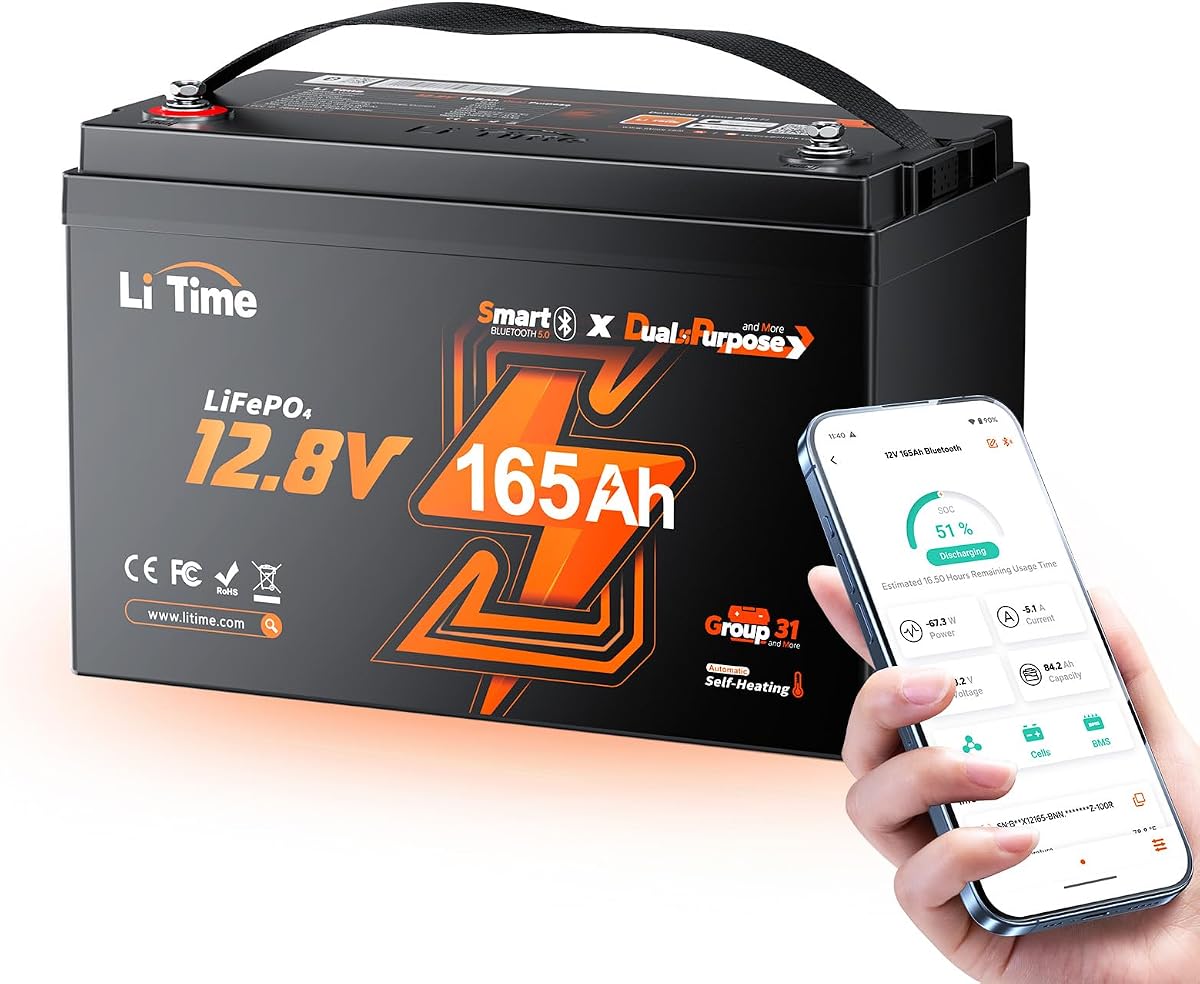
The Litime 12V 165Ah Dual Purpose battery is the only featured model explicitly designed for both outboard-engine cranking and marine device power. It has a 4.5 rating, a Group 31 format, and 2112Wh of stated capacity, allowing it to replace separate starting and house batteries in compatible installations.
We may earn a commission when you buy through this link, at no additional cost to you.
Starting performance is the central feature. The battery is rated at 1,200 CCA at 14°F and 1,300 MCA at 32°F, while an emergency reserve function cuts off discharge at approximately 15% state of charge. That reserve is intended to preserve enough power for safe ignition and return, a particularly valuable safeguard for a battery sharing cranking and accessory duties.
The auto-heating system activates below 32°F and raises the battery toward 50°F to support normal charging, while discharge stops at minus 4°F. Bluetooth 5.0 monitoring provides remote status, discharge controls, and alerts through the LiTime app. The manufacturer also claims more than 5,000 cranking cycles and 4,000 deep cycles at 100% depth of discharge.
Compatibility is the major consideration. The listing says to contact the seller for guidance, but it also excludes LiveScope fish finder chargers, outboard motors without voltage regulators—including specified Evinrude, Johnson, and Mercury Black Max systems—and MerCruiser marine engines or inboard systems. It is a compelling space-saving option for compatible boat builders, not a universal engine-battery replacement.
A dual-purpose battery can reduce the number and weight of batteries aboard a compatible boat. The 165Ah capacity, emergency reserve cutoff, and strong cold-cranking figures make the design appealing where space is limited and both starting power and accessory power are required.
Outboard systems differ in charging architecture, regulator design, and electrical requirements. Before purchasing, owners should identify the exact motor year and model and confirm charging compatibility rather than relying only on the general brand names included in the description.
We may earn a commission when you buy through this link, at no additional cost to you.
The MARSENERGY 12V 100Ah Group 24 has the highest customer rating in the roundup at 4.8. It combines a standard BCI Group 24 case, a 21-pound weight, a 100A BMS, and unusually detailed cycle claims, making it a strong all-around choice for boat house power, trolling systems, and mobile energy storage.
We may earn a commission when you buy through this link, at no additional cost to you.
The stated endurance figures are 4,500 deep cycles at 100% depth of discharge, 8,000 at 80%, and 15,000 at 60%. That range allows buyers to evaluate the battery according to how aggressively they intend to use it. The product also uses A-grade cells and includes BMS protection for short circuits, overvoltage, abnormal temperature, and other fault conditions.
Its dimensions are listed as 10.16 by 8.46 by 6.54 inches, matching the Group 24 standard and allowing direct consideration for an existing battery box. Larger Group 27 or Group 31 compartments are also compatible. The enclosure is described as waterproof, robust, and reliable, with low-temperature additives in the cells adding some resilience in cold conditions.
The battery still enforces sensible cold-weather limits: charging is cut off at 32°F and discharge at minus 4°F, even though the cell's technical operating standard extends lower. A sleep-mode state may also require activation after certain protections. For a boat owner seeking a high rating, compact Group 24 footprint, and long advertised service life, it is the premium stand-out.
The three depth-of-discharge figures provide a more useful picture than one headline cycle number. A boater who routinely returns with unused reserve should focus on the 60% figure, while frequent deeper cycling calls for evaluating the 4,500-cycle claim under more demanding conditions.
The Group 24 footprint and 21-pound weight make the battery attractive for replacing a standard lead-acid unit. A direct-size match does not guarantee every charger is suitable, so lithium-compatible charging remains a separate and essential installation requirement.
We may earn a commission when you buy through this link, at no additional cost to you.
The Power Queen 12V 100Ah Group 31 is a 4.6-rated LiFePO4 battery designed for marine, RV, solar, backup, and trolling-motor applications. It combines a 100A BMS, Grade A cells, a 24-pound weight, and support for a four-series, four-parallel system in a widely recognized Group 31 format.
We may earn a commission when you buy through this link, at no additional cost to you.
The battery's 100A BMS provides protection against overcharge, over-discharge, short circuits, and overheating. A 3% self-discharge rate is listed, while the manufacturer claims 13 times more cycles than lead-acid, three times the lifespan, and two times the energy density. These are headline comparisons, so actual performance will depend on depth of discharge, temperature, charging, and application.
At 24 pounds, the Group 31 battery weighs approximately one-third as much as a lead-acid battery in the general size class according to the listing. Expansion to 4S4P can create a 51.2V, 400Ah, 20.48kWh bank, and the stated trolling-motor use extends to motors rated from 30 to 70 pounds of thrust.
Unlike some other featured products, no Bluetooth monitoring or dedicated trolling-motor transient-voltage suppressor is mentioned. That may be perfectly acceptable for a house-bank installation, but trolling owners who value real-time motor-spike protection may prefer a more specialized model. As a balanced, well-reviewed, expandable battery, it remains a strong general option.
Group 31 is common in larger marine and RV battery compartments, making this model relevant to owners who have more space than a compact Group 24 installation allows. Boaters should still verify physical clearance, cable placement, and the restraint system in their compartment.
The 100A BMS handles core safety functions without requiring an app or paired device. For some installations, that simplicity is preferable, while owners who want remote state-of-charge visibility may need to choose a Bluetooth-equipped alternative.
We may earn a commission when you buy through this link, at no additional cost to you.
The Power Queen 12V 100Ah Trolling Motor battery is a 4.4-rated marine energy-storage unit with an emphasis on larger trolling motors. It is designed for 12V to 36V systems and motors up to 120 pounds of thrust, making it more specialized than many of the general-purpose 100Ah batteries in the list.
We may earn a commission when you buy through this link, at no additional cost to you.
A built-in transient-voltage suppressor is intended to protect the trolling motor from voltage spikes, while the BMS provides dust, water, and salt-spray protection alongside overcharge, overheat, and short-circuit safeguards. The battery also meets the ABYC E-13 standard, a valuable detail for owners prioritizing marine-specific design requirements.
The Group 31 case weighs 22.16 pounds, which the listing says is up to 64% lighter than a 12V 100Ah lead-acid battery. It supports 4P4S expansion to a stated 51.2V, 400Ah, 20.48kWh configuration and offers more than 4,000 cycles at 100% depth of discharge. Low-temperature protection stops charging below 32°F and discharging below minus 4°F.
The main limitations are the absence of listed Bluetooth monitoring and the lack of a stated engine-starting function. It is also important to confirm that the boat's motor voltage, control wiring, and charger are compatible with the battery and its surge-protection design. For high-thrust trolling applications, it is one of the most focused choices available.
The 120-pound thrust claim and built-in surge protector distinguish this battery from general-purpose house-power models. Those features make it worth checking for owners running larger digital trolling systems where voltage transients and sustained current demand are central concerns.
Salt-spray, water, and dust protection address the realities of an open or semi-exposed marine environment. At the same time, a solid compartment, proper restraint, and sound connections remain important parts of a complete installation.
We may earn a commission when you buy through this link, at no additional cost to you.
The most useful battery is the one that fits the electrical design, physical compartment, charging system, and real operating demands of your boat. Begin with the load, then work through form factor, marine protection, cold-weather behavior, monitoring, expansion, and manufacturer support.
A starter battery and a house or trolling battery perform fundamentally different jobs. Cranking requires high current over a short period, while trolling, electronics, refrigeration, lighting, and navigation loads call for sustained deep-cycle delivery. Most products in this roundup are explicitly for energy storage and should not be used to start an engine. The Litime 12V 165Ah Dual Purpose is the exception, and it comes with specific exclusions for motors, regulators, chargers, and inboard systems.
A 100Ah, 12V battery provides 1,200Wh of nominal energy, while the featured 165Ah model is rated at 2,112Wh. Nominal capacity does not necessarily equal usable capacity because voltage, temperature, discharge rate, and BMS limits affect delivery. Compare realistic load duration, reserve, and weight rather than relying on amp-hour figures alone. For an all-day trolling run or a bank serving multiple liveaboard loads, expansion and energy management may matter more than a small increase in one battery's rated capacity.
Most featured batteries use either BCI Group 24 or Group 31 dimensions, but exact measurements and terminal positions should still be checked. The DC HOUSE unit is described as about 0.32 inches taller than a standard Group 24, and some manufacturers do not provide every dimension in the supplied information. Measure the compartment, cable reach, and lid clearance. Also ensure the battery can be secured without crushing the case and that heavy objects cannot shift during rough water.
Salt spray, humidity, dust, vibration, and corrosion can shorten battery life. Batteries explicitly stating ABYC E-13 compliance, salt-spray protection, and dust-and-water shielding deserve particular consideration. A robust BMS is also important for guarding against overcharge, over-discharge, overcurrent, short circuits, and temperature extremes. These claims do not make any battery maintenance-free in every sense: terminals still need inspection, connections remain vulnerable to corrosion, and protective covers should remain installed.
Cold reduces charging performance and can damage lithium cells if charged outside their safe range. Most featured batteries stop charging at 32°F and halt discharge at approximately minus 4°F. The DC HOUSE unit uses a slightly lower charging cutoff of about 19.4°F, while the Litime 12V 165Ah adds automatic heating below 32°F. For cold-water boating, determine where the battery will be stored and how long it may sit between trips, because a protected battery still needs a charging plan when access is limited.
Lithium iron phosphate batteries generally require a charge profile suited to their chemistry, commonly around 14.4 to 14.6 volts for the 12V models discussed here. Some products recommend a dedicated lithium charger, while others list compatible marine and trolling-motor chargers explicitly. An old alternator or a lead-acid charger may need replacement or adjustment. Review wiring, fusing, charge controllers, and converter behavior before installation, especially in a boat with a charging path that was designed for flooded, AGM, or SLA batteries.
Bluetooth models can report state of charge, voltage, current, temperature, and fault status from a phone. This is useful for remote compartments, long trips, and detecting developing imbalance problems. DC HOUSE provides cell-level information and push notifications, while BUKNUWO provides a broad real-time dashboard over a stated 33-foot range. Monitoring is not a substitute for physical inspections, and readings can vary with temperature, humidity, and measurement methods. A simple non-Bluetooth battery may still be the better choice for owners who value fewer electronic dependencies.
Most 100Ah models support 4S4P expansion, creating a 51.2V, 400Ah configuration when properly wired. DC HOUSE permits a maximum of eight batteries but does not allow 4P4S, while Lithova describes expansion with as many as 16 identical batteries. Parallel banks, larger configurations, or mixed battery ages require careful planning. Warranty length, technical support, and clear documentation are also valuable because an advanced bank can be more complex than a single battery.
Before installation, identify the battery's positive and negative terminals, confirm the compartment is clean and dry, and verify that the charger, motor controller, and wiring are appropriate for LiFePO4 chemistry. Use correctly sized cables and fuses, tighten connections to the manufacturer's guidance, and secure the battery so it cannot move. Check terminal clearance and keep metal tools away from both posts.
Charge with a compatible lithium profile, normally around 14.4 to 14.6 volts for these 12V models, and follow the battery maker's current recommendations. The system should not be charged below the specified cold-weather cutoff. During use, avoid routinely leaving the battery fully depleted, monitor the state of charge, and use a low-battery cutoff where available.
Inspect the battery and cables periodically for swelling, heat, loose hardware, salt residue, or corrosion. Clean around the terminals with appropriate methods and keep the enclosure vents unobstructed. For long storage, maintain an appropriate charge, check the battery periodically, and use a charger that will not attempt unsafe charging in cold conditions.
Most LiFePO4 batteries in this roundup are designed for energy storage and expressly exclude engine cranking. The Litime 12V 165Ah Dual Purpose model supports cranking, but its compatibility list excludes certain motors, charging arrangements, and marine systems. Always confirm the exact engine model and charging architecture before using any lithium battery as a starter.
They need appropriate cold-weather protection, which is why most featured models stop charging at 32°F and discharging near minus 4°F. The Litime 12V 165Ah can heat itself when temperatures fall below 32°F. Even with these safeguards, charging should occur within the manufacturer's safe temperature range and the battery should be protected from prolonged extreme cold.
Yes, a charger with a charge profile appropriate for lithium iron phosphate chemistry is generally required. The products here recommend or specify lithium-compatible charging around 14.4 to 14.6 volts in many cases. An old lead-acid charger, alternator, or solar controller may need adjustment or replacement, so review the entire charging path before installation.
The answer depends on motor thrust, voltage, average current, runtime, electronics, and desired reserve. A 12V 100Ah battery is common in this category, while a 165Ah dual-purpose model offers more energy for combined cranking and accessory loads. Calculate expected consumption, keep an appropriate safety reserve, and confirm that the battery bank stays within the boat's weight limit.
Most featured products support series and parallel expansion, commonly up to 4S4P, though DC HOUSE allows only eight batteries and does not permit 4P4S. Use batteries of the same type, capacity, age, and state of charge, follow the manufacturer's wiring diagram, and have larger installations assembled or inspected by a qualified marine electrical professional.
It may, because Group 24 is a common size, but the name alone does not guarantee clearance. The DC HOUSE battery is about 0.32 inches taller than a standard Group 24, while other models list exact dimensions. Measure the compartment, terminals, cable route, lid, and restraint before purchasing.
No. Bluetooth is useful for checking state of charge, current, temperature, and faults without physically opening the compartment, but it is optional for many owners. Non-Bluetooth models offer simpler operation, while monitored models can provide earlier warnings of imbalance or abnormal conditions.
They are generally described as maintenance-free in the sense that they do not require watering or routine equalization like flooded lead-acid batteries. They still need occasional attention: inspect terminals, remove salt and corrosion, check the restraint, verify connections, and maintain an appropriate state of charge during storage.
The Litime 12V 100Ah Trolling Motor battery is the leading pick for owners who want marine-specific protection, ABYC E-13 compliance, and a built-in trolling-motor surge shield. MARSENERGY's 12V 100Ah Group 24 stands out for its 4.8 rating, compact 21-pound format, and detailed cycle-life claims, while the SUPER EMPOWER Group 24 offers a practical combination of familiar sizing, a 100A BMS, and expandable capacity.
Before buying, prioritize the electrical task over general battery capacity. Determine whether the application is cranking, trolling, or house power; measure the compartment; confirm cold-weather behavior; and make sure every charger and controller supports LiFePO4 chemistry. Bluetooth monitoring, expansion, and special marine protections are useful only when they match the way the boat is actually used.
Finally, check the current product listing, compatibility documents, warranty terms, and installation instructions before making a purchase. Product details and pricing can change, and the best lithium battery for your boat is ultimately the one that fits your electrical system, environmental exposure, physical space, and operating schedule.