
ASUS Dual GeForce RTX 5060 Ti
4.7Editor score
16GB GDDR7 graphics memory
Dual BIOS operating modes
Compact 2.5-slot design
NVIDIA DLSS 4 support
Discover the best GPU for Davinci Resolve with a detailed comparison of memory, rendering performance, cooling, connectivity, and creator workflows for editors.
A GPU for DaVinci Resolve can dramatically influence timeline responsiveness, preview quality, color processing speed, rendering time, and the number of displays a workstation can support. The right card balances dedicated graphics memory, sustained performance, efficient cooling, professional drivers, and enough connectivity for a creator’s particular editing setup.
This guide compares ten NVIDIA, AMD, and Intel graphics cards using the supplied specifications, including GPU memory, architecture, cooling design, power requirements, display outputs, and creator-oriented features. It covers mainstream gaming cards, compact models, workstation cards, and professional alternatives for users with different Resolve workloads and budgets.
Each review identifies the strongest use case, practical limitations, and compatibility details that deserve attention before purchasing. Ratings and specifications reflect the available product information, while current prices and availability can change at any time, so shoppers should confirm both before making a final decision.
4.7Editor score
4.9Editor score

4.3Editor score
The comparison below highlights the supplied memory capacity, core architecture, cooling configuration, and key interface details of all ten cards, making it easier to narrow the field before reviewing individual recommendations.



The GIGABYTE GeForce RTX 5080 Gaming OC 16G combines NVIDIA’s Blackwell architecture with 16GB of GDDR7 memory on a 256-bit interface. Its 4.6 rating reflects a strong overall reception, while the supplied specifications position it as a high-performance option for demanding DaVinci Resolve timelines, effects, and multi-application editing workflows.
We may earn a commission when you buy through this link, at no additional cost to you.
The major attraction is the combination of a current architecture and ample graphics memory. A 256-bit GDDR7 interface is well suited to data-intensive tasks such as complex node graphs, high-resolution footage, and multiple simultaneous Resolve workspaces. DLSS 4 support may also assist certain interactive workflows, although users should confirm how their exact Resolve version and plugins benefit from it.
Its WINDFORCE cooling system is a sensible foundation for sustained graphics workloads, but a high-end card still demands careful case planning. Buyers should verify the dimensions, recommended power supply, available connectors, and clearance around the card. As a gaming-oriented design, it may not offer the workstation assurances or specialized software support found in the professional alternatives.
This card is best for an enthusiast or advanced editor who wants substantial GPU power and 16GB of memory in a traditional high-performance desktop. It is a compelling overall choice when gaming or other GPU-intensive applications matter alongside Resolve. Buyers prioritizing professional validation or ultra-large working sets should also examine the ASRock Radeon AI PRO R9700 and NVIDIA RTX PRO 6000.
The 16GB pool and 256-bit interface provide a solid foundation for complex timelines, layered effects, and high-resolution media. Memory headroom is especially useful when a creator switches between Resolve and another GPU-accelerated application rather than working with a single lightweight project.
WINDFORCE cooling is designed to manage sustained heat, but a strong workstation still needs adequate airflow. Confirm physical clearance, power capacity, and connector availability before ordering so the card can operate within its intended thermal environment.
We may earn a commission when you buy through this link, at no additional cost to you.
The PNY NVIDIA Quadro RTX 4000 is a professional-oriented card built around NVIDIA’s Turing architecture. It carries a 4.4 rating and is designed around fast interactive professional applications, making it relevant to Resolve users who value workstation positioning, real-time rendering features, and stable visual workflows.
We may earn a commission when you buy through this link, at no additional cost to you.
Its 36 RT cores provide hardware acceleration for ray-traced rendering and advanced shading. Those capabilities can be useful in Resolve when projects include 3D, spatial effects, or intensive lighting and rendering operations. The card also supports immersive VR, extending its relevance to creators who move between virtual production, simulation, and conventional post-production.
The main concern is generational age. Turing is no longer the newest architecture, and the supplied specifications do not identify the exact memory capacity or memory type. It may therefore offer less headroom for modern 4K or 8K multi-layer projects than newer alternatives, especially those with 16GB or more of GDDR6 or GDDR7.
This Quadro is best for an editor who specifically values professional application support and ray-tracing hardware but does not need the newest architecture. It may suit established Resolve studios with compatible workflows. For a new high-resolution workstation, one of the newer 16GB cards or the 32GB ASRock Radeon AI PRO R9700 will usually offer a more forward-looking memory platform.
The dedicated RT cores are the defining feature for creators working with ray-traced scenes. They provide hardware support for realistic lighting, reflections, and shading that may otherwise place substantial demands on CPU and GPU processing time.
Quadro positioning makes this a logical consideration for professional editing environments where application certification and predictable workflows matter. Confirm current Resolve, operating-system, and driver compatibility before making the final purchasing decision.
We may earn a commission when you buy through this link, at no additional cost to you.
The NVIDIA Titan RTX pairs 4,609 CUDA cores with 72 RT cores and 577 Tensor cores. Its 4.4 rating and supplied operating-system certifications make it a distinctive option for advanced users who need substantial parallel-processing resources in Resolve and related creative software.
We may earn a commission when you buy through this link, at no additional cost to you.
Tensor hardware can be valuable when a workflow uses AI-assisted tools, while the large CUDA and RT counts support demanding GPU-accelerated operations. The card is especially relevant to creators combining timeline editing, color work, 3D rendering, effects, and other compute-intensive applications in a single system.
Power and heat are the central practical concerns. A recommended 650-watt power supply demonstrates the need for a suitably substantial workstation, and users should follow the manufacturer’s power and cooling guidance exactly. The supplied details also identify a 1,770MHz boost clock, but the architecture itself belongs to the older Turing generation.
The Titan RTX makes most sense for an experienced user whose existing software stack benefits from its specific compute resources and whose workstation can support its power demands. It is less compelling as a fresh build when buyers want efficient power use, newer media engines, and more current creator features. Newer RTX 5080 models or the Radeon AI PRO R9700 deserve consideration for contemporary workflows.
A large CUDA core count can help with demanding effects, filters, masks, and other GPU-parallel tasks. The benefit is greatest in complex projects where the processor would otherwise become a recurring bottleneck during interactive work.
The stated 650-watt recommended power supply is a crucial installation constraint. A capable unit, suitable connectors, good airflow, and careful cable routing are necessary parts of a safe and stable deployment.
We may earn a commission when you buy through this link, at no additional cost to you.
The ASRock Radeon AI PRO R9700 Creator stands apart with 32GB of GDDR6 memory, a 256-bit bus, and a workstation-oriented design. Its 4.4 rating and extensive creator specifications make it one of the most interesting choices for Resolve projects that need more graphics memory than a conventional gaming card offers.
We may earn a commission when you buy through this link, at no additional cost to you.
The 32GB capacity is especially useful for 8K video editing, complex 3D rendering, large AI models, and other compute-intensive workloads. Its 64 compute units, third-generation ray tracing, and dedicated AI accelerators make it a broader professional platform rather than a simple gaming card adapted for editing.
Its single-blower cooling design exhausts heat outside the chassis, making it useful in dense multi-GPU workstation or server configurations. That design also requires users to consider acoustic behavior, since workstation cooling strategies often prioritize consistent thermal performance and enclosure pressure over the silence possible with some axial-fan cards.
The main precaution is compatibility. The product is optimized for professional applications, and its listing explicitly advises verifying software and driver support. This is the recommendation for creators who need generous memory, professional cooling, multiple professional displays, and compute capability, provided the workstation and Resolve environment are fully compatible.
The larger memory pool gives Resolve more room to retain high-resolution media, complex node trees, and compute-heavy data than a typical 16GB card. It can also benefit users who run AI, 3D, and editing applications concurrently.
The standard two-slot design and blower cooler are aimed at professional multi-GPU environments. That makes the card easier to deploy in compact workstation designs where consistent outward airflow is valuable.
We may earn a commission when you buy through this link, at no additional cost to you.
The GIGABYTE Radeon RX 9070 XT Gaming OC 16G delivers 16GB of GDDR6 memory, PCIe 5.0 support, and a 4.7 rating. It offers a compelling alternative for Resolve editors who want a modern, high-performance graphics card without moving into the highest professional workstation tier.
We may earn a commission when you buy through this link, at no additional cost to you.
The 16GB allocation is useful for demanding 4K editing, layered effects, and projects that mix Resolve with other graphics-heavy applications. A PCIe 5.0 interface also prepares the card for current platforms, while the WINDFORCE cooling system and hawk fan configuration provide the thermal foundation expected from a gaming card.
As with other gaming-oriented products, professional support and specific workstation features are not highlighted in the supplied information. Editors working with certified plug-ins, managed workstation hardware, or a particular studio support matrix should check the relevant application and driver requirements before choosing this model.
This Radeon is a strong mainstream choice for a creator who wants plenty of memory and a modern graphics platform, particularly when gaming performance is also important. Its high rating makes it an attractive general-purpose option, although Resolve users should compare driver stability and media-engine behavior against the NVIDIA alternatives in the list.
Combining 16GB of memory with a modern interface provides enough graphics capacity for many high-resolution editing scenarios without moving to a large professional card. The result is a flexible option for both creative work and general computing.
The WINDFORCE system and server-grade thermal conductive gel are intended to help control heat. A well-ventilated case remains important, particularly when long exports or repeated effects keep the GPU under sustained load.
We may earn a commission when you buy through this link, at no additional cost to you.
The NVIDIA RTX PRO 6000 Blackwell is the premium choice in this guide, with 96GB of DDR7 ECC memory, 1.8 TB/s bandwidth, and fourth-generation ray-tracing cores. Its 4.3 rating reflects its specialized character: this is infrastructure for demanding professional visualization, AI, simulation, and large creative workloads.
We may earn a commission when you buy through this link, at no additional cost to you.
The 96GB pool offers extraordinary headroom for multi-app workflows, large 3D scenes, local AI model processing, and projects that would exceed the practical memory limits of mainstream 16GB cards. Fourth-generation RT cores and fifth-generation Tensor cores further strengthen the card for physically accurate rendering and accelerated AI workflows.
Its power and packaging demands make it unsuitable for most ordinary desktops. The double-flow-through cooler is designed to sustain performance under 600-watt loads, while Universal MIG supports isolated concurrent workloads. The listing also notes that retail packaging is not included and that export regulations may apply outside the United States.
This GPU is best for studios, virtual-production facilities, engineering teams, and creators whose professional software can genuinely use its scale. For ordinary Resolve editing, the enormous specification may be unnecessary. However, for large datasets, multi-application AI work, complex 3D, or enterprise deployment, it offers a level of capability no conventional gaming card in this list matches.
Ninety-six gigabytes allows exceptionally large working sets to remain resident on the GPU. That can reduce transfers and support demanding combinations of editing, 3D, AI, simulation, and visualization without forcing the user to choose a single specialized application.
DisplayPort 2.1 support enables high-resolution and high-refresh displays, including the listed 8K and 16K scenarios. These capabilities suit color-critical and multi-display professional environments where bandwidth and stable output are critical.
We may earn a commission when you buy through this link, at no additional cost to you.
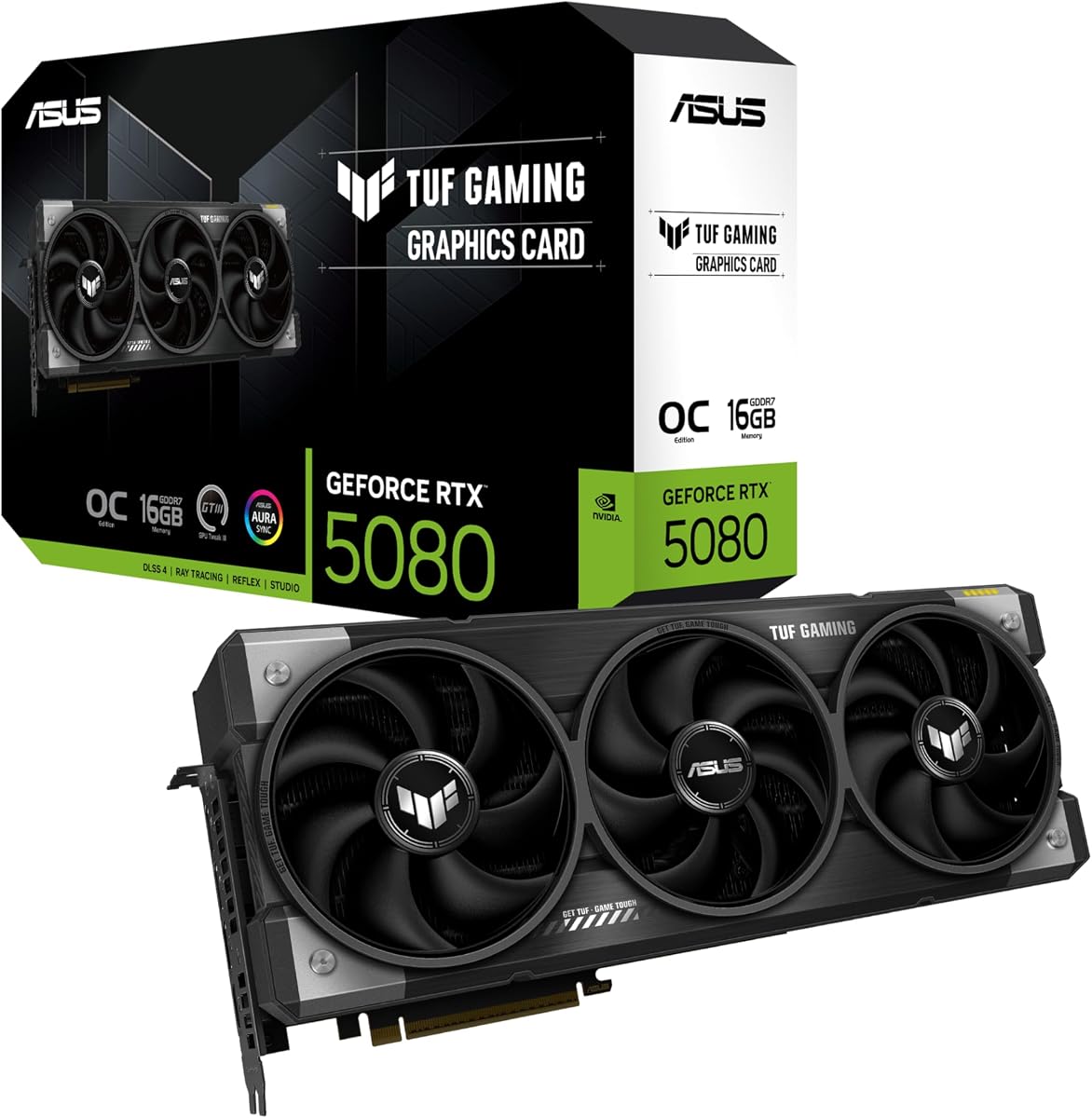
The ASUS TUF Gaming GeForce RTX 5080 pairs 16GB of GDDR7 memory with a 2,730MHz OC boost clock. Its 4.6 rating and extensive thermal design make it a high-end Resolve option for users who want strong graphics performance and a card built around a substantial cooling system.
We may earn a commission when you buy through this link, at no additional cost to you.
Three Axial-tech fans, a large fin array, and a phase-change GPU thermal pad are designed to manage sustained loads. The PCB coating adds protection against short circuits caused by moisture, dust, or debris, while GPU Tweak III provides controls for performance, thermal monitoring, and tuning.
Physical fit and electrical demands require particular attention. The card measures 348mm long, occupies 3.6 slots, weighs 4.3 pounds, and requires a minimum 850-watt power supply with a 16-pin 12V-2×6 connector. Buyers must confirm case clearance, slot spacing, and PSU compatibility before purchasing.
This TUF model is well suited to a large, high-performance workstation used for intensive editing, effects, and color workflows. Its size makes it a poor match for compact cases, while its power requirement raises the total system cost. If a smaller card is needed, the ProArt RTX 5080 offers a more compact 2.5-slot design.
The three-fan cooler and phase-change thermal pad focus on sustained performance. These features are particularly relevant during lengthy renders or when repeated high-intensity effects keep the GPU working continuously.
Length, slot thickness, weight, connector type, and PSU capacity all matter. Treat the physical and power specifications as a checklist rather than assuming the card will fit a generic high-end desktop.
We may earn a commission when you buy through this link, at no additional cost to you.
The ASRock Intel Arc Pro B60 Creator offers 24GB of GDDR6 memory in a compact, two-slot workstation design. Its 3.9 rating is the lowest among these selections, but the supplied specifications reveal several attractive features for editing, AI inference, 3D rendering, and multi-monitor production.
We may earn a commission when you buy through this link, at no additional cost to you.
The 192-bit memory interface provides 456 GB/s of bandwidth, and the Intel Xe2-HPG architecture includes 20 Xe cores and 160 XMX engines. Twin media transcoders support AV1, H.264, and HEVC export formats, making the card relevant to editors who value efficient media handling alongside general graphics work.
Its single blower cooler, single eight-pin power connector, and 200W TDP make installation more approachable than the largest cards in the guide. The 271 by 112 by 39mm dimensions still need to be checked, and the blower design may prioritize outward airflow over low acoustic output. Resolve and plugin compatibility should be verified directly.
The Arc Pro B60 is most attractive to a creator who wants 24GB of memory, a compact workstation format, and specialized media transcoding without moving to the highest professional tier. It can be an efficient alternative, but its lower rating and ecosystem-specific support make careful research more important than for a mainstream NVIDIA choice.
The twin media transcoder engines are one of the card’s most editor-specific features. Native handling for AV1, H.264, and HEVC can benefit export, review, and media-management workflows when the surrounding software supports the hardware.
The two-slot form factor and 200W TDP make this easier to accommodate than many high-end alternatives. Verify connector availability, chassis clearance, and operating-system support before integrating the card into a production machine.
We may earn a commission when you buy through this link, at no additional cost to you.
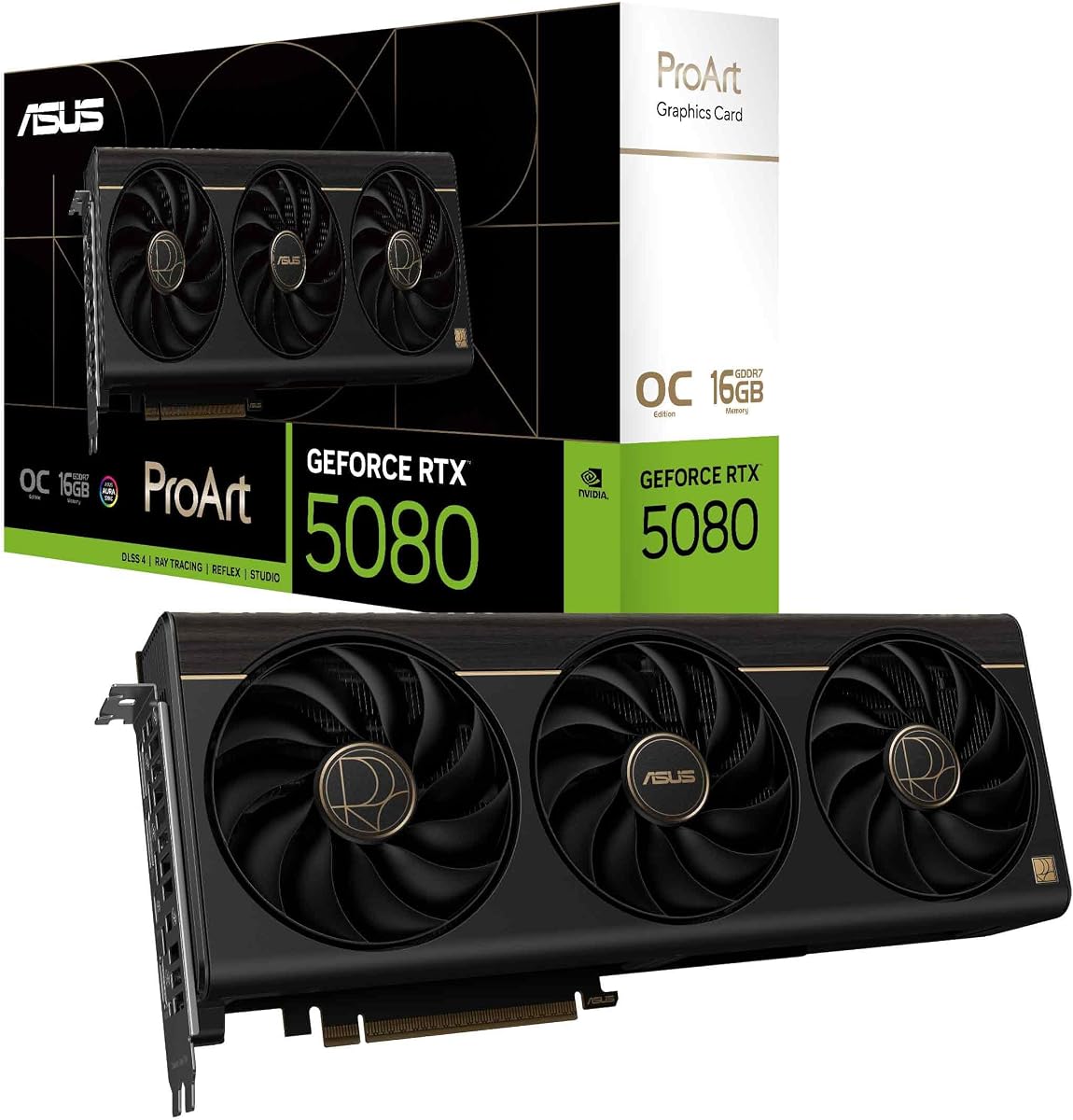
The ASUS ProArt GeForce RTX 5080 is a creator-focused version of NVIDIA’s Blackwell platform, combining 16GB of GDDR7 memory with a 4.9 rating—the highest among the ten products. It offers a compelling balance of current GPU features, thermal design, physical manageability, and content-creation connectivity.
We may earn a commission when you buy through this link, at no additional cost to you.
Its 2,730MHz OC clock and 1,858 AI TOPS indicate substantial parallel and AI-oriented hardware. The MaxContact heatsink uses a vapor chamber, while axial-tech fans and a phase-change thermal pad support cooling. An integrated USB Type-C port is particularly relevant to content creators using compatible peripherals, external devices, or streamlined workstation connections.
The 2.5-slot design is a meaningful advantage over the much larger ASUS TUF RTX 5080. It can be easier to pair with other expansion cards and fit into more cases, although buyers should still verify exact dimensions and power requirements. Because the ProArt name applies to a GeForce product, it is not equivalent to a professional workstation certification.
This is the strongest all-around recommendation for a creator building a current high-performance editing PC. It suits users who want 16GB of memory, strong Blackwell performance, flexible cooling, and creator-oriented connections without moving to a much more demanding enterprise GPU. It is especially attractive for Resolve plus gaming or mixed creative workloads.
The integrated USB Type-C connector adds useful flexibility without requiring the larger footprint of some high-end coolers. Its 2.5-slot construction also leaves more room in a workstation with multiple expansion devices.
The combination of a high factory clock, Blackwell architecture, and AI hardware supports demanding editing, effects, and creative applications. It also makes the card attractive to users who expect to use the same system for gaming and other GPU-intensive work.
We may earn a commission when you buy through this link, at no additional cost to you.
The ASUS Dual GeForce RTX 5060 Ti 16GB stands out as a value-focused Resolve card because it combines 16GB of GDDR7 memory with a 4.7 rating. It is designed for creators who need more memory than entry-level cards typically offer while keeping the overall platform more attainable.
We may earn a commission when you buy through this link, at no additional cost to you.
The card uses NVIDIA’s Blackwell architecture and supports DLSS 4, with 767 AI TOPS and a 2,632MHz OC clock. Those specifications make it suitable for mainstream 4K editing, color work, common Resolve effects, and projects that also use other graphics-accelerated applications.
Its physical design is another advantage. The 2.5-slot cooler is intended to improve compatibility, 0dB technology reduces fan activity at light loads, and dual BIOS profiles let users switch between Quiet and Performance configurations. Dual ball fan bearings are also specified to last up to twice as long as sleeve-bearing designs.
The Dual RTX 5060 Ti is best for a budget-conscious editor building or upgrading a general-purpose workstation. It may not satisfy large 3D scenes or high-end multi-user demands, and it lacks an explicit professional-workstation designation. Even so, 16GB of GDDR7 makes it one of the strongest budget choices for ordinary Resolve production.
A 16GB graphics-memory allocation helps Resolve handle high-resolution footage, layered timelines, and multiple effects more comfortably than many lower-capacity cards. It is the most important feature to notice when choosing this model for editing.
The dual BIOS gives users a simple way to balance acoustics and performance. Quiet mode is useful during routine editing, while Performance mode can be selected for more demanding sessions.
We may earn a commission when you buy through this link, at no additional cost to you.
The most suitable GPU for DaVinci Resolve depends on timeline complexity, footage resolution, effects, rendering habits, display count, power limits, and software compatibility. Memory, architecture, thermals, and workstation support should be weighed together rather than relying on one headline specification.
Graphics memory determines how much footage, cached data, masks, effects, and rendered previews a card can hold without offloading work to system memory. A 16GB card is a strong starting point for modern 4K workflows, particularly when using multiple Resolve windows or switching among Resolve, 3D, and AI applications. The 24GB ASRock Intel Arc Pro B60 and 32GB ASRock Radeon AI PRO R9700 offer more breathing room, while the 96GB NVIDIA RTX PRO 6000 is designed for exceptionally large professional datasets.
Choose enough memory for realistic project complexity rather than the largest option available. More memory can improve stability and responsiveness, but it does not automatically make every operation faster. Prioritize capacity when timelines contain many effects, high-resolution layers, 3D scenes, or simultaneous creative applications.
Newer architectures can provide more specialized hardware for ray tracing, AI, media processing, and general parallel computation. The RTX 5080 family uses Blackwell, the Radeon AI PRO R9700 uses RDNA 4, the Arc Pro B60 uses Xe2-HPG, and the Quadro RTX 4000 and Titan RTX use the older Turing architecture. These differences influence which specialized functions are available and how efficiently supported workloads run.
Choose architecture based on the applications in your actual workflow. A modern GPU is generally preferable for a new system, while an established professional card may make sense where software certification, deployed workflows, or existing infrastructure matter more than generational performance.
Memory capacity and memory bandwidth solve related but distinct problems. Capacity controls how much can be stored on the GPU, while bandwidth influences how quickly data can move between memory and the processor. The Radeon AI PRO R9700 pairs 32GB with a 256-bit bus, the Arc Pro B60 uses 24GB on a 192-bit bus, and the RTX PRO 6000 claims 96GB with 1.8 TB/s bandwidth.
For interactive editing, enough bandwidth helps effects, previews, and rendering remain responsive. For sustained large-file operations, a wider bus and high bandwidth become increasingly important. Compare both figures instead of assuming the card with the most memory always performs best.
Resolve can keep the GPU active for extended periods during playback, effects, grading, and rendering. Axial-fan gaming coolers move air through the card’s own heatsink, while blower-style professional coolers push hot air out of the chassis. The latter can help in dense multi-GPU systems where card-to-card airflow is limited. Phase-change thermal pads, vapor chambers, and multiple fans are indicators of attention to sustained thermal performance.
Match the cooler to the chassis. A powerful card in a cramped case can accumulate heat even if its own cooler is effective. Conversely, a blower card in a quiet single-workstation environment may produce more noise than a user expects. Check dimensions, slot width, nearby expansion cards, and the case’s overall airflow.
High-end graphics cards can demand more power and space than their headline performance suggests. The ASUS TUF RTX 5080 requires a minimum 850W power supply and a 16-pin 12V-2×6 connector, while the Titan RTX lists a 650W recommended supply. The ASUS Dual RTX 5060 Ti and ASRock Arc Pro B60 use more compact 2.5-slot or two-slot designs, which can simplify installation.
Before buying, check the case’s maximum graphics-card length, available slots, PSU wattage, connector type, and the number of power cables required. For a complete workstation, leave headroom for the processor, storage, memory, cooling, and potential future upgrades rather than sizing the PSU only around the GPU.
A Resolve workstation may need more than one high-resolution monitor, a projector, a reference display, or specialized capture equipment. The Radeon AI PRO R9700 supplies four DisplayPort 2.1a outputs, the Arc Pro B60 supplies four DisplayPort 2.1 outputs, and the RTX PRO 6000 supports advanced high-resolution and high-refresh configurations. The ProArt RTX 5080 also includes a convenient USB Type-C port.
Count the displays and connections required by the editing suite before selecting a card. Confirm the desired resolution, refresh rate, color format, adapter requirements, and operating-system support. A connector being present does not guarantee that every display mode is supported in every application.
Professional GPUs are generally built for managed workstation environments, validated applications, and predictable deployment. The Quadro RTX 4000, Titan RTX, Radeon AI PRO R9700, RTX PRO 6000, and Arc Pro B60 all have some degree of professional positioning in their supplied descriptions. The Radeon AI PRO listing specifically advises checking application and driver compatibility.
For a studio machine, confirm that the exact card, operating system, Resolve version, and critical plug-ins appear on the relevant support lists. Professional support can be as valuable as raw performance when an edit cannot afford missing effects, unstable exports, or delayed troubleshooting.
A GPU purchase is only one part of the total cost of a Resolve workstation. The graphics card may require a larger power supply, more case space, stronger airflow, or additional system memory. The ASUS Dual RTX 5060 Ti offers 16GB in a relatively compact design, the Radeon RX 9070 XT combines 16GB with modern PCIe support, and the RTX PRO 6000 requires a professional-grade platform by design.
Value should be measured by useful memory, workload performance, reliability, and fit rather than by the lowest purchase cost alone. A more expensive card can be sensible when it reduces export time, eliminates bottlenecks, or supports specialized work. A less expensive card can be better when it meets the actual project needs and fits the rest of the system cleanly.
Install the graphics card and power connections according to the manufacturer’s instructions, then power on the system and install the appropriate operating-system and GPU drivers. Open DaVinci Resolve, confirm that the application recognizes the card, and set the preferred processing mode in Resolve’s graphics options after checking which modes your supported software version exposes.
Build a test project that represents your real work: open representative footage, apply the effects and color operations you routinely use, and monitor playback responsiveness, GPU memory consumption, temperatures, frame rate, and export behavior. Keep the operating system, Resolve, plug-ins, and drivers updated, and use a known-good configuration when troubleshooting a project-specific issue.
Give the card adequate airflow and avoid repeated abrupt power changes. Clean the exterior vents and filters with care, check that cables are routed without strain, and monitor the system during long renders. For workstation or multi-GPU configurations, follow the professional card’s support documentation and confirm export regulations before shipping or deploying hardware internationally.
A 16GB card is a practical starting point for many modern 4K editing workflows and offers more room for effects than lower-capacity models. Complex 3D, AI, multiple applications, and very high-resolution timelines may benefit from 24GB, 32GB, or even 96GB. Choose based on the actual project rather than one isolated metric.
A professional card can provide better application validation, workstation drivers, and features designed for enterprise deployment. A gaming card may deliver stronger graphics performance for less money and is often sufficient for individual editors. The best choice depends on your software support requirements, budget, power limits, and facility management needs.
A capable GPU can accelerate supported effects, image processing, decoding, encoding, and certain export operations. Improvement depends on the codec, export settings, filters, effects, system balance, and whether software correctly uses the hardware. Faster interactive performance does not always translate into a proportionally faster final render.
Resolve can work with multiple GPUs in supported configurations, but the exact software version, operating system, driver, application, and card combination must be checked. Some cards are designed with blower coolers for dense multi-GPU systems, while display routing, power limits, and cooling can all affect whether the arrangement is practical.
Possibly. The ASUS TUF RTX 5080 specifies a minimum 850W PSU with a 16-pin 12V-2×6 connector, and the Titan RTX recommends a 650W supply. A workstation should also have enough capacity for the processor, memory, storage, and accessories, so the graphics card’s recommendation should not be treated as the entire system requirement.
Sixteen gigabytes can be a useful starting point, but 8K projects may place substantial pressure on memory depending on codec, layer count, effects, and color pipelines. Cards with 24GB, 32GB, or 96GB provide additional headroom. Editors should test a representative project and monitor memory use while the timeline and cache are under load.
Yes. The ASUS TUF RTX 5080 is 348mm long and 3.6 slots thick, while several alternatives use 2.5-slot or two-slot designs. Check chassis length, expansion-slot spacing, cooler height, power-cable bend radius, and neighboring card clearance before purchasing.
Both ecosystems include cards that can support Resolve, and the better choice depends on the specific application version, plugins, drivers, GPU features, and your other software. Check current compatibility guidance and test critical workflows, rather than deciding solely by brand. Intel’s Arc Pro B60 also targets professional creator use with transcoding and ISV-certified software support.
The ASUS ProArt GeForce RTX 5080 is the strongest all-around choice, pairing 16GB of GDDR7, current Blackwell hardware, strong user feedback, and a creator-oriented design. The ASUS Dual GeForce RTX 5060 Ti delivers the most focused value recommendation, while the NVIDIA RTX PRO 6000 provides unmatched 96GB memory for specialized professional workloads.
Prioritize the needs of your actual project: choose enough graphics memory for realistic timeline complexity, confirm application and driver support, and leave room in the system for power, cooling, and display requirements. Workstation credentials, media-transcoding hardware, memory capacity, and physical design can matter as much as general processing power.
Finally, check current prices, availability, warranty details, and exact product details before ordering, since they can change. Compare the selected card with the workstation’s case and power supply, and ensure the operating system and Resolve version support every required feature.