
Alphacool Eisfluegel Red Fins
4.3Editor score
G1/4-inch fitting threads
Six-to-eleven-millimeter hose support
Clear body with red fins
Silent impeller operation
Flow indicators for water loops make it possible to confirm circulation at a glance instead of guessing whether a pump, reservoir, radiator, or other component is receiving coolant. A useful indicator should suit the intended fluid, fit the available tubing or pipe, provide a clearly visible impeller, and tolerate the system’s operating conditions.
The products in this guide cover several distinct applications, including custom PC water-cooling loops, household plumbing, agricultural irrigation, industrial pipelines, and compact liquid-cooling assemblies. We compared their stated connection sizes, construction, temperature and pressure limits, viewing arrangements, supported media, installation requirements, and customer ratings.
Each review explains where the indicator is most practical, highlights the specifications that set it apart, and notes any limitations that could affect compatibility. The top three represent our strongest overall options for different priorities, while the complete ranking covers specialized and budget alternatives. Prices and availability can change.
4.3Editor score
4.8Editor score

4.6Editor score
As an Amazon Associate we earn from qualifying purchases.
The following side-by-side comparison highlights each indicator’s connection type, body material, viewing style, and practical application. These details make it easier to identify a model that matches the pipe, tubing, coolant, operating pressure, and temperature of your installation.




The Alphacool Eisfluegel Flow Indicator with red fins is an economical choice for a custom PC water-cooling loop. It carries a 4.3 customer rating and stands out with a clear body, vivid red fins, and a G1/4-inch connection. Its purpose is straightforward: show whether coolant is moving through the loop without requiring a sensor, display, or recurring adjustment.
We may earn a commission when you buy through this link, at no additional cost to you.
The housing is made from plexi and SAN or PMP materials, and the stated dimensions are 88 by 40 by 15 millimeters. It is designed for hoses with an internal diameter of 6 to 11 millimeters. The G1/4-inch fitting threads make it more appropriate for enthusiasts familiar with standard water-cooling hardware than for conventional household plumbing.
Its pressure rating is modest at a maximum of 2 bar, which means it is better suited to normal cooling-loop conditions than to demanding industrial pressure. Temperature capability also depends on the relevant material, reaching up to 60 degrees Celsius with PMP or 30 degrees Celsius with SAN. The clear body and red fins improve visibility while adding a decorative element to the installation.
This is a compelling selection for a builder who wants visual circulation confirmation and an attractive component without paying for a digital meter. It is particularly useful during initial loop filling, bleeding, and troubleshooting. Buyers should confirm their fitting thread, hose inside diameter, and expected operating pressure before installation. For those requirements, it is our best budget selection.
The indicator is simple to incorporate because it visually integrates with a custom cooling loop rather than demanding electrical power or configuration. A spinning red fin set makes circulation easy to recognize from typical viewing angles, while silent operation avoids the noise associated with some mechanical monitoring devices.
The red fins provide a strong visual cue against the transparent housing, allowing a builder to confirm movement at a glance. This is useful when checking a newly filled loop or investigating a suspected circulation issue without opening the system.
G1/4-inch threads and support for 6-to-11-millimeter hose inside diameters align the indicator with common custom water-cooling components. Checking both measurements before purchase helps prevent an incompatible or unnecessarily restrictive fit.
We may earn a commission when you buy through this link, at no additional cost to you.
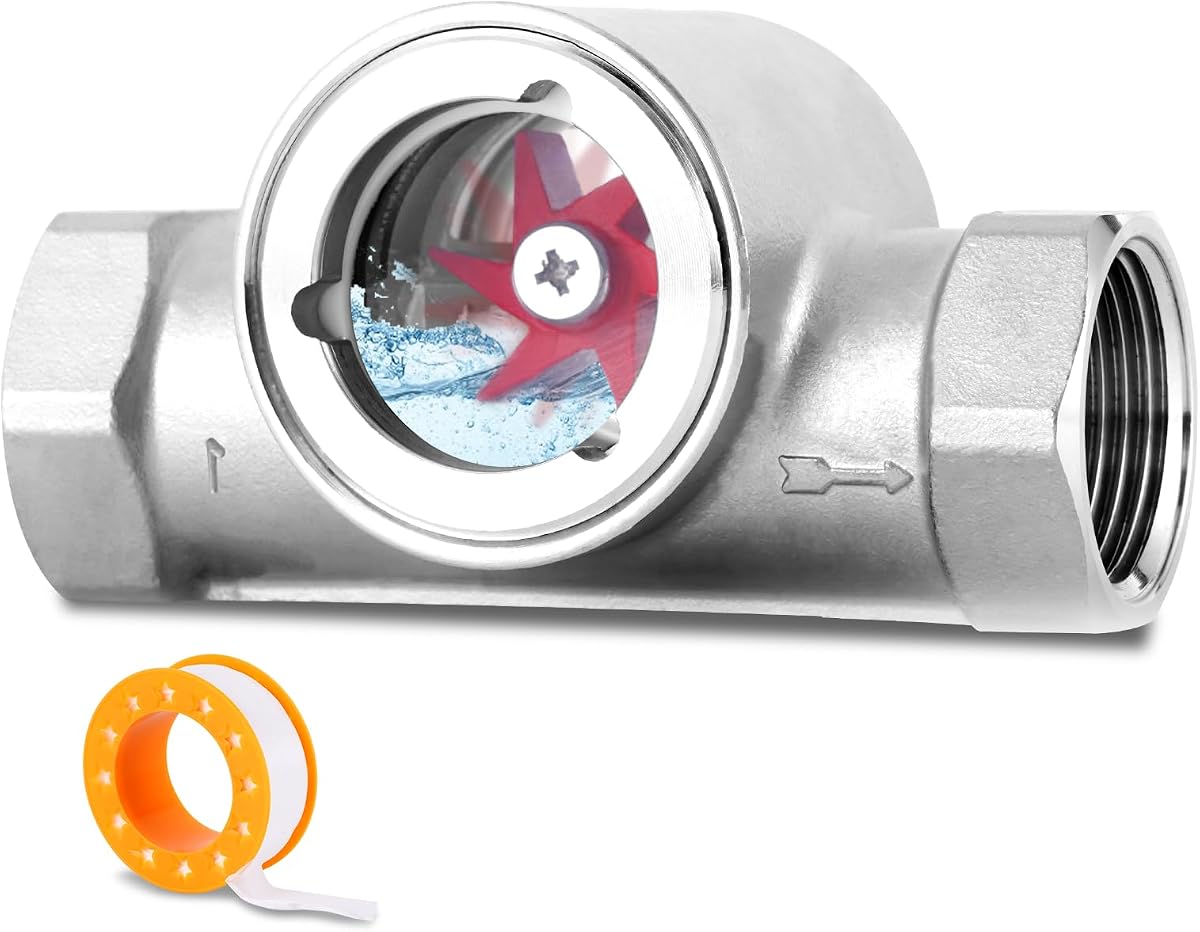
This 1-inch NPT water flow indicator is the strongest all-around option in the group, combining a 4.8 customer rating with a durable 304 stainless steel body. Its glass window and red impeller make direction and movement easy to observe, while the stated range of compatible media extends beyond ordinary household water.
We may earn a commission when you buy through this link, at no additional cost to you.
The eccentric impeller design is intended to make it easier for incoming flow to rotate the impeller efficiently. The body resists corrosion, and the polytef impeller provides thermal stability across a stated temperature range of -13 to 302 degrees Fahrenheit. A working pressure range of 0.2 to 1.6 MPa gives buyers a useful framework for judging whether the unit fits their line.
Installation flexibility is another important advantage. The unit can be fitted horizontally or vertically depending on available pipe geometry, and a roll of waterproof tape is included to improve the seal. Its one-inch NPT connection is substantial, however, so it is most appropriate for larger plumbing or industrial arrangements rather than slim PC cooling tubing.
Choose this model when visual flow verification, corrosion resistance, and a clearly visible red impeller are priorities. It can serve water, oil, gas, acid, and alkaline lines, as well as petroleum, chemical, and food-production applications. The principal trade-off is size, but for a compatible one-inch line, its rating, materials, orientation options, and included sealing tape make it our editor’s choice.
The stated compatibility with water, oil, gas, acid, and alkaline liquids makes this indicator more versatile than a cooling-only model. Users should still verify the concentration, temperature, pressure, and material requirements of the specific fluid before installation.
The glass window exposes the high-visibility red impeller, allowing operators to observe circulation without opening the pipe. A clean viewing surface keeps visual checks effective, while horizontal or vertical installation makes the device adaptable to different routing needs.
We may earn a commission when you buy through this link, at no additional cost to you.
The half-inch NPT stainless steel flow indicator offers a useful balance of compact size, clear visibility, and pipe-compatible construction. Its 4.4 customer rating reflects a generally favorable reception, and the red PTFE impeller gives users an immediate indication of flow through the transparent viewing section.
We may earn a commission when you buy through this link, at no additional cost to you.
The stated working temperature reaches 120 degrees Celsius, while the title identifies a 362 PSI maximum pressure. The indicator is 85 millimeters long, with a 30-millimeter glass lens. Both lying and standing installation positions are supported, making it easier to fit around different plumbing or equipment layouts.
The listing says the viewing glass can be observed through 180 degrees and that the window surface is easy to clean. That matters because a flow indicator is only useful if its moving element remains visible. The body and impeller materials also provide a more industrial appearance than the acrylic and plastic options commonly found in PC loops.
This is a sensible choice for a half-inch water, oil, gas, acid, alkaline, or toxic-gas line where the stated media and operating conditions are appropriate. Its limitations are the temperature ceiling and the need to protect the glass during installation. Subject to those constraints, it offers a well-proportioned indicator for compact pipe layouts.
The viewing window supports observation across 180 degrees, reducing the need to position the pipe at one exact angle. Routine cleaning helps keep the red impeller visible and makes changes in circulation easier to identify.
At 85 millimeters long, the model offers a more compact profile than larger NPT indicators. The 304 stainless steel body and PTFE impeller suit applications where durability and obvious visual feedback are priorities.
We may earn a commission when you buy through this link, at no additional cost to you.
The Antrader three-quarter-inch NPT sight glass flow indicator is designed for straightforward pipe monitoring. It has a 4.3 rating and uses a rotating impeller behind a clear window, providing an immediate view of water movement without electronics or a separate display.
We may earn a commission when you buy through this link, at no additional cost to you.
Its female three-quarter-inch NPT connection allows it to be attached directly to a compatible pipe. The stated applications include agriculture, residential water supply, pool maintenance, and industrial use. Horizontal installation is supported, and the design is described as easy to disassemble when inspection or maintenance becomes necessary.
The 304 stainless steel construction gives it a more durable appearance and should help it cope with ordinary plumbing environments. Its central advantage is the unobstructed sight window, which makes the impeller’s movement easier to interpret than on a unit with a smaller or partially obscured viewing area.
This indicator is best for users who value clear visualization and simple integration over having every operating limit prominently specified. The listing does not provide a temperature or pressure rating, so buyers should not assume performance comparable to models with published maximums. Confirm the pipe size, thread form, fluid, and expected service conditions before committing.
The impeller and clear sight window make movement in the line easy to interpret. This is particularly helpful for identifying a blocked or reversed section during troubleshooting across residential, agricultural, pool, or industrial pipework.
The indicator attaches to the pipe without a complex control assembly, and its removable construction supports inspection. Keeping the window clean will maintain visibility and make subtle changes in circulation easier to spot.
We may earn a commission when you buy through this link, at no additional cost to you.
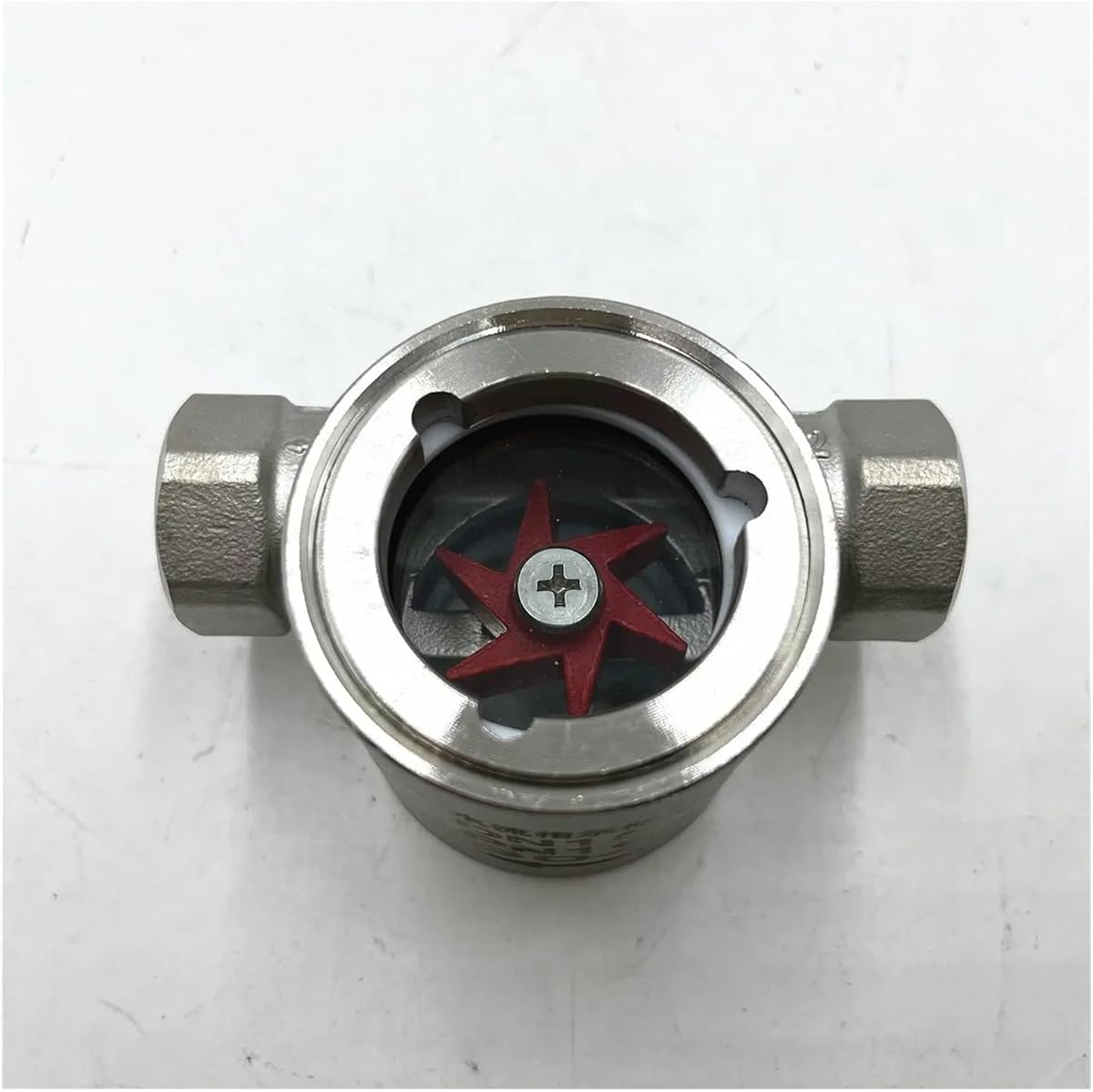
The DN15 stainless steel flow indicator is a practical half-inch option that includes everything needed for a basic installation. The package contains one 304 stainless steel concentric-impeller indicator and a roll of PTFE tape. Its transparent sight glass permits real-time visual monitoring of fluid movement.
We may earn a commission when you buy through this link, at no additional cost to you.
The connection is half-inch NPT, also identified as DN15, and the overall length is 93 millimeters. The housing is described as corrosion resistant, wear resistant, and suitable for high-temperature and high-pressure pipeline environments, although the listing does not state exact numerical limits for either condition.
Installation is designed to be straightforward. The included PTFE tape assists with sealing, while support for horizontal and vertical placement allows the indicator to adapt to available routing. No complex tools are required, which makes it approachable for maintenance and replacement projects.
The product has no published customer rating, so it is impossible to evaluate its reception using the same evidence available for the other models. Even so, the complete package, clear viewing arrangement, stainless construction, and broad fluid compatibility make it a strong candidate for household supply, industrial piping, irrigation, and other suitable lines. Verify the operating limits before use.
Including PTFE tape removes one common installation step and helps create a tight seal at the threaded connection. Users should still apply the tape correctly and verify compatibility with the specific pipe and sealant requirements of the installation.
The centered impeller and transparent sight glass create an immediately readable visual indicator. This makes it useful for locating abnormal flow, blockages, or circulation changes in supported pipeline applications.
We may earn a commission when you buy through this link, at no additional cost to you.
The 316 stainless steel water flow indicator stands out for its higher-grade body material and durable PTFE impeller. This selected half-inch version uses a female NPT connection and includes glass for visual inspection. No customer rating is currently available, but its published material and operating specifications give it a distinct technical profile.
We may earn a commission when you buy through this link, at no additional cost to you.
The stated maximum pressure is 1.6 MPa, or 232 PSI, and the maximum temperature is 150 degrees Celsius. Those figures make the indicator relevant to demanding pipe environments where a basic acrylic model would be less appropriate. The 316 stainless steel construction is also intended to provide strong corrosion resistance and durability.
The product family is offered in quarter-inch, three-eighth-inch, half-inch, three-quarter-inch, and one-inch NPT configurations. This listing represents the half-inch choice, so buyers should ensure that the selected variant matches their pipe rather than relying only on the family name in the title.
This model is a strong fit for a technically specified plumbing or industrial installation where stainless steel, PTFE, and published pressure and temperature limits matter most. It is less compelling for a small PC loop because of its female NPT connection and industrial proportions. The lack of customer feedback warrants careful product review, but the specification set supports shortlisting it for compatible systems.
The 316 stainless steel body is a meaningful distinction from the 304 stainless steel used by many competitors. It is worth considering in lines where chemical exposure, washdown, or demanding service conditions make material grade a priority.
A maximum pressure of 232 PSI and maximum temperature of 150 degrees Celsius provide clear comparison points. These published figures help installers assess fit before ordering, although actual suitability still depends on the complete system.
We may earn a commission when you buy through this link, at no additional cost to you.
The three-quarter-inch NPT 304 stainless steel indicator is defined by a high stated pressure rating and a straightforward sight-glass design. Its 4.1 customer rating is the lowest numerical score among the rated products, but the unit still offers useful published limits and practical installation features.
We may earn a commission when you buy through this link, at no additional cost to you.
The maximum pressure is 2.5 MPa, or 362 PSI, and the maximum temperature is 120 degrees Celsius. Its glass window can be viewed through 180 degrees, and the smooth glass surface is easy to clean. Horizontal installation is supported, and the body is designed for straightforward installation or disassembly.
The female three-quarter-inch NPT connection places it between the more compact half-inch models and larger one-inch indicators. The impeller provides a visible indication of movement, while the stainless housing suits plumbing, process, or maintenance systems that need more durability than a simple plastic sight tube.
Buyers should choose this option when the three-quarter-inch thread matches, high pressure is a central concern, and a clean, easily viewed window is important. Its lower customer rating means it may deserve closer comparison with similar models. Nevertheless, the strong pressure specification and convenient viewing make it a credible three-quarter-inch choice.
A stated maximum of 362 PSI gives this model a useful advantage over lower-rated indicators. It can be shortlisted for more demanding lines, subject to confirming that the rest of the system and all connected fittings are appropriately rated.
The 180-degree viewing range reduces blind spots when checking the impeller. Cleaning the smooth glass surface helps preserve visibility and supports routine visual maintenance.
We may earn a commission when you buy through this link, at no additional cost to you.
The push-in inline water flow indicator is a specialized choice for compact liquid-cooling and pump systems. It uses a clear acrylic body and rotating impeller, allowing the user to see circulation at a glance. The selected listing is the six-millimeter push-in configuration, while the product family supports several tube sizes.
We may earn a commission when you buy through this link, at no additional cost to you.
Rather than relying on NPT threads, the indicator connects directly to tubing through push-in fittings. The family is available in 4, 6, 8, 10, 12, 14, and 16 millimeters, and both ports use the same diameter. That symmetrical arrangement can simplify pipe matching and support smooth flow through the inline component.
The transparent shell makes the impeller easy to see, while the stated purpose is to help users observe circulation and support cooling efficiency. Its compact form is especially suitable where threaded plumbing hardware would be too large or awkward. No numerical temperature or pressure limit is provided, so the unit should be matched carefully to the system.
This is a good fit for a small cooling loop, pump assembly, or liquid-cooling installation that uses compatible push-in tubing. Buyers should confirm the selected size, the tube’s outside diameter and wall thickness, and the assembly method required by the system. Although there is no published customer rating, its simple connection and clear monitoring make it useful for the right setup.
Push-in fittings can simplify routing in compact assemblies where standard threaded adapters would be inconvenient. Correct tube sizing and firm seating are essential to prevent leaks or unintended disconnection.
The transparent acrylic shell provides a clear view of the rotating impeller. This immediate feedback is useful for checking whether coolant is moving through a small pump or cooling path.
We may earn a commission when you buy through this link, at no additional cost to you.
The Bitspower G1/4-inch flow indicator combines a 4.6 customer rating with a refined finish for custom PC water-cooling loops. Its clear body, black blade, and Black Sparkle color treatment provide visual confirmation of coolant movement without looking visually intrusive beside other premium components.
We may earn a commission when you buy through this link, at no additional cost to you.
The indicator is made from high-quality brass and uses a G1/4-inch thread, making it a natural match for water-cooling hardware built around that standard. The hidden O-ring design keeps the sealing element out of sight, contributing to a cleaner overall appearance and organized component layout.
Its main advantage is the combination of visual monitoring and finish quality. The dark blade remains noticeable against the clear housing when coolant is moving, while the understated styling suits a build where appearance matters as much as functional feedback. Installation should remain straightforward for anyone already working with G1/4-inch fittings.
This is our best premium pick for an enthusiast water-cooling loop because it balances material, connection compatibility, customer feedback, and visual presentation. The principal limitation is the absence of published maximum pressure and temperature values in the supplied specifications. Confirm the broader loop requirements and operating environment before installation, especially outside a conventional PC cooling setup.
The clear housing, black blade, and Black Sparkle treatment offer a restrained alternative to brightly colored indicators. That makes the unit easier to coordinate with a clean, premium cooling layout.
High-quality brass provides a more substantial foundation than basic acrylic fittings, while the concealed O-ring keeps the visible assembly clean. Users should inspect the seal during installation and ensure the threads engage properly.
We may earn a commission when you buy through this link, at no additional cost to you.
The Alphacool Eisfluegel with blue fins offers the same practical cooling-loop monitoring concept as the red-fin version, but with a cooler visual accent. It has a 4.6 customer rating, a clear plexi housing, and a G1/4-inch connection designed for PC water-cooling applications.
We may earn a commission when you buy through this link, at no additional cost to you.
The indicator supports hoses with a 6-to-11-millimeter internal diameter and measures 88 by 40 by 15 millimeters. Silent operation is a useful feature in a display-oriented PC build, where unnecessary mechanical noise would be undesirable. The blue fins make the moving element easy to identify against the clear body.
Compared with the red-fin model, the product data provides less detail about pressure and temperature limits. Buyers should therefore treat the red version as the more fully documented option when operating specifications are especially important, and consult the current manufacturer information for either model before use in demanding conditions.
The blue model is best for builders who want visible flow feedback and a coordinated aesthetic without a large digital component. Its compact proportions, familiar G1/4 thread, silent movement, and strong rating make it a worthwhile PC-loop choice. It is less relevant to threaded household plumbing, where a dedicated pipe indicator is more appropriate.
Blue fins create a visible focal point while remaining complementary to many custom cooling color schemes. The clear housing also keeps surrounding fittings visible, helping the component blend into a carefully planned loop.
Silent operation allows a builder to monitor movement without adding noticeable mechanical noise. This makes the indicator more suitable for a quiet desk or display system than some noisier monitoring options.
We may earn a commission when you buy through this link, at no additional cost to you.
The right flow indicator depends on the system rather than appearance alone. Start with the fluid, connection size, operating limits, and required visibility, then consider installation space, maintenance access, and the type of water loop being monitored.
Begin by measuring the pipe or tubing that will receive the indicator. NPT models use a tapered pipe thread and must match both the nominal size and the physical thread form, while G1/4-inch fittings are most common in custom water-cooling loops. Push-in models depend on the tube’s outside diameter, wall thickness, and the selected fitting size. An incorrect connection can prevent installation, require unsuitable adapters, or introduce sealing problems. The example products cover one-quarter-inch through one-inch NPT variants, G1/4-inch cooling connections, and push-in options from 4 to 16 millimeters.
The fluid moving through the loop determines which body and impeller materials are suitable. Several industrial indicators are listed for water, oil, gas, acid, alkaline liquids, or toxic gas, while the Alphacool and Bitspower models are intended for water-cooling systems. Broad compatibility claims still require caution: concentration, additives, temperature, and exposure duration can affect seals, glass, plastics, and metals. PC coolant and ordinary tap water may place very different demands on a component than a chemical-processing line. Review the supported media carefully rather than assuming that every visible impeller design handles every liquid.
Published pressure and temperature limits provide a useful safety framework. The products in this group include a two-bar Alphacool maximum, a 232 PSI and 150-degree-Celsius 316 stainless model, a 362 PSI and 120-degree-Celsius three-quarter-inch model, and several units with stated pressure ranges. Compare those figures with the system’s maximum operating conditions rather than its normal resting state. A pump can create pressure spikes, and a closed loop may heat during operation. If a product omits a numerical limit, do not assume it is unlimited or automatically suitable for demanding service.
Material choice affects durability, corrosion resistance, heat tolerance, and visual integration. Acrylic and plexi are useful for compact cooling and liquid-cooling assemblies, while stainless steel and PTFE offer a more industrial profile. Brass is common in enthusiast fittings and provides a polished appearance. Glass or transparent polymer windows make movement visible, but they should be protected from impact during installation. The impeller and body both need to suit the medium because a durable housing cannot compensate for an incompatible rotor material.
A flow indicator is useful only if its movement can be seen when needed. Red impellers offer high contrast, dark blades create a more understated appearance, and larger or centrally positioned windows can improve visibility. Some products support observation through 180 degrees, reducing sensitivity to the pipe’s orientation. Consider where the indicator will be viewed from and whether a bright impeller might be distracting in a display build. Cleanability also matters because deposits on glass or acrylic can obscure a perfectly functional rotor.
The indicator must fit into the available plumbing run without stressing the connection. Several industrial models support horizontal or vertical positioning, which makes them easier to adapt to existing routes. Push-in indicators are convenient for compact tubing assemblies, while NPT units require sufficient straight pipe and wrench access. Check the stated length, including any fittings, and leave enough room to clean the window or remove the unit. Crowding the component against a wall or frame can make maintenance difficult even when the initial connection is technically correct.
Flow indicators for water loops fall into two broad groups: compact PC and liquid-cooling components, and larger pipe-mounted sight indicators. G1/4-inch models integrate with common cooling hardware and often emphasize appearance and silent operation. NPT sight indicators are better for household plumbing, agriculture, pools, chemicals, and industrial lines where thread sealing and published operating limits matter. A push-in indicator occupies the middle ground, serving small liquid-cooling and pump systems with compatible tubing. Selecting by application prevents an attractive cooling component from being installed in a pipe system where its connection and specifications do not fit.
Threaded installations depend on a proper seal, and the relevant models either include PTFE or waterproof tape or clearly benefit from applying it. Follow the thread-sealant instructions and avoid mixing incompatible sealants. Push-in fittings use an internal grip mechanism instead of tape, so tubing dimensions and insertion depth become more important. Before assembly, inspect threads, O-rings, and window surfaces for damage. Loose fittings can leak, while an improperly seated push-in connection may restrict flow or detach. Spending a few minutes checking the connection can prevent the most common installation problems.
Install the indicator only after confirming the connection size, thread or tube type, fluid compatibility, and operating limits. For an NPT model, clean the threads, apply the recommended PTFE tape evenly, and engage the fitting by hand before tightening it with an appropriate tool. Avoid excessive force, which can distort the housing or stress the glass. For a push-in model, confirm the tube dimensions, square-cut the tube cleanly, and push it into the fitting to the specified depth.
Place the indicator where the impeller can be seen during operation but remains protected from impact. Follow the manufacturer’s preferred orientation, and avoid placing a high-visibility unit where vibration could make it strike a nearby component. Once the loop is filled, run the pump and confirm that the impeller rotates as expected. A stationary impeller may indicate an air pocket, a closed valve, inadequate pump pressure, an obstruction, or a connection that does not permit the intended flow.
Maintain the indicator by keeping the viewing window clean and checking the connection periodically for moisture or seepage. Do not use harsh chemicals that could cloud the window, attack the impeller, or damage the seal. If a coolant or process fluid requires a cleaner, confirm its compatibility with the body, window, rotor, and seals first. Replace the indicator if the glass cracks, the impeller becomes damaged, or the fitting can no longer maintain a secure seal.
A flow indicator shows whether liquid is moving through a pipe, cooling line, or water-cooling loop. Its rotating impeller provides immediate visual feedback, which helps during filling, bleeding, routine operation, and troubleshooting. It is especially useful when a pump sounds active but a blockage, closed valve, air pocket, or poor connection may be preventing circulation. It confirms movement but does not measure the exact flow rate.
No. G1/4-inch fittings are commonly used in custom PC and liquid-cooling loops, while NPT models use tapered pipe threads for plumbing or industrial lines. They may be adapted only with correctly rated, compatible fittings, and an adapter can add restriction or create a leak point. The appropriate choice is normally the one that matches the existing connection directly.
Run the pump and watch the impeller through the viewing window. A visible rotation indicates that fluid is moving through that portion of the system. If the impeller remains still, check for trapped air, closed valves, pump pressure, blockages, and incorrect orientation. Clean the window first because dirt or deposits can make a working rotor appear motionless.
These are visual sight indicators, not calibrated electronic flow meters. They show the presence and general direction of flow, but they do not provide a precise rate in gallons per minute, liters per minute, or another measurement unit. If exact flow data is required, use a properly calibrated flow meter alongside the indicator.
Pressure capability varies considerably by model. The Alphacool Eisfluegel is rated up to 2 bar, the 316 stainless model up to 1.6 MPa or 232 PSI, and the three-quarter-inch 304 model up to 2.5 MPa or 362 PSI. Other listings provide ranges or omit exact limits. Always compare the model’s published maximum with the system’s highest possible operating pressure.
Several models list compatibility with water, oil, gas, acid, alkaline liquids, or other industrial media. Suitability still depends on the exact chemical, concentration, temperature, and exposure duration, as well as the impeller and seal materials. Review the complete material specification and seek compatibility guidance before introducing a chemical process fluid.
Use matching NPT pipe, clean the threads, and apply compatible PTFE tape in the proper direction and quantity. Tighten the connection with an appropriate wrench without applying excessive leverage to the glass window. The indicator can then be installed in horizontal or vertical orientation when the model supports both. Confirm there is no pressure in the line before opening or altering the connection.
Only if the tubing, connector standard, fluid, and operating conditions are compatible with that indicator. A push-in model is best suited to assemblies designed around matching push-in tubing, while many traditional PC loops use G1/4-inch threaded components. Confirm the tube outside diameter and wall thickness, and check the indicator’s suitability for the loop’s pressure and coolant before adapting the design.
The Alphacool Eisfluegel with red fins is the best budget option for a standard custom cooling loop, offering a G1/4-inch connection, clear body, visible red fins, and silent operation. The one-inch NPT sight indicator is the editor’s choice for its excellent 4.8 rating, stainless steel construction, red impeller, broad media compatibility, and flexible installation. For a premium PC-loop appearance, the Bitspower G1/4-inch model combines brass construction with a clean black-blade design and a strong 4.6 rating.
Prioritize compatibility before appearance. Match the thread or push-in size, verify that the supported fluid suits the coolant or process liquid, and compare the operating limits with the system’s worst-case pressure and temperature. Material grade, viewing angle, included sealing supplies, and maintenance access should then determine which of the remaining models is the most practical fit.
Finally, check the current product listing, availability, dimensions, thread details, and operating specifications before purchasing. Ratings and designs can change over time, and models within the same size may offer different pressure limits, impeller materials, or accessories. Reviewing those current details helps ensure that the selected flow indicator integrates cleanly and provides reliable visual confirmation under the intended conditions.