
AIMILER Level 2 EV Charger
4.6Editor score
Adjustable 16A to 32A output
Plug-in 240V installation
App and touchscreen controls
Built-in leakage protection
J1772 connector compatibility
This guide compares fast chargers for electric vehicles at home, covering power, connectivity, installation, safety, connector fit, and buying considerations
A fast home EV charger can turn an ordinary driveway or garage into a reliable fueling station, but the best choice depends on your vehicle, electrical panel, connector, and charging habits. The right unit balances useful power with safe installation, durable construction, convenient controls, and the flexibility to handle changing household electrical demands.
This guide compares ten Level 2 charging stations for home use, focusing on maximum amperage, installation methods, connector compatibility, safety certifications, weather protection, displays, and app-based features. It includes hardwired, plug-in, hybrid, and high-power models so readers can compare practical differences rather than relying on charging speed alone.
Each pick highlights the features that distinguish it, along with installation and compatibility considerations that deserve attention before purchase. Ratings, specifications, and product configurations can change, and pricing and availability also fluctuate, so shoppers should verify the latest listing details and consult their electrician before ordering.
4.6Editor score
4.7Editor score

4.4Editor score
This side-by-side comparison organizes the ten chargers by their most consequential factors: maximum charging output, installation style, connector support, smart-control options, and weather resistance. The differences show that the most powerful model is not automatically the easiest to install, while the most flexible model may require more careful circuit planning.


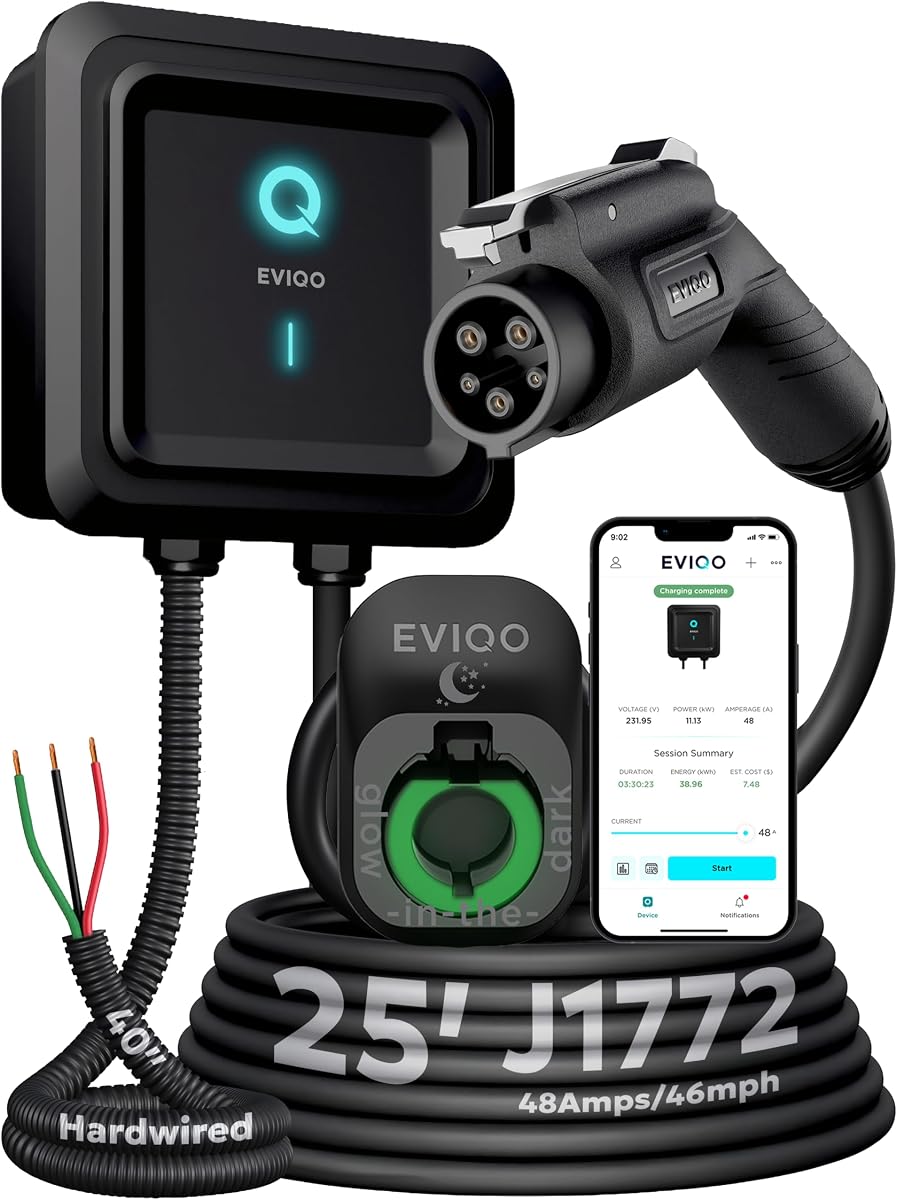
The EVIQO Level 2 EV Charger earns a 4.7 rating and stands out as a balanced choice for owners who want substantial overnight charging power with refined app control. Its hardwired design supports up to 48 amps on a dedicated 60-amp circuit, while DIP switch configuration can unlock 50 amps when the home electrical service and vehicle can support it.
We may earn a commission when you buy through this link, at no additional cost to you.
Its strongest features extend beyond raw output. A stronger internal antenna helps preserve WiFi connectivity in garages and basements, while the app supports remote start and stop, current adjustment, reminders, charging schedules, and energy tracking. The 25-foot cable provides useful reach across a two-car garage or driveway, and the included glow-in-the-dark holster makes the connector easier to locate after dark.
The station is built for both indoor and outdoor use, with an IP66 and NEMA 4 housing designed to resist rain, snow, heat, dust, and prolonged exposure. A side reset button permits maintenance without opening the enclosure, and automatic over-the-air updates are intended to keep charging features current. These qualities make it feel thoughtfully designed for years of regular service.
The principal drawback is installation complexity. Because it is hardwired, a licensed electrician should install the unit according to the National Electrical Code, and buyers should confirm that their panel can support the required dedicated circuit. For drivers with a modern EV, a garage, and adequate electrical capacity, however, this is a compelling all-around home charger.
The companion app provides more than basic on-and-off control. Drivers can tailor charging schedules, change output from 6 to 48 amps, monitor energy use, and receive reminders, making it easier to avoid periods when household electricity demand is especially high.
Up to 48 amps of output can add meaningful range overnight, while the sealed IP66 housing and long cable make the charger practical for a permanent home installation. The 50-amp configuration also offers extra flexibility where the electrical panel and vehicle support it.
We may earn a commission when you buy through this link, at no additional cost to you.
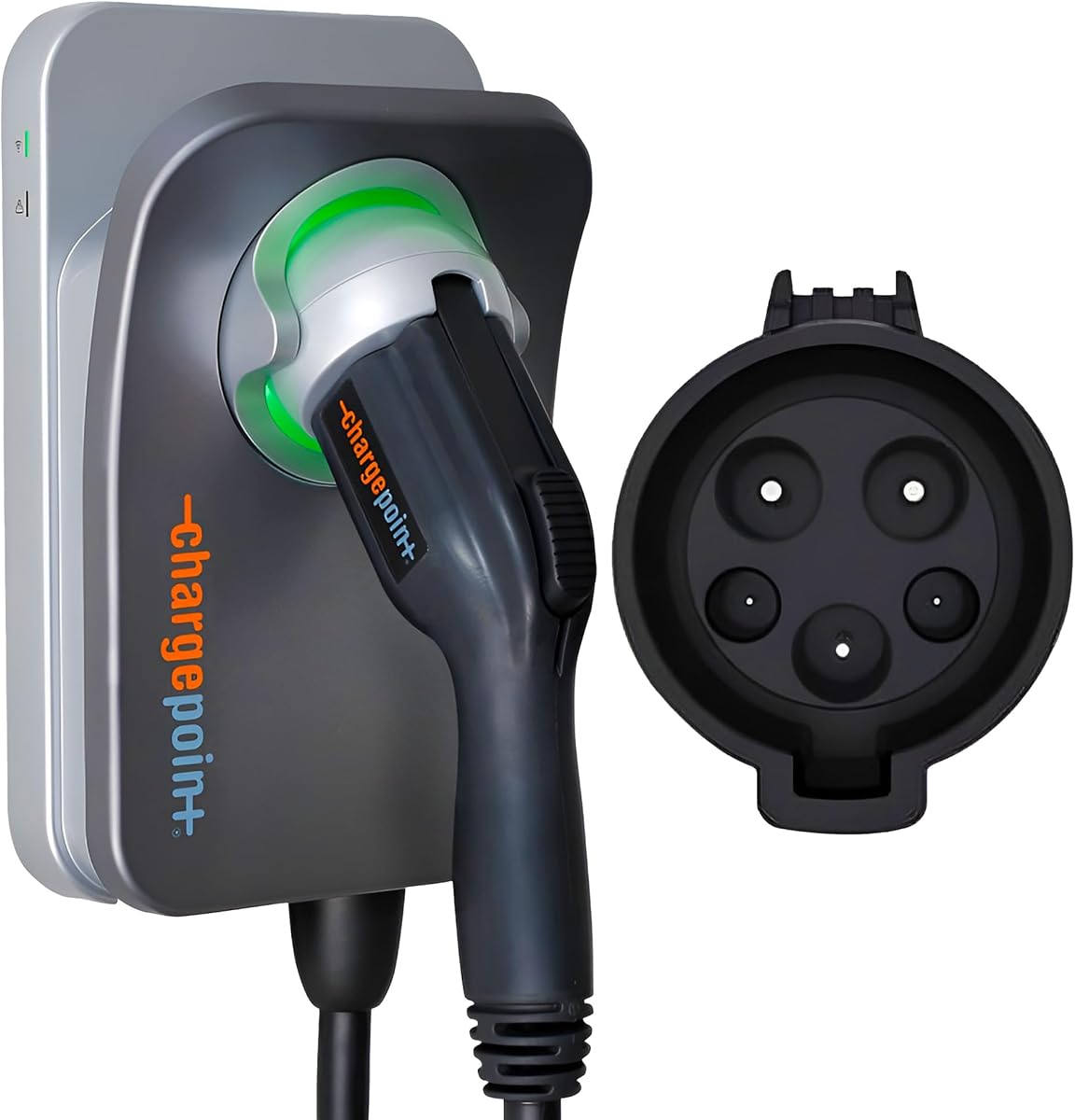
The ChargePoint HomeFlex Level 2 EV Fast Charger holds a 4.3 rating and brings a recognizable charging ecosystem to the home market. This hardwired 50-amp station uses the common J1772 connector, making it suitable for most non-Tesla EVs and plug-in hybrids sold in North America.
We may earn a commission when you buy through this link, at no additional cost to you.
One of its most persuasive features is connectivity. The ChargePoint Mobile App can control charging, manage reminders, connect with smart-home devices, locate public charging stations, and display charging information. That broader network integration may appeal to owners who want one app for both home and away, although WiFi is required for certain functions and troubleshooting.
The HomeFlex is UL certified and intended for professional installation indoors or outdoors. Its cold-resistant cable is particularly relevant to owners in regions with harsh winters, while the up-to-45-mile-per-hour charging estimate demonstrates the substantial improvement over a standard 120-volt outlet. Actual range added depends on the vehicle, battery temperature, and charging curve.
The main compatibility limitation is Tesla ownership, because a J1772-to-NACS adapter must be supplied separately. The product listing also mentions a 20-amp or 80-amp circuit requirement, which is unusual enough to warrant careful confirmation. Overall, HomeFlex is a strong choice for drivers who prioritize a familiar app ecosystem, dependable certification, and straightforward hardwired charging.
The app's access to ChargePoint's large public network is a meaningful advantage for frequent road-trippers. Home charging, station discovery, notifications, and charging information can be handled in one familiar interface, though reliable 2.4 GHz WiFi coverage is important.
The 50-amp specification provides ample potential for overnight charging, and the cold-resistant cable helps address a common concern for seasonal EV use. Professional installation remains essential because the station is designed for a dedicated hardwired circuit.
We may earn a commission when you buy through this link, at no additional cost to you.
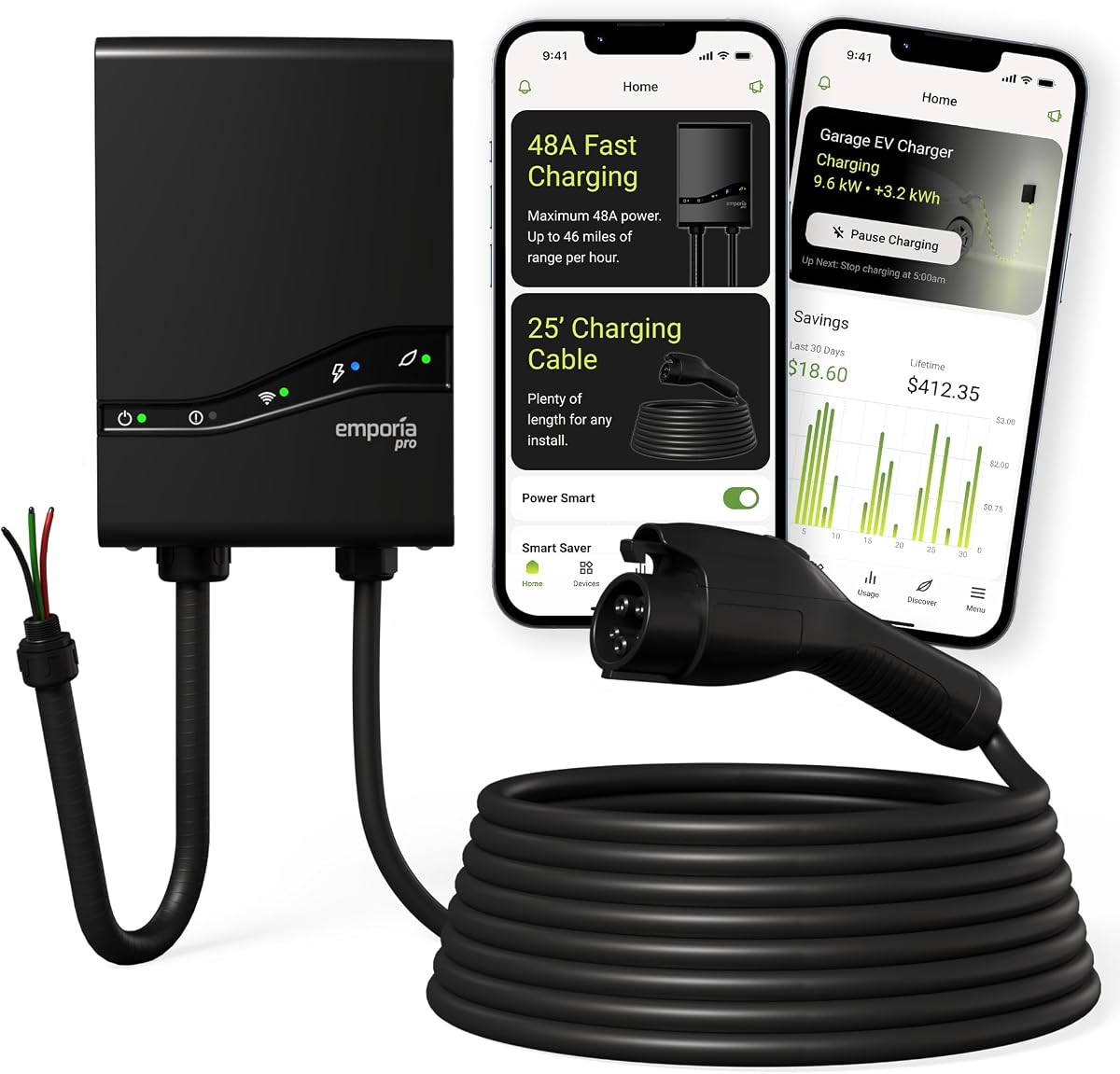
The EMPORIA Pro Level 2 EV Charger has a 4.8 rating, the highest among the ten products compared, and distinguishes itself with PowerSmart technology. Rather than requiring a panel upgrade in every situation, the system can work with the existing electrical panel and automatically balance charging load to fit available capacity.
We may earn a commission when you buy through this link, at no additional cost to you.
That load management is especially useful in homes where the EV charger shares an electrical system with HVAC, water heating, kitchen appliances, or other high-demand equipment. Drivers can schedule charging through the app, follow off-peak periods, and monitor real-time usage. The included EMPORIA Vue also provides a broader view of household energy consumption, helping users understand when charging fits best.
Installation flexibility is another strength. The charger can use a NEMA 14-50 plug or be hardwired, giving owners a path that may simplify installation while retaining the option for a permanent setup. It includes WiFi and Bluetooth support resources and is backed by responsive US-based support, which can be reassuring during initial configuration.
PowerSmart does not eliminate the need for safe electrical work, and the more elaborate energy-management system may feel unnecessary for a simple two-vehicle household. Even so, the combination of a 48-amp rating, flexible wiring, app scheduling, and real-time load balancing makes EMPORIA Pro an especially attractive option for owners who want more than a basic charging box.
PowerSmart adjusts the charging demand according to the home's available electrical headroom. This can make a 48-amp charger more practical in a constrained electrical environment, subject to confirmation by a qualified electrician.
The bundled EMPORIA Vue expands the experience beyond the vehicle, showing real-time household energy information. That visibility helps drivers make informed scheduling choices and see how the charger affects overall demand.
We may earn a commission when you buy through this link, at no additional cost to you.
The AIMILER Level 2 EV Charger combines a 4.6 rating with an approachable plug-in design, adjustable output, and extensive controls. It supports up to 32 amps, or 7.68 kilowatts, and includes a 25-foot cable plus a J1772 connector for most North American EVs and plug-in hybrids.
We may earn a commission when you buy through this link, at no additional cost to you.
Its flexibility comes from the ability to match charging current to the installed breaker. It can deliver 16 amps on a 20-amp circuit, 24 amps on a 30-amp circuit, or 32 amps on a 40-amp circuit. A touchscreen displays amperage, voltage, charging speed, and delay information, while the app adds scheduling, cost tracking, history, status monitoring, and full-charge notifications.
Safety features include built-in CCID-20 leakage detection, allowing the unit to work with a NEMA 14-50 receptacle without requiring a separate GFCI breaker. It is ETL and FCC listed, references multiple SAE J1772 and UL standards, and has an IP66-rated enclosure for suitable protected locations. The long charging cable and 16-to-32-amp adjustment make it a capable home option.
The charger should not be confused with an ordinary extension cord, and the product information specifically warns against using a recreational-vehicle adapter. It also recommends avoiding direct sunlight and exposed rainy conditions despite its weather resistance. For owners with an appropriate 40-amp circuit who want app control without hardwiring, AIMILER delivers useful performance and flexibility.
Changing output from 16 to 32 amps lets the charger adapt to available circuit capacity. This is useful for a new installation and gives owners a clear way to select a suitable rate after consulting an electrician.
The combination of plug-in installation, app scheduling, and a readable touchscreen makes everyday operation approachable. A 2.4 GHz network is required for app setup, and the unit should be connected to a properly installed NEMA 14-50 receptacle.
We may earn a commission when you buy through this link, at no additional cost to you.
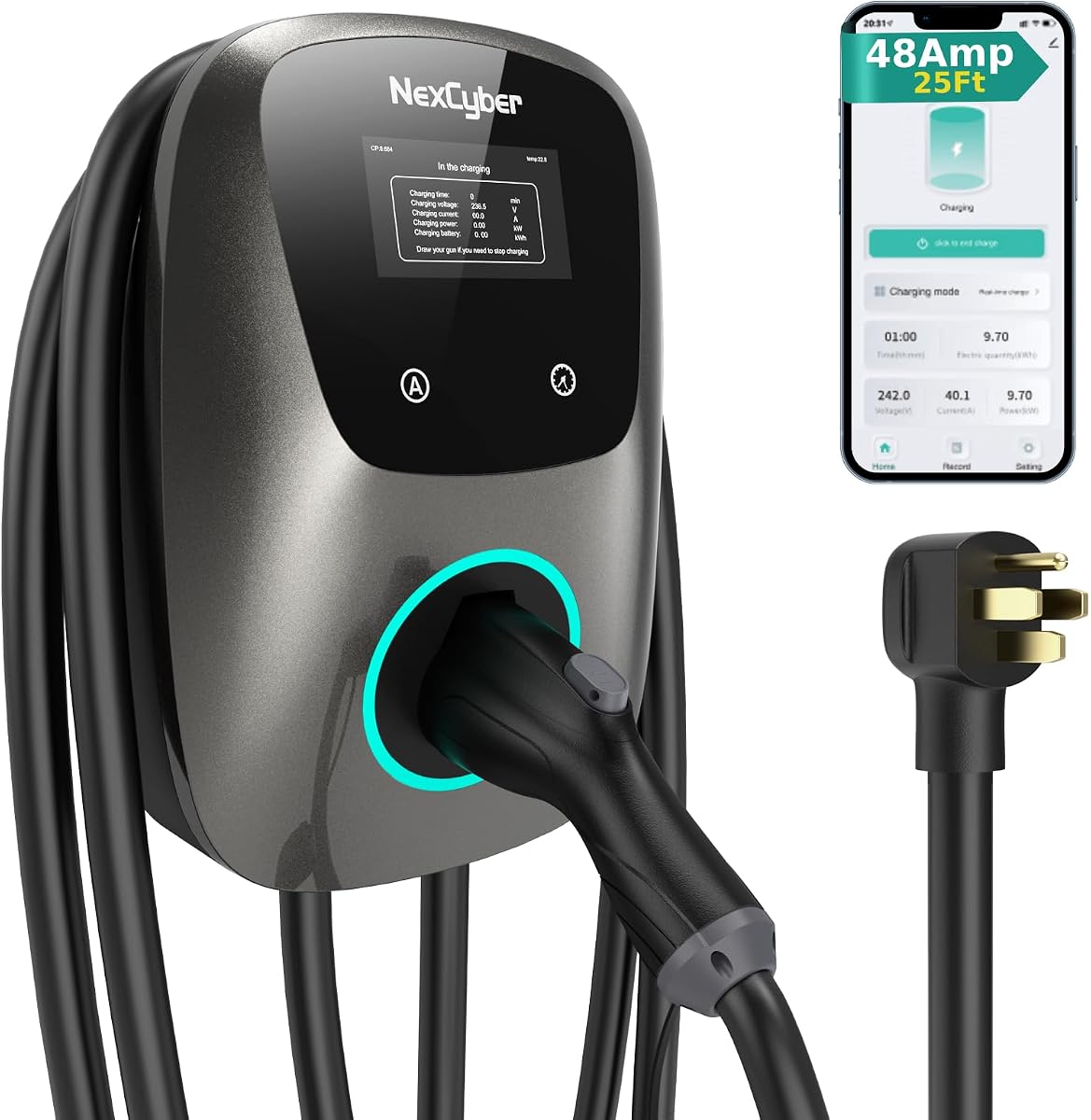
The NexCyber 48A Level 2 EV Charger has a 4.5 rating and combines unusually high output with plug-in convenience. It can deliver up to 48 amps through a hardwired connection or 40 amps through its NEMA 14-50 plug, making it adaptable to different installation plans.
We may earn a commission when you buy through this link, at no additional cost to you.
The 25-foot cable provides generous reach, while the touchscreen presents amperage, input voltage, charging speed, delay timing, and other operating information. The WiFi app can add scheduling, charging history, status monitoring, cost information, and full-charge notifications. The default operating mode does not require the app, which is helpful if connectivity is temporarily unavailable.
Safety credentials include ETL and FCC certification, Energy Star certification, and references to several SAE J1772 and UL standards. The product also carries a three-year warranty. Its adjustable 16-to-48-amp range gives owners a way to adapt output to the circuit, and the listed emergency-stop and reset procedures provide additional ways to manage unusual operating states.
Weather protection is the central limitation. The enclosure is approved to NEMA Type 3 with a stated extent of IP65 protection, and the manufacturer advises against direct sunlight or exposure to rainy conditions. It is therefore better suited to a garage or sheltered exterior location than an unsheltered wall. Within those parameters, it offers an appealing mix of output, adjustment, and app support.
The NEMA 14-50 plug allows an owner to begin with a suitable outlet and retain a hardwiring path for a permanent installation. Appropriate wire size and breaker selection are essential when operating near the upper output limit.
Useful information is available directly from the touchscreen, while the app adds remote scheduling and historical tracking. This dual-control approach accommodates both quick daily interactions and longer-term energy management.
We may earn a commission when you buy through this link, at no additional cost to you.
The EVDANCE 32A Level 2 EV Charger has a 4.4 rating and focuses on portable, adjustable home charging. It supports up to 32 amps and 7.68 kilowatts through a NEMA 14-50 plug, with selectable 16-, 24-, and 32-amp outputs that can be matched to different circuit capacities.
We may earn a commission when you buy through this link, at no additional cost to you.
The current selection is made with the charger's button interface, while the built-in LED screen displays amperage, voltage, charging speed, and delay settings. A delay function supports scheduled charging during off-peak periods. The product information also describes settings ranging from 10 to 32 amps in additional steps, giving owners room to tailor charging behavior to their vehicle and installation.
Portability is a meaningful advantage because the package includes a carrying case and wall-mounting bracket. The 25-foot cable reaches most home parking arrangements, and the connector is designed to withstand repeated insertion. For environmental protection, the unit uses a NEMA Type 4 and IP66-rated enclosure, making it suitable for garages, carports, and covered outdoor areas when protected from prolonged direct sun and heavy rain.
The screen makes basic operation manageable without depending on wireless connectivity, but there is no indication of a full-featured app comparable to those offered by several competitors. The listed warranty covers the EV charger extension cable for one year. It remains a flexible option for owners who value portability, straightforward controls, and a moderate maximum charging rate.
The included case and mounting bracket make it easy to move between a home garage, an office, or a travel destination. The long cable adds flexibility, while the wall bracket keeps the unit organized when it is not in use.
Drivers can select current and delay directly on the unit, which is useful when connectivity is inconsistent. The readable display makes operating status visible without opening an app or navigating a separate control page.
We may earn a commission when you buy through this link, at no additional cost to you.
The EVDANCE 40A Level 2 EV Charger earns a 4.4 rating and raises the output ceiling for EVDANCE's portable home format. It can supply up to 40 amps and 9.6 kilowatts through a 240-volt NEMA 14-50 connection while allowing users to select from 10-, 16-, 20-, 24-, 32-, or 40-amp settings.
We may earn a commission when you buy through this link, at no additional cost to you.
A 2.4-inch TFT display provides a particularly clear view of charging current, voltage, power, elapsed time, and operating status. LED indicators supplement the display, and a delay-start function can postpone charging by one to 12 hours. The intuitive controls and clear feedback make the charger easier to manage for owners who do not want to depend on a mobile application.
Safety protections cover leakage, grounding issues, overvoltage, undervoltage, overcurrent, overcharging, overheating, and short circuits. The charger also shuts off when the vehicle reaches a full charge. Its IP66 rating and stated operating range of minus 22 to 122 degrees Fahrenheit support use across a broad range of climates, although proper outlet installation remains essential.
A 25-foot cable, connector holder, control-box holder, and carrying case make the station suitable for home, work, or travel. Tesla drivers need a separate J1772-to-NACS adapter. For others seeking a portable charger with a larger screen and more output than the 32-amp model, this is a strong middle ground.
The TFT display presents more operating detail than a basic LED indicator, including current, voltage, power, charging time, and status. That visibility can simplify troubleshooting and help drivers confirm that the selected amperage matches their electrical setup.
The delay timer gives owners control over when charging begins, while the wide stated temperature range and IP66 enclosure support use in varied conditions. The unit remains portable thanks to its included cable holders and carrying case.
We may earn a commission when you buy through this link, at no additional cost to you.
The ApexCharger MACH 1 has a 4.6 rating and offers one of the broadest connector packages in this comparison. It includes a J1772 connector and a NACS adapter, allowing the same station to serve conventional North American EV ports and Tesla vehicles without requiring a separate adapter purchase.
We may earn a commission when you buy through this link, at no additional cost to you.
Its installation design is flexible. The unit can use a NEMA 14-50 plug for 40-amp operation with an appropriate 50-amp breaker or be hardwired for the full 48-amp configuration with a 60-amp breaker. A 30-foot cable gives owners generous reach across a garage, driveway, or parking area, while the wall-mount format helps keep the connector and cable organized.
Smart and access features make MACH 1 more elaborate than a basic home charger. WiFi and Bluetooth connectivity, a mobile application, two RFID cards, a 2.4-inch LED display, and a True Plug N' Play function provide several ways to start and manage charging. An anti-theft bolt and included fittings add another layer of physical security for a permanently mounted unit.
The station's height, larger enclosure, and included access controls give it a more substantial footprint than compact plug-in models. Owners should also verify the correct circuit and breaker configuration before installation. For households with mixed connector needs, especially owners who do not want to purchase a separate Tesla adapter, MACH 1 is a versatile and well-equipped choice.
The included NACS adapter removes a common compatibility hurdle for Tesla owners while retaining the standard J1772 connector for other EVs. This makes the station easier to use across a household with different vehicle brands.
Owners can begin with a NEMA 14-50 arrangement or hardwire the unit for maximum output. RFID cards and anti-theft hardware add options for shared or exposed installations, while the long cable improves vehicle reach.
We may earn a commission when you buy through this link, at no additional cost to you.
The Autel MaxiCharger Level 2 carries a 4.4 rating and is the most technically advanced premium option in the group. Its hardwired design supports up to 80 amps and 19.2 kilowatts, with the potential to add about 70 miles of range per hour depending on the vehicle. It is intended for owners who want substantial charging headroom for large-battery EVs or busy households.
We may earn a commission when you buy through this link, at no additional cost to you.
The AI-integrated app adds scheduling around time-of-use utility rates, remote session control, current adjustment, real-time energy data, and alerts when the system detects unusual conditions. Dual WiFi and Wi-SUN connectivity are designed to keep the station online, while internal temperature monitoring adds another layer of operating oversight.
Physical and installation features reflect a premium permanent setup. The flame-retardant enclosure, tamper-resistant screws, remote locking, 25-foot cable, and indoor-outdoor design support long-term use. One-click configuration is intended to simplify setup, and the charger is described as CSA certified and eligible for many rebates, incentives, and tax credits. A five-year warranty and 24/7 expert support add further reassurance.
This level of performance places the greatest demand on the home electrical system. Full 80-amp output requires a recommended 100-amp circuit and careful professional installation. For a household with sufficient electrical capacity and a desire for advanced energy management, Autel MaxiCharger is a forward-looking premium choice with unusually high output.
An 80-amp rating gives the charger significantly more headroom than typical 32-, 40-, or 48-amp home units. That makes it well suited to large batteries, multiple EVs, or drivers who want short, powerful charging windows.
Real-time energy information, unusual-activity alerts, dual-network connectivity, temperature monitoring, remote locking, and tamper-resistant screws create a comprehensive management package. These functions are particularly relevant to a permanently installed home charger.
We may earn a commission when you buy through this link, at no additional cost to you.
The EMPORIA 48A Level 2 EV Charger has a 4.7 rating and provides a proven combination of installation flexibility, safety certification, and connected charging. It is preconfigured for a NEMA 14-50 plug at up to 40 amps and can be converted to a hardwired installation for the full 48-amp output.
We may earn a commission when you buy through this link, at no additional cost to you.
That flexibility lets an owner select the configuration that fits the property rather than committing immediately to one approach. In hardwired form, the charger can add up to 46 miles of range per hour, while the plug-in arrangement is described as capable of up to 38 miles per hour. Exact results vary with the vehicle, battery condition, and operating environment.
The station is UL listed, Energy Star certified, and associated with standards covering NEC 625, SAE J1772, UL 817, UL 991, UL 2231, UL 2251, and UL 2594. Its 25-foot cable and white housing suit a clean permanent installation, while 2.4 GHz WiFi connects it to the EMPORIA app for energy data, mobile controls, and scheduling tied to utility rates.
The J1772 connector supports a broad range of North American EVs and plug-in hybrids, including Tesla vehicles when an appropriate adapter is used. Professional installation is recommended for safe, optimized performance. Overall, this model is a strong all-rounder for buyers who want meaningful power, smart functions, and the option to convert a plug-in setup into a hardwired one.
The NEMA 14-50 configuration makes the unit usable with a suitable outlet, while the conversion path supports full 48-amp hardwired operation later. This gives owners flexibility as their vehicle and electrical needs develop.
UL listing, Energy Star certification, and extensive standards coverage provide a strong safety foundation. The app adds real-time energy data and rate-aware scheduling, while the long cable provides flexibility across common parking arrangements.
We may earn a commission when you buy through this link, at no additional cost to you.
The right home EV charger is one that matches your vehicle, connector, electrical service, parking arrangement, and preferred level of control. Reviewing these factors before ordering can prevent compatibility problems, unnecessary installation work, and charging performance that falls short of expectations.
Maximum charger output is only one part of the equation; the vehicle's onboard charger determines how much power it can accept. A 32-amp unit may be all a particular EV needs, while drivers with large-battery vehicles or plans for multiple EVs can benefit from 48 amps or more. Advertised range-per-hour figures also vary because charging speed slows as a battery approaches full capacity.
Choose enough power to meet realistic needs, not simply the largest number available. Compare the charger's output with your vehicle's supported charging rate, then ensure the electrical system can safely deliver that level.
A dedicated 240-volt circuit is the foundation of dependable Level 2 charging. A 40-amp charger generally requires a 50-amp breaker, a 48-amp hardwired charger generally calls for a 60-amp breaker, and an 80-amp charger may require a 100-amp circuit. Panel age, available breaker space, grounding, and simultaneous household loads can all affect what is feasible.
Ask a licensed electrician to assess the panel before choosing final output. Some smart chargers can manage available capacity, but they do not replace proper electrical design and professional installation.
A plug-in charger is generally easier to relocate and can be a practical choice when a suitable NEMA 14-50 outlet already exists. A hardwired station is usually better for a permanent garage installation because it avoids a visible plug connection and may support higher output. Several products offer both modes or include conversion hardware.
Consider whether you want the flexibility to move the charger or the permanence of a wall-mounted setup. Confirm included hardware, permitted configurations, local electrical requirements, and whether professional installation is expected.
Most North American EVs and plug-in hybrids use the SAE J1772 connector, while many Teslas use NACS. Some stations include both a J1772 cable and a NACS adapter, but others require the owner to purchase an adapter. Even within J1772-equipped vehicles, owners should confirm the inlet location and whether an adapter is needed for certain newer models.
Check the exact connector on the charging port, not merely the vehicle's brand. If the household may own a different EV later, choosing a unit with an included NACS adapter can simplify future compatibility.
WiFi-enabled chargers can schedule sessions around off-peak utility periods, report energy consumption, send charging notifications, and allow remote control. These features are useful when electricity rates vary by time or when household demand makes automatic load management valuable. Screen-only models can be simpler and more reliable for users who do not need remote access.
Look for controls you will actually use. Check whether the app supports rate-based scheduling, historical data, remote start and stop, and integration with home energy equipment, and verify that your phone and router support the required 2.4 GHz network.
Look for recognized safety certification from organizations such as UL, ETL, or CSA, along with credible references to the standards that govern EVSE equipment. Built-in leakage detection, ground-fault protection, overcurrent and overvoltage safeguards, temperature monitoring, and automatic shutoff at full charge add further layers of protection.
Certification should be verified from the product listing and manufacturer documentation. A certification mark is more meaningful than an unsupported claim, so shoppers should avoid relying on vague statements that a product is simply safe or weatherproof.
A garage offers more installation latitude than an exposed driveway wall. Outdoor chargers should have a clearly stated IP or NEMA rating, while the product instructions should explain whether direct sun, rain, snow, or standing water are permitted. A 25-foot cable provides enough reach for many two-car garages, whereas 30 feet can be useful for larger properties or awkward parking layouts.
Match protection to the actual mounting location rather than assuming every weather-resistant unit is suitable for full exposure. Also consider cable visibility, vehicle approach angle, and the distance from the electrical panel.
A clear display showing amperage, voltage, charging status, and elapsed time helps owners confirm that the charger is operating as intended. Touchscreens add convenience, while LEDs can provide quicker status recognition at a glance. Side reset buttons, accessible connectors, holsters, mounting hardware, and carrying cases improve everyday usability.
Choose a design that remains easy to operate in rain, darkness, or limited light. A glow-in-the-dark holster, illuminated controls, a readable screen, and an accessible emergency-stop or reset control can make routine charging less frustrating.
Before connecting a vehicle, confirm that the charging port is clean and dry, inspect the connector and cable for visible damage, and verify that the charger's current setting matches the circuit and vehicle requirements. Plug in the vehicle first when following a plug-in station's instructions, confirm that charging begins, and then review the displayed voltage, amperage, and status. Never use a damaged connector, an improper adapter, or a household extension arrangement that the charger manufacturer has not approved.
For scheduled charging, connect the app to the charger's 2.4 GHz network, identify the station, and establish a schedule that aligns with the vehicle's required departure time and the utility's lower-cost periods. If the charger supports adjustable current, begin with a conservative setting and increase it only when an electrician has confirmed that the circuit and vehicle can handle the selected level. Remote start and stop functions should be used consistently with the vehicle's charging controls.
Periodically clean the connector and holster, keep the cable free from moving parts and sharp edges, and inspect the outlet or hardwired enclosure for heat, discoloration, moisture, or looseness. Do not spray water directly on the control box, display, or connector. If charging stops unexpectedly, check the vehicle, app status, breaker, emergency-stop control, and relevant fault message before resetting the unit, and contact the manufacturer or a qualified electrician when the cause is not clear.
The fastest Level 2 charger in this guide is the Autel MaxiCharger, which supports up to 80 amps and 19.2 kilowatts. Actual charging speed still depends on the vehicle's maximum acceptance rate, battery temperature, and electrical capacity. A more powerful charger cannot force a vehicle that accepts only 32 amps to charge at 80 amps.
Professional installation is strongly recommended for any hardwired 240-volt charger, and it is also wise for a plug-in unit because the outlet and circuit must be correctly installed. An electrician can assess panel capacity, breaker selection, grounding, wire gauge, and local code requirements. This prevents overload, overheating, and compatibility problems.
Many Tesla vehicles can charge with a J1772-to-NACS adapter, but the adapter is not included with every charger. The ApexCharger MACH 1 includes a NACS adapter, while several other products require the buyer to obtain one separately. Check the Tesla's charging port and the current adapter guidance before ordering.
A hardwired charger that delivers up to 48 amps normally requires a dedicated 60-amp branch circuit, subject to the charger's instructions and local electrical code. Plug-in configurations may have different limits, such as 40 amps through a NEMA 14-50 outlet. A qualified electrician should confirm all final circuit and conductor selections.
A standard extension cord is not a safe substitute for a properly installed Level 2 charging circuit. Some products include specialized adapter cables for limited use, but their instructions must be followed exactly, and ordinary household extension cords can overheat under sustained high-current charging. Consult the charger manufacturer and a licensed electrician for guidance.
The amperage determines maximum charging power when paired with 240-volt electricity: roughly 7.68 kilowatts at 32 amps, 9.6 kilowatts at 40 amps, and 11.52 kilowatts at 48 amps. The real benefit depends on the EV's onboard charging limit and the home circuit. Higher output adds potential range per hour but also requires appropriate wiring and breaker capacity.
App-connected chargers are designed to manage charging sessions and provide visibility into operating status, but connection to a phone does not replace correct installation. Follow the manufacturer's instructions, use the prescribed circuit, and avoid damaged cables or outlets. The vehicle and charger will normally stop or regulate power as appropriate, but owners should still inspect the system periodically.
Choose plug-in when a suitable 240-volt outlet already exists or when portability is important. Choose hardwired for a permanent installation, a cleaner finished appearance, or the highest available output. Several models support both approaches, which can provide flexibility during setup and future changes.
The EVIQO Level 2 EV Charger is the strongest all-around recommendation because it combines 48-amp hardwired performance, reliable app controls, a long cable, and a well-sealed enclosure. The AIMILER Level 2 Charger is a practical budget-oriented choice for owners who want a 32-amp plug-in unit with useful screen and app controls, while the Autel MaxiCharger represents the premium option for households ready to support up to 80 amps.
Before choosing, prioritize vehicle compatibility, electrical-panel capacity, the correct connector, and a realistic assessment of how often you need to charge. More amperage is not automatically better if the vehicle cannot use it or the home lacks the necessary circuit. Installation flexibility, weather protection, scheduling, and physical security should then be weighed according to the location and number of EVs being served.
Finally, verify the current product listing, certification information, included accessories, connector details, and installation requirements before ordering. Electrical service, utility programs, product configurations, and pricing can change, and a licensed electrician can confirm whether the selected charger can be installed safely and operated at its intended output.