
BOSS BC-1X Bass Compressor
4.5Editor score
Multiband internal processing
Professional 18-volt input
High-resolution gain indicator
Our Bass Compressor Pedals guide compares ten options for bass, highlighting transparent control, sustain, noise performance, bypass design, and useful
A bass compressor pedal evens out a bass signal by reducing louder notes and making softer notes more consistent. A well-designed model can add controlled sustain, tighten low-end response, improve consistency, and help a bass sit clearly within a mix without simply turning every note into the same flat volume.
We compared the ten featured pedals using their supplied specifications, including compression behavior, control options, headroom, bypass design, noise considerations, gain-reduction feedback, and bass-specific usability. The list covers dedicated bass compressors, bass-capable studio emulations, general compressor pedals, compact models, and one accessory bundle.
Each review explains the pedal’s strongest qualities, practical trade-offs, and likely audience, while the comparison and buying guide focus on the factors that matter most. Product ratings reflect the supplied listing data, and prices can change, so readers should confirm current availability and cost before purchasing.
4.5Editor score

4.6Editor score

4.6Editor score
This side-by-side comparison highlights the pedal designs, control styles, bypass options, monitoring features, and bass-focused capabilities of all ten products, helping readers distinguish dedicated bass models from versatile general-purpose compressors and studio-style emulations.




The MXR Bass Compressor, model M87, earns a 4.6 rating in the supplied product data and stands out as the most directly focused option in the list. Its defining feature is CHT Constant Headroom Technology, designed to preserve clarity while the signal remains below the compression threshold. The pedal is intended to make bass playing more consistent without unnecessarily altering the instrument’s character.
We may earn a commission when you buy through this link, at no additional cost to you.
Ten gain-reduction status LEDs provide unusually useful visual feedback. They indicate when the compressor begins working and show how much gain reduction is taking place, allowing a player to make changes without relying entirely on what the amplifier reports. True bypass is another meaningful strength: when the effect is switched off, the signal passes through without the compressor’s processing. The combination of transparent operation, dedicated bass design, and clear monitoring makes the M87 especially appealing for players who want reliable leveling rather than dramatic sonic transformation.
The primary limitation is that the M87 focuses on compression rather than providing a broad tone-shaping toolset. There are no listed tone, attack, or sustain controls for adjusting the character of the effect, and some players may prefer the MXR Dyna Comp Bass model because it offers familiar output and sensitivity controls. The ten LEDs can also feel more elaborate than necessary for a minimalist pedal. These are not fundamental shortcomings, however. The M87 is designed to perform one task with clarity, and its true-bypass and headroom features make it a disciplined choice for stage use, recording, and modern amplified bass.
The MXR Bass Compressor is best for players who want transparent, bass-specific leveling with a generous amount of headroom. It is particularly compelling for anyone who values visual gain-reduction feedback and appreciates a simple dedicated design without studio-style parallel controls. Choose it over more multi-control pedals if your priority is a dependable compressor that preserves dynamics until the threshold and stays out of the way. It is our Editor’s Choice because it combines focused bass utility, clear monitoring, and a clean bypass path in one purpose-built package.
The M87 is designed around preserving the bass signal until it reaches the compression threshold. That approach is valuable for players who want even note volume and extra sustain without a heavily processed, obviously compressed character.
Ten highly visible gain-reduction LEDs show when the circuit is engaging and how strongly it is working. This feedback makes it easier to establish a consistent setting and recognize changes while switching between basses or adjusting the amplifier.
We may earn a commission when you buy through this link, at no additional cost to you.
The BOSS BC-1X Bass Compressor receives a 4.5 rating in the supplied data and is the most feature-forward dedicated bass pedal here. Its intelligent circuitry is designed to adapt to different registers and playing nuances, with the aim of producing natural compression that preserves the fundamental tone of the bass. Rather than exposing every internal parameter, BOSS condenses sophisticated multiband processing into approachable stompbox controls.
We may earn a commission when you buy through this link, at no additional cost to you.
Professional 18-volt input electronics are among the BC-1X’s most attractive features for modern bassists. The increased input headroom allows the pedal to accommodate demanding signals while avoiding the distortion that can result when a compressor receives more signal than its input stage can comfortably handle. Digital circuitry also reduces noise, a frequent concern in older compressor designs. A high-resolution gain-reduction indicator gives the player a clear view of the current compression amount, while the internal multiband behavior allows the pedal to respond differently to different frequency ranges and playing characteristics.
Its sophistication can be a double-edged sword. Players who only want a basic level control may find that the adaptive behavior takes more experimentation than expected, and the BC-1X does not offer a conventional tone control in the supplied specifications. The digital and multiband architecture is also more involved than the simple signal paths found in several other pedals. For those who want dedicated bass voicing, high headroom, and minimal noise, though, those traits are meaningful advantages. The result is a more specialized instrument that can adapt without requiring a dense collection of front-panel settings.
The BC-1X is best for players who routinely use active basses, high-output setups, or varied registers and want the pedal to respond intelligently rather than apply one fixed compression response. It also suits stage and studio users who value clean digital circuitry and precise visual feedback. Choose the MXR M87 for a more minimal, transparent approach; choose the BC-1X when adaptive behavior, professional input headroom, and low noise are the priorities you are most willing to pay for.
The intelligent internal circuitry is intended to recognize changes in register and playing nuance. That makes the BC-1X useful for basses that move between different tonal regions or for players who need consistent behavior without constantly readjusting the pedal.
The 18-volt input stage provides ample room for demanding bass signals. Combined with digital noise reduction and a high-resolution indicator, it offers a clean and highly observable operating environment.
We may earn a commission when you buy through this link, at no additional cost to you.
The BOSS CS-3 Compressor/Sustainer has a 4.6 rating and provides one of the most accessible ways to add controlled sustain and consistency to a bass signal. Although it is a general compressor rather than a bass-only model, its four practical controls—level, tone, attack, and sustain—allow a bassist to shape the effect rather than choosing between a few fixed sounds.
We may earn a commission when you buy through this link, at no additional cost to you.
The CS-3 compresses louder signals while bringing up softer ones, creating a more even overall response. Level controls how much effect enters the chain, tone offers a basic tonal adjustment, attack shapes the initial response, and sustain sets the amount of compression and held sustain. Its low-noise design makes it a practical option for performance and recording, where unwanted pedal noise can be distracting. The compact enclosure also preserves pedalboard space, and the included five-year BOSS warranty provides additional ownership reassurance.
The main qualification is that the CS-3 was not designed exclusively for bass. Guitar players can also use it, and bassists may need to experiment with the level and attack settings to prevent the low end from becoming overly dense. There is also no gain-reduction display, so the player has less visual information than with the MXR M87 or BOSS BC-1X. Those limitations do not outweigh the straightforward design if you want familiar controls, a quiet circuit, and flexible sustain in a compact package.
The CS-3 is best for a bassist who wants a versatile compressor/sustainer with enough controls to refine the sound but not an elaborate dedicated bass unit. It works particularly well for adding consistent note presence, controlled sustain, and a more even relationship between quiet and loud playing. Choose it when straightforward operation and tonal flexibility matter more than bass-exclusive voicing. Among the available choices, it delivers the most useful balance of familiar functionality, compact construction, and accessible configuration.
Level, tone, attack, and sustain give the player meaningful control over the compressor’s behavior. Those controls make it possible to move from light leveling to more pronounced sustain while keeping the overall footprint simple.
By compressing louder passages and lifting quieter ones, the CS-3 helps produce a steadier output. Its low-noise design is particularly helpful for quiet stages, home recording, and players who dislike audible compressor noise.
We may earn a commission when you buy through this link, at no additional cost to you.
The MXR M87 Bass Compressor Effects Pedal with Tonebird Deluxe bundle has a supplied rating of 4.2 and combines the dedicated M87 compressor with several useful accessories. The pedal itself uses Constant Headroom Technology and true bypass switching, preserving the core traits of the standalone M87 while also adding Release, Attack, Output, Ratio, and Input controls for detailed adjustment.
We may earn a commission when you buy through this link, at no additional cost to you.
Ten highly visible LEDs indicate the compression threshold and ongoing gain reduction, giving the player immediate feedback while the five effect controls provide a more hands-on approach. The bundle also includes a Tonebird 9V 1500 mA power supply, a 10-foot instrument cable, two patch cables, and a Groovetech multi-tool. For a bassist building a first pedalboard or replacing several pieces of essential equipment at once, that accessory selection can make initial setup more convenient and complete.
The bundled approach is not necessarily the best value for every shopper. Someone who already owns a dependable power supply, suitable instrument cable, and patch cables may have no use for the additional items. The listed rating of 4.2 is also lower than the supplied rating for the standalone M87, although ratings can reflect different customer pools and package experiences rather than a direct measurement of circuit quality. The bundle description contains a typographical error in “instrument,” but the intended cable is clear. Buyers should assess the whole package rather than assuming the bundle improves the compressor’s sound.
This option is best for someone who specifically wants an M87 and would benefit from having power and connection accessories immediately available. It may especially appeal to a new bass player assembling a simple rig, since the package contains the pedal, a power supply, and multiple cables. If you already have the necessary equipment, select the standalone M87 for the simpler purchasing decision. If you do need the accessories, this bundle delivers the dedicated compressor and everything required for a straightforward initial connection.
Release, attack, output, ratio, and input controls allow the player to shape compression more directly than the standalone M87’s minimalist layout. Constant Headroom Technology still provides the operating foundation for the dedicated bass signal.
A power supply, instrument cable, and patch cables are included in the bundle, along with a multi-tool. These additions can help a new player connect the pedal and begin configuring a basic signal chain with fewer separate purchases.
We may earn a commission when you buy through this link, at no additional cost to you.
The Keeley Bassist Compressor and Limiting Amplifier has a 4.6 rating and is built around the THAT Corp. 4320, a circuit associated with high-fidelity studio compression. Rather than treating the pedal as a simple sustain switch, it is designed to provide true compression and limiting with high bandwidth, low noise, and the capacity to handle very large signals.
We may earn a commission when you buy through this link, at no additional cost to you.
The pedal uses high-performance voltage-controlled amplifiers, an onboard true-RMS detector, and ultra-high-performance operational amplifiers. Its stated bandwidth exceeds 20 kHz, allowing a broad range of bass harmonics to pass through the circuit. The limiter function gives the unit another level of control over peaks, while the low-noise architecture supports recording and performance use. For a bassist who needs a dependable tool for managing dynamic extremes, the technical design is more focused than that of most conventional stompbox compressors.
A circuit capable of handling astonishingly large signals is beneficial with active basses, modern high-output pickups, and dense arrangements, but it also means thoughtful gain staging is important. The player must account for both the compressor’s level control and the pedal’s output behavior to avoid overwhelming downstream equipment. Compared with simpler models, the Bassist can demand more attention during setup and may feel excessive for players who only need occasional sustain. Its specialized approach is not inherently better for everyone, but for demanding signal chains it offers a clear technical rationale.
The Keeley Bassist is best for advanced players who value fidelity, low noise, broad bandwidth, and the ability to control large signal levels. It is particularly relevant to session bassists and technically minded performers working with active instruments or complex recording chains. Those wanting a simpler pedal with visual feedback may prefer the MXR M87. If your priority is transparent dynamics, substantial signal capacity, and a studio-derived compressor architecture, the Keeley Bassist deserves serious consideration.
The THAT Corp. 4320 foundation, paired with voltage-controlled amplification, true-RMS detection, and high-performance operational amplifiers, gives the Bassist a technically serious foundation. The goal is accurate control rather than a heavily saturated sound.
A bandwidth of over 20 kHz allows the pedal to process a wide range of harmonics. That makes it suitable for players who want compression and limiting without sacrificing subtle detail in the bass signal.
We may earn a commission when you buy through this link, at no additional cost to you.
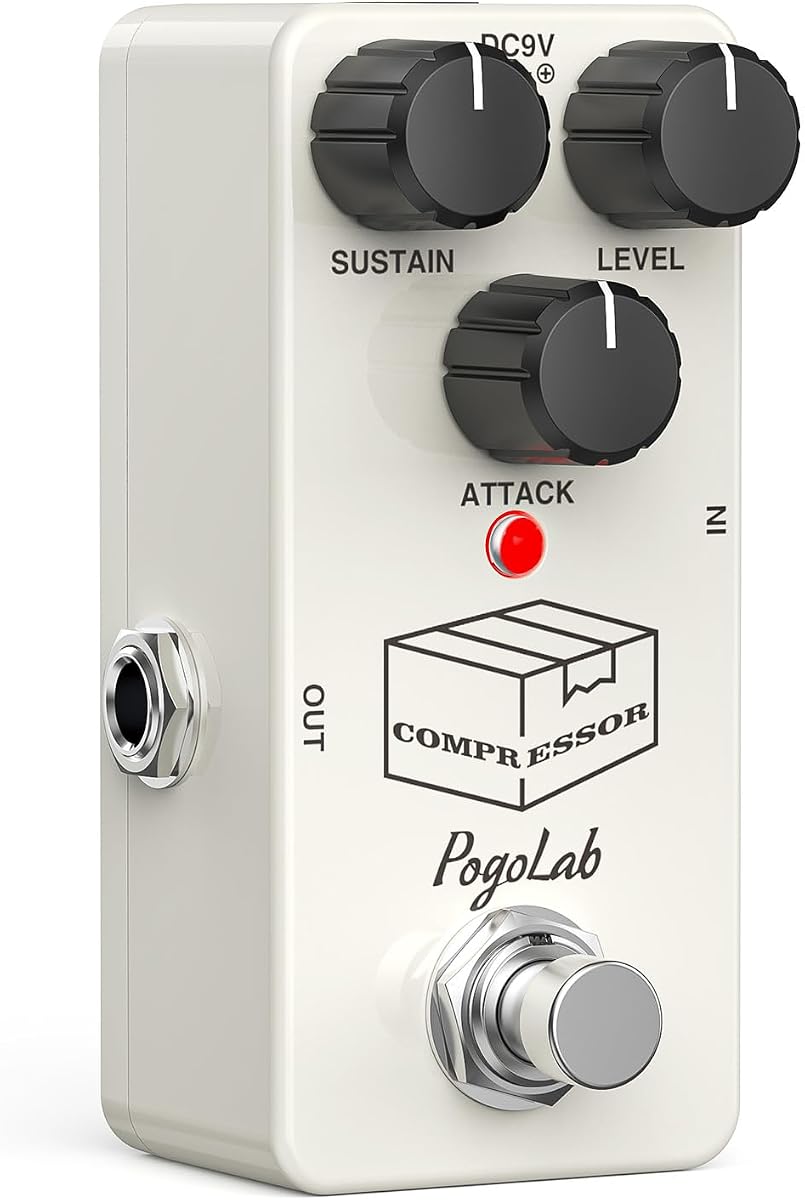
The Pogolab Mini Compressor Pedal has a supplied rating of 4.2 and is intended for electric guitar and bass. Its selling point is a compact format with a straightforward set of functions: a Sustain control for adjusting compressed time, an Attack control for the onset of the effect, true bypass switching, and an operating indicator light. The housing is made from aluminum alloy for a durable build.
We may earn a commission when you buy through this link, at no additional cost to you.
The pedal was developed with an emphasis on reducing noise swells associated with compressor circuits. That focus can make it appealing to players who want more consistency without an obvious increase in background noise. The separate attack and sustain controls provide enough latitude for basic tonal shaping, while true bypass leaves the signal intact when the effect is switched off. A center-negative 9V power connection is standard for pedal operation and helps keep the power requirement straightforward.
The main practical issue is that the power supply is not included. Players without a suitable adapter must add one before using the pedal, and the cable also is not listed as part of the package. The control set is limited compared with the M87 bundle, BC-1X, or CS-3, and there is no gain-reduction display to show the amount of compression. A player who needs exact visual feedback or highly specialized bass voicing may find the small feature set restrictive. Even so, the pedal offers a more direct and compact alternative to larger multi-control compressors.
The Pogolab Mini Compressor is best for players with limited pedalboard space who need basic compression, attack adjustment, and sustain control. It also makes sense for guitarists who occasionally switch to bass and want one compact pedal for both instruments. Confirm that you have the required center-negative 9V power source, then begin with conservative settings. For dedicated bass players who prioritize precise gain-reduction feedback, extensive controls, or maximum signal headroom, one of the specialist models will offer a more refined solution.
The mini enclosure and two principal effect controls keep the pedal visually and physically manageable. It is a practical option when board real estate is more important than elaborate front-panel adjustment.
Noise reduction was a stated design priority, while true bypass passes the signal through when the compressor is off. Together, these features can make the pedal less intrusive in both rehearsals and performances.
We may earn a commission when you buy through this link, at no additional cost to you.
The Electro-Harmonix Bass Preacher Compressor/Sustainer receives a 4.2 rating and is explicitly designed around bass output levels. Its input sensitivity spans from -10 dBu to +2 dBu, allowing it to accommodate both passive and active basses with different output strengths. Maximum gain reduction reaches 21 dB, while included make-up gain returns the signal to full volume at maximum sustain.
We may earn a commission when you buy through this link, at no additional cost to you.
One of the pedal’s most useful features is its three-position attack toggle. Fast, Medium, and Slow settings change the onset timing of compression, giving the player choices for preserving pick attack, smoothing the note, or increasing sustain. True bypass maintains signal-path integrity when the effect is off, and a 9V battery is included so the pedal can be used without immediately buying a separate power supply. The design is therefore convenient and purpose-built for the instrument it serves.
The discrete attack switch is less granular than a continuously adjustable control, and players who prefer fine experimentation may find the choices limiting. There is also no gain-reduction indicator, so visual feedback must come from the sound and the amplifier. A high maximum reduction can create substantial density if used aggressively, and the make-up gain requirement means output levels should be checked carefully. Despite those points, the available settings cover the central decisions most bass players need to make: response speed, input compatibility, sustain level, and bypass behavior.
The Bass Preacher is best for players who want pronounced, controllable sustain and own either a passive or active bass. It is also useful for anyone who prefers a clear three-way attack choice over a dense control panel. Try the different attack positions with your normal picking style, then adjust sustain and output to keep the pedal from overwhelming the amplifier. Choose a more transparent, monitoring-focused pedal if preserving subtle dynamics and seeing the exact gain reduction are your highest priorities.
The -10 dBu to +2 dBu sensitivity range gives the Bass Preacher broad compatibility with passive and active instruments. This is useful for players who switch basses or use varied output levels in the same setup.
Fast, Medium, and Slow positions change when compression begins. Those options let the player preserve attack, create a smoother surface, or favor additional sustain without navigating a complex control set.
We may earn a commission when you buy through this link, at no additional cost to you.
The Universal Audio LA2A Studio Compressor Pedal carries the highest supplied rating in the group at 4.7. It emulates the Teletronix LA-2A optical tube compressor and limiter in a compact stompbox, including the character associated with vintage transformers, tube amplifiers, and the T4 optical cell. The intent is to provide a familiar studio-style sound with a three-dimensional, tube-like character.
We may earn a commission when you buy through this link, at no additional cost to you.
A mix control allows parallel compression, letting the player blend the processed signal with the dry bass path. This is valuable when the desired result is control and cohesion without removing the instrument’s natural response entirely. The pedal also includes a Stock/Fast attack switch and selectable true or buffered bypass. Those choices let the player decide whether the bypass should be completely transparent or whether a buffered path better suits the rest of the signal chain. The result is a versatile compressor that can operate as a controlled studio-style effect or a subtler parallel layer.
The LA2A emulation is not exclusively designed for bass, so some settings may require more careful adjustment than on a dedicated bass pedal. The mix and attack controls also ask the player to think in terms of blending and response rather than a simple threshold-and-sustain model. Its recognizable character may be less neutral than the M87 or Keeley Bassist, which can be either a benefit or a drawback depending on the desired sound. With 4.7 in the supplied data and a broad feature set, it remains one of the most highly rated options here.
The Universal Audio LA2A is best for bassists interested in vintage studio compression, parallel blending, and a recognizable optical character. It can serve as a subtle mix tool when the mix control is adjusted carefully, or as the main compressor when a fuller effect is desired. Choose a dedicated bass pedal if straightforward low-end preservation and bass-specific voicing matter most. Choose the LA2A when tonal character, flexible bypass, and parallel compression are the priorities.
The mix control blends processed and dry signals, allowing a bassist to obtain added control while retaining part of the original response. This makes the pedal useful when full compression would otherwise feel too dense.
Detailed emulation of transformers, tube amplification, and the optical cell gives the LA2A a recognizable studio character. Fast-attack and selectable bypass options expand its usefulness in modern pedalboards.
We may earn a commission when you buy through this link, at no additional cost to you.
The MXR Dyna Comp Bass Compressor, model M282, has a supplied rating of 4.0 and reworks the familiar Dyna Comp sound specifically for bass. Its stated purpose is to retain low end, dynamics, and transparency while providing the stable sustain and output control associated with the classic compressor family. Output and sensitivity controls cover the two primary adjustments needed for basic compression.
We may earn a commission when you buy through this link, at no additional cost to you.
The dedicated bass retuning is the model’s most important distinction. Rather than treating the Dyna Comp as a guitar pedal that bass players may use, MXR has adjusted the voicing to account for the lower-frequency content and different tonal demands of bass. The result should be more immediately recognizable to players who have used other Dyna Comp models while remaining better suited to the instrument. A simple two-control layout also makes it easy to move from subtle leveling to a more obvious compressed surface.
The supplied 4.0 rating is the lowest among the featured products, so buyers should not treat the listing as unequivocal evidence of inferior construction or sound. It simply indicates that the current customer feedback is less favorable than the ratings attached to several alternatives. The pedal also has fewer monitoring features than the M87, and the limited control set offers less fine-grained adjustment than the M87 bundle or BC-1X. Bassists who require fine attack, ratio, or threshold adjustments may therefore prefer another model. Those who value a familiar control scheme and dedicated bass tuning may find the simplicity beneficial.
The Dyna Comp Bass is best for players who know the general Dyna Comp sound and want a bass-focused version with straightforward controls. It is a sensible option for adding consistent sustain and controlled output without navigating a complex interface. Compare it with the standard MXR Dyna Comp if you want to understand the effect of the bass-specific retuning, and choose the M87 if visual gain-reduction feedback is important. For a familiar, compact, bass-specific compressor, this model delivers the essential experience with fewer distractions.
The M282 adapts the Dyna Comp concept with an emphasis on retaining low end, dynamics, and transparency. It provides a familiar entry point for bassists who recognize the general character of the classic compressor.
Output and sensitivity controls cover level and compression behavior. Their limited number makes the pedal approachable and helps the player focus on the overall balance between the bass and amplifier.
We may earn a commission when you buy through this link, at no additional cost to you.
The MXR Dyna Comp Compressor has a supplied rating of 4.8, the highest in this comparison, and delivers a well-known general-purpose compression style. It is described as an in-line compressor that evens the signal sent to an amplifier, making it useful for increased sustain and more stable dynamics. The M102 is not a dedicated bass model, but bassists can benefit from its simple approach to controlling note volume and holding tones.
We may earn a commission when you buy through this link, at no additional cost to you.
The pedal’s core behavior is straightforward: a sensitivity control determines how the circuit responds, while the compressor evens the output. Its constant output signal and familiar tone make it easy to integrate with an amplifier, and it can provide extra sustain for bass lines that would otherwise decay quickly. Power can come from a Dunlop ECB003 AC adapter or a single 9V battery, so the pedal is convenient for mobile rigs and pedalboards that do not use a central supply.
The important qualification is bass suitability. Because the M102 is a general compressor rather than a model developed specifically around low-end frequency content, players should begin with conservative settings and listen for excessive density or loss of fundamental definition. Its minimal control set also does not offer the visual gain-reduction feedback, attack choices, or multi-band intelligence found elsewhere in the list. Still, many players may prefer that lack of complexity. A familiar sound and one principal control can be an advantage when quick, repeatable settings are more useful than detailed manipulation.
The MXR Dyna Comp is best for a bassist who wants a simple compressor/sustainer and recognizes the classic pedal’s sound, particularly alongside an amplifier that already sounds good without additional processing. It also works for guitarists and bassists seeking one uncomplicated pedal for multiple instruments. If your priority is preserving modern bass low end with dedicated tuning, choose the MXR Bass Compressor or Dyna Comp Bass instead. If a proven general-purpose compressor and uncomplicated sustain control are what you need, the M102 remains an effective final contender.
The sensitivity control is the primary adjustment, allowing the player to determine how strongly the compressor responds. Its familiar Dyna Comp approach makes it approachable for anyone who has used a classic in-line compressor.
The pedal accepts a single 9V battery or a Dunlop ECB003 AC adapter. That flexibility makes it easy to include in a compact or mobile rig without depending exclusively on a pedalboard power supply.
We may earn a commission when you buy through this link, at no additional cost to you.
The best bass compressor pedal depends on whether you prioritize transparent leveling, heavier sustain, detailed adjustment, low noise, compact construction, or a recognizable studio-style sound. These factors help narrow the field before you consider controls, power requirements, and practical setup details.
Bass occupies a different frequency range from electric guitar, so a pedal designed around bass can handle low-end content more thoughtfully. The MXR Bass Compressor uses CHT Constant Headroom Technology and a transparent approach, while the MXR Dyna Comp Bass is specifically retuned to retain low end, dynamics, and transparency. The Electro-Harmonix Bass Preacher also offers input sensitivity from -10 dBu to +2 dBu, accommodating passive and active basses. These dedicated designs are often easier for a bassist to dial in without excessive density or a weakened fundamental.
A transparent compressor should reduce dynamic extremes while leaving the bass recognizable and responsive. The M87 is designed to remain clear until the signal reaches the compression threshold, and the Keeley Bassist emphasizes high-fidelity operation and broad bandwidth. If you instead want a more obvious increase in sustain, the BOSS CS-3, Electro-Harmonix Bass Preacher, and general MXR Dyna Comp offer stronger sustain-oriented roles. The Universal Audio LA2A provides a third approach by blending processed and dry signals for parallel compression.
Controls determine how precisely you can shape the compressor. The M87 Accessory Bundle provides release, attack, output, ratio, and input controls, while the CS-3 provides level, tone, attack, and sustain. The BC-1X uses intelligent internal processing and simple stompbox controls rather than exposing every parameter. The Electro-Harmonix uses discrete attack positions, and the Pogolab Mini Compressor limits adjustment to sustain and attack. More controls can increase versatility, but they also require more knowledge and experimentation.
Headroom determines how cleanly the pedal can accept a strong bass signal. The BOSS BC-1X uses professional 18-volt input electronics for ample headroom, and the Keeley Bassist is specifically described as capable of handling exceptionally large signals. Dedicated bass pedals with broad input sensitivity are also useful when switching between active and passive instruments. Regardless of the model, begin with the bass volume at a moderate level, set the compressor’s sensitivity or input control, and then use the output control to balance the result with the amplifier.
A compressor should not create unwanted noise swells or a distracting background hiss. The BOSS CS-3 has a low-noise design, the BC-1X uses digital circuitry to reduce noise, and the Keeley Bassist lists low noise as a core achievement. The Pogolab Mini Compressor also emphasizes noise reduction. Bypass design matters as well: true bypass keeps the effect out of the signal path, while buffered or selectable bypass can help players who need a consistent signal and do not use a long cable run.
Visual feedback can make a compressor much easier to configure, especially when its effect is subtle. The MXR M87 and its bundle use ten LEDs to show gain reduction and indicate the threshold. The BC-1X has a high-resolution gain-reduction indicator, while the CS-3, Electro-Harmonix Bass Preacher, Pogolab Mini Compressor, Keeley Bassist, and Universal Audio LA2A do not list a display in the supplied information. A display is helpful for comparing settings, but the absence of one does not make a pedal less functional; players can still adjust by ear and amplifier response.
The bypass circuit determines how the pedal behaves when switched off. True bypass is available on the M87, the M87 bundle, the Electro-Harmonix Bass Preacher, and the Pogolab Mini Compressor. The Universal Audio LA2A offers both true and buffered bypass, allowing the player to choose. The BC-1X and CS-3 focus on digital circuitry, while the standard MXR Dyna Comp is a conventional in-line compressor. Also consider the enclosure, control spacing, connector placement, and available power, especially on a crowded pedalboard.
Power arrangements affect setup convenience and cost. The M87 bundle includes a Tonebird 9V 1500 mA supply, an instrument cable, patch cables, and a multi-tool. The Electro-Harmonix Bass Preacher includes a 9V battery, and the standard MXR Dyna Comp accepts either a 9V battery or a Dunlop ECB003 AC adapter. The Pogolab requires a center-negative 9V source, but the adapter and cable are not included. Confirm voltage, polarity, connector type, and whether your board already supplies the pedal before completing the purchase.
Start with a clean, familiar bass tone and set the compressor to its least intensive setting. Connect the pedal between the bass and amplifier, power it with a compatible source, and set your bass output to a moderate level. Adjust the sensitivity or input control gradually, listen for even note volume, and then use the output control to match the compressed signal with the rest of the rig.
Make small changes while playing familiar material. On models with attack, release, ratio, or sustain controls, use each to address a specific goal: preserving pick definition, smoothing note onset, extending sustain, or preventing peaks. On the BC-1X, observe the gain-reduction display to understand how the adaptive circuitry responds. On the M87, the ten LEDs reveal when compression begins. The LA2A’s mix control should be adjusted gradually so parallel blending does not obscure the intended blend.
For care, use the correct power voltage and polarity, keep the connections secure, and avoid placing the pedal in direct moisture or extreme heat. Clean the enclosure with a dry or lightly damp cloth, avoid abrasive cleaners around controls and connectors, and replace the battery if performance becomes inconsistent. When changing basses, recheck input levels and compression depth, and periodically revisit the settings because amplifier, instrument, and playing changes can alter how the pedal feels.
A compressor is not required for every bass setup, but it can make note volume more consistent, increase sustain, and help the instrument project clearly in a dense mix. It is especially useful for slap playing, sparse arrangements, high-gain amplifiers, and situations where a bassist alternates between light and heavy passages. Players who already have a very even tone may need only gentle leveling rather than strong compression.
A dedicated bass compressor is usually easier to tune because its circuitry and voicing are designed with low-frequency content in mind. General compressors can still work well, as shown by the BOSS CS-3, MXR Dyna Comp, and Universal Audio LA2A. The best choice depends on how much control you need, how much headroom your instrument provides, and whether you prefer transparent leveling or a distinct sustained character.
Most players place the compressor before the amplifier so the pedal can even out the signal entering the preamp and gain structure. This also makes the bass compressor’s output control easier to balance against the amplifier. Some modern players use a compressor after the amplifier for parallel or tone-shaping effects, but that is a different approach and requires careful gain staging to preserve clarity.
Gain reduction is the amount by which the pedal lowers the signal to keep it within the desired range. More gain reduction generally means stronger compression and a flatter, more sustained response. The M87 and BC-1X provide visual feedback that helps the player see when this process begins and how much it is occurring.
An active bass can produce a strong signal that exceeds the comfortable input range of some pedals, potentially contributing to distortion. The BC-1X offers professional 18-volt input electronics, and the Electro-Harmonix Bass Preacher covers a broad sensitivity range for passive and active basses. Regardless of the model, setting the instrument volume moderately and leaving adequate room for the compressor’s make-up gain reduces the risk of overload.
True bypass is useful because the signal passes through the pedal without compression when the effect is off. It can be particularly helpful for high-gain bass rigs or long cable runs. Buffered bypass also has advantages because it maintains a consistent signal and may be better for some modern systems. The Universal Audio LA2A offers both choices, while several MXR and Electro-Harmonix models emphasize true bypass.
There is no universal amount because the right amount depends on the instrument, amplifier, playing style, and tone. Start gently, increase compression only while listening for a more even response, and use the output control to maintain balance. If individual notes lose definition, the fundamental feels overly dense, or the sound becomes lifeless, reduce the compression or adjust the attack and release controls.
Power requirements vary. The Electro-Harmonix Bass Preacher includes a 9V battery, the MXR Dyna Comp can use a 9V battery or a Dunlop ECB003 AC adapter, and the Pogolab Mini Compressor requires a center-negative 9V power source that is not included. The M87 bundle includes a 9V power supply. Always verify voltage and polarity before connecting an adapter.
The MXR Bass Compressor is the strongest all-around choice because it combines dedicated bass design, Constant Headroom Technology, true bypass, and ten gain-reduction LEDs without an oversized control panel. The BOSS BC-1X is the premium option for intelligent multiband behavior, 18-volt input headroom, and low-noise digital circuitry, while the BOSS CS-3 offers the best budget combination of familiar controls, low noise, and flexible sustain.
Your priority should determine which feature matters most. Choose transparent threshold-based control for natural dynamics, stronger compression for obvious sustain, high headroom for active or high-output basses, parallel blending for natural control with added density, or a dedicated bass retuning for lower-frequency clarity. Compact size matters for crowded boards, while visual monitoring is useful when you want to compare how aggressively the circuit is working.
Before purchasing, verify the pedal’s power requirements, bypass type, control layout, and compatibility with your amplifier and instrument. Product ratings and prices can change over time, so check the current listing and confirm the latest specifications, included accessories, warranty information, and seller details before making a final decision.


