
HiLetgo ADS1256
4.6Editor score
24-bit ADC resolution
Eight single-ended inputs
Up to 30 kSPS output
Discover the best Arduino ADC Board options, comparing resolution, channels, gain, interfaces, accuracy, and compatibility to help you choose the right module.
An Arduino ADC Board expands a microcontroller’s ability to measure analog signals that cannot be read directly through a digital pin. The right module can improve sensor projects involving temperature, pressure, light, strain, voltage, and other continuously changing inputs while giving your data more usable detail and control.
We compared the listed Arduino ADC Board options by examining resolution, supported channel configurations, programmable gain, sampling capability, interface type, supply range, and compatibility with common maker platforms. The selection includes multi-packs of ADS1115 modules for general-purpose sensor work, an ADS1256 for higher-resolution data acquisition, and an AD7606 for synchronized multichannel sampling.
Each review explains where the module fits, which technical strengths matter most, and where its specifications impose practical limits. Ratings and product details reflect the supplied listings, while availability and pricing can change, so readers should confirm current product information and compatibility before making a final purchasing decision.
4.6Editor score

4.7Editor score

5.0Editor score
The table below compares all ten modules by their most consequential specifications, including converter resolution, channel count, supported input configurations, communication method, and sampling rate. It makes it easy to distinguish general-purpose ADS1115 boards from the higher-resolution ADS1256 and high-speed multichannel AD7606.


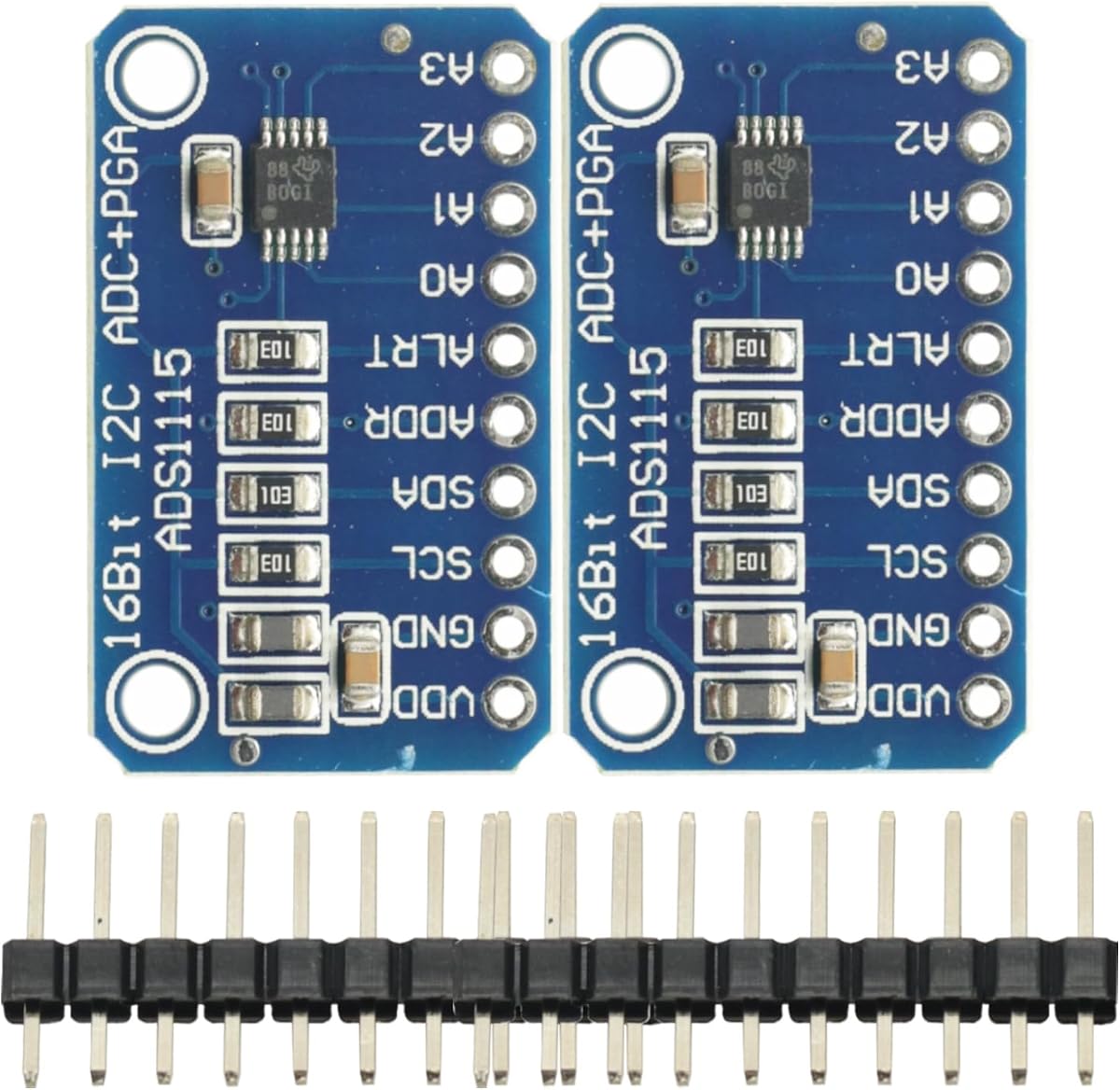


The Teyleten Robot ADS1115 3-Pack is an ADS1115-based analog-to-digital converter package aimed at makers who need more accurate analog readings than a basic Arduino ADC implementation can provide. Its 4.7 rating reflects generally favorable customer feedback, while the inclusion of three modules gives users more than enough hardware for multi-sensor projects, classroom stations, or keeping spares available.
We may earn a commission when you buy through this link, at no additional cost to you.
The converter provides 16-bit resolution, four analog channels, an onboard programmable gain amplifier, and a programmable data rate from 8 to 860 samples per second. A broad supply range of 2.0V to 5.5V supports both common 3.3V and 5V systems, and the I2C interface makes the module straightforward to connect to Arduino and Raspberry Pi boards.
The main limitation is that the ADS1115 is not intended for high-frequency waveform capture. Its maximum listed rate of 860 SPS is appropriate for slow sensor readings, configurable monitoring, and general data acquisition, but it would not suit demanding audio, vibration, or rapidly changing signal analysis. Shared I2C addressing also means that multiple boards need careful configuration rather than simple plug-and-play parallel use.
This is a strong all-around recommendation for Arduino ADC Board buyers who want a useful balance of precision, channel count, and expansion options. It is particularly appealing to users planning multi-sensor systems because three modules are supplied, but the single-board listings can also make more sense for projects that need only one converter.
The onboard programmable gain amplifier can make low-voltage sensor outputs easier to resolve. Selecting a suitable gain range improves the converter’s effective use of its measurement window, which is valuable for devices whose analog output does not span the module’s full available range.
A three-module package is useful when one board must monitor several independent sensors. It also reduces the need to purchase separate boards later when a prototype grows into a classroom installation, monitoring node, or multi-channel logger.
We may earn a commission when you buy through this link, at no additional cost to you.
The HiLetgo ADS1256 is the most technically advanced board in this guide, with a 24-bit TI ADS1256 converter, an onboard 2.5V reference source, and support for as many as eight single-ended inputs. Its 4.6 rating indicates solid customer reception, and the specification set makes it a compelling option for precision-oriented data acquisition projects.
We may earn a commission when you buy through this link, at no additional cost to you.
Users can configure the board for eight single-ended channels or four differential inputs, which is valuable when measuring bridge-based sensors or rejecting unwanted common-mode signals. Data output rates can reach 30 kSPS, and the listed nonlinearity of ±0.0010% indicates that the board targets more exacting measurements than a typical 16-bit ADS1115 setup.
Its input specification is the most important constraint. The listing states that the module is suitable for measuring analog voltage within 3V, so it should not be treated as a direct solution for higher-voltage signals without appropriate conditioning and protection. The greater resolution and channel flexibility also make software configuration more important than in a straightforward ADS1115 sensor project.
Choose the ADS1256 when measurement precision and input configuration matter more than simplicity or minimum channel count. It is well suited to laboratory measurements, bridge sensors, and multi-channel acquisition, provided the incoming signals remain within the supported range and the developer understands the additional setup involved.
Supporting four differential inputs allows the module to compare two signal lines, which can be valuable for sensor outputs centered around a reference voltage. This configuration is especially relevant to precision sensor work in which reducing common-mode interference matters.
The onboard ADR03 2.5V reference helps establish a consistent conversion basis. For precision-oriented projects, having the reference circuitry integrated can simplify board selection compared with using a converter board that requires an external reference.
We may earn a commission when you buy through this link, at no additional cost to you.
The 2-Pack ADS1115 Module combines a 16-bit converter, four single-ended channels, two differential inputs, and seven programmable voltage ranges. Its 5.0 rating is the highest listed rating in the group, giving it a particularly strong customer-feedback profile, while the two-board format is useful for projects that will measure more than one analog source.
We may earn a commission when you buy through this link, at no additional cost to you.
The programmable ranges extend from ±0.256V to ±6.144V, allowing the user to select a scale that better fits the incoming signal. Its I2C interface supports seven-bit addresses from 0x48 through 0x4B, which gives some flexibility when multiple converters share a bus, and the module is explicitly intended for Arduino and Raspberry Pi use.
The ADS1115 architecture still imposes limits that buyers should understand. The maximum data rate of 860 SPS is sufficient for temperature, pressure, light, and many environmental sensors, but it is not appropriate for high-speed signal capture. The 0–VDD channel input range also means source signals must remain within the board’s allowable limits.
This is an excellent starting choice for an Arduino ADC Board because it combines strong ratings, generous gain settings, and enough channels for most maker projects. The two-pack is particularly appealing for dual-sensor experiments or as a low-cost way to keep a spare module on hand.
Programmable input ranges let the user match the conversion scale to the sensor output. This reduces the amount of available range wasted on a small signal and makes the module adaptable to both millivolt-level outputs and larger analog voltages.
The available 7-bit I2C addresses from 0x48 to 0x4B provide options for combining converters on one bus. That flexibility is useful for multi-channel projects, provided wiring and software addresses are configured carefully.
We may earn a commission when you buy through this link, at no additional cost to you.
The HiLetgo ADS1115 3-Pack is a conventional ADS1115 development board offered with three modules. Its 4.3 rating is lower than the leaders in the list but still indicates a generally positive customer response, and the package is particularly attractive to educators or makers who expect to build more than one sensor circuit.
We may earn a commission when you buy through this link, at no additional cost to you.
The board offers 16-bit resolution, four channels, a programmable gain amplifier, and a data rate adjustable from 8 to 860 SPS. Its 2.0V to 5.5V operating range works with both 3.3V and 5V environments, while the straightforward I2C interface reduces the number of connections required compared with a parallel data bus.
Single-shot mode includes automatic shut-down, which is useful for battery-operated or intermittently sampled projects. However, the module shares the general ADS1115 limitation of a relatively low maximum rate, and its 4.3 rating gives less evidence of broad user satisfaction than modules rated 4.6 or 4.7.
Buyers should select this product when multiple boards, familiar I2C integration, and flexible gain are the priorities. It remains a practical option for Raspberry Pi projects that lack analog GPIO pins, as well as classroom benches where several students or sensor nodes need independent converters.
Single-shot operation and automatic shut-down can reduce energy use when measurements are taken periodically. This is particularly helpful in portable sensor nodes that do not need to keep the converter active continuously.
The 2.0V to 5.5V range allows the same module family to be used with 3.3V and 5V systems. That versatility reduces the need for a dedicated converter whenever a project moves between popular maker platforms.
We may earn a commission when you buy through this link, at no additional cost to you.
The 4-Pack ADS1115 Board provides four converter modules in one package, making it the largest ADS1115 bundle among the products reviewed. Its 4.1 rating is the lowest listed customer rating, so buyers should evaluate the package around its expansion potential rather than treating it as the most strongly rated option.
We may earn a commission when you buy through this link, at no additional cost to you.
Each converter has 16-bit resolution, a programmable gain amplifier, four differential input channels, support for single-ended signals, and an internal oscillator. Single-shot operation shuts down automatically after conversion, while the programmable data rate spans 8 to 860 SPS. The 2.0V to 5.5V supply range supports widespread platform compatibility.
Four modules are excellent for classroom fleets, multi-sensor monitoring, or a project that may later need additional channels. The tradeoff is that each board requires a unique I2C address if all four share the same bus. In addition, the lower 4.1 rating suggests that some buyers may have encountered issues not captured by the core specifications.
This package is most practical when four separate converters are genuinely needed. For a single sensor, a one- or two-module option would be less demanding and generally better aligned with a user’s actual requirements, while this set becomes compelling as a workshop or expandable system investment.
With four converters available, a system can be designed with more independent analog input sections than a single four-channel board provides. This is useful when sensor grouping, wiring organization, or future expansion matters.
The onboard internal oscillator is part of the module’s integrated converter design. It helps make each board more self-contained for projects that do not need to supply an external timing reference.
We may earn a commission when you buy through this link, at no additional cost to you.
The 2-Pack ADS1115 Module is a two-board package centered on the widely used ADS1115 architecture. It carries a 5.0 rating, tying for the strongest customer-feedback score in this selection, and provides enough hardware for dual-channel experiments or a useful spare at an accessible entry point.
We may earn a commission when you buy through this link, at no additional cost to you.
Each module offers 16-bit resolution, four single-ended channels, two differential inputs, and a programmable gain amplifier. Seven input ranges run from ±0.256V to ±6.144V, the rate can be set from 8 to 860 SPS, and four I2C addresses from 0x48 to 0x4B help support multiple modules on a shared bus.
The primary limitation is its 860 SPS ceiling, which rules it out for serious high-speed waveform work. The two-board format also means that users who operate both modules together must set different addresses and confirm that their wiring, pull-ups, and software configuration are consistent.
This is a strong recommendation for general-purpose Arduino and Raspberry Pi sensor projects. It suits users who want more than one converter, especially when their signals are slow-changing and the broad gain selection is more valuable than rapid sampling.
The two included modules are enough for a straightforward dual-sensor installation. They can also be assigned different I2C addresses, allowing both converters to remain connected to the same host bus.
Seven selectable ranges make the board suitable for sensors with widely varying output levels. The appropriate range allows the 16-bit converter to devote more of its measurement capability to the signal being read.
We may earn a commission when you buy through this link, at no additional cost to you.
The Lonely Binary ADS1115 3-Pack is a maker-focused take on the standard converter, adding ENIG plating, pre-soldered headers, detailed compatibility guidance, and three finished modules. Its 4.4 rating is solid if not the highest in the comparison, and the package is especially attractive for projects that will connect multiple sensors cleanly.
We may earn a commission when you buy through this link, at no additional cost to you.
The board uses 16-bit resolution and offers four single-ended or two differential channels per module. Six software-selectable ranges cover ±0.256V through ±6.144V, and the listing highlights a resolution of 7.8 microvolts per LSB under appropriate gain conditions. Users can chain up to four modules on one I2C bus, creating as many as 16 analog channels.
Construction quality is a notable differentiator. The ENIG finish supports solderability and oxidation resistance, while pre-soldered headers make breadboard and jumper-wire assembly more convenient. The module is compatible with common 3.3V and 5V platforms, including Arduino, ESP32, ESP8266, Raspberry Pi, Pico, STM32, and BBC micro:bit boards.
The module is a good choice for organized multi-sensor builds, IoT nodes, and classroom projects. The main limitation remains the ADS1115’s maximum rate of 860 SPS, so demanding signal acquisition would require a different converter architecture.
The ready-installed headers make the modules easier to place on breadboards and connect with jumper wires. This is particularly helpful for classroom groups, beginners, and prototypes that may be moved or rewired repeatedly.
The ADDR pin provides four selectable addresses, 0x48 through 0x4B. That feature allows up to four modules to share standard I2C wiring, supporting as many as 16 analog channels in a larger monitoring system.
We may earn a commission when you buy through this link, at no additional cost to you.
The Teyleten Robot AD7606 is radically different from the ADS1115 options in this guide. It is an eight-channel, 16-bit data acquisition module capable of 200 kSPS sampling, and its 3.0 rating is notably lower than every other product listed. Buyers should therefore approach it as a specialized board whose high-speed capabilities serve a different need.
We may earn a commission when you buy through this link, at no additional cost to you.
Its eight independent channels support synchronized measurements, and the input range can be ±5V or ±10V with an input impedance of 1MΩ. The module uses SPI serial communication and offers serial or parallel output modes, making it appropriate for multichannel acquisition, monitoring, and signal comparison applications that exceed ordinary ADS1115 sample rates.
Complexity is the main trade-off. A 3.3V control signal level, 5V module power, multiple output options, and 3.81–8-pin input connectors create a more involved system than a simple I2C sensor board. The 3.0 rating also warrants greater attention to documentation and project fit, although the core specifications are unusually capable.
This board is worth considering when simultaneous eight-channel sampling or high acquisition speed is essential. It is not the natural choice for a simple temperature logger, but it may be the most technically appropriate option for synchronized research, industrial-style monitoring, or other demanding data acquisition work.
The ability to sample eight independent channels is valuable when relationships between signals matter. Synchronized acquisition helps users compare changing conditions across sensors without relying on a slow, staggered reading process.
The choice between serial and parallel output gives the board more integration options. Serial output can simplify connections, while parallel output can suit systems designed to transfer complete channel groups efficiently.
We may earn a commission when you buy through this link, at no additional cost to you.
The 4-Pack ADS1115 Modules offers four standard 16-bit converter boards for projects that need broad sensor support and multiple units. Its 4.6 rating is among the strongest in the guide, providing a positive customer-feedback signal despite the fact that it uses the same basic ADS1115 architecture as many less highly rated alternatives.
We may earn a commission when you buy through this link, at no additional cost to you.
Each module has four analog input channels, an integrated programmable gain amplifier, and a standard I2C interface requiring SDA and SCL communication lines. The listing identifies compatibility with Arduino, Raspberry Pi, ESP32, STM32, and other microcontrollers, making the set suitable for temperature, pressure, light, and general voltage measurements.
Four boards make the package useful for multi-sensor data loggers, robotics, monitoring systems, and engineering experiments. As with other multi-module ADS1115 bundles, however, each board should use a distinct address if they share the same I2C bus. The 16-bit converter is best suited to relatively slow signals rather than high-frequency waveform capture.
This four-module set is a solid general-purpose choice, especially for users who value platform breadth and a 4.6 rating alongside a high quantity of boards. It gives beginners spare hardware and gives experienced makers the components to build larger systems without changing converter families.
Using SDA and SCL for data communication keeps the physical connection relatively simple. The module still needs power and ground, but fewer signal lines leave more flexibility on a crowded Arduino or embedded-controller board.
The quantity suits projects built around several different sensors, from temperature and pressure to light and general analog outputs. It is also useful for classroom or laboratory workflows that require identical spare modules.
We may earn a commission when you buy through this link, at no additional cost to you.
The HiLetgo ADS1115 is a straightforward single-board option for adding analog input capability to an Arduino or Raspberry Pi. Its 4.3 rating reflects generally positive customer feedback, and the familiar combination of 16-bit resolution, four channels, programmable gain, and I2C makes it a conventional entry point for basic data acquisition.
We may earn a commission when you buy through this link, at no additional cost to you.
The module operates from 2.0V to 5.5V, accommodates four analog inputs, and supports programmable sampling rates from 8 to 860 SPS. A programmable gain amplifier helps match the converter to smaller sensor outputs, while single-shot mode includes automatic shutdown for intermittent measurement and power-conscious applications.
Its advantages are simplicity and accessibility rather than exceptional performance. The maximum data rate remains low for waveform-oriented work, and its 4.3 rating does not stand out among the available alternatives. Compared with multi-packs, it also gives the buyer less flexibility for immediate multi-sensor expansion.
This board remains appropriate for a first ADC project, a tutorial build, or a compact monitoring device. It is most attractive to someone who needs one reliable ADS1115 channel group without paying for a bundle, particularly when the project’s signals change slowly enough for the converter’s standard sample rate.
Automatic shut-down after a conversion is useful when readings are taken only when needed. It can improve power behavior in battery-powered monitoring devices that do not require continuous analog sampling.
The ADS1115’s I2C interface and standard four-channel arrangement are well represented in maker projects and libraries. Buyers can focus on sensor wiring and conversion settings rather than a complex parallel data interface.
We may earn a commission when you buy through this link, at no additional cost to you.
Choosing an Arduino ADC Board starts with the signal rather than the headline resolution. Consider voltage limits, channel count, sampling speed, noise sensitivity, interface complexity, and the number of independent converters your project will need.
In short, choose resolution that matches the signal and the system noise floor rather than selecting the largest number by default.
In short, count the signals you need, then determine whether each one is single-ended or differential before choosing a board.
In short, verify both the board supply voltage and the signal’s maximum voltage, and add attenuation or conditioning when necessary.
In short, select the narrowest gain range that safely contains the expected signal to preserve usable detail.
In short, use 860 SPS for slow sensors, consider the ADS1256 for faster acquisition, and use the AD7606 only when its speed and complexity meet the design.
In short, choose I2C for simple wiring and shared buses, but accept more hardware complexity when SPI or parallel output is required.
In short, favor a multi-pack when several converters are already required, but do not buy extra boards merely for a hypothetical future project.
Begin by confirming that the incoming analog signal fits the selected module’s input range. Check signal polarity, maximum voltage, and whether a differential connection is appropriate. If the source can exceed the converter’s rating, use an appropriate attenuator or other conditioning circuit rather than connecting it directly. This is also the stage to identify whether the signal changes slowly enough for an ADS1115 or requires a faster converter.
Connect the module to the correct power and ground rails, then wire the interface carefully. I2C boards require SDA and SCL, and multiple ADS1115 modules should receive unique addresses. The AD7606 uses SPI and 3.3V control signals, so its wiring plan differs from the I2C modules. Confirm pin labels against the documentation for the exact board rather than assuming every module in the category has an identical layout.
Configure the conversion settings in software before taking meaningful measurements. Select the gain range, choose single-ended or differential mode, set an appropriate data rate, and read the status or conversion-ready result according to the library and device procedure. For long-term reliability, keep connections stable, protect the board from voltage transients, provide suitable decoupling, and allow ventilation around components that generate heat during sustained high-rate operation.
Many Arduino boards include internal analog-to-digital converters on designated analog input pins, but an external ADC board can add resolution, gain control, more channels, differential measurement, or faster sampling. The external module is most useful when the built-in converter cannot provide the accuracy or channel flexibility required by the project.
The ADS1115 provides 16-bit resolution, four single-ended or two differential channels, and rates up to 860 SPS. The ADS1256 provides 24-bit resolution, eight single-ended or four differential inputs, and output rates up to 30 kSPS. The ADS1256 is therefore the more specialized choice for precision, channel count, and faster data acquisition.
Yes, provided each module is assigned a different I2C address. The relevant boards support selectable addresses from 0x48 to 0x4B, allowing up to four modules on one bus. Correct address configuration and dependable wiring are essential, and the available addresses limit how many converters can coexist directly.
Usually not. Its maximum listed rate of 860 SPS is designed primarily for relatively slow sensor measurements such as temperature, pressure, light, and slowly changing voltages. Fast waveforms and detailed vibration analysis call for a converter with a substantially higher sampling rate and appropriate signal conditioning.
Programmable gain changes the analog range that the converter uses for measurement. Applying a suitable gain to a small sensor output can make its changes more significant relative to the converter’s measurement window. The selected range must still contain the full input signal, or the reading may saturate.
Yes, the ADS1115 listings specifically identify Raspberry Pi compatibility, and the boards use I2C, which is appropriate for a Pi that lacks native analog GPIO inputs. Users still need suitable libraries, correct I2C configuration, and compatible wiring. The AD7606 requires a different SPI-based integration approach.
The listed ADS1115 modules operate from a 2.0V to 5.5V supply, and their channel input range is listed as 0–VDD. The source voltage must remain within the range appropriate to the configured gain and supply voltage. Higher-voltage inputs require attenuation or other protection rather than direct connection.
Not usually. The AD7606 is advantageous when you need eight independent channels, synchronized acquisition, a 200 kSPS sampling rate, or selectable ±5V and ±10V input ranges. For ordinary slow sensors, an easier-to-wire ADS1115 module may be sufficient, while the ADS1256 offers a middle ground for higher resolution and faster conversion.
The Teyleten Robot ADS1115 3-Pack stands out as the most balanced overall recommendation, combining a 4.7 rating with 16-bit conversion, four channels, programmable gain, and three modules. The HiLetgo ADS1255 serves as the premium technical option with 24-bit resolution, eight single-ended inputs, four differential inputs, and rates up to 30 kSPS. The 2-Pack ADS1115 Module is the budget pick for buyers who want a perfect 5.0 rating and versatile gain ranges.
For ordinary temperature, pressure, light, and voltage monitoring, a 16-bit ADS1115 is usually the easiest route. Choose a multi-pack when several sensors or spare modules are needed, move to the ADS1256 when precision and acquisition speed justify more involved setup, and consider the AD7606 only for demanding synchronized multichannel work. Always match the converter to the signal’s voltage, speed, and required channel configuration.
Product ratings, availability, and pricing can change, so confirm the current listing details before ordering. Check the exact module’s pin arrangement, supplied documentation, library support, and accessory requirements, and ensure the selected board operates safely with your sensor and host platform.