
LASER TREE 10W Output Module
4.4Editor score
10000mW optical output
Built-in FAC
Air-assisted cutting system
Multi-hole mounting pattern
Our Diode Laser Module guide compares 10 options for engraving, cutting, alignment, and DIY electronics, with ratings, key specifications, and buying advice.
Diode laser modules range from compact red pointers to high-output blue engraving systems, making them useful for everything from alignment and electronic projects to CNC cutting and detailed engraving. A capable module must match the intended material, machine, power supply, and control system while providing a focused and stable beam.
The products in this guide were compared using their stated wavelength, optical output, focus options, electrical requirements, dimensional details, installation features, intended applications, and customer ratings. The list includes both specialized engraving modules and smaller diode assemblies for electronics, leveling, positioning, and experimental builds.
Each review identifies the module's strongest use case, notable technical benefits, and practical limitations based on the supplied product information. Ratings reflect the listed customer feedback, while details such as compatibility, cooling, and cutting ability vary by project. Product pricing and availability can change, so check the current listing before purchasing.
4.4Editor score

4.6Editor score

4.3Editor score
This side-by-side overview highlights the main differences in optical output, beam color, electrical requirements, focus control, mounting provisions, and intended uses. It helps distinguish purpose-built engraving modules from low-power diode sets designed for alignment, leveling, electronics, and other compact projects.
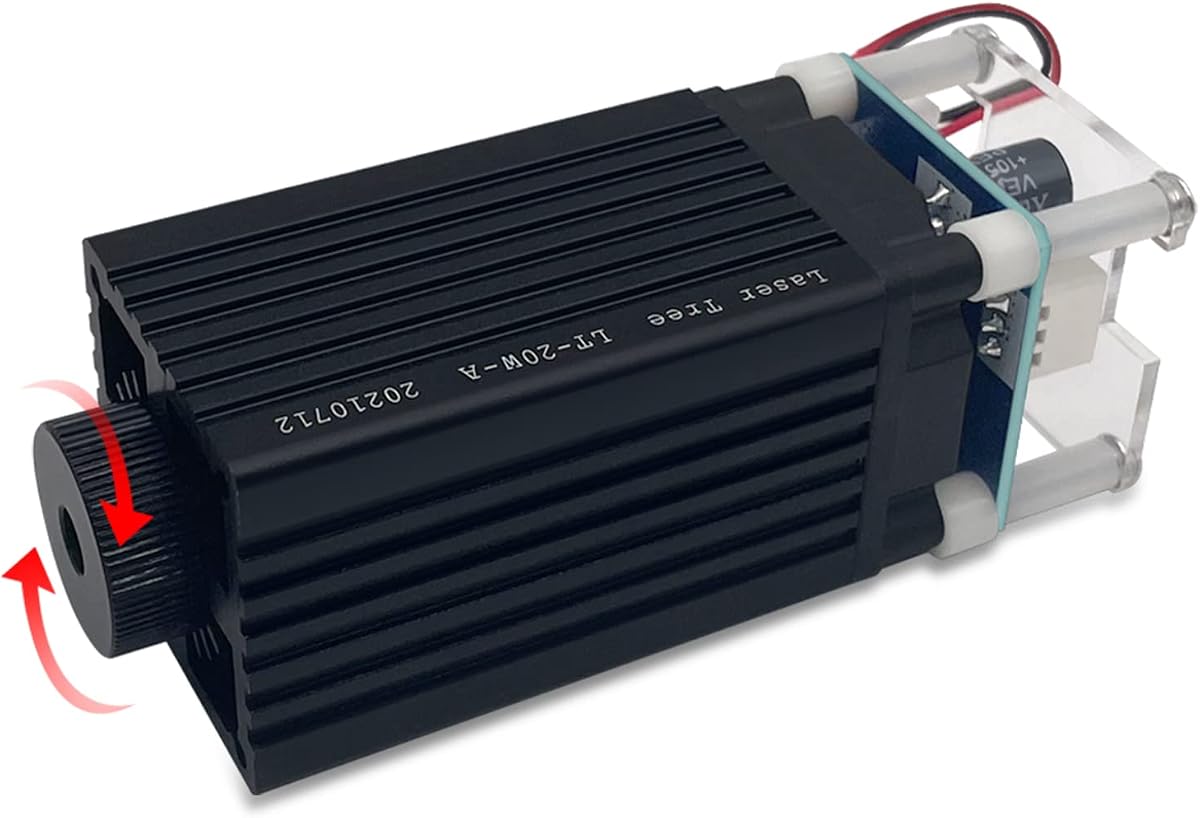




The LASER TREE 4W Laser Engraver Module combines a 450nm blue-violet beam with 4000mW of stated optical output, giving it a much more capable profile than the low-power pointer-style products elsewhere in the guide. Its 4.3 rating reflects a generally positive reception, and its adjustable focus and installation-oriented design make it an appealing option for DIY engraving-machine builders.
We may earn a commission when you buy through this link, at no additional cost to you.
A major strength is the 20–50mm adjustable focus range, which allows the beam to be adjusted for different working distances and materials. The original diode is paired with a focus-adjustable FAC lens, while the compact 35×35×99.6mm housing and three-pin pluggable control connection help simplify integration. It accepts DC 12V, supports 5V PWM modulation, and can cut through one- to two-millimeter plywood in a single pass according to the product information.
The module is not universally compatible with every engraving machine, even though it is designed for PWM-controlled systems. Its supplied information also notes that blue, purple, white, and transparent materials cannot be engraved, while aluminum generally requires an oxide layer. Safety glasses and careful control of reflections are essential because the blue-violet beam and its reflections can injure eyes.
This is a sensible choice for a maker building or upgrading a three-axis engraver who wants moderate cutting ability and a narrow engraving line. It may be less attractive for an existing machine requiring 24V, specialized connectors, or a different optical configuration. For compatible 12V systems, it offers a practical balance of power, focus adjustment, compactness, and installation convenience.
The 20–50mm focus adjustment lets the user account for different module heights and working distances. This is especially useful when moving between engraving, shallow cutting, and materials of varying thickness, reducing the need to compromise on one fixed focal position.
Its compact housing, DC 12V input, XH2.54 three-pin socket, and PWM support suit common DIY engraving platforms. Buyers should still verify electrical polarity, connector layout, driver requirements, and mounting dimensions before ordering.
We may earn a commission when you buy through this link, at no additional cost to you.
The HiLetgo 10-piece set is one of the most approachable diode laser options because it provides ten 650nm red laser heads with leads, each operating at 5V and producing a stated 5mW output. The 4.3 rating and broad set quantity make it useful for schools, electronics workbenches, and makers who want several modules for separate experiments.
We may earn a commission when you buy through this link, at no additional cost to you.
The listed applications include level instruments, ground instruments, long-distance laser-listener remote controls, and long-distance laser wireless communication projects. Each head has a 6mm outer diameter, while the stated working temperature range is approximately -10°C to +40°C. Because the modules come with leads, they can be positioned or connected more easily than a bare diode package.
These are dot laser heads rather than engraving or cutting modules. Their small output is suitable for pointing, alignment, indication, and electronic experiments, but it does not provide the energy needed to remove material. Users should also maintain the correct operating current; a 5V rating alone does not mean the module can be connected directly to any supply without suitable control.
Choose this set when you need multiple low-power red diode heads or want an approachable way to learn basic laser-module wiring. It is a better fit for experimentation than CNC work, but the ten-piece format, simple five-volt design, and range of alignment uses make it an efficient choice for the intended category.
Ten separate heads are more useful for multi-part builds than a single loose diode. They can be distributed across instruments, prototypes, classroom projects, or indicator assemblies without requiring the builder to source each component individually.
The 650nm red wavelength produces a visible dot that is easy to locate on work surfaces and instrument targets. This makes the set more practical for alignment and positioning tasks than a non-visible wavelength would be.
We may earn a commission when you buy through this link, at no additional cost to you.
The 650nm Two-Pack Line Module provides two red line laser modules rated at 5mW each. Its 4.1 rating places it in the middle of the group, but the distinctive line output gives it a clear role in projects requiring a straight projected guide rather than a conventional dot beam.
We may earn a commission when you buy through this link, at no additional cost to you.
The supplied information is concise: the modules operate at 650nm, provide a 5mW red line, and use a diode laser design. The two-pack format is useful when a project needs a reference line in more than one location, or when one unit can serve as a spare. Their small output is suitable for indication and alignment rather than heavy fabrication.
Limited documentation is the main consideration. Buyers do not receive a detailed electrical range, housing dimensions, operating-current guidance, or a long list of approved applications in the supplied information. As a result, the modules require more careful circuit design and verification before use, particularly regarding current regulation and heat dissipation.
This option is best for electronics enthusiasts seeking a red line module for a custom indicator, positioning aid, or alignment fixture. It is less appropriate for CNC engraving, and the limited specifications mean the buyer should confirm the physical and electrical details in the current listing. Within that narrower role, the line format is the principal attraction.
A projected line can help define an edge, establish a reference, or indicate a working boundary without the user having to track a small point. That makes line output convenient for fixture-building and alignment tasks.
Having two units provides flexibility for mirrored or side-by-side installations and leaves a spare for testing or repair. Confirm the module's exact geometry and mounting requirements before committing to a fixed enclosure.
We may earn a commission when you buy through this link, at no additional cost to you.
The GM532-50 Green Two-Pack uses a 532nm green diode to create a bright, easily perceived dot, and each listing includes two modules with solder wires. Its 4.2 rating indicates a solid middle-tier option for builders who want a green laser source for a custom electronic or demonstration project.
We may earn a commission when you buy through this link, at no additional cost to you.
The product information specifically states that the 532nm output appears brighter than 520nm, which can make the beam easier to see under many working conditions. Solder-wire connections support integration into custom circuits, and the two-pack format provides enough units for paired projects, demonstrations, or one working module plus a spare.
Temperature matters for this type of module. According to the supplied information, when winter temperatures fall below approximately 15°C, the laser needs two to ten seconds of preheating. The information also provides fewer detailed operating specifications than some other listings, so a responsible build should verify power requirements, current limits, and heat management before operation.
This two-pack is most appropriate for a maker creating a green laser indicator, alignment aid, educational apparatus, or other custom device. It is not positioned as an engraving or cutting module. The brighter green visibility and included solder wires are the chief advantages, while the warm-up requirement and limited electrical detail deserve attention during planning.
A green dot can remain easier for the eye to locate than a red one in many environments. The stated 532nm output therefore suits projects where precise positioning or a clearly visible target point is important.
The stated two- to ten-second preheat below approximately 15°C is important for consistent early operation. Builds used in cold storage, workshops, or unheated environments should account for this startup behavior.
We may earn a commission when you buy through this link, at no additional cost to you.
The LASER TREE 10W Output Module is the highest-output engraving module in this guide, with a stated 10000mW optical output and 80W machine power. It carries a 4.4 rating and is designed for serious DIY cutting and engraving systems, combining a focused beam, air assist, cooling support, and mounting hardware.
We may earn a commission when you buy through this link, at no additional cost to you.
The built-in FAC is intended to reduce the focus spot and increase power density, while the original diode is credited with a lifespan of up to 20,000 hours. The upgraded 6mm bending air-metal nozzle is intended to reduce resistance during cutting, and the magnetic removable eye cover filters blue light during operation. Stated performance includes engraving 304 stainless steel at speeds up to 300mm/s and cutting 8mm plywood in one pass at 1.5mm/s with a 45mm focus length.
Installation is made more flexible by the multi-hole rear mounting pattern, an adapter board, a three-pin input cable, a focus-fixing plate set, spare protective window glass, and an L-shaped wrench. The listed 12V version must match the machine's driver board; the product information explicitly advises choosing 12V or 24V according to the installed system. Class 4 labeling also demands strict enclosure, eyewear, interlocks, and operational controls.
This module is the strongest candidate for builders who need greater cutting depth and engraving speed than moderate-power systems can deliver. It is less appropriate for a first compact laser project, a simple pointer build, or any workspace unable to safely contain a high-output beam. For compatible 12V CNC engraving machines, however, the integrated features and accessory package create a notably complete solution.
The built-in FAC and original diode are designed to concentrate energy at the focal point, improving penetration and engraving precision. This makes the module better suited to metal marking and deeper cuts than the low-power diode assemblies in the guide.
The integrated nozzle directs air toward the work area to improve material removal, while the top-mounted fan and air-tube holder support heat management. These features reduce the need to design every auxiliary function from scratch.
The supplied information specifically warns against choosing a voltage that conflicts with the machine's driver board. Confirm the controller voltage, connector pinout, current capacity, grounding, and safety enclosure before installing this high-output module.
We may earn a commission when you buy through this link, at no additional cost to you.
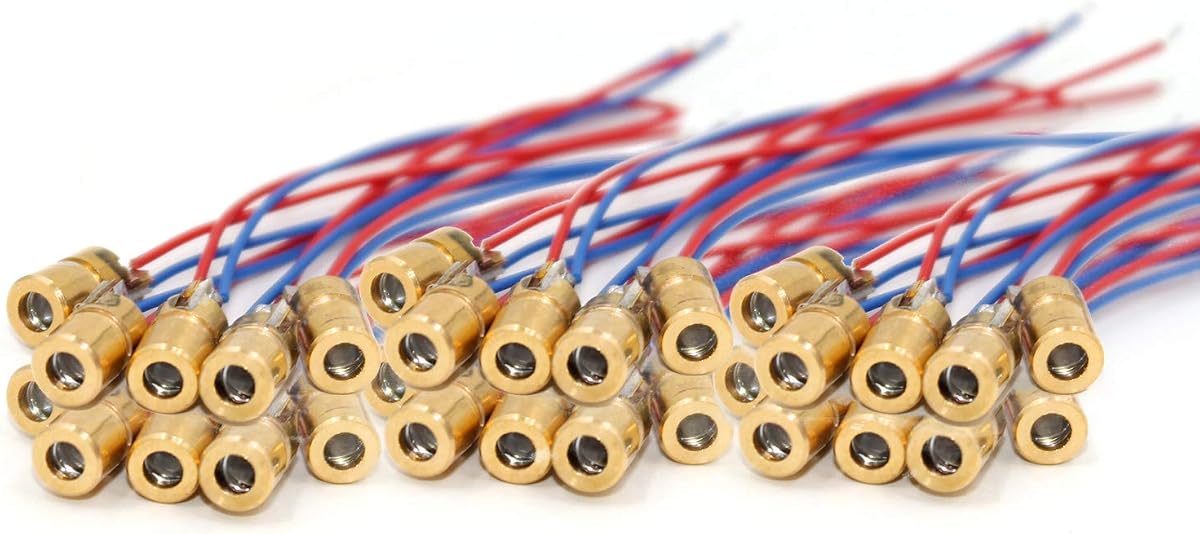
The 30-Piece Mini Red Diode Set stands out for quantity, compact dimensions, and the guide's highest listed rating of 4.6. Each 650nm red module delivers a stated 5mW dot output, operates at 5V, and is designed for Arduino, Raspberry Pi, and other microcontroller projects.
We may earn a commission when you buy through this link, at no additional cost to you.
The package contains 30 modules and a welcome guide. Each laser has a 6mm outer diameter, an overall length of approximately 9cm, and a stated working temperature range of -10°C to +40°C. The copper-and-plastic construction and included lead connections make the modules approachable for repeatable prototypes, classroom exercises, homemade pointers, level meters, and remote-control experiments.
Correct current control is essential. The supplied information states that operating current must remain below 20mA, so a 5V label should not be treated as permission to connect each diode directly to an unregulated supply. The total number of modules also makes circuit planning important, especially if several are active simultaneously. Like all visible laser products, the modules require sensible beam control and must never be directed toward people, vehicles, or aircraft.
This set is an excellent choice for students, educators, and electronics hobbyists who need a large inventory of low-power diode modules. It is less relevant to a maker seeking engraving or cutting, and the 4.6 rating should be understood as customer feedback rather than proof of suitability for every project. For visible, low-power experiments, the quantity and microcontroller focus are compelling.
A thirty-piece set lets learners build multiple circuits, compare results, and retain spare components without repeatedly sourcing identical parts. It is particularly useful for structured classroom work or a series of personal prototypes.
The stated compatibility with Arduino, Raspberry Pi, and similar controllers supports common low-voltage experimentation. Appropriate current limiting, heat management, and an effective driver or resistor arrangement remain necessary.
We may earn a commission when you buy through this link, at no additional cost to you.
The 405nm Violet Industrial Module produces a 5mW violet-purple dot and accepts a DC 3–5V input. Its 3.8 rating is among the lower scores in the collection, yet it offers a combination not found elsewhere here: a short wavelength, a focusable front cap, and an industrial-dot configuration.
We may earn a commission when you buy through this link, at no additional cost to you.
The focus control is achieved by adjusting the front cap until the beam appears as a dot at the desired distance. This is useful for inspection, positioning, demonstration, or custom equipment where the working distance may vary. The 405nm wavelength also creates a visually distinctive violet output that is easy to separate from standard red and green sources.
The module's 5mW output is modest compared with the engraving systems, and the supplied information does not provide a detailed list of operating-current requirements, dimensions, or mounting accessories. Those details should be confirmed before integrating it into equipment. Its violet output and compact voltage requirements are useful, but they do not turn it into a material-processing option.
Choose the module for a specialized violet indicator, alignment fixture, or electronics demonstration where its distinct color and adjustable focus matter. It is not the strongest option for general experimentation, where the larger red sets offer clearer documentation, or for engraving. Its appeal is focused: a small, focusable violet dot for compact custom systems.
Adjusting the front cap changes how the beam resolves into a dot, allowing the user to tune the module for the actual installation distance. This is valuable when the precise distance may not be known in advance.
Violet can make a module visually easier to identify in a demonstration or inspection setup. The distinctive color also separates it from the standard 650nm red and 532nm green choices in this guide.
We may earn a commission when you buy through this link, at no additional cost to you.
The AENBUSLM 40W Module combines a stated 5500mW optical output with 40W machine power, built-in FAC, air assist, and a high-speed cooling fan. Its 4.6 rating ties for the highest score in the guide, while its 12V and 24V compatibility makes it a versatile choice for CNC routers, laser cutters, engravers, and 3D-printer-style frames.
We may earn a commission when you buy through this link, at no additional cost to you.
The focal assembly is intended to create a smaller spot and greater power density, while the air assist helps clear debris and produce cleaner material edges. The product information states that 304 stainless steel can be engraved at up to 800mm/s with a 45mm focus length and that 5mm plywood can be cut in one pass at 60–100mm/s under the stated conditions. A 12000rpm fan handles cooling, although the listing notes a reduction of roughly 300–400mW at full output because of that heat-management design.
Installation is simplified by the multi-hole mounting pattern and plug-and-play control line. The module is presented as suitable for both 12V and 24V DIY systems and other branded engraving and cutting machines, but users should still verify controller type, current requirements, pin assignment, and grounding. Class 4 operation calls for an enclosed working area, protective eyewear where appropriate, interlocks, and clear exclusion zones.
This is the most balanced recommendation for a maker who wants substantial engraving and cutting performance without moving directly to the guide's highest-output module. It is ideal for CNC-focused users who value air assist, cooling, mounting flexibility, and broad electrical compatibility. It is less suitable for a simple pointer project, and its safety requirements should be treated as essential rather than optional.
The built-in air-assist system directs airflow toward the cutting area, helping move debris away from the work zone. According to the product information, this supports cleaner edges and improves the practical result of the cutting process.
A 12000rpm fan provides active heat dissipation during operation. The stated loss of approximately 300–400mW at full output is a trade-off, but active cooling can make the module more practical for repeated engraving and cutting tasks.
Support for both 12V and 24V systems is valuable for builders who may change controllers or reuse the head on a different CNC frame. Compatibility still depends on matching the electrical and control requirements of the installed machine.
We may earn a commission when you buy through this link, at no additional cost to you.
The 650nm Two-Pack Dot Module provides two 5mW red dot modules that operate from 3V to 5V. Its 3.8 rating is tied for the lowest in the guide, but the adjustable focus and stated range of uses make it a functional option for testing tools, locating, and custom electronic projects.
We may earn a commission when you buy through this link, at no additional cost to you.
Users can adjust the front of the laser head to obtain a desired dot, helping compensate for differences in working distance or enclosure geometry. The stated applications include laser test tools, concentric locating, medical-equipment locating, signal-equipment construction, and broader DIY work. Two modules allow for paired positioning or provide a spare while one unit is under development.
The module is a bare component rather than a finished appliance. The supplied information does not indicate that a housing, constant-current driver, or protective enclosure is included, and the 3V–5V input range should be implemented with appropriate current control. A focused beam can also create a meaningful eye hazard, so even a low-power module should be mounted so it cannot shine toward people.
This pair is best for a technical builder who values adjustability and needs a simple red alignment source. It is less attractive for anyone wanting substantial documentation, accessories, or material-processing capability. For compact positioning experiments where a visible, focusable dot is the main requirement, it remains a straightforward choice.
Front-cap adjustment gives the user control over spot definition at the intended working distance. That control can improve alignment when the module is mounted inside an enclosure or pointed at a moving component.
Since the product is presented as a module rather than a complete consumer device, a proper current-regulated driver and secure mounting are the builder's responsibility. A low operating voltage does not remove the need for eye-safety controls.
We may earn a commission when you buy through this link, at no additional cost to you.
The GM532-50 Green Module is a single 532nm green dot module supplied with solder wires. Its 3.9 rating is modest, but it offers a bright visible beam for a focused custom build in which one carefully selected module is preferable to a multipack.
We may earn a commission when you buy through this link, at no additional cost to you.
The product information states that the 532nm output is brighter than 520nm, making the green point comparatively easy to perceive. Solder-wire connections make the module suitable for incorporating into a purpose-designed circuit or enclosure. The form is simple: a single green diode module for DIY green laser products rather than a CNC engraving head.
As with the two-pack version, the listing notes that in winter temperatures below approximately 15°C the module should be preheated for two to ten seconds. Detailed current, dimensions, and mounting information are not provided in the supplied data, making electrical verification essential. The single-unit format also provides no immediate spare if the module is damaged during an experiment.
Choose this module for a small green indicator, educational demonstration, alignment aid, or compact custom laser product. It is not suitable for engraving or cutting, and the two-pack may be more convenient for users who need redundancy or multiple working points. Its main appeal is the bright 532nm green output in a simple single-module format.
The green 532nm output can provide a clear target point in a demonstration, indicator, or alignment apparatus. Its visibility may be especially helpful in projects where the exact beam position must be communicated quickly.
A single module can minimize the number of parts in a compact design. Builders that want two aligned points, a spare, or multiple experimental channels may find the two-pack option more convenient.
We may earn a commission when you buy through this link, at no additional cost to you.
The right diode laser module depends primarily on whether you need a visible alignment source, a specialized line or dot projector, or a high-output CNC engraving head. Wavelength, output, focus, electrical requirements, cooling, mounting, and safety should be evaluated together rather than treated as isolated specifications.
Low-power modules in this collection are generally rated at 5mW and are intended for alignment, leveling, indication, experiments, and custom electronics. They should not be confused with CNC engraving modules, even when all of them use diode-based light sources. The 4W, 5.5W, and 10W products are described as optical-output engraving modules with materially different penetration and cutting characteristics. Begin by identifying whether the application requires a visible guide or the energy needed to mark and cut a workpiece.
The guide includes 405nm violet, 450nm blue-violet, 532nm green, and 650nm red modules. Visible red and green beams are easy to locate, while violet provides a distinct color for specialized indicators and blue-violet is common for engraving-focused systems. Wavelength also affects how readily a human eye can see the beam and how the module may perform with particular materials. Do not select a color solely for appearance when the system has a functional beam-format requirement.
A dot module is appropriate for pinpoint positioning, while a line module is useful for establishing a straight reference or boundary. The two green modules produce dot output, the two-pack line product produces a line, and the violet module can be adjusted through its front cap to resolve a dot at different distances. For CNC work, focus becomes more involved because the focal distance must remain stable as the head moves over uneven or differently thick materials.
The small diode products operate at low voltages such as 3–5V, while the engraving modules use substantially higher-power arrangements. The 4W module specifies DC 12V input, the 10W product is presented in a 12V configuration, and the 5.5W module supports both 12V and 24V systems. Confirm supply voltage, current, connector pinout, PWM requirements, grounding, and driver-board compatibility before installing any module.
Higher-output modules generate more heat and often benefit from active cooling and airflow over the work zone. The AENBUSLM includes a 12000rpm fan and air assist, while the LASER TREE 10W model includes a cooling-related top design, an air-tube holder, and a bending metal nozzle. These systems can improve sustained operation and material removal, but they also add complexity and must be maintained properly.
A module that cannot be mounted accurately will be difficult to align or use safely. The 4W unit measures 35×35×99.6mm and uses a three-pin socket, the AENBUSLM has multi-hole mounting positions on its rear, and the LASER TREE 10W includes an adapter board, cable, and focus-fixing plates. Low-power modules with leads or solder wires require a custom holder, while the high-output models also need careful consideration of weight, clearance, and rigidity.
A visible beam is not the same as a harmless beam. Reflections can direct energy toward the eyes, and the engraving products are identified as Class 1 in their supplied information, while the AENBUSLM and LASER TREE 10W listings use Class 4 language. The correct response is to use an enclosure, beam termination, interlocks where appropriate, controlled access, and suitable protective eyewear. Never rely only on the beam's visible color or modest output to judge risk.
Ratings provide a useful signal about customer satisfaction, but they do not verify every technical claim or indicate suitability for a specific build. The products in this guide range from 3.8 to 4.6, and the highest scores belong to the 30-piece red diode set and the AENBUSLM 40W module. Read the rating alongside the documented output, applications, accessory list, and compatibility constraints. Specifications should determine fit; a high rating cannot replace electrical and safety planning.
Before installation, identify the module's wavelength, output, input voltage, current requirement, connector arrangement, and intended beam format. Inspect the housing, leads, lenses, and front cap for damage, and confirm that the host machine has an appropriate driver, mounting support, heat management, and a safe working enclosure. Low-power diode projects still require stable current limiting and careful alignment.
Install the module without energizing it, then secure it on a stable bracket and verify the beam path before closing the enclosure. Connect power and control wiring according to the device and machine documentation, checking polarity and pin assignments. For a CNC engraving head, set the correct focus, install eye protection where required, establish a safe test area, and begin with a short low-power operation on a known material.
During use, watch for loose mounts, abnormal noise, visible smoke, excessive heat, inconsistent focus, or unexpected control behavior. Stop the machine if any of these occur, allow the module and its cooling system to cool, and inspect the connections and optics. Clean lenses only with an approved method, keep the air path unobstructed, and store the module in a dry, protected enclosure when it is not in use.
A 5mW diode module produces a visible low-power beam for alignment, indication, leveling, and electronics projects. A 4W module produces much more optical energy and is designed to engrave or cut materials. Their electrical requirements, mounting, cooling, safety controls, and intended uses are therefore entirely different.
Only the higher-output engraving modules in this guide are described as capable of material cutting. The 4W module is stated to cut through one- to two-millimeter plywood in one pass, while the 5.5W and 10W products have higher stated cutting abilities. Low-power 5mW dot and line modules are not material-cutting tools.
Choose the version that matches the DC requirements of your machine's driver board. The 4W product specifies 12V, the 10W product is offered in a 12V configuration, and the 5.5W module supports both 12V and 24V. You must also verify current capacity, connector pins, and control-signal compatibility.
A FAC is a focus-adjustable lens assembly that changes the beam's convergence and spot size. In the high-output modules featured here, it is intended to concentrate more energy at the focal point, improving precision, penetration, and engraving performance. Correct focus remains essential for those benefits.
The supplied information for both 532nm green modules states that they may need approximately two to ten seconds of preheating when temperatures fall below 15°C. Allowing the module to stabilize can help it reach consistent output, especially during short test cycles or early operation in a cold environment.
The 30-piece 650nm set specifically identifies Arduino, Raspberry Pi, and other microcontrollers as compatible platforms. Other low-power modules may also be used in electronic projects, but their wiring and current-control requirements must be verified. A microcontroller should not be connected directly to a diode without the correct drive circuit.
Air assist is not essential to every diode laser experiment, but it can help clear debris and produce cleaner edges during material cutting. The 5.5W and 10W engraving modules include integrated air-assist features, making them better suited to demanding CNC work than the small pointer-style diode sets.
Choose a dot when you need to identify one exact position, such as a reference point or inspection target. Choose a line when you need to show an edge, axis, boundary, or guide across a larger area. The green modules in this guide are dot-style products, while the 650nm Two-Pack Line Module is intended for line projection.
The AENBUSLM 40W Module is the strongest all-around CNC choice in this guide because it combines 5500mW of stated optical output, built-in FAC, air assist, active cooling, mounting flexibility, and 12V/24V support. The LASER TREE 10W Output Module is the premium option for users seeking the highest stated output and deeper cutting performance, while the HiLetgo 10-piece red set offers the most practical low-power multi-module package.
For alignment and electronics, prioritize visible wavelength, dot or line format, current control, and documentation. For engraving and cutting, focus more heavily on optical output, FAC, air assist, cooling, electrical compatibility, mounting stability, and safe enclosure design. A high customer rating is useful, but it should never replace checking the machine specifications and the proposed material.
Before ordering, review the current product listing for the exact technical details, included accessories, and machine compatibility, and compare the total cost of the required controller, enclosure, eyewear, cooling, and ventilation. Product prices and availability can change, so the current listing is the final source for purchasing information.