
GOKKO GK-32 SpanishFly
4.8Editor score
True bypass switching
Anti-feedback control
Independent treble boost
Balanced XLR output
Our expert guide compares the best preamps for acoustic guitar, helping you evaluate tone shaping, feedback control, outputs, built-in effects, portability
An acoustic guitar preamp gives a piezo or magnetic pickup more control over volume, tone, feedback, and stage output. The right unit can clarify a muddy sound, tame harsh frequencies, or add useful effects without forcing you to rely on a full amplifier. Models range from compact pedals to feature-rich floor units.
We compared these ten products by examining their EQ layouts, feedback-control tools, pickup compatibility, output options, effects, footswitch functions, power requirements, and portability. The guide includes pedalboard models, direct boxes, onboard acoustic preamps, and portable units suitable for gigs, rehearsals, practice, and recording.
Each pick highlights a different reason to consider an acoustic preamp, from simple tone shaping to comprehensive stage control. Ratings reflect the supplied customer feedback, while specifications are limited to documented product information. Product availability and pricing can change, so confirm current details before purchasing.
4.8Editor score
4.6Editor score

4.7Editor score
The table below compares all ten preamps by their principal control features, signal routing, and practical advantages. It makes it easier to identify a pedal for tone shaping, a direct box for stage use, or a portable unit for practice and recording.


The SONICAKE A Factory is a compact acoustic-effects pedal with a 4.0 rating and a practical combination of analog preamp, digital reverb, filtering, and stage output options. Its appeal comes from solving several common acoustic-guitar problems in one enclosure rather than requiring separate devices for EQ, reverb, and direct connection.
We may earn a commission when you buy through this link, at no additional cost to you.
The preamp includes adjustable gain and frequency-range controls, while the built-in notch filter can help isolate whistling or problematic frequencies. A high-impedance input is designed to reduce tone loss, and the balanced XLR output can feed a PA system, mixer, or audio interface. The buffered bypass is particularly useful for players concerned about signal degradation.
This is not the most comprehensive processor in the group, as it does not offer the larger multi-effect selection of the SONICAKE Sonic Wood. It also requires a 9V center-negative pedalboard supply, which is not included. Even so, the combination of analog amplification, digital reverb, mute, and XLR output is unusually useful for a compact pedal.
Choose the A Factory if you want an all-purpose acoustic pedal for rehearsals, small gigs, or direct recording. It is especially compelling for players who need feedback filtering and balanced output but do not want to fill a pedalboard with separate devices. Check your available power and effects needs before committing.
The adjustable notch filter and gain controls provide practical tools for reducing unwanted acoustic feedback. Instead of abandoning a bright piezo pickup tone, a player can address the frequency causing the problem and retain more of the instrument's natural character.
The balanced XLR output makes the pedal relevant to PA systems, mixers, and audio interfaces. A buffered bypass also helps maintain the quality of the instrument signal, which is valuable in live rigs where long cable runs are common.
We may earn a commission when you buy through this link, at no additional cost to you.
The SONICAKE Sonic Wood carries a 4.5 rating and is designed as a one-stop solution for acoustic players who want preamp shaping and several classic effects in a single pedal. Its analog preamp uses a two-band EQ intended to recreate the character of a traditional acoustic-guitar amplifier.
We may earn a commission when you buy through this link, at no additional cost to you.
Chorus, delay, and reverb cover common needs across different playing situations. The tap tempo function makes synchronized delay timing more manageable, while a tail on/off control allows effects to be ended deliberately. For stage use, the XLR output can connect directly to a PA, mixer, or audio interface without relying on a separate DI box.
The trade-off is that a broad effects palette can take time to learn, particularly for someone who only needs level and tone control. Its feature density also makes it less minimalist than dedicated preamps such as the LR Baggs Para or Fishman AFX Pro EQ Mini. Nevertheless, the combination is compelling for performers who want more sonic options.
The Sonic Wood suits songwriters, worship players, and acoustic performers who move between strumming patterns, fingerpicking, and lead lines. Choose it when chorus, delay, or reverb would be used regularly and you value having those sounds available from one pedal. It is less compelling if your setup demands highly specialized EQ adjustments or extensive deep-level effects editing.
The included chorus, delay, and reverb cover three of the most useful acoustic treatments. A player can add width to a clean rhythm part, create repeating notes for melodic passages, or place a lead phrase in a more expansive ambience without adding three separate pedals.
Tap tempo and a tail on/off function make the delay more practical during a live set. These controls simplify synchronizing repeated effects and allow a player to end a reverb or delay tail deliberately between songs or phrases.
We may earn a commission when you buy through this link, at no additional cost to you.
The L.R. Baggs Venue DI earns a 4.7 rating through its combination of acoustic preamp, five-band EQ, tuner, mute, and stage-oriented control. It is a serious option for players who need to shape several parts of the frequency spectrum and manage feedback without relying on an amplifier's built-in controls.
We may earn a commission when you buy through this link, at no additional cost to you.
Adjustable gain accommodates both passive and active pickups, an important consideration because the two often require different input levels. The five-band EQ includes tunable low-mid and high-mid regions, giving players more flexibility than a fixed two-band design. A Garret Null notch filter targets feedback, while the full chromatic tuner and footswitch mute make the unit more convenient during a performance.
A separate footswitchable volume boost provides another useful performance tool. The trade-off is that this is not as compact or simple as a small stompbox, and players seeking only basic level and tone control may find the feature set excessive. The number of options also calls for deliberate setup rather than immediate operation.
The Venue DI is a strong recommendation for serious acoustic performers, studio players, and anyone who changes between guitars with different pickup systems. Its footswitch layout reduces the need to reach down to small knobs during a set. If you need a straightforward DI with minimal controls, a simpler model may fit better, but this one offers exceptional stage flexibility.
The five-band EQ and tunable midrange sections allow more exact correction than a basic bass-and-treble pedal. That control is useful for accommodating different guitars, changing rooms, and matching an instrument to a backing track or sound system.
The tuner, mute, and boost functions are designed for stage use. Players can check tuning, silence the instrument between songs, or raise the level for a solo or lead passage without leaving the pedal controls.
We may earn a commission when you buy through this link, at no additional cost to you.
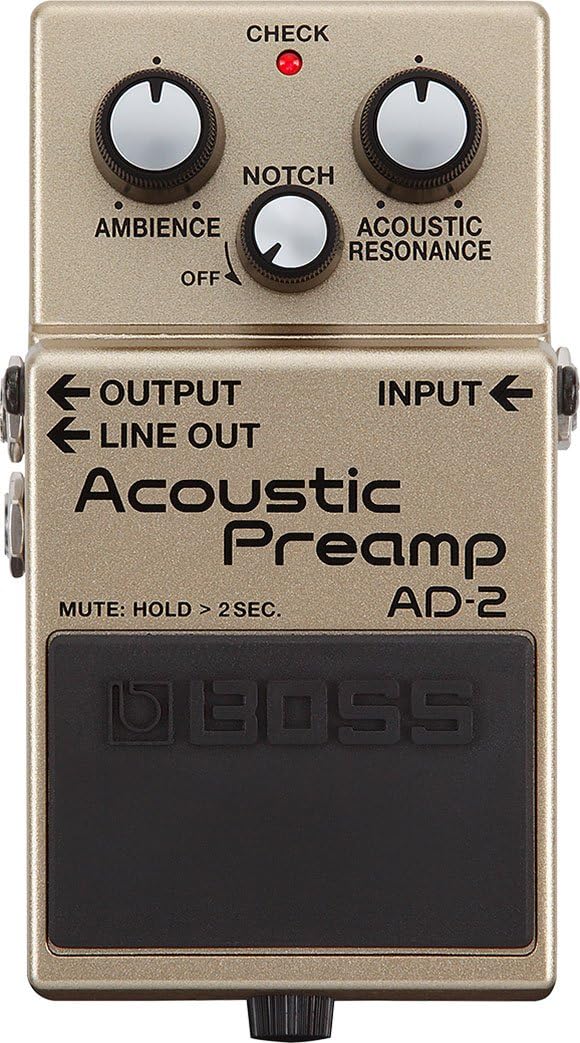
The BOSS AD-2 has a 4.6 rating and stands out for processing that specifically addresses the sound of an unplugged acoustic guitar. Rather than treating an acoustic like a conventional electric-guitar pedal, it uses interconnected acoustic parameters and exposes them through a manageable stompbox layout.
We may earn a commission when you buy through this link, at no additional cost to you.
Its acoustic resonance function reproduces the complex resonance characteristics associated with an unplugged instrument, helping a piezo pickup sound less thin and synthetic. The ambience control provides wide-ranging reverb optimized for acoustic guitar. For live problems, a notch filter offers immediate feedback reduction, while the normal output can feed an acoustic amplifier and the balanced DI output can connect directly to a PA.
A mute function makes it easier to change guitars and tune without producing unwanted noise. The limitation is that the AD-2 does not provide the familiar stack of separate low, mid, and high EQ bands found in several dedicated acoustic preamps. Players who depend on precise midrange sculpting may need to shape the sound upstream or choose a different model.
This is our Editor's Choice because it combines thoughtful acoustic-specific processing, a practical feedback filter, and two useful output paths in a straightforward pedal. It is an excellent fit for a player who wants a polished acoustic base with a touch of ambience. It also makes a strong first acoustic-effects pedal for performers who do not need extensive deep effects.
The acoustic resonance control is intended to restore the body and air characteristics that can disappear when a piezo pickup is amplified. It gives players a fast way to make a thin or overly bright pickup response sound more natural.
Separate normal and balanced outputs broaden the range of possible signal paths. The normal output suits an acoustic amplifier, while the DI output provides a direct connection to a PA, mixer, or recording interface.
We may earn a commission when you buy through this link, at no additional cost to you.
The Fishman AFX Pro EQ Mini is a compact acoustic preamp and equalizer with a 4.1 rating. Its primary attraction is a five-band EQ voiced for acoustic instruments, packed into a small format that is easier to include on a crowded pedalboard than a large floor preamp or direct box.
We may earn a commission when you buy through this link, at no additional cost to you.
Its bypass system provides true bypass, buffered bypass, and mute options, allowing the player to decide how the pedal interacts with the rest of the signal chain. Feedback-Fighting Phase Control offers an additional tool for improving compatibility with amplifiers and other sources of feedback. Innovative dual-path routing adds flexibility when comparing processed and direct signals.
The unit does not include reverb, delay, or other effects, and it needs a 9V external power supply that is not included. These limitations make it less suitable for players seeking a self-contained effects solution. Its strength is focused tone management rather than creative effects, and the compact size does not mean the control set is simplistic.
Choose the AFX Pro EQ Mini when pedalboard space matters and you want detailed acoustic EQ with selectable bypass behavior. It works well for a player who already owns effects or wants a dedicated color box. Confirm that the separate power arrangement suits your board before buying.
True bypass, buffered bypass, and mute provide different ways to navigate the pedalboard. This flexibility lets a player preserve the direct signal, protect a longer cable run, or silence the instrument during a changeover.
The phase control works alongside EQ adjustments to address feedback-prone combinations of guitar, amplifier, and pickup. It is a useful extra degree of control when a plain notch or EQ setting is not enough.
We may earn a commission when you buy through this link, at no additional cost to you.
The GOKKO GK-32 SpanishFly has a 4.8 rating, the highest listed rating among these products. It presents a straightforward acoustic preamp and DI solution for players who want essential stage tools without navigating a large collection of processing parameters.
We may earn a commission when you buy through this link, at no additional cost to you.
Its dedicated anti-feedback footswitch and associated control knob are designed to reduce unwanted feedback during live acoustic playing. A separate treble boost footswitch increases brightness and presence when the instrument needs more definition. Input, bass, and treble controls cover the fundamental tasks of signal-level management and basic tone shaping.
True bypass preserves the direct signal when the pedal is switched out. The enclosure is listed at 11.9 by 9.4 by 3.8 centimeters, making it practical for a pedalboard, and the unit operates from 9V center-negative power with a 30mA draw. The power supply is not included, and there is no built-in tuner, reverb, or delay.
The SpanishFly is a compelling choice for a gigging player who wants dedicated anti-feedback and boost switches. Its high customer rating is encouraging, though the rating does not replace evaluating the control layout for your own setup. Choose it for straightforward acoustic shaping and stage utility rather than elaborate effects.
The anti-feedback control and footswitch make the pedal practical for bright piezo pickups and live amplification. Because the function can be changed during performance, a player can engage it when a problematic frequency appears without interrupting the flow of the set.
The independent treble boost provides a quick way to improve definition and presence. It is useful when a guitar disappears in a mix, though the dedicated bass and treble controls allow more nuanced adjustments when the boost is switched off.
We may earn a commission when you buy through this link, at no additional cost to you.
The Fishman Platinum Pro combines an acoustic preamp, equalizer, DI, and onboard compression in a full-size pedal. Its 4.5 rating reflects a feature set aimed at players who want more control over a direct acoustic signal, particularly in a live sound system.
We may earn a commission when you buy through this link, at no additional cost to you.
The balanced XLR output can feed a PA or mixer, and a pre/post EQ switch determines whether the equalizer is applied before or after the compressed signal. A footswitchable boost with its own level control provides performance control, while onboard compression helps even out the natural peaks and valleys of acoustic playing. Phase control adds another tool for reducing feedback and improving signal compatibility.
Its largest drawback is physical size compared with the compact preamp pedals in this guide. The numerous features may also be unnecessary for a player who simply needs basic volume and tone shaping. Nevertheless, the combination creates a more complete front end than a basic acoustic pedal without requiring a separate compressor or DI.
The Platinum Pro is well suited to experienced performers, recording engineers, and players who want direct-stage control from a single unit. It may be overkill for practice-room use, but it offers a practical balance of EQ, dynamics, boost, and balanced output for serious acoustic work.
The pre/post EQ switch provides meaningful control over the processing order. Players can experiment with the character of the equalized signal before compression or place the EQ after the compressor for a different response.
Onboard compression can reduce the extreme variation that often occurs between flat-picked and strummed passages. It gives a sound engineer or player another level to stabilize a direct acoustic source.
We may earn a commission when you buy through this link, at no additional cost to you.
The Plastic 301 is an onboard acoustic-guitar preamp rather than a conventional pedal, and it carries a 4.4 rating. Its selling point is accessibility: the documented solder-free installation and easy-access battery compartment make it appealing to players who want onboard control without using a separate stompbox.
We may earn a commission when you buy through this link, at no additional cost to you.
Its control set includes volume, bass, midrange, treble, brilliance, a notch filter, and a phase switch. That range allows the player to address common pickup problems such as excessive brightness, unwanted mids, feedback, or phase-related tone issues. The phrase in the product description about spending less time tweaking reflects the goal of putting essential adjustments directly on the guitar.
Because it is an onboard unit, buyers need to think about compatibility with their instrument and willingness to modify the guitar for installation. The supplied information does not describe a balanced XLR output, footswitch controls, or onboard effects, so it should not be judged as a replacement for a stage DI pedal. Its strengths are localized tone management and pickup control.
Choose the Plastic 301 for players who want their acoustic guitar to carry a more complete preamp, particularly if they are comfortable with an onboard installation. It is less convenient for switching instruments or creating a portable pedalboard setup. Confirm the connection and installation requirements with the manufacturer or a qualified guitar technician.
Putting the preamp on the instrument lets a player adjust volume and tone before the signal reaches an amplifier or recording device. This can be especially useful when different guitars need different pickup compensation.
The solder-free installation approach can simplify setup, while the accessible battery compartment makes routine changes easier. Players should still confirm that the unit suits their guitar's existing electronics before installation.
We may earn a commission when you buy through this link, at no additional cost to you.
The Palmer POCKET AMP ACOUSTIC is a portable preamp aimed at acoustic guitars and basses, with a 4.5 rating. It supports both piezo and magnetic pickups, giving it broader utility than a unit designed around one pickup type and making it useful for players who own multiple instruments.
We may earn a commission when you buy through this link, at no additional cost to you.
Its three-band EQ uses a semi-parametric mid control specifically tuned for acoustic instruments. This is more involved than a simple fixed-frequency control and provides better access to the frequencies where acoustic tone often becomes crowded or boxy. The product is positioned for gigging, recording, and practice, so it can serve as a central source of level and tone control.
The main limitation is that the documented feature set focuses on preamplification and equalization rather than the extensive stage routing found in dedicated DI units. No built-in effects are listed, and the supplied information does not highlight multiple footswitches. A player who requires a balanced output, tuner, mute, or deep effects may need another product or an additional accessory.
The POCKET AMP ACOUSTIC is a good match for musicians who need a portable, pickup-flexible preamp for rehearsals, recording sessions, or smaller performances. Its semi-parametric midrange makes it more adaptable than a basic two-knob unit. It is best chosen for focused tone shaping rather than as a complete stage-control solution.
Compatibility with both piezo and magnetic pickups gives the preamp a useful place in a multi-instrument setup. It can serve instruments with very different output and tonal characteristics without requiring a separate unit for each.
The semi-parametric mid section offers a practical way to address the body of an acoustic tone. Instead of choosing only a broad mid boost or cut, the player can concentrate the adjustment around a more useful range.
We may earn a commission when you buy through this link, at no additional cost to you.
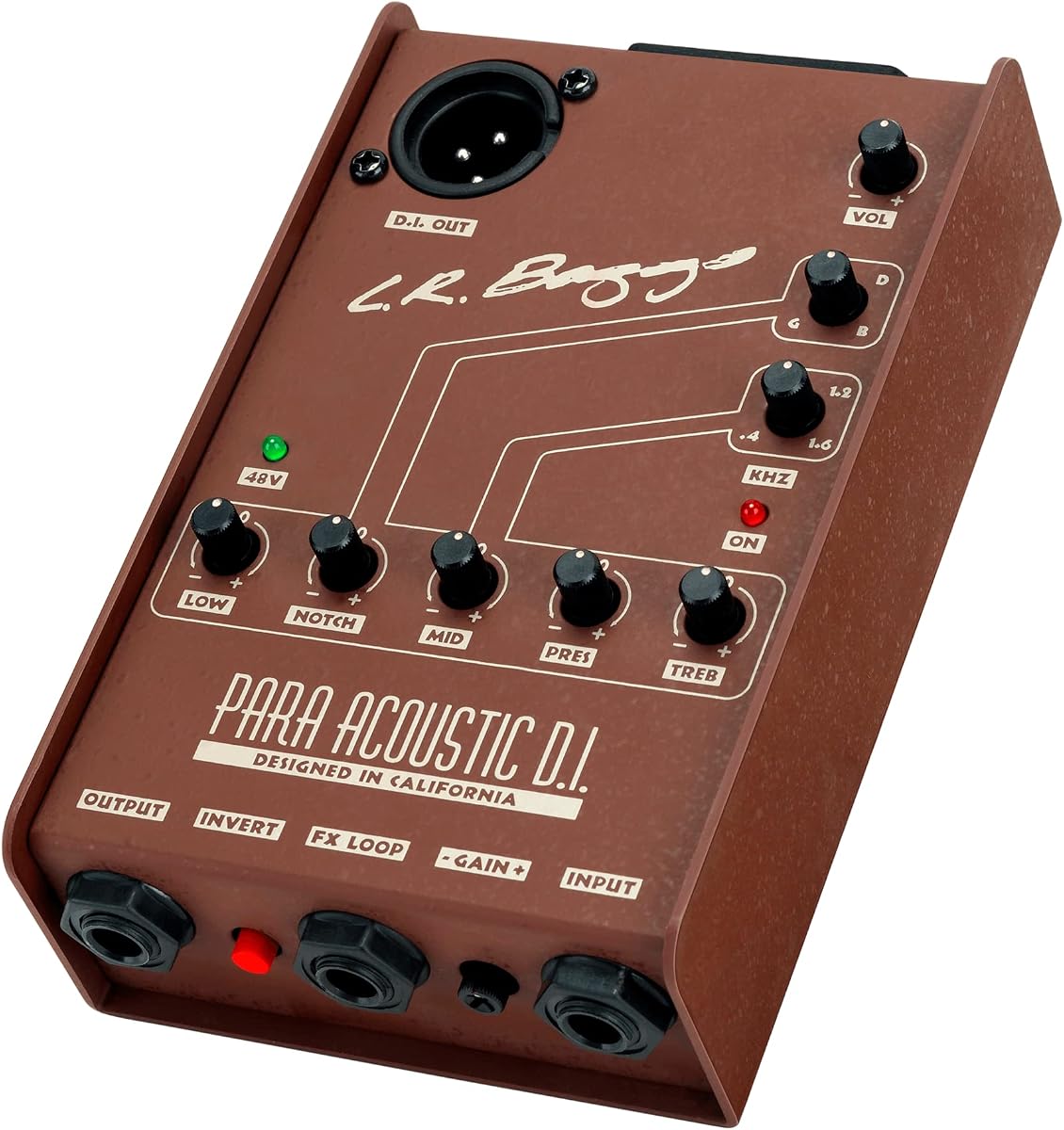
The LR Baggs Para Acoustic D.I. has a 4.7 rating and offers a refined, relatively simple route from an acoustic pickup to a PA, mixer, or amplifier. It provides adjustable gain, five-band EQ, phase inversion, and both XLR and quarter-inch outputs without attempting to be a full multi-effects processor.
We may earn a commission when you buy through this link, at no additional cost to you.
The gain adjustment accommodates passive and active pickups, while the five-band EQ includes tunable notch and midrange sections. The notch is useful for feedback reduction, and phase inversion gives the player another way to find the best relationship with an amplifier or sound system. Two output formats make the unit practical for stage boxes, mixers, and conventional instrument connections.
Its power flexibility is another strength because it can operate from a 9V battery or 48V phantom power. The trade-off is the absence of built-in reverb, delay, tuner, and performance footswitches. It is therefore better viewed as a dependable preamp and direct box than an all-purpose acoustic effects pedal.
Choose the Para when you want detailed tone and feedback control with simple routing. It is well suited to studio and stage players who already have separate effects or prefer a clean preamp section. For performers seeking a single pedal that handles ambience, modulation, and timing, one of the multi-effects models will be more convenient.
The combination of XLR and quarter-inch outputs allows the preamp to move between a professional sound system and a conventional amplifier or input. This makes it easier to build a signal chain around the player's existing equipment.
A tunable notch filter and phase inversion offer two distinct approaches to feedback and signal compatibility. The notch removes an unwanted frequency, while phase changes the polarity relationship between the guitar and the receiving device.
We may earn a commission when you buy through this link, at no additional cost to you.
The right acoustic preamp depends on your pickup, sound system, performance habits, and need for effects. Compare signal routing and control features carefully, because the most useful unit is the one that solves your everyday tone and feedback problems without complicating the setup.
Begin by confirming that the preamp can accept the output and character of your guitar's pickup. Piezo pickups often produce a bright, high-output signal that benefits from careful level control, while magnetic pickups may need a different gain range. Several products on this list explicitly support both passive and active pickups, while the Palmer POCKET AMP ACOUSTIC accommodates piezo and magnetic instruments. Match that information to the pickup in your primary guitar before considering deeper features.
Also consider whether the preamp is intended for a pedalboard, direct connection, or permanent installation in the instrument. An onboard model and a stompbox can perform similar basic jobs, but they require different levels of modification and setup. Choose the format that matches how you actually play and move between instruments.
A basic bass-and-treble control is easy to use, but a five-band or semi-parametric EQ offers much finer control over the acoustic spectrum. The L.R. Baggs Venue DI, LR Baggs Para, and Fishman AFX Pro EQ Mini provide five-band layouts, while the Fishman Platinum Pro adds pre and post EQ routing. Look for controls that make it possible to address muddy low mids, harsh upper mids, or a thin overall response without radically altering the instrument's character.
The best EQ for you is the one you understand. A larger control set is valuable if you play different guitars, move between rooms, or record with varied backdrops. If your needs are simpler, a three-band unit may be easier to operate while still offering enough latitude for everyday acoustic tone.
Feedback can result from the pickup, the instrument's body, the amplifier, the room, and the signal chain. A dedicated notch filter gives you a way to reduce a specific problematic frequency, while phase controls can improve compatibility between the guitar and the receiving device. The GOKKO SpanishFly includes an anti-feedback control and footswitch, the BOSS AD-2 has a notch filter, and the Fishman AFX Pro EQ Mini adds phase control.
For a pedal that can be engaged during a performance, a footswitch is often more useful than a small knob that must be adjusted in a hurry. Consider both the filter and phase tools when comparing a preamp, and make sure it works with the amplification equipment you already use. A feature only solves a problem when it can be deployed at the right moment.
A balanced XLR output is the most direct route into a PA system, mixer, or many audio interfaces. A quarter-inch output can be useful with a conventional acoustic amplifier, recorder, or other instrument-level device. The LR Baggs Para includes both, while the SONICAKE A Factory, Sonic Wood, and Fishman Platinum Pro emphasize balanced XLR connectivity.
Consider the entire signal path rather than focusing on the output in isolation. A preamp with a useful direct output may reduce the need for a separate DI box, while a unit with both normal and DI outputs can connect to more than one type of amplifier. Confirm the connection format required by your venue, recording setup, or practice system before purchasing.
Effects such as reverb, chorus, and delay can enrich an acoustic tone, but they are not substitutes for good level and EQ control. The SONICAKE Sonic Wood combines an analog two-band preamp with all three effects, and the SONICAKE A Factory pairs its analog preamp with digital reverb. The BOSS AD-2 focuses on acoustic resonance and a dedicated acoustic reverb rather than a broad effects library.
Decide whether you want a preamp that stays out of the way or a pedal that actively shapes the performance. Effects-heavy models are convenient for songwriters and solo performers, while dedicated preamps provide a cleaner foundation for a pedalboard or studio signal chain. Simplicity can be a strength when the rest of your setup already supplies the sonic color.
Footswitches make a preamp easier to use while playing. A mute can prevent unwanted noise during a guitar change, a tuner supports quick setup, and a boost can make a lead line more prominent. The L.R. Baggs Venue DI combines a chromatic tuner, footswitch mute, and volume boost, while the GOKKO SpanishFly offers anti-feedback and treble-boost switches.
Performance controls are most valuable when they reduce the need to reach for small knobs. Consider how often you change guitars, check your tuning, or need to alter levels quickly. A single well-placed switch can be more useful than several features that are difficult to adjust during a song.
Pedalboard power can affect both convenience and signal routing. The SONICAKE A Factory, SONICAKE Sonic Wood, Fishman AFX Pro EQ Mini, and GOKKO GK-32 SpanishFly require external 9V power, while some power supplies are not included. The LR Baggs Para offers battery or 48V phantom power, which can be convenient for a simple direct-box role. Always verify connector polarity and current requirements.
Bypass design is equally important in a chain of multiple pedals. True bypass seeks to preserve the direct signal, while buffered bypass can protect the instrument from the effects of long cable runs or unusual input impedance. The A Factory emphasizes its buffer, and the AFX Pro EQ Mini offers true bypass, buffered bypass, and mute options. Match bypass behavior to the rest of the pedalboard rather than judging it in isolation.
A full-featured preamp can be valuable in a fixed rig, but portability matters for acoustic players who travel with a guitar case or perform standing. The GOKKO GK-32 SpanishFly has a documented compact size, the SONICAKE A Factory emphasizes easy portability, and the Palmer POCKET AMP ACOUSTIC is explicitly designed for portable gigging, recording, and practice.
Think about space, weight, controls, and power together. A pedal that fits on a crowded board is only portable if you can find a reliable power source. An onboard preamp avoids external equipment but requires installation in the instrument. Choose the format that supports your most common setting rather than the one that appears theoretically versatile.
Start with a neutral sound and raise the preamp gain only as high as needed to reach the input level of the next device. Excessive gain can distort the pickup response before the EQ and feedback controls have a chance to work. Make small adjustments, listen from the player's position, and then check the result from another part of the room or through the recorded signal.
Set the EQ in a deliberate order. Reduce a clearly problematic frequency before making broad tonal changes, use the midrange controls for boxiness or harshness, and move the treble control gradually to avoid creating a piercing result. If a phase control is available, try it when the pedalboard or amplifier produces feedback. Engage the feedback filter only as aggressively as necessary, since overly narrow cuts can color the sound.
For care, use the specified power supply and confirm center-positive or center-negative polarity before connecting the unit. Keep the connections supported and avoid placing a pedal where cables can be pulled loose. Clean the enclosure with a soft, dry cloth, inspect the jack connections periodically, and consult a qualified technician for any onboard installation or internal repair work.
An acoustic guitar with a pickup usually benefits from a preamp because it provides level control, tone shaping, and a stronger signal for an amplifier, PA, mixer, or recording interface. A high-quality pickup and amplifier can sometimes provide enough shaping on their own, but a preamp makes the instrument easier to control and adapt to different backdrops. The most valuable features vary according to whether your main concern is feedback, EQ, stage routing, or ambience.
A basic DI box primarily converts an instrument-level signal to a balanced line-level output for a PA or mixer. An acoustic preamp usually includes gain and EQ controls and may also provide tone-shaping tools, phase control, effects, a tuner, or a mute. Some products combine both jobs, while others are optimized primarily for one purpose, so check the routing and control details before choosing.
No preamp can guarantee that every feedback problem will disappear. Notch filters, phase controls, and low gain settings can reduce common causes, but the pickup placement, instrument, amplifier, room acoustics, and cable connections also matter. Start with the least aggressive setting that works and investigate a poor pickup location or excessive gain if feedback remains persistent.
A five-band EQ offers more precise control than a simple bass-and-treble circuit, especially when a guitar sounds muddy, thin, or harsh. It is particularly useful for players who change instruments, venues, or recording settings. The extra controls are not automatically better for every player, however, and a smaller layout can be more convenient if your tone needs are straightforward.
True bypass is useful when you want the most direct signal and your pedalboard is compatible with it. Buffered bypass can preserve the guitar's response across longer cable runs or with equipment that presents a difficult input impedance. A model offering both, such as the Fishman AFX Pro EQ Mini, gives you the most flexibility, while a single-mode design should be checked against the rest of the chain.
Built-in reverb is helpful if you perform solo, accompany singing, or want a quick way to add space without carrying another pedal. It is less essential if your PA, amplifier, or recording software already provides high-quality ambience. The SONICAKE Sonic Wood and BOSS AD-2 include effects, while several dedicated preamps concentrate on gain, EQ, and feedback control instead.
Power requirements depend on the individual model. Several pedals in this guide use 9V center-negative power, while the LR Baggs Para can run from a 9V battery or 48V phantom power. Always check the manufacturer's specifications before connecting a supply, especially when placing multiple pedals on one board. A power supply that supplies the wrong voltage or polarity can prevent operation or damage equipment.
Yes, provided its output is appropriate for the recording device. A balanced XLR output can feed many audio interfaces and preamps, while a quarter-inch output may be more convenient for a conventional input. Keep the recording level conservative, watch the interface meter, and record a short test before committing to a full take.
The GOKKO GK-32 SpanishFly is the strongest budget-oriented choice for players who want focused controls, dedicated anti-feedback switching, and true bypass operation. The BOSS AD-2 stands out for acoustic-specific resonance processing, useful ambience, and flexible output routing. For a more comprehensive premium instrument, the L.R. Baggs Venue DI provides five-band EQ, a tuner, mute, boost, and detailed feedback control.
Prioritize the features that solve a recurring problem rather than the largest control count. Choose a five-band EQ if you routinely change guitars or settings, a balanced XLR output for a PA, a tuner and mute for live performance, or built-in ambience if you want sound-shaping effects in one box. Check power requirements, bypass behavior, and physical size as carefully as the tone controls.
Customer ratings can help identify products that have resonated with other players, but they do not replace checking the specifications and signal routing for your own setup. Product availability and pricing change over time, so review the current listing and confirm compatibility before making a final purchase decision.