TESMEN TLP-123A
4.6Editor score
RJ11 and RJ45 testing
One-button operation
Detachable remote unit
Network cable tester guide comparing ten tools for Ethernet fault detection, cable tracing, PoE checks, length measurement, port testing, and fiber inspection.
A network cable tester helps technicians and advanced home users verify Ethernet wiring, locate faults, identify active connections, and confirm whether installed cabling is ready for service. The best model is not necessarily the one with the most display options; it is the tool that matches your connectors, cable types, testing environment, and need for portability.
This guide compares ten network cable testers based on the documented functions of each model, including wire mapping, fault detection, cable tracing, length measurement, PoE testing, port flashing, non-contact voltage detection, and optical fiber functions. It covers practical choices ranging from simple continuity testers to advanced multi-function diagnostic kits.
Each review explains the standout capabilities, limitations, and ideal user for the corresponding product. The guide also explains how to interpret common results and what to look for when selecting a tester. Product availability and prices can change, so compare current specifications and offers before purchasing.
4.6Editor score

4.8Editor score
4.8Editor score
The following comparison highlights each tester's supported connections, principal diagnostic functions, power options, and best-fit application so buyers can distinguish simple continuity checkers from advanced tracing and fiber-testing systems.


The Klein Tools VDV526-200 LAN Scout Jr earns a 4.8 rating and stands out as the most balanced choice in this guide for anyone who wants clear Ethernet diagnostics without carrying a large field-testing system. Its large backlit LCD presents pin-to-pin wire-map information in a format that is easier to interpret than a row of coded LEDs, particularly in closets, crawl spaces, and other dimly lit work areas.
We may earn a commission when you buy through this link, at no additional cost to you.
Its diagnostic coverage is particularly strong for a compact tester. The unit checks for open, short, miswire, split-pair, cross-over, and shield conditions in RJ45-terminated data cables and patch cords. The split-pair function deserves attention because a cable can appear continuous while still performing poorly if its twisted pairs are wired or paired incorrectly. Multiple tone-generator styles can be applied to one wire, a wire pair, or all eight conductors.
The main trade-off is that the analog probe required for tone-based cable tracing is sold separately. That makes the VDV526-200 less convenient for buyers who expect a complete tracing kit in the box. It is also designed around data-cable testing rather than telephone or coax testing, and the interface offers three buttons rather than the more elaborate menu systems found on advanced multifunction models.
This is the best general recommendation for network installers, IT support personnel, and serious home users who want dependable wire mapping and fault diagnosis. Choose it when display clarity, portable construction, and specific Ethernet fault reporting matter more than integrated optical or non-contact voltage functions.
The large backlit LCD makes pin-to-pin results easier to read before moving a cable or comparing multiple conductors. That practical readability is a major advantage in server rooms, wall cavities, and poorly illuminated network closets.
Open, short, miswire, split-pair, cross-over, and shield diagnostics help distinguish a dead link from a subtler installation problem. The display is especially helpful when the fault must be identified at both ends of a cable.
We may earn a commission when you buy through this link, at no additional cost to you.
The FNIRSI LPM-10A combines cable continuity, tracing, port location, PoE checks, and network-speed verification in a field-oriented kit. Its 4.2 rating places it below the most highly rated models, but the documented feature set is well suited to technicians who want a compact instrument that can handle several common diagnostic tasks without a separate collection of tools.
We may earn a commission when you buy through this link, at no additional cost to you.
The transmitter and receiver are rechargeable, and the kit includes a low-battery alert and built-in flashlight for dark installation areas. Its tracing function uses adjustable sensitivity, which can help identify Ethernet cables and active ports in noisy bundles. The tester also checks RJ45 continuity and crimp quality and diagnoses opens, shorts, miswires, and other faults.
PoE and performance checks add a useful layer beyond basic continuity. The unit measures cable length, verifies 10, 100, and 1000 Mbps operation, and automatically detects standard and non-standard PoE. A built-in non-contact voltage function can alert users to live AC wiring, although safe work practices still require treating unidentified conductors as energized.
The LPM-10A is best for mobile network technicians and installers who often work in dark or active environments. Its main limitation is that the relatively modest rating and more compact feature set may not satisfy a specialist seeking the most detailed wire-map and crimp analysis available.
Adjustable tracing sensitivity offers practical control when following a cable through a crowded pathway. The port-finder function can further reduce guesswork when identifying an active connection.
A rechargeable transmitter and receiver reduce dependence on disposable batteries. The built-in flashlight and low-battery warning support continued use in dark wiring spaces.
We may earn a commission when you buy through this link, at no additional cost to you.
The Klein Tools VDV501-851 Scout Pro 3 combines telephone, data, and coax testing in one instrument. Its 4.7 rating reflects a strong balance of functionality, and the broader connector support makes it especially useful for technicians who work across legacy voice lines, modern Ethernet networks, and video cabling rather than specializing in only one media type.
We may earn a commission when you buy through this link, at no additional cost to you.
Unlike a basic RJ45-only continuity tester, this model measures cable length up to 2,000 feet and reports wire map, cable identification, and test results on a backlit screen. It can test voice cables terminated with RJ11 or RJ12, data cables terminated with RJ45, and coax cables fitted with F connectors. It also checks for opens, shorts, miswires, and split-pair faults.
Cable tracing is available through a multiple-style tone generator, but the required analog probe is not included. More importantly, the product information explicitly states that the unit is intended for unenergized Ethernet cables and is not designed to test PoE. That limitation should be considered whenever the test environment includes powered network equipment.
The Scout Pro 3 is a strong choice for general IT support, facilities maintenance, and residential or office installers who need a broader cable toolbox. It is less suitable for a specialist whose main priority is live PoE identification or a fully self-contained tone-tracing kit.
RJ11, RJ12, RJ45, and coax F-connector support reduces the need to carry separate testers for common building cables. That versatility is valuable in mixed voice-and-data environments.
The stated 2,000-foot capability makes the tester useful for determining installed cable length on larger runs. It can also help identify where a run terminates or whether a cable is longer than expected.
We may earn a commission when you buy through this link, at no additional cost to you.
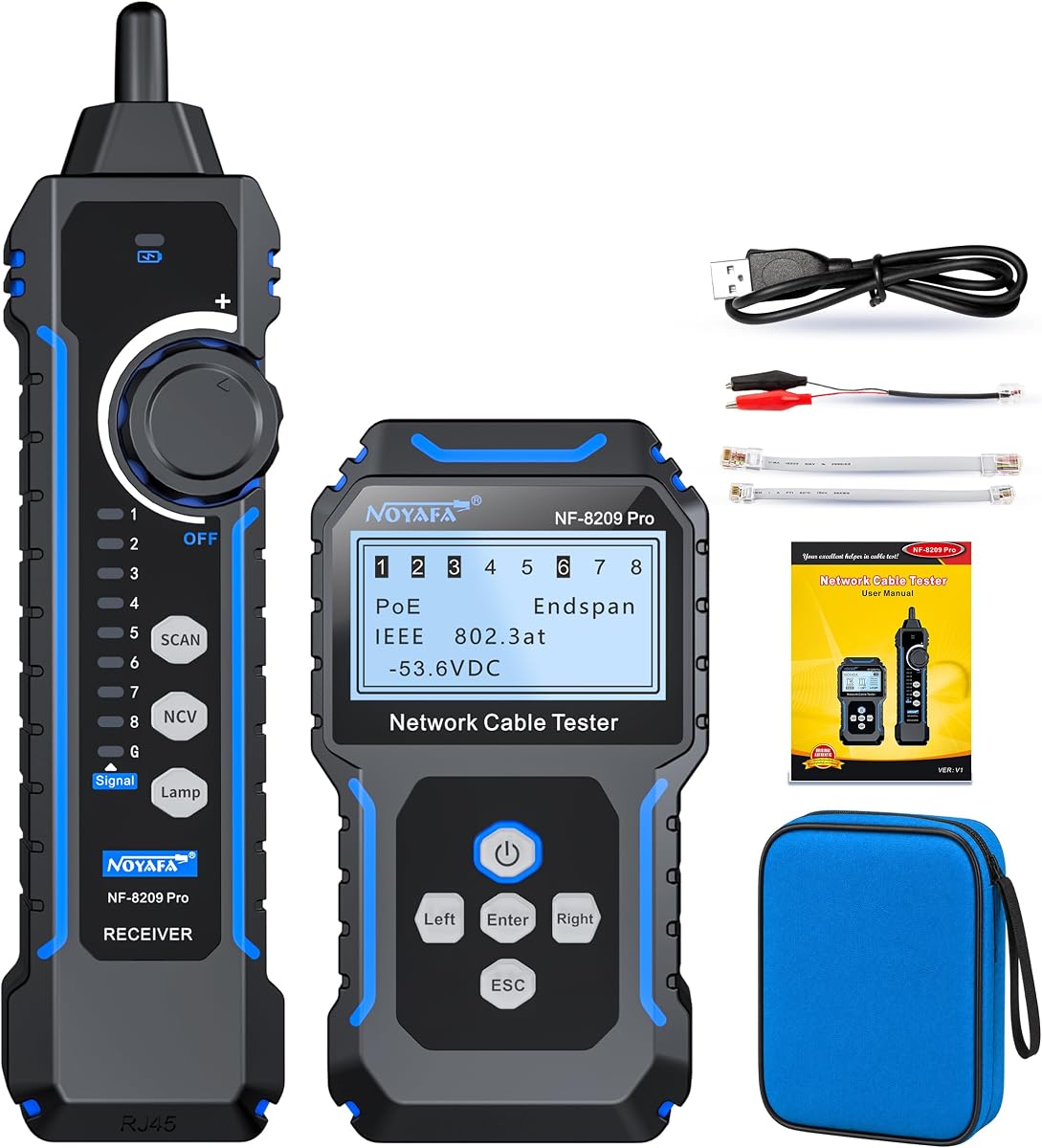
The NOYAFA NF-8209 is a detailed network diagnostic kit with a 4.3 rating. Its distinguishing strength is the combination of digital cable tracing, continuity and fault testing, length measurement, port functions, and extensive PoE information. This makes it more specialized than a basic wire-map tester and more practical for technicians who routinely diagnose powered Ethernet installations.
We may earn a commission when you buy through this link, at no additional cost to you.
The PoE system checks standard and non-standard power, identifies IEEE 802.3af and IEEE 802.3at, and displays power method, voltage, and polarity. It also supports 10M, 100M, and 1000M port flash and link testing. These details can help explain why a powered device fails even when a basic continuity check says the cable is correctly wired.
The remote adapter permits one-to-one testing of RJ45 shielded and unshielded cables, including eight-pin network and nine-pin shielded wiring. The tester identifies short circuits, open circuits, miswiring, and normal connections. Length measurements cover 2.5 to 200 meters and can be displayed in meters, feet, or yards, while digital decoding and dedicated modes help reduce interference during live tracing.
The included transmitter, receiver, remote adapter, cable set, tool bag, battery, and Type-C cable make this a convenient field package. Its mixed battery arrangement—one rechargeable 3.7V unit in the transmitter and a 9V battery in the receiver—is a minor inconvenience compared with an all-integrated rechargeable design.
Showing voltage, polarity, power method, and standard type is more useful than a simple yes-or-no PoE indicator. The information helps distinguish missing power from a nonstandard source or a cabling problem.
Measurements from 2.5 to 200 meters can be viewed in metric or imperial units. This is useful for checking both short patch cords and longer structured-cabling runs without manually converting readings.
We may earn a commission when you buy through this link, at no additional cost to you.
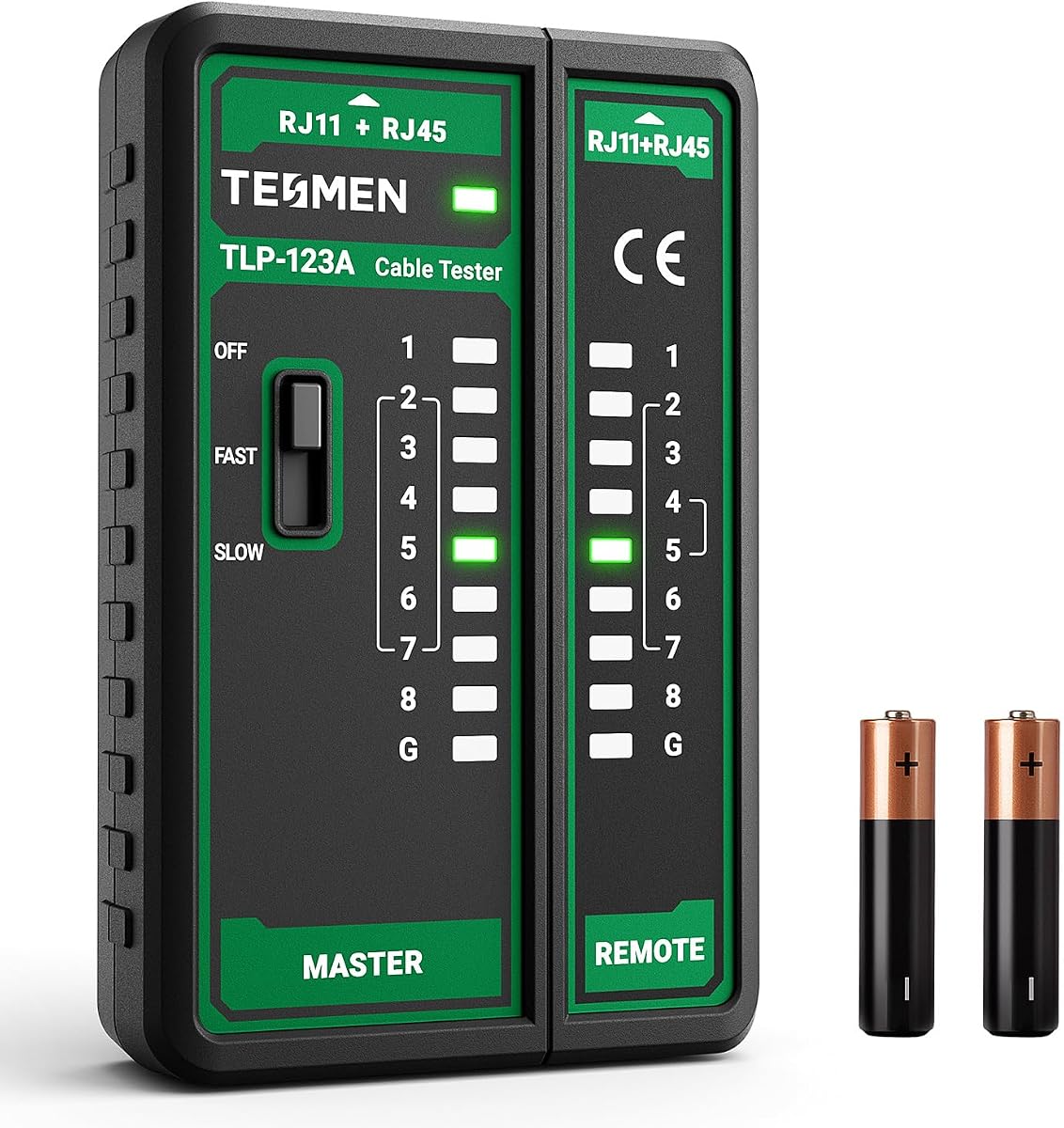
The TESMEN TLP-123A is the best budget selection for basic Ethernet and telephone continuity testing. Its 4.6 rating is strong for a simple tool, and the product focuses on the essentials: identifying connectivity, short circuits, open circuits, miswiring, and shield status without requiring a complex menu-driven interface.
We may earn a commission when you buy through this link, at no additional cost to you.
The main unit and remote can be separated and operated independently, allowing the remote to remain at one end of a long cable while the main unit is used at the other. That design makes the tester practical for installed wall ports, patch panels, and structured-cabling systems. A one-button workflow, adjustable test speed, and clear LEDs keep the results approachable for home users while still providing useful information to professionals.
The tester supports RJ45 and RJ11 connections and is listed for CAT5, CAT5E, CAT6, CAT6A, CAT7, UTP, and STP. That broad compatibility makes it a straightforward option for routine LAN and telephone work. It does not provide cable length measurement, tone tracing, PoE detection, or advanced port diagnostics, so its appeal depends on a focused continuity-checking requirement.
The package includes the TLP-123A, a user manual, and two AAA batteries. It is a sensible first tool for homeowners, computer builders, and small IT teams that need to diagnose patch cords and basic installed Ethernet wiring without paying for multifunction features they may never use.
The indicator-based results make common fault categories visible without navigating screens. This keeps the testing process fast for routine patch-cord checks and basic troubleshooting.
Separating the remote from the main unit allows testing when the far end is recessed in a wall or located in another room. The detachable arrangement is the TLP-123A's most practical physical feature.
We may earn a commission when you buy through this link, at no additional cost to you.
The Network LAN Cable Tester, also presented as a VDV Tester and LAN Explorer with Remote, is a compact option for technicians who want fast fault identification without a large display. Its 4.7 rating and straightforward design make it appealing for everyday patch-cord testing, move testing, and basic troubleshooting.
We may earn a commission when you buy through this link, at no additional cost to you.
A single button controls tests for RJ11, RJ12, and RJ45 terminated voice and data cables. The specifications list support for CAT3, CAT5e, CAT6, and CAT6A, while fast LED responses identify Pass, Miswire, Open-Fault, Short-Fault, and Shield conditions. Those fault categories cover the most common reasons a basic network link may fail.
The remote stores securely inside the tester body, helping prevent the loss of small components that can occur with detachable remotes. Automatic power-off conserves battery life, a low-battery indicator provides advance warning, and the included 9V battery keeps the power system simple. Its compact case also fits easily into a pocket or small technician's tool pouch.
This tester is best for users who need a dependable basic network cable checker and value portability over advanced features. It does not offer PoE measurement, cable length, tone tracing, or optical functions, so a professional working on complex installations may eventually need a more capable instrument.
Storing the remote inside the main housing reduces clutter and protects the small component from being misplaced. It is a simple design choice that matters for mobile technicians.
LED feedback for pass, miswire, open, short, and shield conditions makes results easy to communicate. The simplified readout is useful when the goal is to decide quickly whether a cable should be replaced or investigated.
We may earn a commission when you buy through this link, at no additional cost to you.
The NOYAFA Network Cable Tester with Optical Power Meter and VFL is among the most capable tools in this roundup, carrying a 4.9 rating. It combines copper-cable diagnostics with an optical power meter and visual fault locator, making it particularly attractive to technicians who maintain both structured cabling and fiber links.
We may earn a commission when you buy through this link, at no additional cost to you.
The optical meter supports 850, 1300, 1310, 1490, 1550, 1625, and 1650 nanometer wavelengths. Its stated measurement range extends from minus 70 to plus 10 dBm, and FC, SC, and ST connectors are supported. The visual fault locator uses a 650-nanometer source to help identify fiber breakpoints, poor connections, bending, or cracking.
The copper side includes digital continuity and scanning, cable tracking, length measurement up to 350 meters, PoE testing, port flashing, a quality-control test, non-contact voltage detection, and automatic shutdown. Its color display and integrated flashlight are useful in dark server racks and attics, while the 1500mAh rechargeable battery and Type-C charging simplify long-shift use.
The kit includes a color transmitter, tracking receiver, RJ45 and RJ11 adapter jumpers, a Type-C cable, a carrying case, and a manual. It is best for field technicians who genuinely need optical measurements alongside network testing; a homeowner fixing one Ethernet cable will likely find its broad feature set unnecessary.
Seven-wavelength measurement and broad connector support reduce the need for a separate optical meter for routine fiber work. Users can assess signal strength and attenuation-related concerns without carrying a dedicated instrument.
The 650-nanometer visual fault locator helps identify breakpoints, poor terminations, and visibly damaged fiber. It is particularly useful when a technician needs to find the precise section requiring repair or splicing.
We may earn a commission when you buy through this link, at no additional cost to you.
The NOYAFA NF-8209PRO combines seven major diagnostic categories in a 4.8-rated professional package. Wire tracking, cable mapping, length measurement, PoE detection, port flashing, crimp testing, and non-contact voltage detection make it one of the most comprehensive copper-cable tools in this comparison without adding an optical meter.
We may earn a commission when you buy through this link, at no additional cost to you.
Digital signal technology is designed to minimize false alarms while tracing opens, shorts, and cross connections on RJ45 and RJ11 cables. CAT5 and CAT6 wiring can be tested in shielded or unshielded forms. The PoE section identifies standard and non-standard power along with voltage and active wire pairs, providing more context than a simple PoE indicator.
Length testing extends to 350 meters and is intended to locate breakpoints, while port flashing helps match a cable to a switch port. The crimp-quality test examines the eight-core RJ45 connector, which can help reduce connector rework. A rechargeable lithium-ion battery, Type-C charging, automatic shutdown, a low-battery reminder, and a flashlight make the unit suitable for extended field work.
This is the best premium pick for network installers, structured-cabling technicians, and serious power users who want one copper-focused diagnostic toolkit. The package includes a transmitter, receiver, 8P and 6P test cables, an alligator clip line, a charging cable, and a manual, making it ready for a broad range of field tasks.
Digital decoding is intended to limit false alerts and improve confidence when tracing among bundled cables. That makes the NF-8209PRO useful in dense patch panels and complex wiring routes.
Eight-core RJ45 crimp inspection can identify a poorly terminated connector before it is installed into a patch panel or outlet. Checking the termination early helps reduce troubleshooting time later.
We may earn a commission when you buy through this link, at no additional cost to you.
The NOYAFA NF-8508 combines nine network-maintenance functions with a seven-wavelength optical power meter, visual fault locator, and 650-nanometer light source. Its 4.2 rating is competitive within the specialized category, and the model is suited to technicians who regularly service both copper networks and fiber optic connections.
We may earn a commission when you buy through this link, at no additional cost to you.
Copper-related functions include continuity testing, cable scan, port flashing, length measurement, PoE supply testing, quality control, cable tracking, short-circuit testing, and open-circuit testing. The stated cable length range reaches 200 meters, and supported cabling includes RJ45 network cables, phone lines, and BNC cables. PoE mapping and voltage checks are designed to handle up to 60 volts DC.
The optical section measures 850, 1300, 1310, 1490, 1550, 1625, and 1650 nanometer wavelengths from minus 70 to plus 10 dBm. FC, SC, and ST connectors are supported. A self-calibration feature is included for stable long-term performance, while port flashing can present operating speed, duplex mode, and negotiated settings on the tester screen.
The NF-8508 includes a rechargeable 1500mAh battery, Type-C charging, adjustable backlight and shutdown timing, and non-contact voltage detection. It is a strong maintenance platform for mixed-network work, though its lower rating and shorter stated length range make the newer NOYAFA multi-function model worth considering when those factors are priorities.
Showing operating speed, duplex mode, and negotiation settings can make a port-level diagnosis more precise. This goes beyond simply confirming that a switch light is blinking.
The built-in self-calibration is intended to support stable optical readings over time. Combined with seven wavelength choices, it makes the device more useful for routine fiber monitoring.
We may earn a commission when you buy through this link, at no additional cost to you.
The TESMEN TLP-528A pairs a 4.9 rating with a focused set of features for continuity, wiring status, shielding, and connector quality. It is particularly suitable for users who regularly sort and test RJ45 or RJ11 cables and want quick LED feedback without navigating a large screen.
We may earn a commission when you buy through this link, at no additional cost to you.
The tester can switch between fast and slow test modes, providing flexibility for different routine workflows. Its LEDs report line continuity and shield status, while the connector crimp QC check adds a useful quality-control step for network maintenance. Support for CAT5, CAT6, and CAT7 broadens the range of cable types it can handle for LAN and telephone work.
The main and remote units are detachable, allowing each to be positioned at opposite ends of a long installation. A high-quality plastic shell with a non-slip silicone surface supports durability and handling. These physical details matter in a work bag or on a ladder, where a slippery tester can be frustrating to use.
The package contains the TLP-528A with dual RJ11 and RJ45 interfaces, a storage box, a user manual, and two AAA batteries. It lacks length measurement, PoE detection, and advanced port analysis, making it best for fast cable sorting rather than comprehensive network certification.
Separate fast and slow modes let users balance speed against the pace of a repeated testing process. This is useful when checking many cables in succession or working through a slower one-at-a-time verification.
Crimp inspection adds value beyond basic wire continuity. It helps identify a questionable RJ45 termination that could otherwise cause intermittent network performance.
We may earn a commission when you buy through this link, at no additional cost to you.
The right network cable tester depends on the cable types, faults, and powered equipment you need to diagnose. Consider display clarity, supported connectors, tracing capability, PoE features, and field power before choosing a model.
Begin with the cables and connectors you actually use. A model limited to RJ45 is well suited to Ethernet patch cords and installed data cables, while builders working with telephone systems may need RJ11 as well. The Klein VDV501-851 goes further by supporting coax F connectors, making it a broader choice for mixed voice, data, and video work. Verify whether shielded wiring is supported when your installation uses STP or screened connectors, and check the listed categories such as CAT5, CAT5E, CAT6, CAT6A, or CAT7. A broad label alone does not guarantee every specialized diagnostic function, so review the individual test modes as well as the compatible standards.
In short, match the tester to the connectors and media you service, not merely to the largest supported cable category.
Wire mapping shows which conductors connect at the far end and where a cable violates the expected pinout. For useful troubleshooting, look for clear identification of opens, shorts, miswires, and split pairs rather than a generic pass-or-fail result. Split-pair detection deserves special attention because a cable can pass simple continuity checks while still producing unreliable network performance. A backlit LCD may also be more practical than LEDs when a technician needs to identify a specific conductor, particularly in a dark closet or while handling a cable at both ends.
Prioritize models that clearly separate wire mapping from advanced analysis, with pass, open, short, miswire, split-pair, cross-over, or shield results where relevant.
Tracing helps identify which cable carries a particular signal, which becomes important in a wall with many similar runs or in a crowded patch panel. Some testers generate a tone on a single conductor, a pair, or all eight conductors. The Klein VDV526-200 offers multiple tone styles but requires a separate analog probe, so include the cost and availability of that accessory when comparing complete setups. Digital tracing in the NOYAFA models is designed to reduce interference in complicated environments. If your work is primarily identifying a route rather than diagnosing individual conductors, a tracer may be more important than length measurement.
For cable identification, choose the tracing method that matches your environment and confirm whether the required remote, probe, or receiver is included.
Power over Ethernet can complicate diagnostics because a cable may be connected to energized equipment. A dedicated PoE test can identify standard and non-standard power, report voltage and polarity, and sometimes reveal the active wire pairs. The Klein Scout Pro 3 is explicitly not designed for PoE testing, while several NOYAFA and FNIRSI models provide dedicated PoE functions. Non-contact voltage detection can also add a warning layer when tracing among household wiring, but it does not replace safe work practices. Do not treat a tester as permission to contact conductors that have not been properly identified and de-energized.
If the network includes PoE equipment, select a model with documented PoE support and understand the limits of any non-contact voltage alert.
Length measurement can confirm whether an installed run matches its expected distance, identify a break, or help locate the end of a cable. The range varies considerably: the TESMEN TLP-123A does not list length measurement, the Klein VDV501-851 reaches 2,000 feet, and several advanced NOYAFA models specify up to 350 meters. Check both the maximum range and minimum useful range, since extremely short patch cords may not be measured accurately by every device. Some testers also report results in meters, feet, or yards, which is convenient when working from installation drawings.
Choose a measurement range appropriate to the longest cable you expect to test, and do not choose a length tester if your needs are strictly basic continuity checking.
The display determines how easily you can understand a failed result. LED-only testers are fast and simple, often making them ideal for sorting cables or making quick pass-or-fail decisions. Color screens and backlit LCDs are more useful when you need to compare conductors, review PoE data, examine port information, or read measurements in a dark space. Button count and menu complexity also matter: advanced models provide more data but may take longer to master. Consider the screen size, backlight, indicator layout, and whether the tester can be used one-handed with gloves or in a confined work area.
Balance information density against usability. The best display is the one that allows you to reach the correct diagnosis quickly and confidently.
Port flashing sends activity through a switch port and can make it easier to match a cable to the correct connection. Link tests verify whether a port reports an active connection, while port-information displays may reveal speed, duplex, and negotiation details. Connector crimp QC is useful when a network problem may originate from a poorly terminated plug. These functions are common on advanced multifunction devices and can reduce the need to replace a cable or move equipment solely to locate the issue. However, they do not necessarily qualify a tester as a formal network certification instrument.
Consider port and crimp functions when you need faster installation checks or more complete troubleshooting than basic continuity testing.
Field power affects how easily a tester can be used throughout the workday. Rechargeable devices reduce battery replacement, while included AAA or 9V batteries simplify initial setup. The NOYAFA multi-function kits use rechargeable 1500mAh lithium-ion batteries and Type-C charging, while the FNIRSI LPM-10A also has a rechargeable transmitter. Portability includes more than weight: a detachable remote, secure storage, a case, flashlight, and low-battery warning can materially improve field usability. Check the complete package because some tone probes are sold separately, whereas remote adapters, jumper cables, and charging leads may be included with advanced models.
Choose a power system and accessory bundle that suit your work pattern, and verify that every required probe or adapter is included before ordering.
Start by identifying the cable, connector type, and network standard involved. Disconnect the cable from active equipment when the manufacturer's instructions call for an unenergized test, especially for a model without PoE support. Inspect both connectors for damaged pins, dirt, bent contacts, or loose strain relief, because a faulty connector can produce misleading test results.
Connect the tester and remote according to the selected cable type, place the remote at the far end, and initiate the appropriate continuity, wire-map, length, tracing, PoE, port, or crimp test. Wait for the result to stabilize before changing the cable or connection. For tracing, adjust sensitivity gradually and record the conductor or cable identifier so a path can be followed through a bundle without confusing nearby runs.
After use, disconnect the leads, remove batteries if the instructions recommend it during long storage, and inspect the tester and cables for damage. Keep probes and remotes in their designated storage spaces, clean connectors gently, and avoid moisture or extreme heat. Recharge the unit according to its instructions and use a qualified replacement battery or power source if the original accessory is no longer serviceable.
A network cable tester verifies whether conductors connect correctly between the two ends of a cable or installed link. Depending on the model, it can identify opens, shorts, miswires, split pairs, shielding issues, and incorrect pin mappings. Advanced tools also measure cable length, trace signals, identify active ports, test PoE, inspect crimps, and measure optical power.
It depends on the tester and the function being performed. A basic continuity or wire-map test may require both ends to be disconnected, while a dedicated port-flash function is intended to work with a live switch connection. PoE testing is also different from basic wire mapping, so use the proper mode and follow the manufacturer's instructions, especially around energized equipment.
A wire-map tester checks the internal relationship among conductors, such as whether each pin reaches the correct pin or whether a pair is split. A cable tracer identifies a route through a wall, ceiling, or bundle and tells you which cable carries a generated signal. Some advanced tools combine both functions, while simpler units perform only continuity checks.
PoE testing is unnecessary for a basic home Ethernet installation unless the network includes powered cameras, access points, VoIP equipment, or other PoE devices. It becomes valuable when a link works unpowered but fails once PoE is applied. In that situation, voltage, polarity, power method, and pair information can help separate a cabling fault from a power or equipment problem.
Some models support multiple media types, but many are limited to RJ45 Ethernet or include RJ11 telephone support. The Klein VDV501-851 also tests coax cables with F connectors, while several TESMEN and NOYAFA models support RJ11 alongside RJ45. Always check the exact connector list because a product name alone may not indicate every supported media type.
A split pair occurs when conductors are connected correctly by pin number but paired with the wrong partners. Simple continuity checks may pass because every conductor reaches the far end, yet the cable can perform poorly because the intended twisted pairs are not preserved. Testers with explicit split-pair detection can reveal this issue more reliably.
Choose a range that comfortably exceeds the longest installed run you expect to measure. A basic continuity-only tester may not provide length information at all, while advanced models can reach 200 meters or 2,000 feet. Consider the minimum measurement range as well, especially if you routinely test short patch cords, and check whether results can be shown in the units used on your drawings.
Only if your work includes fiber optic links. Copper Ethernet and conventional telephone cables do not require optical power measurement, although a visual fault locator can still be useful for fiber. The NOYAFA models with optical power meters are most relevant to technicians maintaining both fiber and copper infrastructure or working in environments where one combined field instrument is preferable.
The Klein Tools VDV526-200 is the strongest all-around recommendation for clear Ethernet wire mapping and detailed fault detection. The TESMEN TLP-123A offers the most approachable budget option for simple RJ11 and RJ45 checks, while the NOYAFA NF-8209PRO is the most comprehensive premium copper-cable kit in the group. Each serves a distinct need rather than competing on identical functions.
Prioritize the jobs you will perform most often. Choose a clear continuity tester for patch-cord sorting, a tracer for identifying routes, a PoE-capable model for powered networks, a length meter for installed runs, or an optical model for fiber maintenance. Also consider the power system, included accessories, display, connector support, and whether the tester must be used around energized wiring.
Before ordering, verify the current specifications, accessories, availability, and price for the exact model. Ratings and product configurations can change, and a seller's current listing should be treated as the final source for included components and operating requirements.