HPFIX Silicone Soldering Repair Mat
4.7Editor score
Heat resistant silicone construction
Built-in parts organization
Includes wristband and grounding wire
An ESD anti static desk mat creates a more controlled workspace for handling circuit boards, phones, computers, and other static-sensitive electronics. The right mat combines controlled static dissipation with enough room, durability, and organization for the repair work performed on it.
The products in this guide are compared by their stated electrical characteristics, dimensions, material construction, heat resistance, grounding arrangements, storage features, and included accessories. The list covers compact silicone mats, large rubber workbench pads, portable kits, and long rolls that can be cut to fit.
Each review explains who benefits most from the featured mat and where its trade-offs may matter. Ratings reflect the supplied customer feedback, while availability and pricing can change, so readers should confirm the current listing details before making a purchase.
4.7Editor score

4.8Editor score

4.6Editor score
As an Amazon Associate we earn from qualifying purchases.
This side-by-side comparison highlights each mat's size, material, grounding system, and practical features, making it easier to identify the right work surface for electronics repair, soldering, assembly, or a portable technician setup.


This 17 by 25-inch anti static mat is a general-purpose electronics work surface with a 4.2 customer rating. Its two-layer composite construction separates the dissipative blue surface from a conductive black layer, combining controlled static reduction with a path for discharging accumulated charge.
We may earn a commission when you buy through this link, at no additional cost to you.
The stated surface resistivity spans 10^6 to 10^8 ohms, while the volume resistivity ranges from 10^5 to 10^8 ohms. Its generous footprint is useful for circuit-board work, computer repair, pad repair, and cell phone servicing, and the included wrist strap, coil cord, and common-point ground cord support a complete workstation setup.
The main limitation is that an outlet ground adapter is not included, so users may need to confirm how the grounding cord connects to their available equipment. The mat also lacks the built-in compartments found in some silicone models, making it more of a broad protective platform than an all-in-one organization station.
This is a sensible choice for a home technician or repair shop that wants a large, conventional ESD mat with multiple grounding components. It offers the most balanced package for users who will regularly work on phones, personal computers, circuit boards, and similar devices.
The dissipative top layer manages charge across the work surface, while the conductive underlying layer helps discharge it. This layered approach is appropriate for varied repair tasks where components may be placed, removed, and repositioned throughout a session.
A wrist strap, coil cord, and common-point ground cord provide the essential pieces needed to establish a controlled static work area. The absence of an outlet adapter should be considered before purchase if the workspace has a nonstandard grounding arrangement.
We may earn a commission when you buy through this link, at no additional cost to you.
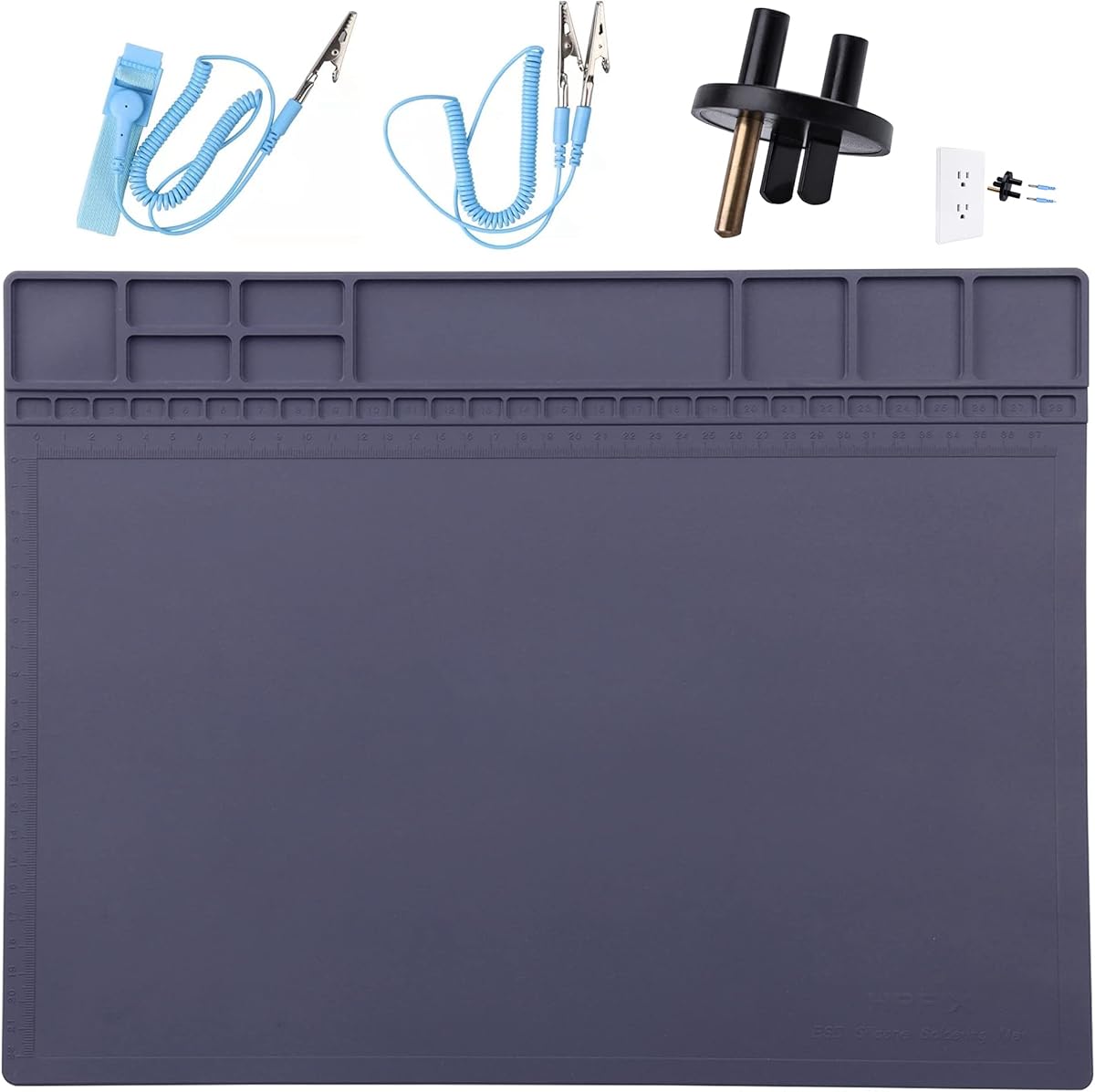
The HPFIX silicone repair mat pairs electronics work-area organization with strong heat resistance and a 4.7 rating. Its 15.9 by 12-inch size is compact enough for a regular desk while still providing a defined surface for phones, tablets, laptops, computers, and circuit-board repairs.
We may earn a commission when you buy through this link, at no additional cost to you.
Static protection is stated at 10^6 to 10^8 ohms, a range suited to dissipating charge rather than merely insulating the bench. Built-in rulers, compartments, and trays help separate screws, small parts, and tools, reducing the chance that a tiny component disappears during disassembly.
The silicone surface is listed as heat resistant to 932°F, giving it an advantage over ordinary rubber mats during prolonged soldering or hot-air work. It also includes a grounding plug, grounding cord, and ESD wristband. The principal compromise is its smaller footprint compared with the 24 by 36-inch and 36 by 24-inch options in this guide.
For a technician who values organization, soldering performance, and compact footprint, this is one of the strongest all-around choices. It is especially well suited to mobile-device and computer repair benches where small components must be sorted during teardown and reassembly.
A stated temperature tolerance of 932°F allows the mat to serve as a soldering surface without relying on a separate heat-resistant layer. That makes it convenient for repair workflows involving irons, hot-air stations, and delicate electronic assemblies.
Compartments and trays keep small fasteners within reach during disassembly. A built-in ruler also supports common measuring tasks, reducing the need to move away from the protected work area for basic layout or component checks.
We may earn a commission when you buy through this link, at no additional cost to you.
The StarTech anti static ESD mat is a broad, low-profile work surface with a 4.6 rating. Measuring 24 by 27.5 inches and only 0.1 inch thick, it can sit beneath a keyboard, CPU, VDT, or other desk equipment without creating a bulky barrier.
We may earn a commission when you buy through this link, at no additional cost to you.
Its static-dissipative design is intended to protect sensitive equipment differently from a fully conductive system. The stated design targets IBM and United States military static-control standards, giving it a professional profile for home offices, service benches, and technical workspaces where a broad, stable surface is valuable.
One important distinction is that the anti-static wrist strap identified as SWS100 is an additional accessory rather than part of the listed package. The mat also offers no built-in storage areas, so users who routinely sort dozens of tiny parts may prefer one of the silicone organizer designs.
This mat is best for buyers who prioritize a clean, low-profile area and established static-control positioning over bundled organization features. It also works well when the mat needs to support a more traditional computer-service layout.
The 0.1-inch profile keeps the mat functional beneath everyday desktop equipment. Its dimensions provide ample room for a keyboard and nearby components while preserving a relatively flat working environment.
The product description specifically references IBM and US military static-control standards. Buyers handling particularly sensitive equipment can use those claims as an additional point of comparison alongside the mat's low-profile layout.
We may earn a commission when you buy through this link, at no additional cost to you.
This KooMall kit delivers one of the largest dedicated work areas in the guide, measuring 36 by 24 inches. Its 4.6 rating reflects a favorable customer reception for a mat intended for soldering, PC building, assembly, and the repair of phones, tablets, watches, and circuit boards.
We may earn a commission when you buy through this link, at no additional cost to you.
Both sides are conductive, with stated surface resistance from 10^3 to 10^5 ohms. The front has an anti-slip dotted texture, and two 10mm male studs provide stable connection points for the included grounding cord, plug, and wrist strap.
The rubber material is described as non-toxic, flexible, durable, and easy to clean with water. Its principal drawback is physical rather than functional: a mat this large demands a broad workbench, and buyers with a small desk may find it unnecessarily difficult to deploy.
For a professional repair bench, shared electronics workspace, or dedicated PC-building station, the expansive area and built-in grounding points are compelling. It is less suitable for mobile technicians who need a compact, easily transported mat.
A 36 by 24-inch footprint can accommodate open computer cases, multiple circuit boards, hand tools, and parts at the same time. That coverage can reduce the need to rotate projects or transfer components onto unprotected surfaces.
Two mounted male studs provide dedicated points for the grounding cord. This arrangement is useful in a permanent bench where a repeatable connection point and a broad, stable surface are more important than compact storage.
We may earn a commission when you buy through this link, at no additional cost to you.
The Portable Anti Static Mat ESD Pad has the highest supplied customer rating in this roundup at 4.8. Its 16 by 24-inch format balances usable bench space with portability, and the included packaging makes it practical for technicians who work at different locations or set up temporary repair stations.
We may earn a commission when you buy through this link, at no additional cost to you.
The kit includes the mat, adjustable wrist strap, alligator clip, grounding cord, and a US-standard three-prong grounding plug. Its static-dissipative top layer is described as smooth and scratch resistant, while the non-slip underside helps the mat lie flat without curling.
The grounding system is less flexible outside the United States because the supplied plug is specifically designed for a standard US wall outlet. The mat also lacks built-in trays, so users who need extensive small-part organization may prefer a silicone model with dedicated compartments.
This is the most attractive all-in-one option for a mobile technician, home repairer, or learner who wants a credible grounding kit in one package. Its high rating, complete accessory set, and portable format make it an especially balanced recommendation.
A wrist strap, alligator clip, cord, and US-standard plug establish the basic elements of a static-control station. Buyers outside the United States should confirm plug compatibility or plan to use the mat with an appropriate alternative connection.
The scratch-resistant top and non-slip backing are intended to create a stable surface for phones, laptops, motherboards, and other devices. The mat can also be wiped with a damp cloth, simplifying maintenance between jobs.
We may earn a commission when you buy through this link, at no additional cost to you.
The Kaisi mat combines a generous 21.6 by 16.9-inch silicone surface with 48 built-in positions for screws and small parts. Its 4.4 rating reflects a practical design for assembly, repair, and soldering, with the added convenience of keeping tiny components classified throughout a job.
We may earn a commission when you buy through this link, at no additional cost to you.
The stated resistivity is 10^6 ohms, and the included grounding plug, wire, and wrist strap allow the surface to be connected for controlled static handling. The silicone construction is listed as heat resistant to 932°F or 500°C, corrosion resistant, and soft enough to shield the workbench during hot-tool use.
One packaging detail deserves attention: the grounding accessories are located in the middle of the paper tube, so buyers should check that area immediately after opening the package. The mat has no visible ruler feature, although its dedicated storage positions offer a larger organized area than many competing models.
This is a strong match for repairers who routinely open devices with many fasteners and need heat protection at the same time. It suits work on PCBs, phones, drones, computers, laptops, MacBooks, iPads, and Raspberry Pi projects.
The numbered or sectioned storage areas help separate removed screws and precision parts during disassembly. This is particularly useful for dense electronics where identical-looking fasteners can easily become mixed.
A stated 932°F tolerance allows the mat to serve as a direct soldering surface. Its soft silicone construction also helps protect the underlying bench from heat and incidental tool contact.
We may earn a commission when you buy through this link, at no additional cost to you.
The MYOYAY mat is a 118 by 23.6-inch rubber roll designed for workbenches, laboratory counters, studio surfaces, and electronics workstations. Its 4.2 rating and flexible cut-to-size format make it distinct from the smaller ready-to-use repair mats in this guide.
We may earn a commission when you buy through this link, at no additional cost to you.
The top layer has a stated surface resistivity of 2 × 10^6 to 10^8 ohms, while the bottom layer ranges from 8 × 10^3 to 10^5 ohms. Its double-layer structure is designed to resist acid, alkali, chemical flux, abrasion, oil, grease, and most solvents.
Buyers should account for the handling involved with a large rubber roll. The manufacturer notes that it may have a slight odor and should be flattened before use, and buyers will need suitable cutting tools and a safe way to unroll it. The listed 0.08-inch thickness also provides less surface height than some lower-profile options.
This mat is ideal for users who want to cover a long bench consistently, share one ESD surface across several stations, or cut a custom length for a specific workspace. It is less convenient for someone who needs a compact pad that can be stored in a small drawer or transported frequently.
The 118-inch length can cover a substantial workbench or be divided among separate benches. This flexibility makes the product useful for workshops, labs, production rooms, and home studios that require a consistent protected surface.
The double-layer rubber is designed for exposure to flux, solvents, oils, grease, acids, and alkalis. These properties make it a practical workbench layer for demanding repair environments where maintenance and cleaning are routine.
We may earn a commission when you buy through this link, at no additional cost to you.
This green 118 by 23.7-inch rubber ESD mat is built for long work areas and controlled electronic environments. Its 4.2 rating reflects the appeal of a durable, dual-sided surface that can cover substantial portions of a counter, production table, or repair bench.
We may earn a commission when you buy through this link, at no additional cost to you.
The upper layer is static dissipative, while the bottom is described as conductive black rubber. Both sides have stated resistance ranges reaching 10^8 ohms, and the embossed matte surface is intended to reduce glare and help prevent small parts from slipping.
The material is advertised as resistant to solder-iron deformation, solvents, flux, oils, grease, and other harsh chemicals. As with any oversized rubber roll, the user must have room to unroll and flatten it. The product also provides no built-in storage system and no stated wrist strap in the supplied information.
This mat is a strong option for electronic manufacturing, medical assembly, aerospace work, fiber optics, hard-drive handling, and general soldering stations. Its main advantage is the ability to establish a long, consistent ESD-controlled area rather than protecting a single compact repair zone.
A static-dissipative top and conductive underside create a layered approach to charge control. The design is particularly relevant to large work areas where components may travel across the mat during assembly or inspection.
The embossed finish is intended to reduce glare and improve part stability. That can make small components easier to see and handle during detailed circuit-board, phone, computer, or tablet work.
We may earn a commission when you buy through this link, at no additional cost to you.
The Bertech kit is a 16 by 24-inch gray ESD table mat with a 4.5 rating. Its single-layer homogeneous polymer construction provides a consistent surface for mobile-phone and computer repairs, electronic assembly, server setup, fiber optics, hospital equipment, aerospace assembly, and solar-industry work.
We may earn a commission when you buy through this link, at no additional cost to you.
The mat is 0.094 inch thick and has a stated surface resistivity of 10^9 to 10^10 ohms. It comes with an anti-static wrist strap and grounding cord, and a built-in snap makes it ready to use with minimal assembly.
Its listed service-temperature range is minus 20 to 160 degrees Fahrenheit, which is considerably narrower than the heat-resistance claims associated with the silicone soldering mats in this guide. It is also resistant to degradation from organic and inorganic acids, reducing agents, detergent solutions, and alcohols, but it does not include small-part compartments.
This product is best for general static-control work where a consistent homogeneous surface and included grounding accessories are priorities. Technicians performing extended, high-temperature soldering should choose a model explicitly designed for that thermal exposure.
Unlike a multi-layer pad, the mat uses one homogeneous polymer mixture with ESD properties throughout. That construction can simplify material selection for work surfaces where consistency across the entire panel is important.
A wrist strap, ESD grounding cord, and built-in snap are included, so the kit supports a controlled setup with minimal assembly. It is a practical bundle for technicians who want the essential grounding pieces already in the box.
We may earn a commission when you buy through this link, at no additional cost to you.
This 24 by 36-inch green mat covers a standard full-size bench area and uses synthetic NBR rubber in a two-layer design. It is intended for electronics work requiring a broad, stable surface, with a static-dissipative top layer and a black conductive bottom layer.
We may earn a commission when you buy through this link, at no additional cost to you.
The smooth semi-gloss surface resists hot solder and chemicals, while the non-skid construction helps the mat remain in place. The package also includes a wrist strap and grounding component, allowing the mat to function as more than a passive work surface.
No numerical customer rating was supplied for this product, so it is not ranked on that basis. Its 24 by 36-inch footprint may also be more than a mobile technician needs, and there are no built-in compartments for sorting fasteners.
The mat is best suited to a permanent home or professional bench where full-width protection matters. Buyers seeking a smaller portable solution, a silicone organizer, or a documented high-temperature rating should look elsewhere in this guide.
A 24 by 36-inch surface can hold tools, instruments, boards, and devices at the same time. It is a familiar bench size for users who want a broad dedicated area rather than a small pad for occasional tasks.
The dissipative top and conductive bottom provide the core static-control structure. A non-skid semi-gloss surface adds stability and is specified to resist hot solder and chemicals encountered in routine repair work.
We may earn a commission when you buy through this link, at no additional cost to you.
Choosing an ESD anti static desk mat requires balancing electrical performance, usable area, grounding compatibility, heat resistance, portability, and organization. The right choice depends on the devices you service, the tools you use, and whether the mat belongs on a fixed bench or travels with you.
An effective ESD mat should manage charge across the work surface rather than merely appear rubbery or antistatic. Review the stated surface and volume resistivity, and look for a product description that distinguishes a static-dissipative top layer from a conductive layer. Those resistance figures provide a more useful basis for comparison than vague antistatic language.
Choose based on documented electrical characteristics and the intended electronics work. Do not assume that a mat is interchangeable with every grounding system without confirming the connection method.
A mat may be static-dissipative on its own, but a controlled workstation commonly includes a proper connection to ground. Look for a wrist strap, grounding cord, common-point cable, snap, stud, or plug that matches the layout of the workbench. Products with a US-standard three-prong plug may require a different connection method in other countries.
Match the included hardware to the intended workstation rather than assuming every grounding accessory is universal. A complete, clearly explained kit usually creates fewer setup ambiguities.
Compact mats around 16 by 12 inches suit phones and small components, while 16 by 24-inch and 21 by 16.9-inch models support larger devices and better organization. A 24 by 36-inch mat fits a standard permanent bench, and long rolls can cover multiple work zones or be cut to a custom length.
Measure the available bench before buying. A larger mat may protect more projects at once, but it also requires more storage, handling, and cleaning.
Soldering and hot-air work create a meaningful thermal load. Silicone mats in this guide are specifically described as resistant to 932°F, while other rubber products emphasize high-temperature performance without the same numerical claim. Check the stated temperature limit against the tools and procedures used in your work.
For frequent soldering, choose a product explicitly designed for high-temperature contact. For occasional inspection or assembly, room-temperature durability and ESD performance may be more important.
Built-in trays, screw positions, compartments, and rulers are especially useful during device teardown. The HPFIX and Kaisi silicone models provide dedicated storage, while large plain mats emphasize uninterrupted working area. Consider whether small parts are handled often enough to justify sacrificing some open surface for organization.
For heavy repair work, organized compartments can reduce lost fasteners and improve workflow. For large builds, a clear, uninterrupted surface may be the better priority.
Portable kits may include a roll tube, folding design, or relatively compact footprint suited to field repair. Large rubber rolls require significant storage and may need time to flatten. If the same mat moves between customers, a manageable size and simple transport method are important.
Choose a portable model for mobile work and a large bench mat for a fixed station. A mat that is difficult to store may end up being used less often than intended.
Look for resistance to solder, flux, solvents, oils, grease, acids, alkalis, and abrasion when those substances are likely in the workspace. A smooth or embossed surface can simplify cleaning, while textured rubber may require more attention around debris. Non-slip backing or a non-skid underside helps keep the mat stable during detailed work.
Match the material to the messiest part of your workflow. Easy-clean properties are valuable only when the surface can withstand the tools, chemicals, and heat used in the actual bench environment.
Begin by placing the mat flat on a stable, clean work surface. For a roll product, unroll it fully and allow it to flatten before use. Confirm that the mat is not wrinkled or folded beneath the active work area, and keep the surface free of conductive dust, metal fragments, and moisture.
Next, connect the grounding hardware according to the included instructions. Attach the wrist strap before handling a static-sensitive device, route its cord so it does not restrict movement, and make sure the mat's ground connection is secure. A mat with built-in compartments should be oriented so parts can be placed without contacting conductive contaminants.
During work, keep the protected surface as the main landing area for boards, chips, phones, and other sensitive items. Remove the wrist strap before leaving the grounded station, avoid cleaning the mat while it is connected, and follow the product instructions for approved cleaners. Roll or store the mat only when it is dry, clean, and free of sharp tools that could damage the surface.
An ESD anti static desk mat provides a controlled work surface for handling electronic components that can be damaged by electrostatic discharge. It is commonly used for phone, laptop, circuit-board, computer, drive, and electronic-assembly work. A properly grounded mat helps manage charge while a wrist strap protects the person handling the device.
No. A mat can provide effective static control without being designed to tolerate direct soldering-tool heat. Look for a stated heat-resistance rating, especially when using a soldering iron or hot-air station continuously. The silicone mats in this guide are specifically described as heat resistant to 932°F, while other products have different thermal specifications.
A complete static-control workstation normally benefits from both a mat and a correctly connected wrist strap. The strap links the person handling the equipment to the controlled grounding system, while the mat manages charge across the work area. Confirm that the included cord, snap, stud, or plug fits the user's grounding arrangement.
Choose a smaller mat for phones, compact boards, and space-limited desks, or a larger surface for computer cases, multiple tools, and active repair benches. A 16 by 24-inch pad offers a practical middle ground, while 24 by 36-inch and 36 by 24-inch models suit permanent workbenches. Long rolls are useful when a user wants to cover an entire table.
Some roll-style products are explicitly intended to be cut according to the user's work area. The MYOYAY roll is described as cuttable for individual studio countertops or laboratory desktops. Buyers should confirm the product's installation guidance and use suitable tools before cutting, and they should preserve the original electrical characteristics of the selected section.
A dissipative surface allows controlled charge movement across the work area, while a conductive layer helps discharge accumulated electricity. Several products in this guide combine both structures in a multi-layer design. The distinction matters because a surface described as antistatic may not provide the same grounding behavior as a complete layered system.
Follow the manufacturer's guidance, especially for products with grounding accessories, silicone compartments, or special surface finishes. Many options can be wiped with a damp cloth or cleaned with water, while chemical exposure should remain within the manufacturer's stated resistance. Let the mat dry fully before reconnecting it to ground or returning it to storage.
The Portable Anti Static Mat ESD Pad stands out for its high rating, complete grounding package, and portable format. The HPFIX silicone mat is a strong alternative for technicians who prioritize heat resistance and built-in organization, while the StarTech mat offers a polished, low-profile surface for a permanent computer-oriented desk.
For large professional benches, the KooMall and 24 by 36-inch mats provide extensive working areas, and the long rubber rolls suit buyers who want to protect multiple zones or customize the dimensions. The most important selection criteria remain documented static performance, a compatible grounding arrangement, the needed work area, and suitability for the temperature and chemicals used in the workspace.
Before purchasing, compare the current listing, included accessories, dimensions, and electrical specifications with the intended bench. Ratings and customer feedback can change over time, while pricing and availability also fluctuate, so checking the latest product page ensures that the selected mat still fits the planned work.