
Jojomis 2.1X Max TV Headband
4.0Editor score
2.1x magnification
Easy-grip focusing wheel
Portable headband design
Recommended three-meter distance
Useful beyond television
Magnifying glasses for watching TV can make distant screens easier to see; this expert guide compares magnification, focus, comfort, field of view, and fit.
Magnifying glasses for watching TV are designed to enlarge distant images, reduce the effort required to focus on a screen, and make programming more accessible for people with low vision. The most useful pair balances magnification with a broad viewing area, adjustable focus, a comfortable frame, and optics that remain clear without excessive distortion.
This guide compares ten full-frame, headband, and clip-on magnifiers using the specifications and customer feedback supplied with each product. It examines magnification, working distance, focus controls, field of view, weight, lens design, intended users, and important limitations, particularly where macular degeneration may affect performance.
Each review identifies the feature that makes a product most useful and explains where it may fall short. The selections range from basic adjustable designs to dedicated television viewers with objective-lens focus controls. Product listings and availability can change, so readers should confirm current specifications and compatibility before purchasing.
4.0Editor score

5.0Editor score

3.9Editor score
The comparison below highlights the principal differences among the ten options, including magnification strength, viewing style, focus range, physical comfort, and the degree of prescription flexibility.


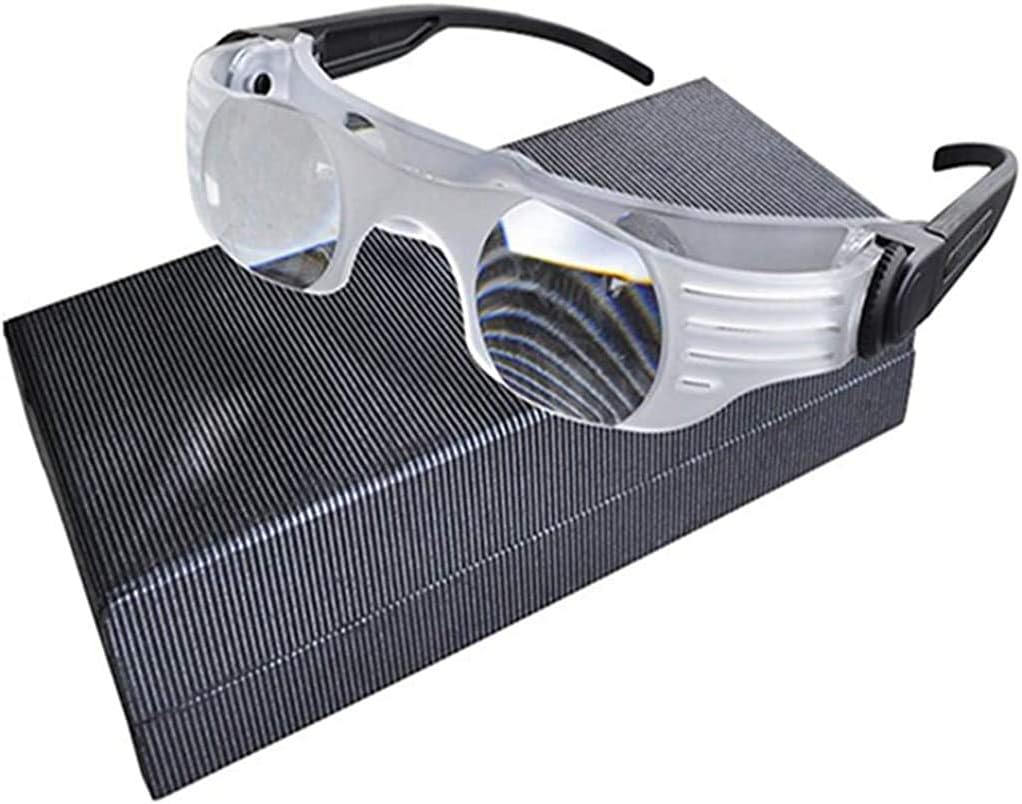


The 2.1X Eschenbach Max TV Glasses Distance Viewing by MAGNIFYING AIDS is a dedicated Galilean television viewer with a customer rating of 3.5. Its strongest combination is 2.1x magnification, a bright 20-degree field of view, and independently focusable objective lenses. Rather than functioning as a simple close-up magnifier, it is built to make a distant television screen appear larger and easier to inspect.
We may earn a commission when you buy through this link, at no additional cost to you.
The objective lenses can compensate for plus or minus 3D of spherical correction, which may help users whose two eyes require different adjustments. Focal length can also be changed from 10 feet to infinity. The frame weighs only 49 grams, and flexible plastic temples should be more comfortable during long viewing sessions than a rigid, heavy clip-on arrangement.
The frosted objective housing is a practical touch because it reduces distracting reflections while preserving the open viewing experience. That makes the glasses useful for television, sports, theater, and other distance-viewing activities. The main reservation is the 3.5 rating, which suggests that comfort, focus, or results may vary depending on the wearer's vision and viewing setup.
This is a strong choice for a buyer who values dedicated distance optics, a relatively broad field, and per-eye adjustment more than portability. It is less appropriate for someone with severe vision loss or advanced macular degeneration, for whom telescopic television glasses may not provide the expected benefit. For users who can work with the adjustment process, it remains a well-specified traditional option.
The Galilean design magnifies a distant screen without requiring the user to hold a magnifier in place. A 20-degree field provides room to follow moving subjects, subtitles, and on-screen graphics while retaining a glasses-like appearance.
Independent objective controls can address differences in spherical correction and fine-tune the apparent focus. This is particularly useful when both eyes do not respond identically or when the television sits at a different distance than the default setting.
We may earn a commission when you buy through this link, at no additional cost to you.
The HongDee-style dual-lens television glasses have a 2.4 rating, making this a polarizing choice rather than a universal recommendation. Their most notable specification is a stated 1.6- to 65-inch working-distance range, suggesting that the glasses can serve different screen sizes and room layouts. The product uses a curved lens solution rather than the more conventional spherical design.
We may earn a commission when you buy through this link, at no additional cost to you.
Adjustment is important because people with low vision do not all experience distance viewing in the same way. The supplied information specifically notes that users need to adjust the glasses according to their personal vision. A light, compact frame also makes these glasses less cumbersome than a full-size telescopic headset and easier to move between chairs or viewing locations.
There are meaningful limitations. The listing warns that the glasses may not work for some users because of personal vision status and the effects of macular degeneration. They are also intended for distance viewing and are not suitable for reading material closer than 0.5 meters, or 1.6 inches. The low rating reinforces the need for cautious expectations and a clear return policy.
Consider these glasses if you want a portable distance magnifier and understand that comfort and effectiveness will depend on your particular vision. They may be a practical first option for mild low vision, but the limitations make them unsuitable as a universal solution for severe visual impairment. A vision-care professional can help determine whether telescope-style magnification is appropriate.
The stated 1.6- to 65-inch range allows the same pair to accommodate television screens of several sizes. That versatility makes the design useful in homes where the main display or secondary monitor may differ considerably in dimensions.
The compact, lightweight construction is easy to store and less noticeable during use than a bulky telescopic headset. Its advantage is convenience, although the lower customer rating suggests that the optical experience may not satisfy every buyer.
We may earn a commission when you buy through this link, at no additional cost to you.
The Jojomis 2.1X Max TV Headband is the strongest budget-oriented selection in the list, with a 4.0 customer rating. It uses a wearable headband rather than conventional temples and provides 2.1x magnification, making a television screen appear roughly twice as large. An easy-grip focusing wheel allows the user to refine the image without handling a separate magnifier.
We may earn a commission when you buy through this link, at no additional cost to you.
The supplied information identifies a recommended observation distance of three meters and a refractive range from 0 to -3, indicating that it is intended primarily for people with myopia. The broad visual range and natural distortion are intended to reduce eye fatigue while allowing the user to move in and out of the enlarged image. This is more flexible than a fixed-focus magnifier.
The headband format is portable and does not require temple arms, which can be convenient for people who dislike conventional eyewear. It also allows the lenses to be positioned relatively close to the eyes, potentially helping the user see more of the screen without a long telescope-like extension. The trade-offs are that a headband can interfere with hair, may feel different than glasses, and does not provide the more sophisticated focus correction described for some Eschenbach models.
This is an appealing choice for budget-conscious buyers who want hands-free 2.1x magnification and an easy adjustment process. It is also listed for reading, research, electronics repair, and jewelry appraisal, adding value beyond television. Users should verify the recommended viewing distance and ensure that the headband feels secure before settling in for a long session.
The focusing wheel offers a straightforward way to tune the magnification while wearing the glasses. It avoids the need to remove the device, find a separate control, and refocus from scratch each time the viewing position changes.
The same magnification can assist with fine-detail work, reading, research, and repair tasks. That broader role makes the headband more useful when it is stored near a work area as well as beside the main television.
We may earn a commission when you buy through this link, at no additional cost to you.
The 2.1X Hyperopia Magnifying Glasses for TV Viewing are presented as a lightweight, portable option for distance viewing. They provide 2.1x magnification and are described as ergonomic for extended wear. Unlike several specialist telescope-style products in this list, the supplied information does not provide a detailed focus range, field-of-view measurement, or independent prescription adjustment.
We may earn a commission when you buy through this link, at no additional cost to you.
The most appealing qualities are portability and comfort. A compact frame can be stored near a television, carried in a bag, or used for outdoor activities, while the stated ergonomic shape suggests that the manufacturer has considered long viewing sessions. The intended 2.1x magnification is also more moderate than the 4x and 8x products, which may make the image easier to scan without an extreme reduction in context.
A key drawback is the absence of a numeric customer rating and the limited technical detail. The description refers to clear vision and reduced eye strain, but it does not explain whether users can adjust the focal length, compensate for different prescriptions, or lock the optics for a particular television distance. Those details matter when magnification introduces a depth-of-field problem.
This product is best suited to buyers who prioritize a light, conventional-looking design and need one magnification level rather than advanced prescription controls. It may be especially useful for hyperopia-related viewing difficulty, as the title indicates. Before buying, confirm that 2.1x is sufficient for the intended screen distance and consider whether adjustable focus would be beneficial.
The ergonomic design is the central selling point. A lighter, less bulky pair may be easier to wear through an entire film or news broadcast, which is particularly valuable when magnification is being used as a routine viewing aid.
The compact profile suits travel, outdoor viewing, and storage in multiple rooms. It is a straightforward option, although buyers who need prescription flexibility may prefer a model with explicit objective-lens controls.
We may earn a commission when you buy through this link, at no additional cost to you.
The Low Vision Magnifier Glasses Far View Magnifier Telescope Watching TV has a 3.2 customer rating and shares a similar design language with the other HongDee-style product. Its curved lens solution is intended to distinguish it from conventional spherical lenses, while the advertised 1.6- to 65-inch working-distance range supports use with different television and monitor sizes.
We may earn a commission when you buy through this link, at no additional cost to you.
Adjustment is necessary because the product is designed to accommodate differences in individual vision. Its light weight and compact structure are practical advantages over heavier telescope systems, particularly for a user who wants to put the glasses on for a program and remove them afterward. The far-view format also makes it more specialized for a television than a general close-up magnifier.
The 3.2 rating indicates mixed experiences, and the supplied information does not provide enough detail to judge optical consistency, exact field of view, or the type of focus control. Curved lenses may be comfortable once properly adjusted, but adjustment can take time. Users with substantial or uneven refractive errors may need a more explicitly engineered focusing system.
This is a reasonable portable option for mild-to-moderate distance-viewing needs, particularly for buyers who want one device to handle a variety of screen sizes. It is less compelling for someone seeking a refined optical system with independently adjustable objective lenses. Anyone with advanced age-related eye disease should discuss telescope magnification with a vision-care professional before relying on it.
The curved lens design is intended to improve the viewing experience beyond what a standard spherical lens offers. Proper positioning and focus are still important, so users should expect a short adjustment period when first wearing the glasses.
The light frame is easy to keep near the main television and less cumbersome than a full telescopic unit. It also avoids the need to hold a handheld magnifier, which can be tiring over a long program.
We may earn a commission when you buy through this link, at no additional cost to you.
The Max TV Clip On Magnifying Glasses offer 2x magnification in a compact clip-on format and carry a 3.9 customer rating. They are designed for users who already wear prescription glasses and want a telescopic television aid without replacing their everyday eyewear. The system uses an aspherical lens made from PXM optical resin and a stainless-steel body.
We may earn a commission when you buy through this link, at no additional cost to you.
The stated focal length begins at approximately 6.6 feet, or 2 meters, and extends farther. This makes the clip-on relevant for a wall-mounted television viewed from across a room. Its compatibility with pupillary distances from 60 to 68 millimeters helps it fit a broad range of existing frames, while the 28.6-gram weight keeps the added hardware manageable.
The main limitation is structural: it must physically attach to the user's glasses, and correct positioning is essential. A 2x increase may be sufficient for many television situations, but it will not provide the stronger enlargement offered by 4x or 8x products. The aspherical lens, optical resin, German origin, and included case nevertheless suggest a more refined build than many basic clip-on magnifiers.
This is the best premium choice for a user who values established optical specifications, metal construction, and the convenience of retaining prescription glasses. It is especially suitable when the television is at least several feet away. Buyers should confirm that their frame shape and pupillary distance allow the clip-on to sit level and that 2x magnification meets their viewing needs.
The clip-on format adds distance magnification without requiring the user to swap out corrective eyewear. It is a practical choice for people who need their regular glasses for reading but want more magnification only while watching television.
An aspherical lens can help control aberrations compared with a simple spherical lens. The PXM optical resin and stated focus range make this option appealing for buyers who prioritize optical design over the very high magnification offered by generic wearable magnifiers.
We may earn a commission when you buy through this link, at no additional cost to you.
The Adjustable Eyeglasses 8X Magnifying Glasses provide the highest stated magnification in this comparison, with a customer rating of 3.4. They are designed as hands-free eyewear for seniors, television viewing, reading, fishing, crafting, and other tasks that require a closer look. An easy adjustment mechanism lets the user tune the focus for different applications.
We may earn a commission when you buy through this link, at no additional cost to you.
The large nose pad distributes contact over a broader area, which may improve stability when looking downward at fine details. A frosted objective housing reduces distracting reflections, and the description highlights performance in dim conditions. The large magnification can make very small details visible, particularly when reading labels or following a fishing line.
Television is a different challenge. At 8x, the visible area becomes much smaller, and moving between channels or following an entire screen can require repeated scanning. The moderate rating also indicates that the experience may vary according to the user's eyesight, the intended distance, and the quality of the final focusing adjustment. This is not the most natural option for a wide television picture.
Choose these glasses if your priority is seeing very small objects and you want a single wearable device for several close-detail activities. They are less suitable for viewers who want to scan a whole screen comfortably. For television, the 2x-to-4x products generally offer a more balanced relationship between enlargement and viewing context, while this model is strongest for focused details.
The 8x setting is the defining feature and is intended for fine details that are difficult to resolve with ordinary vision. It can be valuable for hobbies and detailed tasks, although users need to adjust their head position because the field of view is limited.
The large nose pad and eyeglass-style frame help keep the lenses aligned while both hands remain free. This makes the product useful when the user must handle fishing gear, craft materials, or another object while examining it closely.
We may earn a commission when you buy through this link, at no additional cost to you.
The 2.1X Eschenbach Max TV Glasses Distance Viewing has a 3.4 customer rating and is engineered for wearers with binocular pupillary distances of 60 to 68 millimeters. Like the other Eschenbach television model, it uses a Galilean design, 2.1x magnification, a 20-degree field of view, and objective lenses that can be focused independently.
We may earn a commission when you buy through this link, at no additional cost to you.
The individual focus controls can compensate for plus or minus 3D of spherical correction and adjust the focal length from 10 feet to infinity. This gives users more control than a fixed-distance magnifier. The molded bridge is described as free of sharp edges, improving comfort for longer periods, while the frosted objective housing helps limit reflections.
Compatibility is the principal constraint. The stated pupillary range excludes people whose measurements fall outside 60 to 68 millimeters, and the manufacturer notes that the glasses may not work for individuals with age-related macular degeneration or other severe vision loss. Magnification cannot correct damage to the central visual field, so an eye-care professional's guidance is especially relevant for advanced conditions.
This model is a good option for someone who has a compatible pupillary distance, a relatively stable prescription, and a television at or beyond 10 feet. Its fine-tuning capability and comfortable bridge make it more sophisticated than a basic fixed magnifier. If the wearer falls within the stated limitations, the product offers a balanced mix of magnification, field size, and personalization.
The plus or minus 3D objective adjustment can compensate for spherical differences that would otherwise make the image feel uneven. It also offers a practical way to tune the television for a particular room and seating position.
A molded bridge without sharp edges reduces pressure points around the nose. That design is particularly helpful for users who plan to wear the television glasses for extended viewing sessions rather than occasional quick checks.
We may earn a commission when you buy through this link, at no additional cost to you.
The Adjustable 4X Magnifying Eyewear offers a middle ground between conventional 2x television glasses and very high 8x magnifiers. It includes an easy-grip focusing wheel and individually focusable objective lenses, allowing the wearer to refine the image and compensate for plus or minus 3D of spherical correction.
We may earn a commission when you buy through this link, at no additional cost to you.
A focal length beginning at 10 feet makes it plausible for a television viewed across a room. The 85-degree nose bridge and molded design are intended to reduce pressure during extended wear, while the frosted objective housing minimizes distracting reflections. The product is also marketed for reading, crafting, fishing, and other detailed activities, so it is not limited to a single screen size.
The supplied listing does not include a numeric customer rating, and the product title is truncated in the source information. It also does not state a measured field of view, which is an important consideration at 4x. A strong enlargement narrows the visible area, and the degree of that narrowing will affect how comfortably a user can follow a full television scene.
This product is best for buyers who want more enlargement than 2x but do not need the extreme enlargement of an 8x model. Its independently adjustable objectives and broad nose bridge are meaningful strengths for long sessions. People with advanced macular degeneration should obtain professional advice, since no magnification level can restore a missing area of central vision.
The 4x setting is intended to reveal more detail than standard television magnifiers while remaining less restrictive than an 8x device. This middle-ground power is useful when subtitles, faces, or small on-screen graphics need extra size.
The 85-degree bridge is designed to spread contact across a larger area, improving stability and comfort. Meanwhile, the frosted objective housing reduces reflections that could otherwise obscure the magnified image during long viewing periods.
We may earn a commission when you buy through this link, at no additional cost to you.
The Eschenbach MaxTV Glasses 2.1x are the strongest overall recommendation in this guide, combining a 5.0 customer rating with a well-rounded set of television-viewing features. They magnify screens and distant objects by 2.1x, making content appear larger and sharper from 10 feet to infinity. A 20-degree field of view balances enlargement with enough surrounding area to follow a program naturally.
We may earn a commission when you buy through this link, at no additional cost to you.
The most useful feature is adjustable focus for each eye across plus or minus 3 diopters. This allows a wearer to fine-tune the image independently, compensating for spherical differences without needing a custom prescription for the television device. Flexible temples and a weight of only 1.7 ounces support comfortable, hands-free wear, and the supplied protective case makes storage straightforward.
The design is also more versatile than a television-only product because it can be used for sports, theater, and other distant viewing. The principal caution is that no telescope-style magnifier can overcome every form of visual impairment, particularly when central vision is significantly affected. Users should also allow time to learn the focus controls and determine the correct setting for their room.
This is the best pick for someone who wants a balanced television magnifier with independently adjustable focus, a broad viewing area, and a lightweight full-frame design. It works especially well for people who can benefit from optical correction but do not need the extreme enlargement of 4x or 8x glasses. The included case and flexible fit add practical value for regular use.
Independent plus or minus 3D controls let each eye be tuned for a sharper image. The 10-foot-to-infinity range also makes the glasses adaptable to different television positions rather than locking the wearer into one fixed distance.
The flexible temples and 1.7-ounce weight reduce the burden of extended wear. A 20-degree field provides useful context around the magnified center, which is important for following movement, reading captions, and viewing live sports.
We may earn a commission when you buy through this link, at no additional cost to you.
The right television magnifier depends on your prescription, seating distance, tolerance for peripheral loss, and need for adjustment. These factors are more important than choosing the largest available magnification.
In short, begin with moderate magnification and increase only if you cannot comfortably resolve the details that matter to you.
Choose a model whose stated focus range includes the distance from your eyes to the screen, while allowing room to move closer or farther if necessary.
Prefer independently adjustable optics when your prescription varies, and make sure the controls are easy to reach and understand before committing.
A wider field generally supports relaxed television viewing, while a narrow field can be more useful when you only need to inspect a small, specific detail.
Choose the style that feels stable and pressure-free during a trial session, and verify that it can accommodate your prescription, face shape, and normal seating position.
Do not treat magnification as a substitute for an eye examination, and seek professional advice when central vision is significantly impaired.
Choose a model with a secure case or stable storage location, and clean the lenses only with a method approved for their optical material.
Begin by measuring the distance from your usual viewing position to the television and setting up the screen as centrally as possible. Put on the glasses or headband, then use the individual focus controls or focusing wheel to bring the picture into clarity. Make small adjustments rather than changing several settings at once, and move your head gently to locate the center of the magnified image. Allow a few minutes to adapt to the enlarged field and altered depth of focus.
Use the device only in the stated working range. Do not try to focus by moving extremely close to the television or by wearing high-power glasses that were not designed for that distance. If a full-frame model feels unstable, adjust the temples and bridge rather than forcing the lenses into a different position. Clip-on users should ensure that the unit is level and seated firmly, while headband users should check that it does not shift or press uncomfortably against the hair.
Store the magnifier in its case or in a clean, padded location away from children and pets. Clean the lenses with a soft microfiber cloth and avoid abrasive cleaners, solvents, and ordinary paper towels, which may scratch the coating. Check the focusing mechanism periodically for looseness, and avoid placing the optical surfaces face-down. If the image becomes cloudy, uneven, or impossible to focus, stop relying on the device and have the lenses or mechanism inspected.
No. TV magnifying glasses are designed primarily to enlarge images at a distance, while reading magnifiers are intended to bring nearby print closer. Some general-purpose wearable magnifiers support both tasks, but their stated working distances and field of view may make them less comfortable for television. Always check whether the product is explicitly designed for distance viewing before using it with a screen.
For most users, 2x to 2.1x offers a practical balance between visible detail and the amount of the screen that remains visible. A 4x model may help when smaller captions or graphics are difficult to read, although it reduces the viewing area. An 8x device is generally better suited to inspecting tiny objects than scanning an entire television picture.
They may help some people enlarge visible details, but they cannot restore central vision that has been damaged. Several products in this guide explicitly warn that they may not work for advanced macular degeneration or severe vision loss. An eye-care professional can determine whether telescope magnification is appropriate and recommend a safer alternative if it is unlikely to provide meaningful benefit.
That depends on the design. The full-frame Eschenbach and Jojomis models are worn as standalone eyewear, while the Max TV Clip On is designed to attach to an existing pair of prescription glasses. Users of standalone models should consider whether their prescription can be handled by the available focus adjustments. A clip-on buyer should verify frame shape and pupillary-distance compatibility.
Magnification enlarges optical imperfections as well as useful details, and viewing through the edge of a lens can introduce additional distortion. Focus, positioning, and the quality of the optics all affect the result. A broad-field, aspherical design may perform better at the edges than a basic high-power magnifier, but no lens creates a perfectly flat image across every viewing angle.
Use the working distance specified for the product. Several Eschenbach models can focus from 10 feet to infinity, and the clip-on model starts at approximately 6.6 feet, or 2 meters. If the picture is unclear, confirm that the television is within the stated range and adjust the individual focus controls before moving the screen or chair.
Clip-on magnifiers are convenient for people who already wear prescription glasses and do not want to switch frames. Full glasses can offer a more integrated appearance, flexible temples, and purpose-built television optics. The clip-on must sit correctly on the user's frame, so its stability and alignment can be less convenient on incompatible eyewear.
Only if the product supports close-range viewing. The HongDee television model specifically states that it is not suitable for reading closer than 0.5 meters, or 1.6 inches. Products marketed for reading, fishing, crafting, and television may support both, but you should adjust the focus carefully and avoid forcing a distance-focused lens into close use.
The Eschenbach MaxTV Glasses 2.1x are the strongest overall choice because they combine independent focus adjustment, a 20-degree field, a 2.1x image, and a lightweight full-frame design. The Jojomis 2.1X headband stands out as the best budget option, while the Max TV Clip On offers a premium approach for wearers who want to keep their existing prescription glasses.
Prioritize the viewing experience rather than the largest number on the package. Confirm the working distance, assess whether the field is wide enough, and check whether the focus controls can address your prescription differences. A 2x device used correctly is generally more satisfying for television than an 8x device that makes the screen difficult to scan. For advanced vision loss, obtain guidance from a qualified low-vision professional.
Before ordering, review the current product listing carefully, confirm the fit and intended screen distance, and consider a return option that allows time to adjust the focus. Product specifications and availability can change, so the latest listing should remain the final source for compatibility, included accessories, and current terms.


