
Justrite Type II Gasoline Safety Can
4.6Editor score
Patented controlled-flow manifold
Flexible metal dispensing hose
Stainless steel flame arrestor
Multiple safety certifications
Our All Metal Jerry Can guide compares ten steel fuel containers for capacity, safety, fuel compatibility, pouring control, durability, and everyday portability
An all metal jerry can is more than a rugged alternative to plastic fuel containers. The right steel model combines secure closure, controlled dispensing, corrosion resistance, and enough capacity for the fuel you regularly move. Safety approvals, flame arrestors, and compatible openings matter just as much as a strong body and comfortable handle.
This guide compares ten metal jerry cans, safety cans, and fuel containers using the information supplied for each product. It covers capacity, steel construction, intended fuel, approval standards, closure systems, portability, and dispensing designs, helping readers distinguish compact 2-gallon models from full-size 5-gallon and 20-liter options.
Each review explains the strongest reasons to consider a particular model and its practical trade-offs. The three featured picks emphasize overall versatility, controlled premium dispensing, and straightforward value, while the complete list includes gasoline, diesel, and kerosene containers for workshops, farms, vehicles, and emergency preparedness. Prices and availability can change.
4.6Editor score
4.4Editor score

4.5Editor score
The comparison below places all ten containers side by side, showing their principal capacity, construction, safety, dispensing, and intended-fuel characteristics so buyers can quickly identify the most suitable metal option.


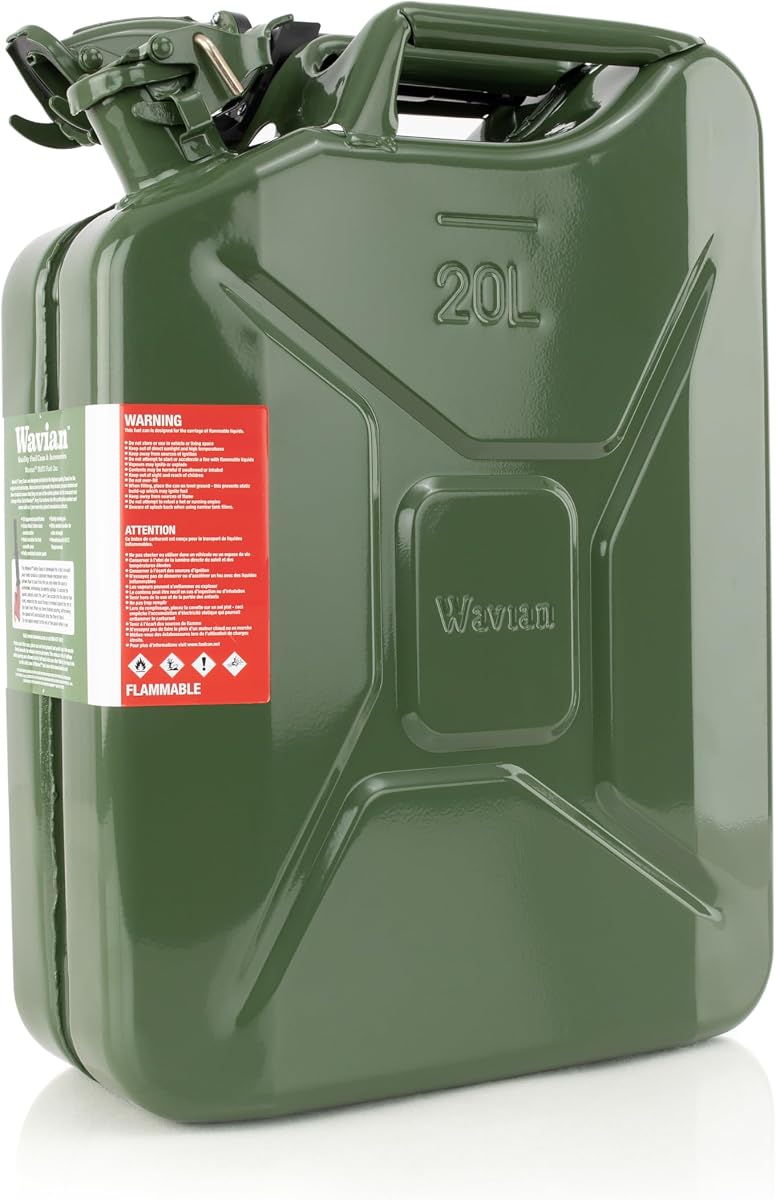
The Wavian USA Authentic NATO Jerry Can and Spout System combines a familiar military-style profile with practical fuel-transfer hardware. It holds 5 gallons, or 20 liters, and receives a 4.4 rating. Its defining advantages are the 0.9mm cold-rolled steel body, anti-corrosive coating, bayonet-style quick-release nozzle, and safety lock.
We may earn a commission when you buy through this link, at no additional cost to you.
Capacity is the first reason to notice this model. A full container can cover substantial equipment refills without repeatedly handling smaller cans. The locking spout is intended to contain liquids securely, while the steel shell and protective coating are designed to withstand demanding storage and travel conditions. The listed EPA and CARB compliance makes this a more regulation-conscious option than a basic utility container.
The main trade-off is that the product information gives fewer details about dispensing precision than the premium Justrite Type II model. It is positioned around secure, high-capacity transport rather than a flexible hose and trigger-controlled pour. The bayonet nozzle also requires more deliberate handling compared with a simple open spout, although that additional mechanism supports spill reduction during storage.
This is our Editor's Choice because it combines generous capacity, robust steel construction, environmental compliance, and a secure locking delivery system. It suits overlanders, farm operators, workshop users, and emergency-prepared households who want one substantial container for gasoline or compatible fuel. Buyers prioritizing the finest flow control may prefer a Type II safety can, while most others will find this model balanced and unusually practical.
The 20-liter capacity reduces the number of trips needed for tractors, generators, outdoor equipment, or emergency reserves. Its 0.9mm cold-rolled steel construction and anti-corrosive coating are intended to withstand repeated handling and harsh storage conditions.
The bayonet-style quick-release nozzle connects securely to the can, while the safety lock helps prevent accidental operation. This design is especially attractive when a container must remain stable in a truck bed, trunk, rack, or equipment area.
We may earn a commission when you buy through this link, at no additional cost to you.
This 5.3-gallon steel fuel can is a large-capacity utility container designed for trucks, SUVs, off-road racks, workshops, and farms. It receives a 4.0 rating and emphasizes cold-rolled steel, a rust-resistant coating, a precision-sealed locking cap, and a heavy-duty gasket. Its rectangular form is as important as its material.
We may earn a commission when you buy through this link, at no additional cost to you.
The extra fraction of a gallon beyond a conventional five-gallon can can be useful when transferring enough fuel for a generator, tractor, mower, or other machine. The integrated handle is shaped to make carrying and pouring more manageable, while the classic rectangular profile is easier to arrange than a round container. Compatibility with standard transfer accessories broadens its practical appeal.
Compared with certified safety cans, this model offers fewer documented protections. No specific OSHA, NFPA, FM, UL, EPA, or CARB approvals are stated in the supplied information. Its listed leakproof security seal and sealing cap help contain liquid, but buyers handling flammable liquids in regulated workplaces should verify the applicable certification requirements before purchasing.
The Festisoul is a good choice for individuals who need a large, portable steel reservoir and value straightforward locking-cap architecture. It is less compelling as a formal industrial safety can because the product data does not list recognized safety certifications. Confirm local requirements and fuel compatibility, and this can serve well for equipment refueling, overlanding, or emergency reserves.
The 5.3-gallon format gives operators enough fuel for several common machines while remaining larger than the compact Eagle 2-gallon model. Its rectangular shape also allows the can to sit securely in vehicle compartments or on mounting racks.
A heavy-duty gasket beneath the locking cap helps limit liquid and vapor escape during transport. That seal is especially useful when the container may encounter bumps or changing temperatures on rough roads.
We may earn a commission when you buy through this link, at no additional cost to you.
The Eagle 5 Gallon Type I Red Safety Gas Can is a traditional, safety-focused gasoline container. Its 4.7 rating reflects a strong customer reception, while its galvanized 24-gauge steel body, flame arrestor, double-interlock bottom seam, and multiple approvals make it a compelling choice for regulated or safety-conscious use.
We may earn a commission when you buy through this link, at no additional cost to you.
The Type I arrangement uses one opening for both filling and dispensing, which simplifies the design and makes the overall mechanism easy to understand. A gasketed spout cap self-closes to help prevent leaks, and the cap assembly vents internal vapors automatically. The non-sparking flame arrestor helps stop flames from entering the container and igniting its contents.
Its principal limitation is inherent to the Type I format. The single-opening design is less refined for awkward receiving containers than a Type II can with a dedicated flexible hose. It also uses a fixed handle, which prioritizes stability and simplicity rather than the more controlled pouring experience offered by premium hinged or trigger-operated models.
This Eagle can is an excellent general recommendation for gasoline storage in workshops, garages, and industrial settings. It meets OSHA Standard 1910.106 and NFPA Code 30 requirements and is FM, UL, and ULC approved. Choose it when compliance, recognized construction, automatic venting, and dependable self-closing closure matter more than maximum pouring precision.
The non-sparking flame arrestor, no-weld double-interlock bottom seam, and self-closing gasketed cap work together to reduce common hazards associated with gasoline storage. Formal OSHA, NFPA, FM, UL, and ULC compliance adds confidence for professional environments.
Hot-dip galvanized steel resists rust, dents, and certain chemicals, while the baked powder-coat finish helps protect against scratches, chipping, and fading. These are practical advantages in a container expected to remain in service for years.
We may earn a commission when you buy through this link, at no additional cost to you.
The Justrite Type II Gasoline Safety Can is the premium option in this group, with a 4.6 rating and a dispensing system designed for accurate, low-spill transfer. Galvanized steel, a chemical-resistant powder coat, a flexible metal hose, a Safe-Squeeze trigger, and a stainless steel flame arrestor distinguish it from basic utility cans.
We may earn a commission when you buy through this link, at no additional cost to you.
Its patented manifold and trigger provide smooth, glug-free dispensing with improved flow control. The flexible hose can direct fuel into smaller openings with greater accuracy than a short fixed spout, while the ergonomic lift lever assists with faster refilling. That makes the can especially useful in workshops where containers vary in neck size or precision matters.
The additional hose and manifold create a more involved mechanism than a Type I safety can. They may also demand more care during cleaning and storage, and the product carries a premium-oriented design compared with simple spout-and-cap containers. Nevertheless, the self-closing, leak-tight lid, stainless steel flame arrestor, and pressure-tested body support dependable flammable-liquid handling.
This is our Best Premium pick for users who transfer gasoline frequently or need to fill awkward receptacles accurately. It is FM Approved, UL/ULC Listed, and TÜV Certified, and is designed to support OSHA and NFPA requirements. Professionals, serious home mechanics, and careful fuel handlers will appreciate the control that the premium design delivers.
The flexible metal hose changes the pouring experience by bringing the outlet to the target container. Combined with the manifold and Safe-Squeeze trigger, it provides more deliberate flow control and reduces the chance of fuel hitting the side of a receiving vessel.
A stainless steel flame arrestor helps reduce flashback ignition risk, while the self-closing, leak-tight lid supports safe storage between uses. Pressure testing and recognized certifications make the can appropriate for demanding professional handling.
We may earn a commission when you buy through this link, at no additional cost to you.
The Eagle 5 Gallon Type I Yellow Safety Gas Can for Diesel offers a recognizable 5-gallon format for diesel storage and transfer. It has a 4.6 rating, a yellow finish that helps distinguish its intended use, and the same broad safety architecture found in Eagle's Type I gasoline can.
We may earn a commission when you buy through this link, at no additional cost to you.
A gasketed spout cap closes automatically after use, helping limit spills and vapor escape, while the cap assembly opens automatically to vent internal vapors. The fixed handle, double-interlock no-weld bottom seam, and non-sparking flame arrestor contribute to a stable and safety-conscious design. Galvanized steel provides resistance to rust, dents, and certain chemicals.
The Type I arrangement uses the same opening for filling and pouring. That keeps the mechanism relatively simple and supports dependable sealing, but it offers less flexibility than a Type II can with a dedicated dispensing hose. The fixed handle also provides less balance control when a nearly empty can is being tipped.
This yellow Eagle model is a strong fit for farms, diesel equipment owners, and maintenance operations that want a recognized safety can with a full 5-gallon capacity. It meets OSHA Standard 1910.106 and NFPA Code 30 requirements and carries FM, UL, and ULC approvals. Verify that diesel is the only fluid intended for the selected container and store it in an appropriate location.
The yellow finish immediately distinguishes this container from the red gasoline models in the guide. Clear color coding helps prevent mix-ups in a workshop, farm shed, or fleet area where several fuel containers may be stored together.
The cap assembly automatically vents internal vapors as the spout is opened. This supports smoother operation while the self-closing gasketed cap continues to help limit liquid leakage and vapor escape after pouring.
We may earn a commission when you buy through this link, at no additional cost to you.
The Justrite Type I Gasoline Safety Can is a US-made, galvanized-steel container designed for storing, transporting, and dispensing flammable liquids in professional settings. It carries a 4.6 rating and balances a relatively simple Type I layout with thoughtful handling features such as a counterbalanced swinging handle and integrated bottom lip.
We may earn a commission when you buy through this link, at no additional cost to you.
The handle design is intended to improve balance and pouring control, while the bottom lip provides a defined pouring edge. A stainless steel flame arrestor helps reduce flashback ignition risk, and the self-closing lid incorporates automatic positive-pressure relief to manage vapor release and minimize pressure buildup during use.
Like other Type I cans, it uses a single opening rather than a separate hose-fed dispensing system. That means it will not offer the same precise direction of flow as the Justrite Type II. The counterbalanced handle improves handling but does not entirely change the basic Type I pouring experience. Buyers should also avoid treating any safety can as permission to store fuel in unsuitable or unventilated spaces.
This model is a strong all-around pick for industrial facilities, workshops, and maintenance operations seeking recognized safety features without the complexity of a hose-and-manifold design. FM, UL/ULC, and TÜV certifications support professional confidence, while the 24-gauge galvanized steel body and powder coat are built for repeated use.
The counterbalanced swinging handle is designed to make carrying, filling, and dispensing easier. Together with the integrated bottom lip, it provides more deliberate positioning than a basic fixed-handle can while retaining the straightforward Type I opening.
Automatic positive-pressure relief helps manage vapor and pressure buildup, while the stainless steel flame arrestor reduces flashback ignition risk. These features reinforce the can's safety-oriented design for routine flammable-liquid handling.
We may earn a commission when you buy through this link, at no additional cost to you.
The Eagle 2 Gallon Type I Red Safety Gas Can is the most compact formal safety can in the guide. Its 4.6 rating shows that buyers appreciate the smaller 2-gallon capacity, which is easier to carry, store, and control than a full 5-gallon container.
We may earn a commission when you buy through this link, at no additional cost to you.
It retains the recognizable safety-can features rather than sacrificing them for portability. The gasketed spout cap self-closes to help prevent leaks and spills, and the assembly vents internal vapors automatically. A fixed handle, double-interlock no-weld bottom seam, and non-sparking flame arrestor add stability and ignition protection.
The main trade-off is obvious: two gallons refill fewer machines and require more trips than the 5-gallon and 20-liter options. It is better suited to lawn equipment, small generators, personal watercraft, or routine top-ups than bulk storage. The fixed handle and Type I single-opening format also provide less control than the premium Type II can.
This Eagle model is a sensible pick when maneuverability matters as much as capacity. It meets OSHA Standard 1910.106 and NFPA Code 30 requirements and is FM, UL, and ULC approved. Its galvanized steel construction resists rust, dents, and certain chemicals, while the powder-coat finish helps guard against scratches and chipping.
The compact steel format is easier to lift and carry than a full-size can, yet it still includes a flame arrestor, self-closing gasketed cap, automatic venting, and a reinforced bottom seam. It offers a practical balance for routine smaller-scale refueling.
Two gallons is useful for selected mowers, generators, and compact machines. When portability and simpler handling are priorities, the smaller volume can be more useful than carrying a heavier container with fuel that will remain unused for long periods.
We may earn a commission when you buy through this link, at no additional cost to you.
The Justrite Type I Kerosene Safety Can is a blue, galvanized-steel container purpose-labeled for kerosene. It earns a 4.7 rating and combines professional certification with a practical Type I configuration, making it well suited to users who want clear fuel identification and dependable storage.
We may earn a commission when you buy through this link, at no additional cost to you.
The counterbalanced swinging handle and integrated bottom lip support controlled carrying and pouring. A stainless steel flame arrestor helps reduce flashback ignition risk, while the self-closing lid and automatic positive-pressure relief help manage vapor release and pressure buildup. The galvanized steel shell receives a chemical-resistant powder-coat finish for repeated professional use.
The single-opening design is less convenient when transferring into narrow or awkward receptacles, since it does not provide a flexible hose. Buyers must also keep the blue kerosene container distinct from red gasoline and yellow diesel cans, and should follow the manufacturer's instructions rather than assuming every flammable liquid is suitable for every safety can.
This Justrite is a strong option for kerosene heaters, lamps, workshops, and other appropriate kerosene applications. It is FM Approved, UL/ULC Listed, and TÜV Certified, with construction designed to support OSHA and NFPA flammable-liquid handling requirements. Its key advantage is the combination of kerosene identification, positive-pressure relief, and recognized safety standards.
The blue finish distinguishes the kerosene container from the red gasoline and yellow diesel models shown in this guide. Clear labeling is an important safety practice when multiple flammable liquids are stored in the same workshop, shed, or utility area.
The self-closing lid incorporates automatic positive-pressure relief to reduce pressure buildup and manage vapor release. Combined with the flame arrestor and galvanized steel body, it creates a well-rounded container for routine kerosene handling.
We may earn a commission when you buy through this link, at no additional cost to you.
This Eagle 5 Gallon Type I Yellow Safety Gas Can for Diesel is a high-rated option for users who need a full-size container clearly designated for diesel. Its 4.7 rating places it among the strongest customer-rated products in the guide, and the yellow finish helps organize mixed fuel storage.
We may earn a commission when you buy through this link, at no additional cost to you.
The container uses 24-gauge galvanized steel with a baked powder-coat finish to resist rust, dents, certain chemicals, scratches, and chipping. Its gasketed spout cap self-closes to help prevent leaks and spills, while the cap assembly automatically vents internal vapors when opened. A fixed handle, double-interlock no-weld bottom seam, and non-sparking flame arrestor support stable handling.
The supplied information does not mention an included funnel, which distinguishes it from the other 5-gallon Eagle Type I gasoline and diesel listings in this roundup. That may matter for users who rely on a funnel for clean filling. As a Type I can, it also lacks the flexible hose and trigger found on a premium Type II model.
This is a dependable choice for diesel equipment owners who value formal approvals and a generous five-gallon capacity. It meets OSHA Standard 1910.106 and NFPA Code 30 requirements and is FM, UL, and ULC approved. For a farm, garage, or fleet operation that already handles larger volumes of diesel, the combination of capacity and safety standards is particularly attractive.
Five gallons is a practical volume for diesel-powered tractors, generators, and machinery. It reduces handling frequency while remaining a more manageable volume than the 20-liter utility and NATO-style containers in the guide.
The galvanized steel body is designed to resist rust, dents, and certain chemicals. A baked-on powder coat adds protection against scratches, chipping, and fading, helping the yellow identification finish remain useful through repeated handling.
We may earn a commission when you buy through this link, at no additional cost to you.
The VEVOR Metal Container with Spout and Handle is a straightforward 20-liter yellow metal container with a 4.5 rating. It offers a large capacity and simple utility design, making it our Best Budget pick for buyers who need a spacious steel can without a complex certified safety mechanism.
We may earn a commission when you buy through this link, at no additional cost to you.
Its core features are clearly defined: metal construction, a dedicated pouring spout, an integrated handle, and a 20-liter capacity. Those elements make it easy to understand and use. The yellow finish provides basic visual distinction, while the spout and handle support controlled carrying and transfer into suitable receiving containers.
The main limitation is the limited published detail. The supplied information does not identify steel gauge, coating type, gasket construction, flame-arrestor features, or recognized safety certifications. Buyers needing a formal industrial safety can should not infer those protections from the all-metal description alone. The fixed spout may also be less precise than a flexible hose when filling narrow openings.
Despite those caveats, this VEVOR container is a practical choice for straightforward fuel or liquid transport when appropriate for the material and fluid involved. It is especially useful for larger-volume storage where the priority is capacity, a manageable shape, and uncomplicated handling. Review the manufacturer's current instructions, confirm compatibility, and store it safely before filling.
The 20-liter volume is substantial, yet the basic spout-and-handle format keeps operation uncomplicated. This makes the container appealing for users who want more carrying capacity than a small safety can without a premium hose or manifold system.
The container's general proportions support efficient placement in a vehicle, equipment area, or storage zone. A dedicated handle helps with lifting, while the yellow finish provides immediate visual identification in a collection of containers.
We may earn a commission when you buy through this link, at no additional cost to you.
Choosing an all metal jerry can requires balancing capacity, fluid compatibility, safety design, dispensing needs, and portability. The most useful container is not necessarily the largest or most elaborate; it is the one that safely matches your fuel, workload, and storage environment.
Choose capacity according to useful refills, not maximum theoretical storage. A smaller can may be safer to handle, while a larger one may be more efficient for regular equipment use.
Match the labeled fuel to the intended contents and keep different fuel types physically separate and clearly identified.
Look for galvanized or otherwise protected steel when damp or outdoor storage is unavoidable, and inspect coatings for damage over time.
If local codes, employer rules, or insurance conditions require a certified safety can, verify the exact approval and intended fuel before purchasing.
Choose a Type II design for frequent, precise transfers and a Type I can for straightforward use where simplicity and compact closure hardware matter most.
Test the handle position, full-can weight, and available storage space before buying, especially for lifting into a vehicle or carrying across uneven ground.
For fuel handling, favor a gasketed self-closing cap, flame arrestor, and pressure management over an unverified basic open container.
For professional use, documentation and manufacturer support are practical safety features, not optional extras.
Before filling, inspect the can, cap, spout, gasket, handle, and hose or manifold. Confirm that the container is clean, dry, undamaged, and explicitly intended for the fuel being used. Position it upright on a stable, level surface, and use an appropriate funnel when one is supplied or recommended by the manufacturer.
Fill only to the level indicated by the manufacturer, leaving the required expansion space. Keep the spout clean, avoid over-tightening it, and let the closure seat correctly so the gasket seals evenly. When transferring fuel, control the flow, keep the receiving container grounded and uncovered where appropriate, and move the can only after the closure is fully secure.
Store the container upright in a cool, well-ventilated location away from heat, sparks, open flames, and combustible materials. Do not leave fuel in a can indefinitely, and do not use containers for purposes or fluids not covered by their labeling. Clean compatible parts according to the manufacturer's instructions, dispose of fuel properly, and retire a can that develops leaks, severe corrosion, dents, or a damaged closure.
A Type I safety can generally uses one opening for both filling and dispensing, with a self-closing spout cap. A Type II can adds a separate dispensing arrangement, often a flexible hose, which can provide more controlled flow and better access to narrow openings. Type II models are commonly attractive for frequent or precise transfers.
No. A can must be labeled or certified for the particular fuel or flammable liquid it will hold. The guide includes models designated for gasoline, diesel, and kerosene, plus utility containers with less detailed fuel information. Always check the current manufacturer label and instructions before filling a container.
Color coding helps users identify the intended contents quickly and reduces accidental mix-ups. In this guide, red containers are labeled for gasoline, yellow containers for diesel, and blue for kerosene. Color is a useful warning system, but it should supplement rather than replace the product label and applicable safety procedures.
Generally, yes, because steel is a dense material and the weight becomes more noticeable when the can is full. Some designs use a relatively thin galvanized shell to control weight, while thicker steel and integrated hardware can add further mass. Buyers should consider both the empty weight and how a full container will feel when lifted.
Only when the container is specifically labeled and approved for that fluid. A gasoline can should not be assumed safe for kerosene or diesel merely because it is made of metal. The listed Type I cans are fuel-specific, which makes checking the label especially important in garages, farms, and homes storing multiple fuels.
Useful features include a self-closing gasketed cap, a non-sparking flame arrestor, automatic pressure relief, a reinforced bottom seam, and a secure handle. Professional users may also need FM, UL, ULC, TÜV, OSHA, or NFPA-related compliance for the intended application. These features support safety but do not replace careful storage and transfer practices.
Store it upright in a cool, well-ventilated area away from ignition sources, heat, and combustible materials. Keep the closure secured and the surface clean, and avoid locations where moisture or impacts can damage the can. Follow local regulations and manufacturer instructions, especially for workplace or high-volume fuel storage.
First identify the correct cleaning procedure for the container and the fuel previously stored in it. Avoid using methods that could damage the coating, gasket, flame arrestor, or pressure-relief mechanism. Because used fuel and cleaning residues can remain hazardous, work in a ventilated area, use appropriate protective equipment, and arrange proper disposal of recovered liquid and wash materials.
The Wavian USA NATO Jerry Can is the most versatile featured pick, offering 20 liters of capacity, a locking bayonet-style nozzle, substantial steel construction, and stated EPA and CARB compliance. The Justrite Type II Gas Can is the premium selection for controlled dispensing, while the VEVOR container represents a simple, high-capacity budget option.
Before choosing, prioritize the fuel label, required safety approvals, capacity, closure system, and dispensing style. Professional users should favor documented safety-can credentials, while homeowners and overlanders may value portability and a secure spout more highly. Compact Eagle models suit smaller refills, whereas full-size containers reduce trips for tractors, generators, and larger equipment.
Product availability, ratings, and prices can change, so check the current listing and manufacturer information before ordering. Also confirm local workplace, storage, and environmental requirements. With those checks complete, the right all metal jerry can will provide a durable, serviceable, and appropriately safe way to store and transfer fuel.