
SVBONY 1.25/2-Inch Laser Collimator
4.5Editor score
Seven red-beam brightness levels
Removable two-inch adapter
Metal body construction
Triple-cemented lens
Step-by-step instructions
A laser collimator for telescope alignment helps bring a reflector telescope’s mirrors into proper optical alignment, improving clarity and consistency across the view. A useful model should fit the focuser, project a stable reference beam, offer visible brightness control, and be straightforward enough for a beginner to operate with confidence.
We compared all 10 products by examining telescope compatibility, adapter support, optical construction, laser output, adjustment features, display quality, power requirements, and the guidance provided for collimation. The list covers traditional laser units, a laser-and-Cheshire bundle, a self-centering precision model, and a smartphone-compatible electronic collimator.
Each pick highlights the features that matter most for a particular setup, from straightforward Newtonian alignment to more demanding optical work. Product ratings and specifications reflect the supplied listing information, while availability and current prices can change, so readers should confirm the latest details before making a purchase.
4.5Editor score

4.5Editor score
4.7Editor score
As an Amazon Associate we earn from qualifying purchases.
The comparison below organizes all 10 options by format, telescope compatibility, adjustment method, and included components, helping you narrow the field before choosing a collimation tool.
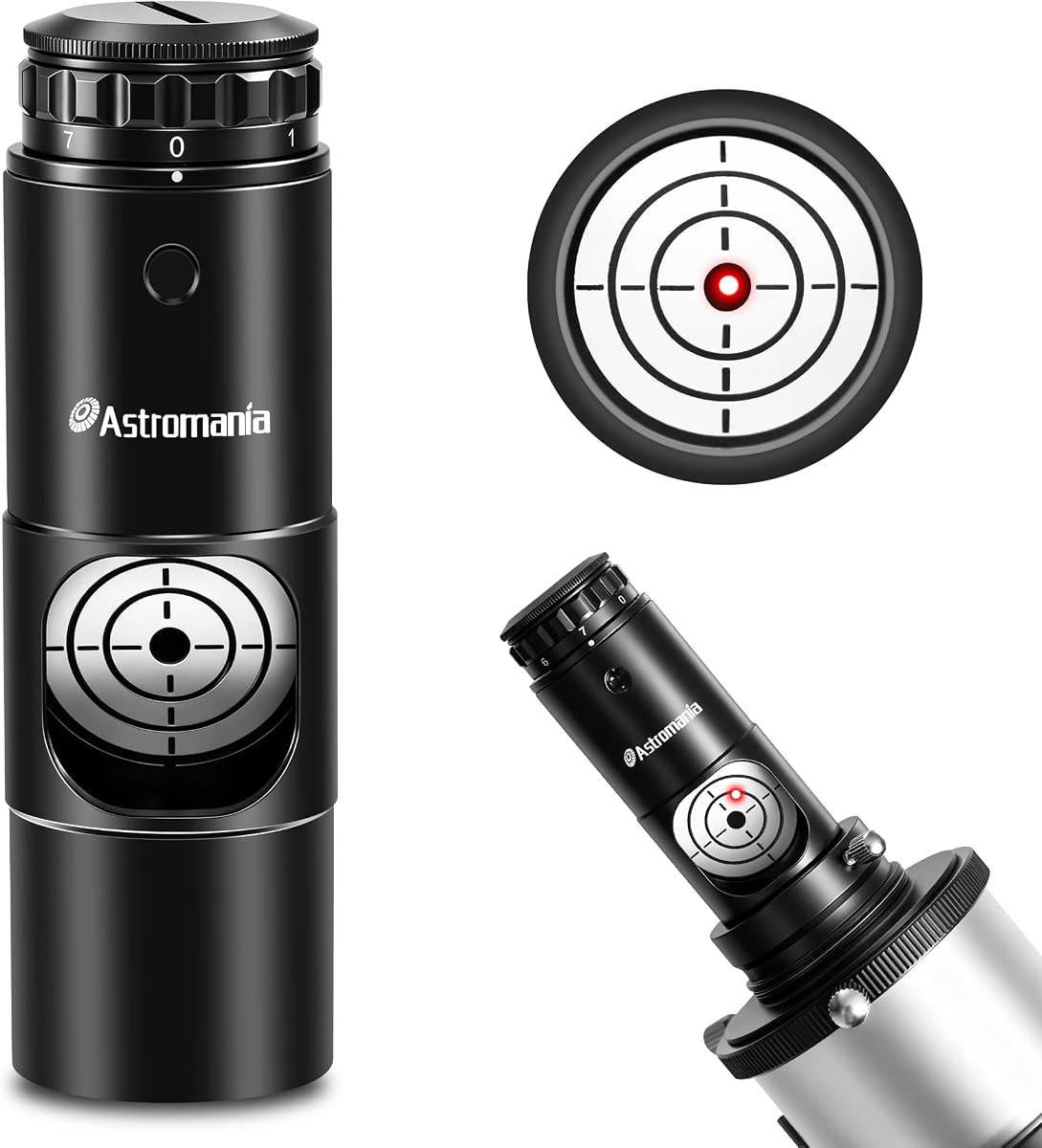


The Astromania 1.25/2-Inch Laser Collimator earns the strongest overall position because it combines broad focuser compatibility with a thoughtful adjustment design. Its supplied listing has a 4.5 rating, and the most useful features include a removable two-inch adapter, seven brightness levels, an inspection window, and an included CR2032 lithium battery.
We may earn a commission when you buy through this link, at no additional cost to you.
The removable adapter allows the same unit to serve standard one-and-quarter-inch and two-inch focusers, which is valuable for owners who may upgrade their optical tube or maintain more than one telescope. Seven brightness levels are equally practical: a lower setting can reduce glare in a dark room, while a brighter beam may be easier to see during daylight work.
The front aperture, side window, and three adjustment ports at 120-degree intervals provide multiple ways to establish and verify alignment. The side window exposes a diagonally oriented disk with a central opening, allowing the user to inspect the returning beam without relying entirely on a distant target. Anodized metal construction also gives the unit a more durable feel than a lightweight plastic-only design.
The main limitation is that it is framed specifically for Newtonian telescopes, and the listed Class 3R output calls for sensible laser safety practices. It also uses a circular dot rather than a crosshair, which may be less visually explicit during final refinement. Even so, its compatibility, clear controls, useful viewing window, and straightforward instructions make it an excellent general-purpose choice for most home Newtonian owners.
The removable two-inch adapter is the key versatility feature. It lets the collimator work with a one-and-quarter-inch focuser and later fit a two-inch model without requiring a second dedicated tool, provided the observing setup and telescope design are otherwise compatible.
Seven selectable brightness levels make the red beam easier to manage in bright rooms, dim spaces, and nighttime conditions. A visible beam is not automatically a better beam, however, so choosing the lowest effective setting can make the return point easier to judge.
We may earn a commission when you buy through this link, at no additional cost to you.
The Astromania 1.25-Inch Laser Collimator is a compact option for observers who know their Newtonian uses a standard one-and-quarter-inch focuser. It carries a 4.5 rating and offers the same practical red laser, seven brightness levels, metal construction, and included CR2032 battery found in the more adaptable 1.25/2-inch model.
We may earn a commission when you buy through this link, at no additional cost to you.
Its compact body fits naturally within a one-and-quarter-inch focuser and is easy to move during the repeated insertion, viewing, and removal steps required for alignment. The laser can be operated by one person, while the front aperture and three sealed adjustment openings support a methodical process. The advertised output is 3.8 milliwatts at a wavelength of 635–655 nanometers.
Compared with the broader Astromania option, the main sacrifice is simple: no two-inch adapter is listed. That makes this a more focused purchase for owners who are certain about their focuser diameter. It also lacks the explicitly described side inspection window, although it retains the side opening and central-hole adjustment concept mentioned in the broader product line.
For a standard one-and-quarter-inch Newtonian, this is a well-rounded, portable tool. Buyers seeking future-proofing or a larger focuser should choose the dual-adapter version instead, while observers who value the simplest possible fit will find this model easier to manage.
The direct one-and-quarter-inch format keeps the setup uncomplicated. It is especially suitable for portable reflectors, beginner telescopes, and observing kits where compact storage and straightforward insertion are priorities.
The lightweight housing and manageable dimensions support one-person collimation. A user can adjust the telescope screws while observing the beam, then rotate or reposition the collimator as needed without requiring a second observer.
We may earn a commission when you buy through this link, at no additional cost to you.
The SVBONY 1.25/2-Inch Laser Collimator offers an appealing balance of useful features for Newtonian reflectors. Its 4.5 rating is supported by a removable two-inch adapter, seven brightness levels, a triple-cemented lens, metal construction, and instructions intended to make the alignment process less repetitive.
We may earn a commission when you buy through this link, at no additional cost to you.
The cemented lens is presented as a way to improve the stability of the red projection point. Stable targeting matters because an unsteady or poorly defined reference makes subtle mirror adjustments harder to evaluate. A removable two-inch adapter broadens compatibility, allowing the tool to remain useful if the user changes focusers or owns reflectors with different standard adapter sizes.
The seven brightness settings allow the same unit to serve daylight and darker observing environments. The supplied description emphasizes the ability to watch the collimator from the mirror end and adjust the relevant screws directly. That workflow suits owners who want an understandable process rather than a complex electronic system.
The listing does not clearly state the beam wavelength or a consistent laser safety classification, which is less informative than the specifications provided for several Astromania and Alstar units. It also describes the unit as suitable as a gift, but that has no bearing on performance. As an alignment tool, however, it remains a strong, adaptable option for standard reflector telescopes.
The triple-cemented lens is intended to preserve a stable red projection. That matters during fine adjustments because a clear, consistent return point helps the observer distinguish meaningful movement from beam flicker or viewing-angle effects.
The included removable two-inch adapter reduces the need to purchase a separate calibrator after a focuser upgrade. It also makes the unit practical for astronomers who maintain more than one telescope.
We may earn a commission when you buy through this link, at no additional cost to you.
The SVBONY Red Laser Collimator Bundle with Telescope Lens is a multi-component alignment package that pairs a laser unit with a wide-field telescope eyepiece. No numerical customer rating is supplied, so its evaluation here rests on the stated features: compatibility with one-and-quarter-inch and two-inch reflectors, seven brightness levels, a removable adapter, and a 62-degree apparent-field eyepiece.
We may earn a commission when you buy through this link, at no additional cost to you.
The eyepiece is listed for broad-field lunar observation, star clusters, wide nebulae, and other expansive targets. Its wide apparent field can also provide a complementary viewing method, although the laser remains the dedicated tool for establishing an optical reference. A user who wants both a collimator and a general-purpose observing eyepiece receives more functionality from one listing.
The product information contains inconsistent laser-class references, including Class IIIa and a separate statement that output is at or below one milliwatt under Class I conditions. Buyers should verify the exact specifications and safety labeling on the package before use. As with any red laser, the unit should never be pointed toward aircraft, vehicles, or people.
This bundle is a sensible choice for a new reflector owner who also wants a wide-field eyepiece. It is less straightforward for a buyer who needs only a collimator or who needs unambiguous technical documentation, but the combination can make a practical introductory package for portable observing.
Including a wide-field eyepiece gives the package value beyond optical alignment. It can support relaxed viewing of lunar landscapes, selected star clusters, and extended deep-sky objects after the telescope has been properly adjusted.
The supplied descriptions mention different laser classes and output limits. Because the responsible specification should match the physical unit, carefully inspect the model marking, output rating, and manufacturer documentation before operating the laser.
We may earn a commission when you buy through this link, at no additional cost to you.
The Alstar 1.25-Inch Laser Collimator is a well-rated entry-level tool for standard Newtonian reflectors. Its 4.5 rating, seven brightness settings, 635–655 nanometer wavelength, and three-point adjustment arrangement make it a familiar alternative to the Astromania models.
We may earn a commission when you buy through this link, at no additional cost to you.
The unit arrives fully adjusted but allows further calibration through three openings positioned at 120-degree intervals. The rear screw cap provides access for battery replacement, while the front aperture emits the beam and the side window lets the user inspect a disk oriented at 45 degrees with a central hole. This inspection method is useful for confirming that the returning beam lands where expected.
Step-by-step instructions in German and English are included, making the tool approachable for a first-time collimation attempt. The metal body and one-person workflow support repeated use, and the adjustable brightness lets users select a visible but manageable beam in different surroundings.
A key practical disadvantage is that the CR2032 battery is not included, so a first-time buyer must add one. The one-and-quarter-inch fit also does not accommodate a two-inch focuser without a separate solution. Subject to that added accessory need, it remains a capable and approachable collimator for a compatible Newtonian.
Arriving pre-adjusted gives users a useful starting point, while three sealed adjustment ports permit correction if the laser becomes misaligned. The sealed ports protect the internal mechanism from dust and accidental movement before use.
The 45-degree side window provides a convenient way to examine the returned laser. This close inspection can make the final adjustment process more methodical than judging alignment only by looking through the focuser.
We may earn a commission when you buy through this link, at no additional cost to you.
The Alstar 1.25/2-Inch Laser Collimator provides a more complete compatibility package than the one-and-quarter-inch Alstar model. Its 4.0 rating is the lowest among the rated traditional laser units in this list, but the product description covers nearly every feature a home reflector owner would expect.
We may earn a commission when you buy through this link, at no additional cost to you.
A standard one-and-quarter-inch fit and removable two-inch adapter cover the most common focuser formats. The red laser offers seven brightness levels, a 635–655 nanometer wavelength, and a stated 3.8 milliwatt output. A triple-cemented lens supports beam stability, while the front aperture and 45-degree side window help the user monitor the returned reflection.
Three adjustment ports are arranged at 120-degree intervals and protected by seals until needed. The unit comes pre-calibrated, uses a rear screw cap for battery changes, and includes the CR2032 cell. Detailed instructions support a one-person calibration process and provide a useful reference when the telescope has been transported or adjusted.
The lower 4.0 rating indicates that some buyers may have found aspects of the product less satisfactory, although the provided information does not identify specific issues. It is also described primarily for Newtonian and reflector telescopes rather than general refractor use. For those needs, it remains a feature-rich and appropriately equipped traditional laser collimator.
The removable adapter means the owner can use one tool across common one-and-quarter-inch and two-inch focusers. This is especially useful for visual observers who may later move to a larger focuser or maintain multiple reflecting telescopes.
The front and side openings let the user inspect the beam during telescope adjustments. Combined with the sealed fine-tuning ports, this provides a practical balance between initial setup and later correction.
We may earn a commission when you buy through this link, at no additional cost to you.
The SVBONY Phone Adapter Bundle differentiates itself with a smartphone clamping accessory alongside the red laser collimator. It has a 4.4 rating, seven brightness levels, a metal collimator body, and a removable two-inch adapter, making it more than a conventional laser-only package.
We may earn a commission when you buy through this link, at no additional cost to you.
The phone clamp accepts eyepiece diameters from 25 to 48 millimeters and is designed to hold a phone over the eyepiece for imaging or viewing. Its adjustable locking mechanism uses a steel bolt rather than a spring, while high-density EVA pads help protect the device. The listed compatibility includes several iPhone, Sony, Samsung, and Motorola models.
The collimator itself supports one-and-quarter-inch and two-inch telescope focusers, and the seven brightness settings are useful in both bright and dark conditions. The listing describes the laser as Class IIIa with power below five milliwatts, so the same basic eye-safety precautions apply.
The accessory is not intended to fit two-inch eyepieces, and the named phone models are not exhaustive because newer devices may use different dimensions. For a telescope owner who also wants phone-assisted observation, the bundle adds meaningful utility; for pure collimation, it is simply a more specialized package than necessary.
The steel-bolt lock provides a firm connection between the clamp and the eyepiece. EVA padding at the contact points helps reduce the chance of scratching or damaging a phone during a long observing session.
The stated 25–48 millimeter range is more useful than any short list of device names. Measure the width and camera placement of the phone, then compare them with the clamp specifications before purchasing.
We may earn a commission when you buy through this link, at no additional cost to you.
The SVBONY SV197 Cheshire Eyepiece and laser bundle provides two distinct ways to align a Newtonian reflector. Its 5.0 rating is the highest numerical rating supplied for these products, and the combination may appeal to users who want a battery-free visual check alongside a laser reference.
We may earn a commission when you buy through this link, at no additional cost to you.
The SV197 Cheshire is precision-machined from aluminum and uses fine crosshairs, a clear bright mirror, and a sighting hole. It needs no battery, can assist with secondary-mirror collimation, and is intended for daytime use. The laser component supplies a red beam with seven brightness levels and a removable two-inch adapter for one-and-quarter-inch and two-inch reflectors.
Using both methods can provide useful confirmation. The laser establishes a beam path, while the Cheshire shows an illuminated pattern and target arrangement when the telescope is aimed toward a suitable bright area. The listing also notes that the Cheshire can be useful for aligning refractor optics accurately, although the bundle is primarily presented for Newtonian telescopes.
This is not the simplest possible purchase for someone who needs only one tool. Daylight-only use for the Cheshire and the need to understand the laser procedure add two separate workflows. In return, users gain a flexible package and an independent visual alignment method, which is valuable for careful reflector setup and periodic maintenance.
The laser and Cheshire do not offer exactly the same information. The laser is convenient for establishing the optical path, while the illuminated Cheshire pattern can help reveal target placement and mirror alignment from another perspective.
The Cheshire eyepiece is designed for daytime work and requires no battery. It can be particularly useful when checking the secondary mirror or confirming that the optical path is producing a centered, symmetrical pattern.
We may earn a commission when you buy through this link, at no additional cost to you.
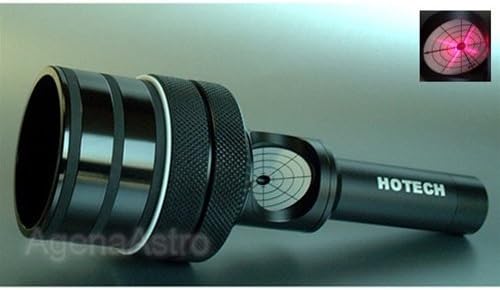
The HoTech SCA-2C stands apart from conventional laser collimators through its patented Self-Centering Adapter technology. It has a 4.7 rating, a crosshair laser pattern, and a supplied setup built around repeatable, centered installation in one-and-quarter-inch and two-inch focusers.
We may earn a commission when you buy through this link, at no additional cost to you.
The central problem addressed by SCA is adapter slop. A small mechanical gap is needed to insert a collimator into a focuser, and thumbscrews or compression rings can leave the instrument slightly off-axis. An off-axis laser can compromise the reference path and reduce the usefulness of a precision alignment tool. The self-centering mechanism is designed to minimize that installation error and make placement repeatable.
The crosshair pattern is particularly useful for finding a narrow returning beam against a distant target. The product includes a one-and-quarter-inch SCA collimator preinstalled in a two-inch-to-one-and-quarter-inch adapter, a CR123 battery, and manuals covering Newtonian, SCT, and star collimation. That makes it a more specialized and potentially more complete purchase than a basic dot-pattern unit.
Its principal drawback is the need to buy an SCA-style tool when a basic collimator would already meet many observers' requirements. The precision advantage is most valuable when repeatability, centering, and fine alignment justify a premium instrument. For serious Newtonian or SCT users who understand their focuser format, it is the most technically advanced traditional laser in this roundup.
A perfectly aligned mirror set cannot be judged accurately if the laser itself sits off-axis in the focuser. The SCA mechanism is intended to center the instrument repeatedly, reducing that source of error before the observer begins adjusting the optics.
The crosshair pattern gives the observer a defined horizontal and vertical reference. It can be easier to locate than a single dot, particularly when aligning against a distant target or during the final stage of secondary-mirror adjustment.
We may earn a commission when you buy through this link, at no additional cost to you.
The Ocal Pro V4.0 is the most electronically oriented product in the list, designed for Newtonian and Schmidt Cassegrain telescopes with smartphone compatibility. No numerical customer rating is supplied, so its evaluation depends on the stated features: built-in calibration circles, factory-centered construction, portable operation, and software-guided optical-axis adjustment.
We may earn a commission when you buy through this link, at no additional cost to you.
The calibration circles provide an on-screen reference for adjusting the telescope’s optical axis. Each unit is described as factory-centered to pixel-level accuracy, establishing a precise baseline before the user performs any field adjustments. Its all-in-one design is intended to support both workshop preparation and mobile astronomy sessions without relying on a traditional laser beam projected onto a distant target.
This electronic approach offers a different workflow from the other nine products. Instead of using a physical laser reference, the user interprets a camera-based pattern and adjusts the telescope according to guided criteria. That can be particularly attractive for Schmidt Cassegrain owners as well as Newtonian users who already use smartphones for imaging or observation.
The smartphone dependency is the main consideration. Buyers need a compatible device and should understand the included software workflow before purchasing. Because the supplied listing does not provide a numerical rating, detailed phone specifications, or detailed software requirements, cautious buyers should verify current compatibility. Within those boundaries, it is a distinctive and potentially precise choice for mobile electronic collimation.
Built-in calibration circles give the user a structured target instead of an optical spot projected onto a wall or distant surface. The display is intended to make small alignment corrections easier to interpret.
Factory centering to pixel-level accuracy provides a consistent baseline. Because shipping movement or telescope setup can still affect the final result, periodic field checks remain important even with a precisely manufactured electronic unit.
We may earn a commission when you buy through this link, at no additional cost to you.
The right collimator depends on telescope design, focuser format, desired precision, and whether you prefer a physical laser reference or an electronic smartphone workflow.
Most traditional products in this guide are designed for Newtonian reflectors, while the Ocal Pro V4.0 explicitly supports Newtonian and Schmidt Cassegrain telescopes. The HoTech manuals also cover Newtonian, SCT, and star-collimation procedures. Confirm that the collimator matches the optical design you own rather than assuming every unit can service every telescope. A focuser fit alone does not guarantee that the optical path or adjustment procedure is appropriate.
One-and-quarter-inch focusers are common on smaller and portable reflectors, while two-inch focusers appear on many larger models and upgrades. A removable two-inch adapter provides useful flexibility, as offered by the Astromania, SVBONY, and Alstar dual-size products. The HoTech SCA-2C also uses an adapter arrangement for both sizes. Check the focuser measurement rather than estimating from the outside of the telescope, since adapters and inserts can affect fit.
A circular red dot is intuitive and widely used, while a crosshair can make a narrow return beam easier to locate and evaluate. Seven adjustable brightness levels are common across the traditional units and allow the user to balance visibility against glare. Consider where the alignment will occur: a dim room may require a brighter setting, while a dark setting can make the lowest useful level easier to judge.
Specified outputs range from less than five milliwatts in several descriptions to a stated 3.8 milliwatts, with one bundle also describing output at or below one milliwatt. Treat these figures as model-specific and verify the marking on the unit received. Never aim a collimator toward people, vehicles, aircraft, or reflective surfaces at unsafe distances, and follow the manufacturer’s handling guidance.
A collimator can only be as trustworthy as its position in the focuser. Conventional thumbscrews and compression rings may permit small amounts of slop, while the HoTech SCA-2C uses a patented self-centering adapter to improve repeatability. Models with three adjustment ports also allow the laser itself to be recalibrated if its internal alignment shifts. Fine-tuning ports are useful, but centering in the focuser remains a separate and important part of the process.
Most of the traditional laser collimators use metal bodies and anodized finishes, making them durable and comfortable to handle. The Astromania one-and-quarter-inch model and SVBONY 1.25/2-inch model are particularly compact for mobile kits. A housing that feels solid is useful, but portability also depends on the size of the adapter, battery compartment, and storage case. The Ocal Pro differs by emphasizing an all-in-one electronic and smartphone-based system.
Most units use a coin-cell battery, but inclusion varies. The Astromania products and the 1.25/2-inch Alstar include a CR2032 cell, while the one-and-quarter-inch Alstar does not. The HoTech includes a CR123 battery. Adapters, instructions, and alignment eyepieces can add value, but a larger bundle is not automatically better if the extra components do not match your telescope or preferred workflow.
Traditional laser units are intuitive, portable, and useful without a phone or computer. Electronic collimation can provide guided on-screen references and factory-centered calibration, but it introduces a dependency on device compatibility and software. Consider whether you want a self-contained physical beam, a camera-assisted method, or both. The SVBONY Cheshire bundle provides a middle ground by pairing a traditional laser with a battery-free visual alignment eyepiece.
Begin by placing the telescope on a stable surface in a darkened room or at night. Remove the eyepiece, insert the collimator into the focuser, and remove the rear screw cap if the manufacturer requires it. Turn the laser on, select a low effective brightness, and orient the telescope toward a suitable distant target where the red beam and its return can be seen safely.
Observe from the open end of the telescope and identify the returning beam on the secondary mirror. Adjust the primary-mirror alignment screws in small movements until the return approaches the center of the laser target. Continue with the secondary-mirror screws, following the supplied manual’s exact sequence. Use the smallest practical beam brightness and make tiny corrections so the final result is not based on a large temporary movement.
After completing the procedure, switch off and remove the laser. Store it in a dry, padded place, keep the adjustment openings protected from dust, and replace the battery if the unit will remain unused for an extended period. Inspect the focuser and adapter for looseness before every alignment session, and never clean the lens with an abrasive or aggressive liquid.
No. Many laser collimators in this guide are designed specifically for Newtonian reflectors, while some also support Schmidt Cassegrain models or include broader manuals. Check the stated telescope compatibility and follow the instructions for the optical design you own. A compatible focuser does not automatically make every alignment procedure suitable for every telescope.
Each offers a useful reference in a different way. A laser is convenient for establishing the optical path and can remain useful in low-light conditions, while a Cheshire provides a battery-free visual pattern and is intended for daylight work. The SVBONY bundle offers both methods, which can be useful for users who want an additional way to confirm alignment.
The cause may be mirror misalignment, a loose or off-axis collimator installation, or a focuser that is not holding the tool steadily. Check the adapter and centering mechanism before making substantial mirror adjustments. If the laser itself appears misaligned relative to its body, use the model’s sealed adjustment ports according to the manual.
Only if your telescope has a two-inch focuser and the collimator does not already include the required adapter. One-and-quarter-inch models are sufficient for compatible smaller reflectors, but a removable adapter provides useful flexibility. Confirm both the focuser diameter and the adapter style before ordering.
Use the lowest setting that remains clearly visible in your working environment. An overly bright beam can obscure the small return point or make it difficult to judge symmetry. Seven-level controls are useful because they allow the image to remain visible in both daylight and darker conditions without working at maximum output unnecessarily.
Collimation is worth checking after transportation, a significant optical-tube change, or whenever image quality appears unexpectedly soft or asymmetric. A properly aligned telescope may remain stable for long periods, but periodic verification is sensible for frequently transported instruments. The correct interval depends on the telescope, its mounting, and how it is transported.
You can perform some outdoor alignment, but you need a safe, distant target and enough ambient contrast to see the beam and return. A dark room is often easier to judge accurately. Never point the laser toward aircraft, vehicles, people, windows, or other reflective surfaces, and follow the device’s safety instructions.
A self-centering adapter can reduce installation slop and make placement more repeatable, but it does not correct the telescope’s mirrors by itself. The user must still inspect the return beam and adjust the optics correctly. The HoTech SCA-2C is the listed model built specifically around this self-centering concept.
The Astromania 1.25/2-Inch model is the strongest all-around choice for most Newtonian owners because it combines two focuser formats, seven brightness levels, a side inspection window, metal construction, and an included battery. The SVBONY 1.25/2-Inch model offers a similarly practical feature set, while the HoTech SCA-2C stands apart for users who prioritize centered, repeatable installation and a crosshair reference.
Prioritize the telescope type, focuser diameter, and adjustment method before considering smaller conveniences. A simple 1.25-inch unit is sufficient for one compatible reflector, an included two-inch adapter is valuable for future flexibility, and the Ocal Pro V4.0 is worth investigating when a guided smartphone workflow and support for Newtonian and SCT telescopes are priorities.
Ratings, bundle contents, compatibility details, and current prices can change, so check the latest product listing before purchasing. The right tool is the one that fits your telescope, provides a stable reference, and supports a safe, repeatable alignment process you can understand and maintain.