
beyerdynamic DT 770 Pro X
4.5Editor score
48-ohm studio compatibility
Detachable mini-XLR cable
Replaceable velour ear pads
Explore the best headphones with detachable cable for studio tracking, mixing, DJing, gaming, and critical listening, with key features compared.
Detachable-cable headphones offer a practical upgrade path: damaged leads can be replaced, connection types can be changed, and studio setups can use longer or more specialized cables. The right model also depends on whether you need isolation, an open soundstage, monitoring controls, or convenient transport.
We compared the ten models in this guide by their documented construction, driver design, isolation, connectivity, monitoring features, comfort, and suitability for recording, mixing, DJing, and everyday listening. The list includes closed-back studio headphones, open-back reference models, and a Bluetooth-capable alternative.
Each review explains the product's strongest qualities and practical trade-offs, while the comparison table highlights the differences that matter most. Ratings and specifications reflect the supplied product information, while prices and availability can change at any time.
4.5Editor score

4.6Editor score

4.5Editor score
This side-by-side comparison covers acoustic design, driver configuration, monitoring versatility, and practical features for creators, musicians, and everyday listeners.



The Audio-Technica ATH-M40x combines the compact, durable construction associated with professional monitoring headphones with a cable system that can be changed rather than discarded when a lead fails. It carries a 4.6 rating, and its defining strengths are isolation, robust materials, and the freedom to rotate either earcup for one-ear monitoring. That combination makes it an especially well-rounded choice for tracking, mixing, and repeated studio use.
We may earn a commission when you buy through this link, at no additional cost to you.
Its 40-millimeter drivers use rare-earth magnets and copper-clad aluminum wire voice coils, while the circumaural shape is designed to contour around the ears and help reject sound in a loud environment. The 90-degree swiveling earcups make it easier to keep one side open when monitoring a vocalist, instrument, or live source. Professional-grade earpad and headband materials add durability without changing the straightforward wired format.
The main trade-off is acoustic rather than functional. Because this is a closed-back monitor, it prioritizes isolation and consistent low-frequency control instead of the airy, unrestricted presentation of an open-back headphone. That makes it less suitable for listeners whose main goal is recreating a natural room soundstage. It may also feel more substantial than a lightweight portable model during a long travel day.
This is the strongest general recommendation for a buyer who wants dependable monitoring tools, a detachable lead, and useful one-ear operation. It suits recording engineers, producers, musicians, and serious listeners who need a direct and controlled presentation. Among the ten choices, its balance of isolation, durability, monitoring convenience, and repair-friendly cabling makes it the most versatile all-rounder.
The closed-back circumaural design helps block distracting sound in busy rooms. That isolation is valuable during recording sessions because outside sound can influence decisions made on volume, balance, and clarity.
The 90-degree swiveling earcups let one cup sit closer to the ear while the other moves aside. This is especially practical for performers who need to hear both their own voice and a live mix.
We may earn a commission when you buy through this link, at no additional cost to you.
The Audio-Technica ATH-M20x is a closed-back studio monitor designed for tracking and mixing, and it earns a 4.6 rating. Its appeal lies in a focused set of features rather than wireless conveniences: 40-millimeter drivers, an enhanced low-frequency tuning, a circumaural enclosure, and a cable that exits from only one side for simpler routing around a desk or mixing console.
We may earn a commission when you buy through this link, at no additional cost to you.
The driver system combines rare-earth magnets with copper-clad aluminum wire voice coils, giving this model the same basic driver architecture associated with professional monitoring. Its low-frequency emphasis can make bass-heavy material easier to evaluate, while the closed-back circumaural design helps isolate the user from a noisy environment. The single-side cable exit is also a meaningful workspace advantage because it reduces cable clutter.
Compared with the ATH-M40x, the ATH-M20x is the more straightforward option. The supplied information does not identify a swiveling earcup mechanism, so users who routinely monitor with one ear open may prefer the M40x. It also does not specify the same detachable-cable details, meaning buyers specifically shopping for a confirmed removable lead should check the connector and included accessories for the current package before ordering.
The ATH-M20x remains a strong choice for home studios, musicians, and listeners who want an uncomplicated closed-back monitor with dependable isolation. It is particularly attractive for users who do not need wireless playback or advanced docking features. The main recommendation is to verify the exact cable configuration if replaceability is the central requirement.
The ATH-M20x is explicitly designed for studio tracking and mixing. Its closed construction and isolated fit create a controlled platform for judging recordings without the broad soundstage of an open-back design.
The documented low-frequency tuning gives this model a more assertive bass foundation. Users should still compare levels in context, but the emphasis can be helpful when checking whether low-end material remains controlled.
We may earn a commission when you buy through this link, at no additional cost to you.
The beyerdynamic DT 770 Pro X is a substantial closed-back studio headphone built around a 48-ohm impedance and the company's STELLAR.45 driver. It has a 4.5 rating, and the detachable mini-XLR connection is a major practical advantage because a worn cable can be exchanged quickly without replacing the entire headphone. A carrying bag and a three-meter cable are included.
We may earn a commission when you buy through this link, at no additional cost to you.
The 48-ohm version is designed for broad source compatibility, including laptops, interfaces, phones, and consoles, without requiring a dedicated headphone amplifier. Its closed-back isolation helps keep headphone sound from entering a microphone during recording. The STELLAR.45 transducer is positioned for precise, high-resolution sound, while the detachable connection and replaceable velour pads extend the useful life of the main components.
This is not the smallest or lightest option for travel, and its studio-style proportions may be less attractive to someone seeking a compact everyday headset. The closed-back design also trades the open airflow of open-back references for a more controlled and isolated experience. Those are acceptable compromises for mixing, tracking, and focused critical listening rather than a lightweight lifestyle product.
Buyers who want a detachable connection, a high-resolution closed-back monitor, and broad equipment compatibility should give the DT 770 Pro X serious consideration. It is a particularly logical choice for home-studio owners who may connect to several different sources. For users specifically prioritizing cable serviceability, the mini-XLR system and replaceable ear pads make it one of the most future-conscious options here.
The detachable mini-XLR connection separates the lead from the main driver assembly. That makes replacement straightforward and allows a spare cable to serve as a useful backup in a studio bag.
The 48-ohm impedance supports use with many common playback and recording sources. This simplifies setup for users moving between a computer, interface, phone, or console without carrying additional amplification.
We may earn a commission when you buy through this link, at no additional cost to you.
The Audio-Technica ATH-M50X is the highest-rated model in this group, with a 4.7 rating. It is a closed-back professional headphone centered on sound clarity, deep and accurate bass, and an extended frequency range. Its 45-millimeter large-aperture drivers, robust circumaural enclosure, and 90-degree swiveling earcups make it a credible choice for detailed monitoring.
We may earn a commission when you buy through this link, at no additional cost to you.
Rare-earth magnets and copper-clad aluminum wire voice coils are used in the driver system. The resulting design is marketed for exceptional clarity across an extended frequency range, with a strong but controlled low end. Its circumaural shape helps isolate the listener in loud environments, while the swiveling earcups allow one side to move away for monitoring. Professional-grade earpad and headband materials support durability and comfort.
The main purchasing question is cable configuration. The supplied information highlights the M50X's driver, isolation, comfort, and monitoring design, but it does not explicitly describe the included leads or connector. Those shopping specifically for a detachable cable should verify the current package and connector type. As a closed-back model, it also offers less natural airflow and spatial openness than the R50X, DT 900 PRO X, and R70XA.
The ATH-M50X is well suited to recording engineers, producers, and critical listeners who want a detailed closed-back presentation. Its strong rating, accurate bass foundation, and swiveling cups broaden its usefulness beyond general music playback. Confirm the cable details first, but for a listener who values isolation and tonal clarity in a traditional studio form, it remains one of the strongest options.
The 45-millimeter large-aperture drivers are the ATH-M50X's central technical feature. They support the model's emphasis on clarity across an extended frequency range and its deep, accurate low-frequency response.
Professional-grade earpads and headband materials are intended to balance durability with comfort. Combined with the circumaural fit, this makes the model a practical option for extended studio sessions.
We may earn a commission when you buy through this link, at no additional cost to you.
The OneOdio Pro-10 is a wired over-ear headphone built for DJs, musicians, and listeners who want a bold low-frequency presentation. It has a 4.4 rating and uses large 50-millimeter neodymium drivers. The design also provides soft padded cushions, an adjustable stretchable headband, 90-degree swiveling cups, and a useful shared audio port.
We may earn a commission when you buy through this link, at no additional cost to you.
Its stated strengths are clear sound, powerful bass, clear vocals, and crisp highs. The padded earcups provide isolation and long-session comfort, while the swivel mechanism supports single-ear monitoring. Wired compatibility extends across smartphones, laptops, tablets, desktop computers, audio interfaces, DJ mixers, amplifiers, and devices with 3.5-millimeter or 6.35-millimeter connections.
The shared port can connect a second pair of headphones for music or video, which is more useful than many similar designs. The trade-offs are its wired-only operation and the fact that the supplied information does not confirm a detachable connector. Buyers focused on a replaceable lead should therefore check the cable attachment and current product details rather than assuming it includes the same serviceability as the clearly documented detachable models.
The Pro-10 is a practical choice for a DJ booth, rehearsal room, home studio, or shared-listening setup. Its large drivers and bass-forward character are particularly appropriate for listeners who want impact, while the wired design avoids charging and wireless latency. It is less universal for commuters, but it covers a broad range of stationary listening tasks.
The 50-millimeter neodymium drivers are tuned for powerful bass while preserving clear vocals and crisp highs. That balance makes the headphone suitable for beat-focused work and ordinary music monitoring.
The shared audio port allows another pair of headphones to be connected for shared music or video. This makes the Pro-10 useful for lessons, interviews, gaming sessions, and casual group listening.
We may earn a commission when you buy through this link, at no additional cost to you.
The OneOdio A70 stands apart from the studio-focused models in this roundup by combining Bluetooth operation with wired listening. It carries a 4.4 rating and supports up to 72 hours of stated wireless playback. In wired mode, the headphones continue working without power, and included 3.5-millimeter-to-6.35-millimeter and 3.5-millimeter-to-3.5-millimeter cables cover common connection needs.
We may earn a commission when you buy through this link, at no additional cost to you.
Custom-made aluminum fascia and 40-millimeter neodymium drivers support the model's high-resolution sound positioning, with a focus on powerful bass and dynamic stereo imaging. The rotatable, foldable design improves portability, while soft memory cotton and skin-friendly protein leather contribute to comfort. A built-in microphone with noise reduction supports hands-free calls, and a jack-lock design is intended to keep wired connections stable.
The audio-sharing arrangement is another notable feature. A second pair of headphones can be connected through the main unit, allowing multiple people to hear the same music or video. The caveat is that the supplied information does not explicitly confirm a detachable headphone cable. Wired operation is clearly supported, but buyers should verify the physical connector if detachable cabling is essential.
The A70 is a strong fit for home users who alternate between wireless convenience and dependable wired playback. It is less ideal as a pure studio reference because wireless operation and a broader feature set can distract from a focused monitoring workflow. For commuting, calls, shared viewing, and occasional DJ-style use, however, its dual-mode design is unusually versatile.
The ability to listen in wired mode without a battery gives the A70 an advantage when the internal power is depleted. It also provides a familiar connection method for DJ-style equipment and other wired sources.
The rotatable earcups and foldable headband reduce the space required in a bag. That portability is particularly useful for listeners who move between commuting, work, and home listening environments.
We may earn a commission when you buy through this link, at no additional cost to you.
The MAONO MH601 is a straightforward closed-back studio headphone for podcast recording, streaming, DJ mixing, and general instrument monitoring. It has a 4.5 rating and stands out because its detachable 9.8-foot spring-loaded cable is explicitly included. An interchangeable 6.35-millimeter jack and a complete passive wired design reinforce its creator-focused purpose.
We may earn a commission when you buy through this link, at no additional cost to you.
A 50-millimeter large-aperture driver is used for a more immersive presentation with clear detail through an extended frequency range and a deeper low-frequency response. The 90-degree swiveling earcups support dual- or single-ear monitoring, while the protein memory cushions and ergonomic headband are designed for long sessions. Its close-back pads are claimed to reduce background noise and create a useful acoustic seal.
The most important limitation is that the headphones do not have a built-in microphone. They are passive devices, so they need no power and contain no internal battery, but voice communication requires a separate microphone. The stated noise-isolation level is also a product claim rather than a measured comparative result, so buyers should not treat it as a guarantee for every environment.
Within this group, the MH601 is a compelling budget selection for creators who specifically value a detachable cable. The long spring-loaded lead, interchangeable jack, swivel cups, and useful device compatibility make it easy to adapt across podcast, music, keyboard, amplifier, and mixer setups. It is a better fit for active production than for calls or wireless listening.
The 9.8-foot spring-loaded cable is detachable and designed to withstand movement around a desk. The included interchangeable 6.35-millimeter jack lets the user match different mixers, instruments, and studio hardware.
The rotating earcups make it possible to alternate between full coverage and one-ear monitoring. This is useful for tracking vocals, checking cues, and making quick mix adjustments without removing the entire headset.
We may earn a commission when you buy through this link, at no additional cost to you.
The Audio-Technica ATH-R50X is a professional open-back reference headphone with a 4.5 rating. It combines extended bass, an accurate midrange, and a fully open-back design intended for demanding audio production. The model is also notably light at 207 grams, which makes it more manageable for long working sessions than many full-size studio references.
We may earn a commission when you buy through this link, at no additional cost to you.
Unrestricted airflow through the open enclosure is designed to eliminate internal resonance and produce extremely quick transient response. The result is a wide, realistic soundstage that helps users understand the placement of instruments and the depth between sounds. The durable, lightweight construction and redesigned headband are intended to balance reference performance with sustained comfort.
Cable flexibility is one of its clearest advantages. Two detachable leads are included: a three-meter cable for studio use and a shorter 1.2-meter cable for mobile listening. Both use a 2.5-millimeter twist-lock connector at the left earcup, while a 6.3-millimeter adapter and carrying pouch are also included. The short lead's compatibility with modern phones that lack a headphone jack should be checked before purchase.
The open-back construction is the key trade-off. Airflow and a wide soundstage come at the cost of sound leakage and little protection from ambient noise. The ATH-R50X is therefore best for critical listening in a controlled room, not for shared offices, public transit, or live recording where leakage could be captured by another microphone. For the right environment, it is a detailed, modern reference option with excellent cable flexibility.
The included long and short detachable leads support everything from a studio desk to a compact listening setup. Twist-lock connectors make cable changes straightforward while helping secure the connection.
The fully open-back design allows air to move freely through the enclosure. That architecture is intended to reduce internal resonance and help the headphone reproduce fast transients with less residual coloration.
We may earn a commission when you buy through this link, at no additional cost to you.
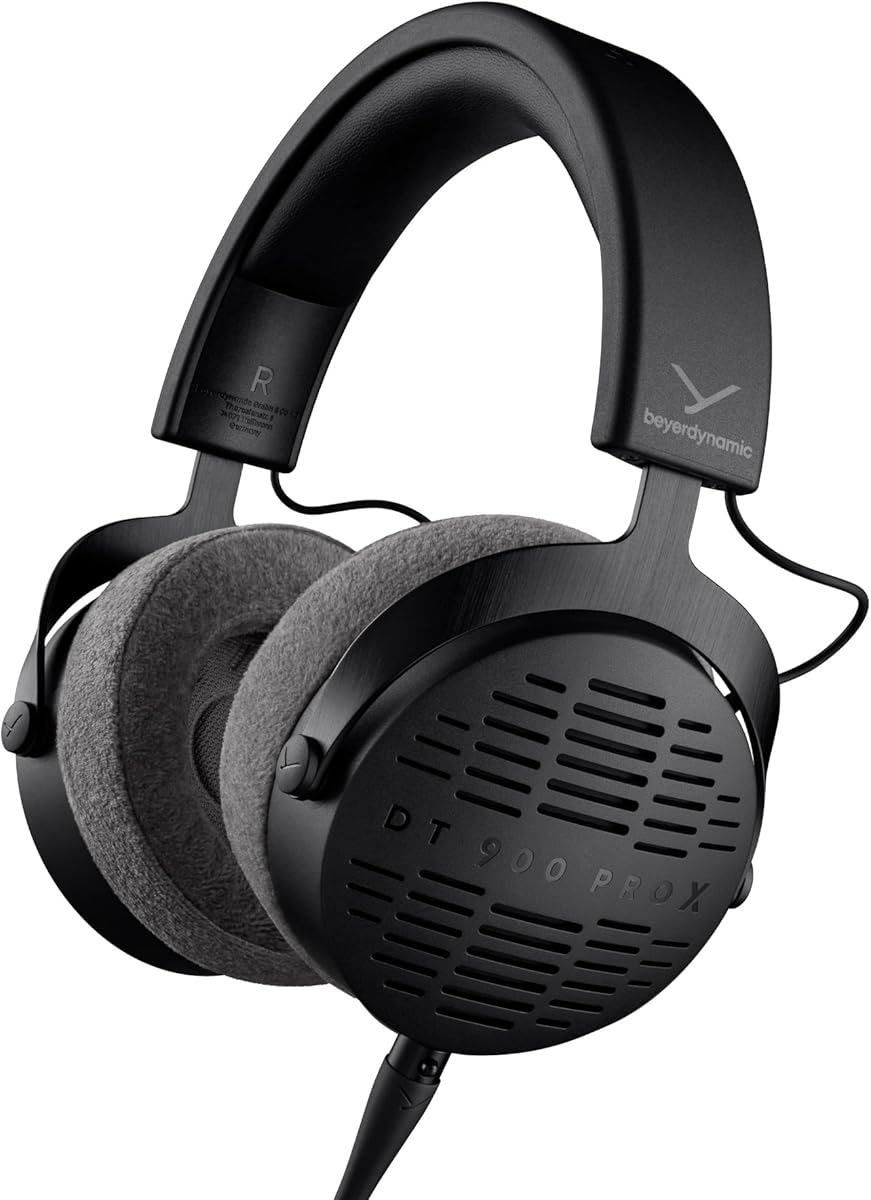
The beyerdynamic DT 900 PRO X is built for mixing, mastering, and critical listening, with a 4.5 rating. Its open-back design and 48-ohm impedance offer a different proposition from the DT 770 Pro X: users gain a wide, natural soundstage and more open airflow while losing the closed-back model's stronger environmental isolation.
We may earn a commission when you buy through this link, at no additional cost to you.
The STELLAR.45 driver is positioned as a high-resolution, low-distortion transducer that can operate at different listening levels. The supplied information highlights its compatibility with laptops, interfaces, and phones without requiring a separate headphone amplifier. A detachable mini-XLR cable allows quick cable changes, and a quarter-inch adapter is included for use with compatible equipment.
Open-back headphones are best treated as specialized tools. They can reveal spatial relationships and instrument placement in a way that closed designs may conceal, but they also emit sound and allow ambient noise to reach the listener. That makes the DT 900 PRO X a poor fit for live rooms where a nearby microphone might capture headphone spill or for users working in a noisy office.
For a controlled home or professional studio, it is an excellent choice for final-mix decisions, mastering, and extended critical listening. The combination of 48-ohm convenience, a detachable cable, and a natural soundstage makes it particularly attractive to users who want the open-back experience without needing a high-output design. It pairs well with a good listening environment rather than a noisy one.
The open-back soundstage is designed to show where each element sits in the stereo field. That can make it easier to evaluate depth, placement, and the relationship between vocals, instruments, and effects.
The mini-XLR cable can be changed in seconds, allowing users to keep or carry a suitable lead for each session. The included quarter-inch adapter expands compatibility with traditional studio outputs.
We may earn a commission when you buy through this link, at no additional cost to you.
The Audio-Technica ATH-R70XA is an open-back reference headphone built around accuracy, transparency, and low weight. It has a 4.6 rating and weighs just 199 grams. That makes it the lightest model in this roundup, while the fully open-back construction provides the natural airflow and quick transient response sought by critical listeners.
We may earn a commission when you buy through this link, at no additional cost to you.
The streamlined frame uses metal-reinforced construction, a reimagined headband, and replaceable velour ear pads. Each pair is assembled from components built in-house and tested in the company's Tokyo factory, according to the supplied information. The design is intended to remain comfortable during long working sessions while maintaining the balanced, transparent presentation expected from a professional reference headphone.
Its cable arrangement is more specialized than a single-sided lead. The unique dual-sided, three-meter detachable locking cable provides independent left- and right-signal channels, helping preserve correct stereo orientation. Users must manage and connect both sides, so the system is less convenient for quick mobile use than a compact single-cable design. The open-back format also offers no meaningful passive isolation and may leak substantially into the room.
The ATH-R70XA is best for engineers, producers, musicians, and serious listeners who spend extended periods in a quiet room and prioritize transparency and low weight. It is a less convenient choice for commuting, shared offices, or live recording. Within a dedicated listening environment, however, its 199-gram design, replaceable pads, and independent locking cable system make it an unusually refined option for long sessions.
At 199 grams, the ATH-R70XA places a premium on reducing fatigue during long working periods. The lightweight metal-reinforced construction and replaceable velour pads support both durability and sustained comfort.
Separate left- and right-signal detachable connections are intended to maintain proper stereo orientation. The system is specialized, but it also allows each side to be serviced independently if one channel is damaged.
We may earn a commission when you buy through this link, at no additional cost to you.
The most important choices are acoustic design, connector format, source compatibility, comfort, and the environments in which the headphones will be used. Buyers should treat a detachable cable as one part of a complete monitoring or listening system rather than the only selection criterion.
A detachable system is only useful when the connector and supplied lead match the intended source. Options in this list include detachable mini-XLR cables, 2.5-millimeter twist-lock connections, and an explicitly detachable spring-loaded 3.5-millimeter lead. Buyers should compare the end plug with the output of their interface, mixer, laptop, phone, or amplifier. They should also check whether an adapter is included or whether a separate adapter will be required. A locking connector may be useful in a studio, while a slim twist-lock plug can be more portable. The goal is a connection that remains secure without preventing easy cable replacement.
Closed-back headphones reduce sound leakage and provide more environmental isolation, making them better for recording, tracking, and noisy spaces. Open-back models allow air to move freely through the enclosure, which supports a wide soundstage and quick transient response, but they also leak sound and admit more background noise. A closed design is usually the safer choice when another microphone is nearby. An open design is better suited to critical listening in a controlled room. Neither approach is automatically more accurate; each changes how the headphone interacts with the recording environment.
The models here use 40-millimeter, 45-millimeter, and 50-millimeter drivers, but driver diameter alone cannot determine sound quality. Tuning, enclosure design, and intended use matter as well. The ATH-M20x is documented with enhanced low-frequency performance, the DT 770 Pro X and DT 900 PRO X emphasize high-resolution monitoring, and the OneOdio Pro-10 targets powerful bass and crisp highs. Consider the type of material you monitor and whether you prefer pronounced impact or a more restrained reference presentation. A larger driver may provide substantial low end, but it should be judged in context rather than treated as a guarantee of superior accuracy.
One-ear monitoring can be essential for recording vocals, playing live, or DJing. The ATH-M40x, ATH-M50X, OneOdio Pro-10, and MAONO MH601 explicitly use 90-degree swiveling earcups for this purpose. Impedance also affects source matching. The DT 770 Pro X and DT 900 PRO X use a 48-ohm design documented as compatible with common sources without a dedicated headphone amplifier. Before purchasing, check the output of your intended equipment, particularly if it is a laptop, phone, or small mixer. Easy monitoring and simple source connection can matter more than extra features in a working setup.
Comfort depends on clamp, pad softness, weight, and the shape of the user's head. The ATH-R50X weighs 207 grams, while the ATH-R70XA is lighter at 199 grams. Other models use protein memory cushions, professional-grade earpads, soft memory cotton, or skin-friendly protein leather to improve long-session comfort. Swiveling cups can reduce pressure by allowing the headset to rest in a natural position. The best choice is one that remains comfortable without creating a seal so tight that fatigue becomes distracting. Users working for many hours should consider weight and pad replacement alongside sound characteristics.
A detachable cable protects the headphone only if it prevents damage at the most vulnerable point. Several options also support broader component longevity through replaceable ear pads. The DT 770 Pro X has replaceable velour pads, the ATH-R70XA includes replaceable velour pads, and the ATH-R50X's detachable leads allow different lengths for different setups. Buyers should learn whether replacement cables and pads are readily available for the exact model. A repairable headphone may serve through multiple equipment changes, making long-term ownership more convenient and environmentally considerate than treating the entire headset as disposable.
Most studio-focused choices here are wired, which simplifies signal routing and avoids charging. The OneOdio A70 supports Bluetooth, a built-in microphone, and wired operation with a stated wireless runtime of up to 72 hours. It also offers audio sharing through a secondary connection. The MAONO MH601 includes a shared interchangeable jack, while the OneOdio Pro-10 has a shared port. Wireless freedom is useful for commuting and calls, but a passive wired monitor is often more appropriate for recording. Decide whether mobility and calls matter more than a focused monitoring setup, rather than assuming one operating method can satisfy every use case.
A large studio headphone can remain comfortable but occupy more room than a compact travel model. The OneOdio A70 has a rotatable and foldable structure designed to save space, while the ATH-R50X includes a carrying pouch. The DT 770 Pro X also includes a bag. If the headphones will regularly move between a home, studio, and listening room, consider the storage volume, included protection, and cable length together. A long cable is useful at a desk but awkward in a small bag. Balanced portability usually requires a detachable lead, a modest cable length, and a folding or compact-enclosure design.
Before the first listening session, identify each earcup's left and right channel, connect the correct cable at the labeled socket, and select the matching input on the source. Fully seat the plug without forcing it, then raise the source volume gradually. For open-back models, use a controlled room to preserve their intended soundstage. For closed-back models used in recording, verify that the earcups are positioned for the best seal and that the swiveling cups are adjusted before monitoring.
Handle detachable cables by their connectors rather than pulling on the wire. Route the cable away from sharp desk edges, foot traffic, and moving equipment. Do not leave a connected cable wrapped tightly around the earcups, and unplug it by holding the plug housing. If a spring-loaded or locking connector resists removal, release any latch before pulling. Keep the contacts clean and dry, and avoid sharply bending the cable near the strain relief.
Store the headphones in a protective case or on a stand that does not compress the earpads. Remove the cable before long-term storage if that reduces stress on the connector. Clean the headband, pads, and cups with a dry or lightly dampened soft cloth, depending on the material, and allow them to dry fully before use. Replace damaged cables promptly and inspect worn pads periodically, especially on models with replaceable velour cushions.
They can be better for long-term ownership because a damaged cable may be replaced without replacing the entire headphone. They also offer greater flexibility when changing source connections, cable lengths, or workstation arrangements. However, detachable construction is only an advantage if compatible replacement parts and the correct connector are available.
Mini-XLR, 2.5-millimeter twist-lock, and 3.5-millimeter-style locking connections appear among the models in this guide. The headphone-side connector and source-side plug are separate decisions, so buyers should confirm both before purchasing. An included adapter may solve the source connection, but it will not automatically make an incompatible headphone cable replaceable.
They are generally less suitable when another microphone is close by because open-back headphones can leak significant sound into the room. A closed-back model such as the ATH-M40x, ATH-M20x, ATH-M50X, DT 770 Pro X, or MAONO MH601 is more appropriate for tracking. Open-back models are better reserved for mixing, mastering, and critical listening in a quiet environment.
The DT 770 Pro X and DT 900 PRO X use a 48-ohm drive that is documented as working with common sources such as laptops, interfaces, phones, and consoles without a dedicated headphone amplifier. Output strength can still vary by device, so users should test their intended source and keep the volume under control.
A 3.5-millimeter plug is common on phones, laptops, consumer devices, and portable audio gear. A 6.35-millimeter plug, often called a quarter-inch, is more common on studio monitors, mixers, amplifiers, and professional equipment. Several models include adapters or alternate leads, allowing the same headphones to cover more than one source type.
Comfort varies with the model, head shape, and session length. The ATH-R50X and ATH-R70XA place particular emphasis on low weight, while the MAONO MH601 and OneOdio A70 use cushioned materials intended for extended wear. Proper adjustment, a comfortable pad pressure, and breaks from continuous use can make a meaningful difference.
Some models explicitly include replaceable pads, including the beyerdynamic DT 770 Pro X and Audio-Technica ATH-R70XA. Other models may also offer replacement pads, but the supplied information does not confirm that for every product. Check the manufacturer's accessory options and the exact model number before assuming pads or cables are interchangeable.
Choose wireless if portability, calls, and cable-free listening are the main priorities. Choose wired if you work with audio interfaces, mixers, or studio equipment and value a consistent connection without charging. The OneOdio A70 supports both approaches, while most models in this guide are designed primarily for passive wired monitoring.
The Audio-Technica ATH-M40x is the strongest all-round recommendation because it combines confirmed detachable cables with robust construction, useful 90-degree swiveling earcups, and effective closed-back isolation. The beyerdynamic DT 770 Pro X stands out as the premium studio option through its 48-ohm compatibility, detachable mini-XLR connection, high-resolution driver, and replaceable velour pads. The MAONO MH601 is the best budget choice for creators who want a confirmed detachable spring-loaded cable without battery power or wireless complexity.
Prioritize the acoustic design and connection format that match your environment. Choose closed-back isolation for recording and noisy spaces, or open-back airflow for critical listening in a quiet room. Confirm the headphone-side connector, source plug, cable length, and replacement-part availability before buying. For reference listening, also consider low weight and replaceable pads; for DJing or live performance, prioritize 90-degree swiveling cups.
Ratings, specifications, accessories, and product availability can change, and prices vary over time. Review the current listing before ordering to verify the exact cable configuration and included adapters. With that final check, you can select a detachable-cable headphone that remains useful across the devices, sessions, and listening environments you actually expect to use.