
DoukAudio D2 5V
4.5Editor score
15W regulated 5V output
Dual output configuration
Toroidal transformer architecture
CLC noise filtering
Linear Power Supplies for Audio: compare ten low-noise PSUs for DACs, streamers, preamps, and headphone amps by voltage, power, filtering, outputs, and noise.
Linear power supplies for audio can provide DACs, streamers, preamps, headphone amplifiers, and digital sources with a steady alternative to noisy wall adapters. Their slow, low-noise regulation may reduce interference, while toroidal transformers, shielding, and thoughtful filtering can support a quieter background, cleaner detail, and more consistent performance in a carefully matched system.
We compared ten options based on their supported voltages, output current, transformer and regulator design, filtering, output configuration, isolation, protection, and intended audio applications. The guide covers models tailored to compact desktop systems, multi-device installations, high-current equipment, and installations that require specific voltages, connectors, or regional mains compatibility.
Each review explains the strongest reasons to consider the product alongside any practical limitations or compatibility issues. Ratings reflect the supplied product information, while measured noise claims and component descriptions come from the listed specifications. Product availability, configurations, and prices can change, so confirm the latest manufacturer details and current listing before purchasing.
4.5Editor score

4.0Editor score

5.0Editor score
The comparison below highlights the voltage, power, filtering, output, and compatibility considerations that distinguish each linear power supply and help identify the most appropriate option for a particular audio system.



The Fosi Audio PSU20 is a versatile linear power supply for desktop hi-fi systems, with a 4.0 rating reflecting its positive but not perfect customer feedback. Its standout qualities are broad voltage selection, independently isolated outputs, and a generous transformer. A custom 80W toroidal transformer, with 100W peak capability, gives the unit more headroom than many compact alternatives.
We may earn a commission when you buy through this link, at no additional cost to you.
The PSU20 can provide selectable 5V, 12V, and 15V outputs, making it useful for a wide assortment of DACs, streamers, headphone amplifiers, and CD players. Two DC outputs use independent rectification, filtering, and voltage regulation, while isolated grounds are intended to reduce ground-loop interference. The additional USB-A output adds another avenue for compatible low-voltage accessories and helps consolidate a compact system around one enclosure.
Noise performance is listed as reaching 0.1mV ripple, while premium Nippon Chemi-Con capacitors, Texas Instruments linear regulators, and a high-performance rectifier form the core power path. A silent 30dB cooling fan manages heat, and built-in overheat, overvoltage, and overcurrent protection adds practical safeguards. The trade-offs are that the fan is not completely passive, and buyers should verify that their required cable dimensions and polarity match the supplied outputs.
This is a strong recommendation for a listener who wants one power supply to serve several source components without maintaining a collection of wall adapters. It is especially attractive to Fosi users because the listed compatibility includes the S3, ZD3, and Merak CD ecosystem, although it is not limited to those products. For a desktop system needing flexible low-voltage outputs and isolated connections, the PSU20 offers the broadest combination of features in this list.
Selecting among 5V, 12V, and 15V makes the PSU20 easier to use with components that have different power requirements. This flexibility also reduces the need to keep several specialized adapters close to a compact listening setup.
Independent rectification, filtering, regulation, and isolated grounds can make the PSU20 a practical centerpiece for a multi-device system. Its two DC outputs and USB-A port consolidate several low-voltage connections while reducing desktop cable clutter.
We may earn a commission when you buy through this link, at no additional cost to you.
The Douk Audio D2-PRO is a low-noise 12V linear supply designed for compact hi-fi installations. It has no published customer rating in the supplied information, so the evaluation relies on its stated architecture and specifications. Its most impressive claim is ripple noise of 28μV RMS under no-load conditions, a figure intended to appeal to listeners who pay close attention to the noise floor.
We may earn a commission when you buy through this link, at no additional cost to you.
The D2-PRO combines a sealed toroidal transformer, EMI suppression circuit, high-speed rectifier, large-capacity matrix filtering, and an LDO regulator. Together, these stages are designed to isolate mains interference and produce smooth, stable DC power. Its dual DC outputs and 35W power level make it suitable for one or two compatible devices, provided their combined draw remains within the specified current and thermal limits.
The primary limitation is its fixed 12V purpose. While appropriate for many DACs, preamps, headphone amps, streamers, digital interfaces, audio switches, and network switches, it cannot supply a component that requires 5V, 15V, or another voltage. The no-load ripple specification also does not establish performance under every possible load, and the absence of a customer rating leaves less purchasing history to evaluate.
The D2-PRO is best for a compact system whose principal components use 12V and benefit from a focused, low-noise supply. It is less suitable for a mixed-voltage setup or a buyer who places greater importance on a long record of independent customer feedback. For a clean, dedicated 12V installation, however, the stated filtering depth and dual-output arrangement make it a compelling choice.
The specified 28μV RMS ripple under no-load conditions reflects the D2-PRO's emphasis on a clean DC foundation. Its layered EMI, rectifier, filtering, and regulation path is intended to reduce power-related interference before it reaches sensitive audio circuitry.
With two DC outputs and up to 35W of total capability, the supply can support more than one compatible low-voltage component. That makes it particularly useful for a compact source chain involving a streamer, DAC, preamp, or related accessory.
We may earn a commission when you buy through this link, at no additional cost to you.
The DoukAudio D2 5V is a compact linear supply aimed at 5V DACs, preamps, streamers, and other compatible desktop audio devices. Its 4.5 rating makes it one of the strongest customer-rated products in this guide. The appeal lies in combining a sealed toroidal transformer, CLC filtering, a CNC aluminum enclosure, and flexible output options in a relatively focused 15W design.
We may earn a commission when you buy through this link, at no additional cost to you.
The supply supports a USB output, dual DC ports, or a configuration with both USB and DC according to the listed description. That flexibility can simplify a compact system where one component uses a USB cable and another requires a conventional DC connection. Its sealed toroidal transformer, EMI filter, and CLC architecture are intended to minimize interference and maintain stable regulated output.
The constrained 5V specification is also the chief trade-off. It cannot serve equipment that needs 12V or 15V, and its 15W maximum output makes it unsuitable for higher-current devices. The stated microvolt-level ripple suppression is appealing, but the exact measured condition is not fully defined, and the rating is better interpreted alongside confirmation of your device's voltage, current, and connector requirements.
This is a recommended choice for value-conscious builders with one or two small 5V components. It may be especially attractive for a streamlined desktop chain where USB and DC outputs are both useful. Buyers should verify the included cables and connection layout because the product's output configuration can vary by version. If the needed equipment runs at 5V and stays comfortably below the output limit, the D2 5V delivers a compelling feature set.
The D2 5V is optimized for a specific role rather than attempting to power an entire mixed-voltage system. It is a natural fit for compact DACs, streamers, and preamps that use regulated 5V and modest current.
USB and dual DC options let the user organize a small system around the connections their equipment actually requires. This makes the unit more versatile than a basic single-output adapter while preserving a compact footprint.
We may earn a commission when you buy through this link, at no additional cost to you.
The 25W 12V Linear Power Supply is a direct approach to powering compatible DACs, headphone amplifiers, digital transports, and digital players. It carries a 4.6 rating, making it the highest-rated product in this roundup. Its full aluminum enclosure, sealed 25VA toroidal transformer, and precision regulation design give it a clear audiophile-oriented identity without an elaborate feature set.
We may earn a commission when you buy through this link, at no additional cost to you.
At the output, it provides regulated 12V with a maximum current of 1.5A and a total limit of 25W. A 5.5/2.5mm connector serves as the output interface. Inside, an EMI high-current filtering inductor works with a precision reference, high-speed op-amp, and MOSFET output transistor to form the low-noise voltage regulation circuit.
Compared with multi-output or multi-voltage models, its limitations are easy to identify. There is only one voltage, only one listed output, and the 1.5A ceiling restricts it to equipment within that envelope. The result is also less convenient for consolidating several products than the Fosi Audio PSU20, PR2, or D2-PRO, but it may be preferable for someone who values a simple topology and uncomplicated operation.
The product is best for a single or modest 12V source component with a matching 5.5/2.5mm plug. Its high customer rating, aluminum construction, and specified filtering make it a confident choice within its simpler design. Confirm the connector size, polarity, voltage, and current draw before ordering, since a superficially identical barrel connector may still be electrically incompatible.
A dedicated 12V design removes the need to understand a selector or switch between operating modes. It is particularly convenient for a system centered on one compatible DAC, transport, or headphone amplifier.
The sealed toroidal transformer and filtering inductor provide the foundation for the stated low-noise design. A full aluminum enclosure also supports heat dissipation while giving the desktop unit a durable appearance.
We may earn a commission when you buy through this link, at no additional cost to you.
The PR2 Linear Power Supply is a 5.0-rated unit for DACs, streamers, servers, NAS devices, routers, optical network equipment, external storage, Mac mini, and Mini PCs. Its defining feature is a selectable output range from 5V to 12V, supported by two GX16-2 DC ports. It therefore sits between single-voltage supplies and larger systems with more demanding output requirements.
We may earn a commission when you buy through this link, at no additional cost to you.
Power comes from a custom 50VA pure-copper R-Core transformer. The filtering path combines EMI suppression, a capacitor array, and CLC filtering, while Nichicon FW audio-grade capacitors support the low-noise objective. A precision TL431 reference and discrete high-current transistor regulation maintain a stable voltage while minimizing electrical interference.
The listed available output is 5V at up to 3.5A or 12V at up to 1.5A, shared across both ports. This is important because two connected devices cannot each draw the maximum independently. Although the product is exceptionally versatile, buyers need to calculate the combined demand and confirm the selected voltage before connecting valuable equipment.
The PR2 is a strong recommendation for a mixed low-voltage setup that includes audio and network or computing accessories. It is particularly useful when two small devices need 5V or two 12V products need to share one source. The top rating is encouraging, although the exact output setting procedure and included connector leads should be checked. For buyers seeking a versatile desktop power hub, it is one of the most capable choices here.
The PR2 is not limited to conventional amplifiers. Its stated device list includes routers, NAS units, optical network devices, Mac mini systems, and Mini PCs, allowing it to support the often-overlooked network and computing parts of a digital audio chain.
Dual outputs are convenient, but the total available current is shared. A careful power budget prevents one device from reducing the headroom available to the other and helps maintain stable operation under a combined load.
We may earn a commission when you buy through this link, at no additional cost to you.
The LHY Audio LPS50 is a 12V, 50W linear power supply designed for DACs, preamps, and amplifiers. It does not have a published customer rating in the supplied data, so its appeal is primarily technical. Its stated ripple of no more than 9μV and triple-stage CLC filtering place it among the most aggressively filtration-focused products in the guide.
We may earn a commission when you buy through this link, at no additional cost to you.
The regulation architecture combines a reference regulator, high-speed op-amp, and MOSFET stage. The stated design is intended to hold the output stable as load conditions change, which can benefit components with variable power demands. A Japanese-core transformer with oxygen-free copper windings supplies the conversion stage, with reduced electromagnetic interference identified as a design goal.
As with other large linear supplies, the need for adequate ventilation and benign placement deserves attention. The 50W rating is a maximum capacity rather than a guarantee that every connected device can draw that amount. The published ripple figure also requires the same scrutiny as any manufacturer measurement: test conditions, output load, and instrumentation can influence the result.
The LPS50 is best for a system with a more substantial 12V amplifier or preamp that benefits from generous current headroom. It is less attractive for small 5V accessories, and its lack of customer feedback means buyers should pay close attention to the return policy and warranty terms. For a dedicated 12V installation prioritizing a high power budget and deep filtering, it is a technically ambitious choice.
The 50W output capacity gives compatible amplifiers and preamps more operating headroom than smaller desktop supplies. That reserve can be valuable when a product's current demand rises during musical peaks.
Triple-stage CLC filtering and MOSFET-based regulation form a more elaborate chain than a basic wall adapter. The architecture is designed to suppress high-frequency interference while maintaining a stable output under dynamic conditions.
We may earn a commission when you buy through this link, at no additional cost to you.
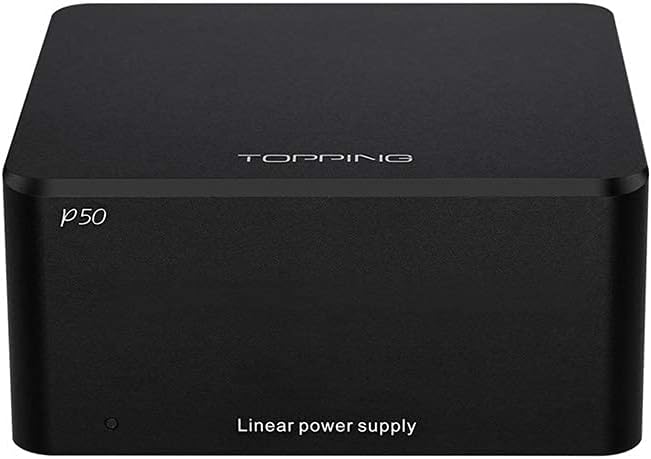
The Topping P50 is a dedicated linear supply for Topping D50III, D50s, D50, A50, A50III, E50, and DX3 Pro+ equipment. It has a 4.4 customer rating and provides separate 5V and 15V outputs rated at 1A each. That defined ecosystem focus gives it a clear role: it is designed to provide a controlled, low-noise upgrade for compatible components.
We may earn a commission when you buy through this link, at no additional cost to you.
The sealed toroidal transformer is designed to limit magnetic leakage and suppress electromagnetic noise. Separate 5V and 15V modules include substantial capacitor reserves—more than 8,000μF for 5V and more than 10,000μF for 15V—while three TPS7A4700 regulators provide low-noise, high-precision regulation. The unit also supports 115V and 230V mains inputs at 50/60Hz.
Its main limitation is that each output is limited to 1A. That is sufficient for many compact source components, but it is not a universal solution for high-current headphone amplifiers, power amplifiers, or devices that need other voltages. The separate outputs also mean there is no universal choice between 5V and 15V for a given port; buyers must match each lead to the correct device.
The P50 is an excellent choice for a Topping-based system and a sensible option for anyone who values the company's established device pairing. Its global voltage support makes it more accommodating for international installations. For listeners outside that ecosystem, the Fosi Audio PSU20's selectable voltage system or the PR2's broader 5V-to-12V range may be easier to deploy, but within compatible Topping systems this model offers a focused upgrade path.
The P50's fixed 5V and 15V architecture removes guesswork when it is used with the listed Topping models. It is a natural fit for a source chain built around the D50, E50, A50, or DX3 Pro+ families.
Substantial capacitor banks in both voltage modules provide the stated energy reserve. That architecture is intended to support stable delivery and precise regulation within the supply's 1A-per-output limits.
We may earn a commission when you buy through this link, at no additional cost to you.
The FiiO Darkside PRO is a premium linear supply for DACs, headphone amplifiers, streamers, digital transports, and other compatible hi-fi equipment. Its 5.0 rating and comprehensive component specification make it one of the most compelling premium options. A custom 75W toroidal transformer supplies the power, while the 12V or 15V output can deliver up to 3A.
We may earn a commission when you buy through this link, at no additional cost to you.
Its fully discrete NMOS regulation circuit uses dual MOSFET parallel output stages to provide low output impedance, strong transient response, and high current capability. The component list is unusually deliberate, including a Japanese SHINDENGEN D15XB60 rectifier bridge, ELNA capacitors, Rubycon filter capacitors, WIMA film capacitors, and a silver-plated monocrystalline copper DC cable.
Voltage selection uses an internal relay-controlled switching system designed to improve efficiency and reduce heat. That arrangement makes the change between 12V and 15V more involved than turning a conventional front-panel selector. The unit also uses a rigid ventilated aluminum enclosure to dissipate heat, reduce vibration, and limit electromagnetic interference, with precision voltage adjustment and self-resetting overcurrent protection.
The Darkside PRO is a strong recommendation for listeners who want more output headroom and a premium discrete power path, particularly within a FiiO desktop ecosystem. It is less suitable for 5V-only equipment or buyers who require multiple output voltages beyond 12V and 15V. The premium complexity is justified when the connected components can exploit its current capability, transient response, and carefully selected internal components.
A 75W transformer and 3A output distinguish the Darkside PRO from smaller source-focused supplies. Those reserves can suit compatible headphone amplifiers and other equipment that asks for stronger current delivery during dynamic passages.
Japanese rectifiers, ELNA and Rubycon filtering capacitors, WIMA film capacitors, and the specified DC cable reflect attention to the entire power path. The design treats external power cabling as part of the system rather than an incidental accessory.
We may earn a commission when you buy through this link, at no additional cost to you.
The HiFi 19V Linear Power Supply is a high-current option aimed at equipment requiring 19V DC, including compatible DACs, amplifiers, and routers. It carries a 5.0 rating and a stated 4.2A current capacity. Its fully discrete, single-pass series regulator is designed for high-accuracy output, low impedance, rapid response, and dependable operation in audio and instrumentation applications.
We may earn a commission when you buy through this link, at no additional cost to you.
Output noise is listed as less than 13μV even at the maximum 24VDC output, with lower noise at lower voltages. The manufacturer also offers the SUPER-PSU family in 5V, 9V, 12V, 15V, 18V, 19V, and 24V versions. This particular listing corresponds to 19V, making it less general-purpose than a selectable supply but potentially ideal for a device that cannot use a common 12V adapter.
The key caution is exact compatibility. A 19V source should only be connected when the equipment's manual specifies 19V and an appropriate current and connector. Linear supplies are not automatically interchangeable, and the high-current capacity does not resolve a mismatched voltage. Buyers should also confirm grounding and polarity before installation.
This model is recommended for a listener with a 19V component that needs more current than a modest desktop adapter can provide. Its high rating and low stated noise make it attractive for that niche, while the precision regulation architecture supports the premium positioning. For more common equipment, one of the 12V or selectable-voltage models offers greater compatibility, but for a correctly matched 19V requirement, this supply brings substantial capacity.
The 19V configuration is valuable because not every compact amplifier, router, or DAC accepts standard 12V. This model provides a dedicated alternative with considerably more current capacity than many small external adapters.
The discrete series-regulator topology is intended to provide accurate voltage and low output impedance. The stated combination of high current, fast response, and low power consumption supports demanding but relatively compact audio applications.
We may earn a commission when you buy through this link, at no additional cost to you.
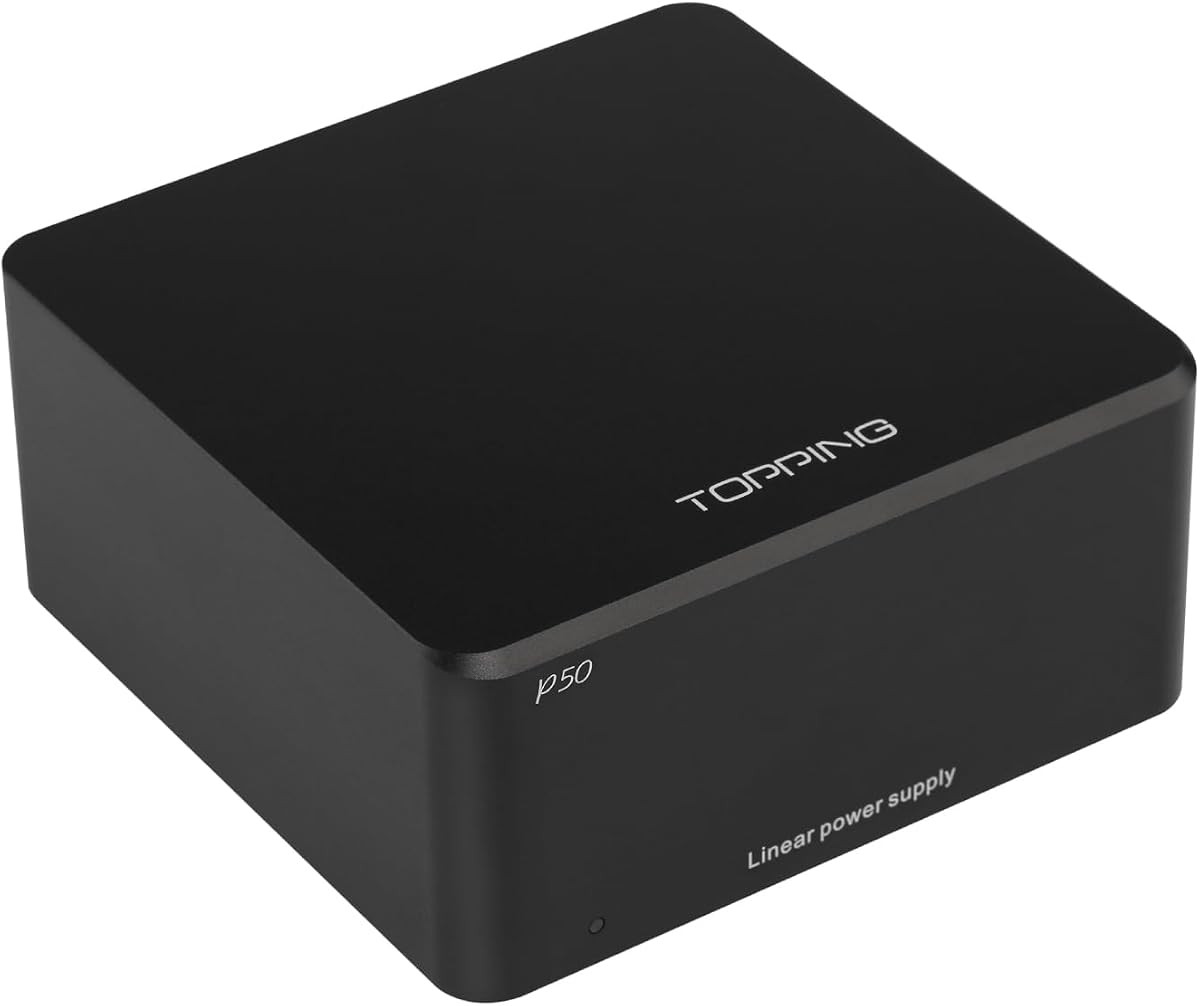
The Topping P50 Black is another dedicated solution for the Topping D50III, D50s, DX3 Pro+, and E50 ecosystem. It shares a 4.4 rating and provides dedicated 5V and 15V outputs, making its intended use very clear. The distinguishing presentation detail is its CNC unibody aluminum enclosure, which the manufacturer describes as improving mechanical strength, durability, and resistance to interference.
We may earn a commission when you buy through this link, at no additional cost to you.
Internally, the design uses a sealed toroidal transformer to reduce magnetic leakage and noise. The 15V module includes 10,000μF of capacitance, while the 5V module includes 8,000μF, providing an energy reserve for stable delivery. Three TPS7A4700 ultra-low-noise linear regulators support high-precision regulation for the specified compatible devices.
Like the standard P50, its fixed output architecture is restrictive for mixed systems, and the listed 1A limit may not suit more demanding amplifiers. A buyer may also find the two Topping P50 listings difficult to distinguish from the titles alone. Carefully checking the enclosure description, included connections, warranty, and current seller information is important before selecting one listing over the other.
The P50 Black is a solid recommendation for a Topping system where a dedicated, globally compatible supply is desired. Its one-piece enclosure and low-noise regulator arrangement fit the same established role as the P50 while offering a distinctive black finish and a more rugged-looking chassis. Outside compatible Topping equipment, the broader voltage choices of the Fosi Audio PSU20 or PR2 may be more practical.
Machining the enclosure as a single aluminum structure is intended to improve rigidity and reduce vibration. The result also provides a stable platform for the transformer and filtering components.
The P50 Black uses familiar Topping power architecture, including sealed toroidal transformation and three TPS7A4700 regulators. It is most compelling when paired with the compatible source components identified in the product title.
We may earn a commission when you buy through this link, at no additional cost to you.
The right linear power supply depends less on marketing language than on electrical compatibility. Begin with your devices' required voltage, polarity, connector, and current, then consider filtering, isolation, output count, transformer capacity, thermal needs, and regional mains support.
Voltage is the first and least flexible requirement. A supply rated for 12V should not be connected to a device expecting 5V, 15V, 19V, or another level. Polarity must also match because reversing center-positive and center-negative power can damage equipment. Check the original adapter, the device manual, and the connector markings rather than inferring the configuration from the plug shape. For a mixed system, a selectable model such as the Fosi Audio PSU20 may be more convenient than several fixed-voltage units.
Current capability determines whether a supply can sustain the connected equipment without strain. The device's power rating should remain below the supply's maximum, while extra headroom is useful for transient loads and future changes. Be careful with dual-output models because their listed current may be shared across both ports. The PR2 illustrates this point: its maximum changes between 5V and 12V, so the combined draw must be checked rather than comparing each port in isolation.
A power supply cannot be used simply because its voltage and current are correct. The barrel plug's outer and inner diameters must match, and some products use proprietary or larger connectors such as GX16-2. USB-equipped versions may suit accessories that use USB-A power, but they do not make a USB data connection. Review the included leads and the physical space available on a shelf or behind an equipment rack before making a final choice.
Linear regulation is only one part of low-noise performance. Toroidal transformers can limit magnetic leakage, while EMI filters, rectifier stages, capacitor arrays, and CLC filters suppress noise at different frequencies. The Douk Audio D2-PRO and LHY Audio LPS50 place particular emphasis on deep filtering, while the Topping models emphasize precision regulators and capacitor reserves. Compare published ripple figures only with caution because test loads, bandwidth, and measurement methods may differ.
Independent outputs and isolated grounds may help when several components create ground loops or when one device's switching activity could influence another. The Fosi Audio PSU20 explicitly isolates its outputs, while other dual-output designs share the overall supply capacity. A multi-output unit can reduce cable clutter, but it only solves ground and noise problems if the connected equipment is actually compatible. Test each configuration and use quality interconnects where appropriate.
Transformer wattage or VA provides a broad indication of available power, but headline capacity does not guarantee a continuous full-power output under every thermal condition. Products range from a focused 15W design to 75W or 80W platforms. Larger supplies offer greater flexibility but may generate more heat and need unobstructed ventilation. Match capacity to realistic demand rather than choosing the largest unit regardless of the components involved.
Overcurrent, overvoltage, and overheat protection can add confidence, particularly when several devices share one supply. Linear supplies can become warm because the voltage difference between the transformer and target output is dissipated as heat. Passive units are silent but may require more clearance, while a fan-assisted model can manage heat with added mechanical noise. Follow the supplied ventilation guidance and avoid enclosing a power supply in a tightly packed cabinet.
A model intended for 115V mains may not be appropriate for a 220V to 240V region, and the reverse is equally important. The Topping P50 listings explicitly support both 115V and 230V inputs at 50/60Hz. For any other supply, look for its input rating and manufacturer support information. International voltage support does not mean that every connector or device configuration is universal, so check the complete system before purchase.
Begin by recording the voltage, polarity, connector size, and current requirement of every device you intend to power. Connect the power supply to the appropriate component first, observe the output indication, and only then energize the system. For dual-output units, calculate the combined load and connect each device to the correct voltage and polarity. Never use a supply with a lower output voltage or incorrect polarity merely because the connector appears to fit.
Place the unit on a stable, ventilated surface and away from sources of vibration, direct heat, dampness, and direct sunlight. Linear supplies can become warm during sustained use, so leave room around the enclosure and follow any guidance concerning airflow. A common arrangement places the power supply near the powered components but away from network switches or other devices that may generate electrical noise. Keep output leads from crossing mains or high-current cables where practical.
For care, use a soft dry cloth and keep liquids away from the enclosure and controls. Do not open the unit, alter the wiring, or connect incompatible loads. Check cable insulation and connectors periodically, especially if the supply is moved frequently. Allow the unit to reach room temperature before operating it after a long transport or storage period, and consult the seller or manufacturer if the output indication, voltage, connector, or protection behavior appears abnormal.
A well-designed linear supply can provide a quieter noise floor and stable DC output, which many listeners value in sensitive source components. However, the audible result depends on the complete system, the original adapter, electrical layout, and the specific product. Linear supplies also produce more heat and may offer fewer voltage options, so they are not automatically superior in every installation.
Yes, if every device uses a matching voltage and the combined current remains within the supply's rating. Dual-output models such as the Fosi Audio PSU20, Douk Audio D2-PRO, and PR2 can simplify a system, but current is often shared across outputs. Check connector sizes, polarity, selected voltage, and total power draw before connecting multiple devices.
Read the input specification on the device or examine the label on its original power adapter. The voltage and polarity must match, and the original adapter's current rating should be treated as a minimum indication of the required current. Never infer the requirement from a barrel connector's diameter, because several connector sizes can carry different voltages and polarities.
No. Ripple figures can be measured with different loads, bandwidths, instruments, and grounding conditions, so values from different brands may not be directly comparable. Transformer design, filtering, isolation, regulation stability, mechanical quality, and the rest of the audio system also matter. Use low ripple as one useful comparison point rather than the only criterion.
Isolated outputs can reduce ground loops when they interrupt an unwanted path between components, but they cannot correct every connection problem. A connected USB or data cable may create another ground route, and incorrect wiring can defeat the benefit. Confirm that the source equipment supports isolated power and experiment with the correct arrangement rather than assuming isolation solves all noise issues.
It can. Linear regulation dissipates the difference between the transformed voltage and the selected output as heat, especially under sustained high load. Provide clear airflow around the enclosure and avoid tightly enclosing the unit. A fan-assisted design may reduce thermal stress but can introduce its own low mechanical noise.
No. Connecting a 19V source to a 12V device can cause immediate damage or failure. Voltage must match exactly, and polarity must also be correct. The 19V-rated HiFi model is intended for equipment explicitly designed for 19V, so consult the device manual before considering it.
The included lead must have the correct connector, dimensions, and polarity, but it does not necessarily need to be a proprietary cable. High-quality replacement cables can sometimes reduce vibration or connection issues, although audible improvements are system-dependent. Preserve the original cable when possible because connector fit and conductor sizing are likely to have been matched to the product.
The Fosi Audio PSU20 stands out for flexible 5V, 12V, and 15V operation, isolated outputs, and an additional USB-A connection. The DoukAudio D2 5V offers a focused, highly rated 5V solution for small desktop systems, while the FiiO Darkside PRO represents the premium selection with a 75W transformer, 3A capability, discrete NMOS regulation, and carefully selected components.
Prioritize exact electrical compatibility before any other consideration. Confirm voltage, polarity, connector size, current draw, grounding, regional mains input, and available ventilation. Then consider whether you need one dedicated supply, selectable outputs, dual outputs, isolation, or a larger power budget. A lower-noise supply is most useful when it cleanly matches the equipment and solves a real power requirement in the system.
Ratings, technical claims, configurations, and product availability can change over time, and market prices also fluctuate. Review the current listing and manufacturer information before purchasing, particularly for connector details, output limits, included accessories, warranty terms, and the exact model variation. Those final checks help ensure that the selected linear power supply integrates cleanly into the intended audio system.