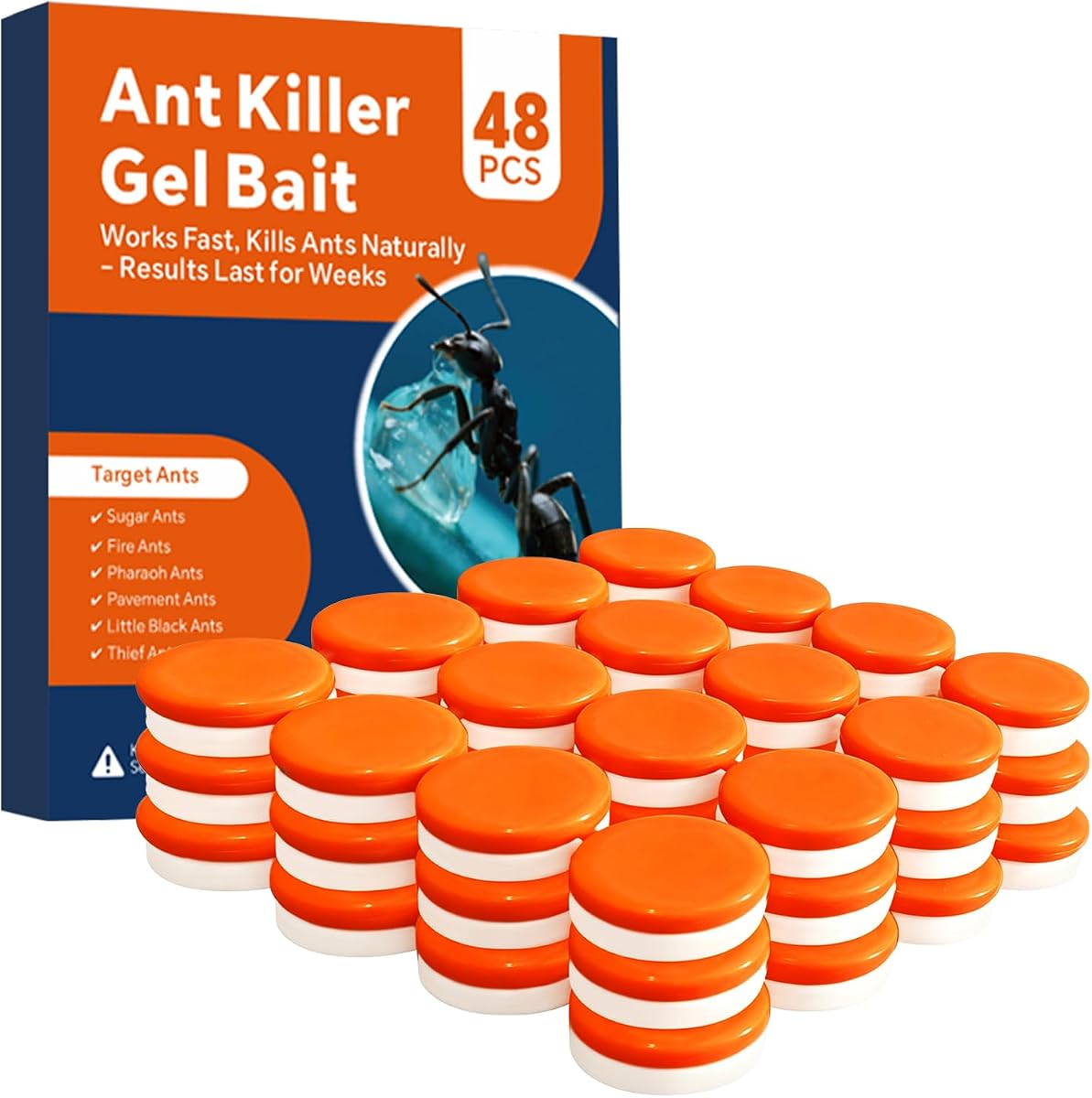
48 Pack Slow-Acting Ant Gel Bait
4.6Editor score
Large 48-station set
Indoor and outdoor placement
Slow-acting gel formula
Discover the best carpenter ant traps by comparing bait formulas, pack sizes, indoor and outdoor designs, colony control, and ease of use.
Carpenter ant traps are most useful when they can attract foraging workers and transfer a slow-acting bait back into the colony. The best choice depends on whether ants are entering from outdoors, nesting inside structural areas, or moving through kitchens, bathrooms, and other high-traffic rooms. Product design, active approach, coverage, and safe placement all matter.
This guide compares ten ant bait products using only supplied product information, with particular attention to whether each trap is labeled for carpenter ants, where it can be used, and how it targets the colony. The list includes general household ant baits, outdoor stakes, gel stations, and a granule product specifically marketed for carpenter ant control.
Each review explains the product's strongest feature, practical trade-offs, and best-fit use. The top selections emphasize explicit carpenter ant targeting, colony-level bait delivery, and practical placement, while the buyer should note that several popular household ant baits expressly exclude carpenter ants. Product availability and prices change, so confirm current listing details before purchasing.
4.6Editor score

4.1Editor score

4.5Editor score
The table below compares all ten products by their supplied naming, format, intended location, and colony-control approach. Because several general-purpose ant baits are not labeled for carpenter ants, inclusion in this comparison does not mean every product is suitable for that species.


The TERRO T300B combines a 12-pack of ready-to-use liquid bait stations with a 4.6 rating, making it one of the strongest general indoor choices in this guide. Its borax-based formula is designed to attract workers that then carry the bait back to the colony, extending the treatment beyond the ants visible near the station.
We may earn a commission when you buy through this link, at no additional cost to you.
A major strength is the simplicity of placement. Users can position stations along baseboards, in corners, on countertops, and in other areas where ants frequently travel without assembling a trap or mixing bait. The product also targets acrobat, crazy, ghost, little black, odorous house, and pavement ants, while the supplied information says that complete control may take two to four weeks depending on infestation size.
The important limitation is species relevance. Although carpenter ants may be attracted to liquid bait, the listed target species for this particular T300B package do not explicitly include carpenter ants. It should therefore be treated as a general household ant solution unless the current label confirms suitability for the species causing the infestation.
This product is a good fit for homeowners seeking an uncomplicated indoor station for ants already entering living spaces. It is less compelling for someone who needs an explicitly carpenter-ant-labeled outdoor intercept or a product guaranteed by its supplied description to target carpenter ants. Confirm the label and identified species before use.
Worker ants carry consumed bait into the nest, where it can be shared with colony members. That mechanism is more useful for long-term control than simply removing visible workers at the station.
Baseboards, corners, counters, and other travel routes give the stations several sensible placement options. More stations along active trails may improve coverage across a larger home.
We may earn a commission when you buy through this link, at no additional cost to you.
This 18-count TERRO T300-3SR package earns a 4.6 rating and differs from the smaller station pack mainly through its broader room-to-room coverage potential. It is a ready-to-use indoor liquid bait designed to attract ants and facilitate transfer into the colony rather than relying on a barrier that only blocks entry.
We may earn a commission when you buy through this link, at no additional cost to you.
The supplied description highlights noticeable reductions in ant activity within days as workers carry the bait back to the colony. Placement flexibility is another advantage: stations can go along baseboards, into corners, and onto counters, making it easier to surround trails, pause points, and feeding areas without a complicated setup.
Carpenter ants are not named among the explicitly targeted varieties in the supplied product information. That distinction matters because consumers searching specifically for carpenter ant traps should favor a product whose label or description identifies the species. This TERRO package may still attract ants that investigate liquid bait, but that is different from having clear labeling for carpenter ant control.
Choose this option when the concern is an indoor infestation involving common household ants or when multiple stations are needed to cover several areas. For confirmed carpenter ants, first verify the species and then compare the label with products specifically formulated for them.
The larger station count supports a distributed strategy. Placing stations near several trails can help workers encounter bait before reaching more sensitive indoor areas.
Because foraging workers transport the bait, treatment can continue beyond the point where an ant is seen. Continued visitation is important for maintaining effective control.
We may earn a commission when you buy through this link, at no additional cost to you.
The TERRO outdoor stake system takes a different approach from indoor floor stations by intercepting ant activity in the yard before it becomes an indoor problem. Its 4.5 rating reflects a practical design that combines ready-to-use installation with monitoring of active bait consumption.
We may earn a commission when you buy through this link, at no additional cost to you.
Each stake uses an insert-and-cut format: push it into the ground where ant activity is visible, cut the tab, and allow workers to visit the bait. The see-through housing helps users monitor feeding and determine when a station may need replacement, while the supplied description says the stations are designed to work through various weather conditions.
Although the package targets acrobat, crazy, ghost, and little black ants, it does not explicitly identify carpenter ants. Its value for a carpenter ant problem therefore depends on whether these ants are using the same outdoor foraging routes and whether the current product label permits the intended application.
This is the top budget-oriented pick for a homeowner who has identified an outdoor trail near the foundation and wants to stop ants before they enter. It is especially useful when the interior is not yet heavily infested. For a nest confirmed inside structural material, an explicitly carpenter-ant-labeled product is a more direct choice.
Placing the stakes on active outdoor trails can address ants before they become an indoor nuisance. This approach is particularly useful around entries and frequently traveled exterior areas.
The transparent housing makes it easier to see whether ants are consuming the bait. That visual feedback helps guide replacement and placement decisions.
We may earn a commission when you buy through this link, at no additional cost to you.
This 48-pack gel bait product stands out because its supplied description explicitly identifies carpenter ants and combines indoor and outdoor use with a 4.6 rating. Its slow-acting formula is designed to let worker ants consume the bait and carry it back to the nest, where it can be distributed to the queen, larvae, and other colony members.
We may earn a commission when you buy through this link, at no additional cost to you.
The large quantity offers unusually broad placement coverage. The stations can be attached to floors, walls, or cabinet bases with included double-sided adhesive, allowing users to address kitchens, bathrooms, living rooms, basements, patios, porches, lawns, garages, and yard perimeters. Prefilled stations eliminate bait squeezing and complicated setup.
The principal trade-off is bulk. Forty-eight units may be more than a small household needs, and adhesive mounting can be inappropriate on dusty, wet, porous, or frequently cleaned surfaces. The claims of long-lasting and colony-wide elimination still depend on ants visiting the bait and on proper placement along their activity routes.
This is the best premium pick for a homeowner willing to build a comprehensive monitoring and treatment network, especially when the infestation involves carpenter ants. It is also appropriate for larger properties, multiple rooms, or a combined indoor-outdoor program. Use the stations where ants are actually traveling and replace depleted units as directed.
A 48-station set allows treatment to extend beyond a single room or property zone. Numerous placements can intercept multiple trails and provide replacement capacity as stations are consumed.
Unlike many general-purpose entries in this guide, the supplied description specifically names carpenter ants. That makes the labeling more closely aligned with the keyword and the intended target.
We may earn a commission when you buy through this link, at no additional cost to you.
The BASF Advance Carpenter Ant Bait Granules are the most explicitly specialized product in the guide, with a product name that directly identifies carpenter ants and a supplied label covering many common household species. Its 4.1 rating reflects a focused, professional-style approach rather than the convenience of a prefilled station.
We may earn a commission when you buy through this link, at no additional cost to you.
The active ingredient is abamectin at 0.011%, and the delayed action is intentional. Worker ants pick up the larger-grit granule and carry it back to the colony, allowing the ants' food-sharing behavior to expose more members. The product can be used indoors or outdoors and lists carpenter ants alongside acrobat, Argentine, bigheaded, crazy, field, fire, harvester, little black, odorous house, pavement, pharaoh, and thief ants.
Safety is the main consideration. The supplied information says the bait is hazardous to humans and domestic animals, toxic to fish and wildlife, and subject to state restrictions. Users must read and follow the label's safety and application instructions, keep the product away from children and pets, and use it exactly as directed.
This is the editor's choice because it most directly addresses the specified pest with a delayed colony-transfer mechanism and broad application options. It is best for consumers willing to follow granular bait application instructions carefully. Those seeking a low-mess station system may prefer the gel bait, while anyone needing the most direct carpenter-ant labeling should start here.
The product is formulated and labeled for carpenter ants as well as many other household species. That direct species focus distinguishes it from baits that exclude carpenter ants from their listed uses.
The delayed action gives ants time to carry bait back to the nest. This approach uses colony communication and food sharing instead of relying solely on immediate contact.
We may earn a commission when you buy through this link, at no additional cost to you.
The Ortho Orthene 12 bait stations offer a straightforward indoor treatment with a 4.1 rating. Each station is placed label side down where ants have been observed, allowing foraging workers to find the bait and share it with the rest of the colony.
We may earn a commission when you buy through this link, at no additional cost to you.
Placement guidance is specific: baseboards, room and cabinet corners, pipes, pantries, window sills, doorways, and garbage cans are all suggested. The product description says fewer ants may be seen within three to seven days, while the underlying goal is to attack the source by reaching the queen and colony rather than merely killing visible ants.
Most importantly for this guide, the supplied information explicitly states that the product is not labeled for use against fire, carpenter, and harvester ants. That makes it unsuitable as a first-choice carpenter ant treatment according to the provided labeling, even though its food-sharing delivery method may sound similar to products that are labeled for carpenter ants.
This product may be useful in a mixed household ant situation involving other eligible species, but a homeowner dealing specifically with carpenter ants should select a product that names the species. Its easy setup remains a plus, but correct species labeling should take priority over general convenience.
The stations require little preparation beyond separating them and placing them correctly. This makes them approachable for targeted indoor treatment along visible travel routes.
Carpenter ants are expressly excluded from the supplied use information. Buyers should not infer suitability from the product's general colony-control claims.
We may earn a commission when you buy through this link, at no additional cost to you.
This ASIN is included to preserve the requested one-review-per-product structure, but the supplied dataset provides no title, rating, image, price information, description, or verified specifications. It is not possible to responsibly identify the item or evaluate its bait format, species coverage, placement method, or colony-control mechanism from the available evidence.
We may earn a commission when you buy through this link, at no additional cost to you.
Consumers should approach this listing cautiously and verify that it actually describes carpenter ant control. The most important details to confirm are the active ingredient, whether carpenter ants appear on the label, whether the product is for indoor or outdoor use, and whether the bait is delivered in prefilled stations, granules, gel, or another format.
Without those facts, claims about effectiveness, ease of use, safety, or colony elimination would be speculation. The absence of a supplied rating also means there is no verified customer feedback in the data available for this roundup. Any visual assessment is likewise impossible because no image URL was supplied.
This entry is not recommended as a blind purchase. Use the direct listing to confirm identity and labeling, and compare it with a clearly identified carpenter ant bait before deciding. The other nine products in this guide have enough supplied information to support a more transparent recommendation.
Open the listing and confirm the full product name, active ingredient, species label, package quantity, and application directions. Those details are essential for determining whether it belongs in a carpenter ant treatment plan.
Because no product facts were supplied, this review makes no claim about speed, longevity, colony control, or indoor and outdoor suitability. Clear labeling should be the deciding factor.
We may earn a commission when you buy through this link, at no additional cost to you.
The Ortho Home Defense four-pack uses compact metal bait stations to deliver food-based gel, and its supplied information describes a colony-focused approach. Worker ants enter the activated station, consume the bait, and return to contaminate the nest, with the stated goal of reaching the queen and colony within 24 hours.
We may earn a commission when you buy through this link, at no additional cost to you.
The metal housing offers practical containment around the pesticide, while the activation process is simple: remove the station, puncture the metal housing, identify affected areas, and place it where ants are active. The product description refers to using the stations indoors and outdoors, which adds placement flexibility for trail-based treatment.
The supplied target list includes pavement, acrobat, pyramid, white-footed, little black, and Argentine ants, but it does not explicitly identify carpenter ants. As a result, the quick colony-targeting language should not be treated as proof of species-specific suitability. The four-unit count may also be modest for a property with many active trails.
This product fits homeowners seeking a compact, contained station system for common household ants. It may be especially attractive where a loose bait format would be inconvenient. For carpenter ants specifically, verify the current label or select one of the explicitly carpenter-ant-targeted products in this guide.
The casing helps keep the bait gel enclosed during use. That containment can be useful around active travel routes where an open bait deposit would be less tidy.
Four stations are straightforward to position but may not cover a large home or yard. The best results depend on placing each unit directly where ants are traveling.
We may earn a commission when you buy through this link, at no additional cost to you.
The Hot Shot MaxAttrax package includes eight child-resistant bait stations and carries a 4.1 rating. Its strongest distinguishing feature is the station design, which adds a visible containment layer for households where children may encounter floor-level traps.
We may earn a commission when you buy through this link, at no additional cost to you.
The product is intended for use near walls, in closets and cabinets, under sinks and refrigerators, and along exterior trails. The supplied description says it starts killing ants within hours, reaches hidden colony members and the queen, and can work for up to six months indoors when properly positioned.
Carpenter ants are not explicitly named among the product's target species in the supplied information. That makes the child-resistant format appealing but not enough on its own to establish suitability for a carpenter ant infestation. Users should also verify the current label for the precise active ingredient and placement directions.
This is a useful choice for a household that values child-resistant bait stations and wants to treat both indoor and outdoor activity. Place one station along each exterior trail and several in problem areas only after identifying where ants travel. For explicitly labeled carpenter ant control, consider a more directly targeted product.
The closed stations are designed to reduce direct access to the bait. They remain pesticides and should still be kept away from children and pets.
Use stations in cabinets, under appliances, near walls, and along exterior trails. Accurate observation of travel routes is more useful than scattering stations randomly.
We may earn a commission when you buy through this link, at no additional cost to you.
The Raid MAX liquid bait stations are prefilled and ready to use, with a supplied rating of 4.0. Their bait-transfer mechanism is designed to reach the queen, other workers, and larvae after foraging ants consume the liquid and return to the colony.
We may earn a commission when you buy through this link, at no additional cost to you.
They can be used indoors or outdoors and cover a broad list of listed ants, including foraging, sweet-feeding, pavement, moisture, little black, Argentine, crazy, acrobat, bigheaded, cornfield, ghost, and odorous house ants. Prefilled liquid stations offer a straightforward application without mixing or transferring bait by hand.
The decisive limitation appears in the supplied product description: Raid MAX excludes fire ants, carpenter ants, harvest ants, and pharaoh ants. It should not be presented as a carpenter ant trap merely because it uses liquid bait and a colony-transfer method. The product's strongest application is against eligible common household species.
This package is worth considering for broad household ant management rather than a confirmed carpenter ant infestation. Its ease of use and dual-location capability are helpful, but the species exclusion makes it a mismatch for the central purpose of this roundup. Check the actual ants present before choosing it.
Prefilled stations eliminate preparation steps and reduce the chance of accidental handling. They can be deployed along indoor and outdoor travel routes.
Carpenter ants are expressly excluded in the supplied information. For this category, a clearly labeled carpenter ant bait is the more relevant choice.
We may earn a commission when you buy through this link, at no additional cost to you.
Selecting an effective carpenter ant trap requires more than comparing package counts. The product must be labeled for the target species, suited to where ants are traveling, and capable of delivering bait back into the colony without creating unnecessary exposure or mess.
The most important filter is whether the manufacturer explicitly labels the bait for carpenter ants. Some liquid and gel products target common household species while expressly excluding carpenter ants, so general colony-control language does not prove that a product is appropriate. Review the current label, species list, and directions before purchasing, especially when the ants have been identified by appearance or professional inspection.
Liquid, gel, granule, and stake formats deliver bait in different ways. All of the better-documented options in this guide rely on worker ants carrying bait toward the colony, but granule grit, prefilled liquid, adhesive gel stations, and push-in stakes suit different spaces. Consider where you can apply the product without disrupting the trail, creating spills, or placing an object where it will be stepped on or disturbed.
Carpenter ants may forage outdoors and enter a structure through cracks, doors, windows, or utility openings, while other carpenter ant problems are centered within the building. Products intended only for indoor use should not be assumed suitable for exterior soil or weather exposure. Outdoor stakes are useful at entry areas, while indoor stations are better reserved for rooms, cabinets, basements, and other protected spaces.
A trap that kills only the ants around it may provide temporary relief without resolving the colony. Look for products that exploit food sharing or a similar behavior so workers can transfer active bait to nestmates, including the queen where the label makes that claim. The time needed for colony reduction can vary, and bait must continue to be visited for this process to work.
Package size affects how many active locations can be monitored at once. A large set of gel stations can cover several rooms, exterior edges, and replacement needs, while a compact four- or eight-station pack may be more practical for a small, focused infestation. Count the number of distinct trails and problem areas rather than assuming one station is sufficient.
Ready-to-use stations require less handling and make it easier to maintain treatment along trails. Prefilled gel or liquid products are convenient, while granule bait offers placement flexibility but requires the user to follow application instructions carefully. Adhesive-backed stations need a clean, suitable surface, and ground stakes need secure insertion into the soil.
All ant baits are pesticides and should be used according to the label. Keep stations and loose bait away from children, pets, food preparation surfaces, and areas where they could be picked up. Pay attention to warnings about fish, wildlife, water, and state restrictions. Never assume that a product labeled for one ant species or one environment is automatically suitable for every use.
Begin by identifying where carpenter ants are entering, traveling, and nesting. Inspect around doors, windows, utility openings, baseboards, cabinets, basements, garage edges, and exterior areas where workers gather. Place traps along confirmed trails or nearby feeding areas rather than in an arbitrary location, since bait only works when ants find and consume it.
Activate each station according to its instructions. Prefilled liquid or gel stations may need to be opened or punctured, while outdoor stakes are pushed into the soil and cut at the designated tab. Position stations away from places where they will be crushed, washed away, removed, or accessed by children or pets. Do not spray another pesticide over bait stations, as competing products can discourage ants from feeding.
Monitor the stations for ant activity and bait depletion. Replace depleted units, move stations if workers are avoiding them, and continue monitoring until activity stops and the relevant label direction for removal or duration is satisfied. Seal obvious entry points only after addressing nearby ant traffic, and keep bait away from food, utensils, dishes, counters, and other surfaces where it could contaminate food.
No. Several general household ant baits in this guide explicitly exclude carpenter ants from their labeled uses. Check the species list on the current package before buying, and prioritize products that name carpenter ants directly when the infestation has been confirmed. A shared delivery method alone does not make a general bait product species-appropriate.
Results depend on the product, infestation size, bait placement, and whether ants continue visiting the stations. Some products describe visible activity reduction within days, while complete colony control may take several weeks. Colony-targeted bait often works gradually because workers must carry it back and distribute it through the nest.
It depends on where you observe the ants. Outdoor intercepts are useful along active trails near the foundation, while indoor stations belong near entry points, cabinet bases, baseboards, basements, and other travel routes. Some products are labeled for both environments, while others are restricted to indoor use, so the package directions control.
Visible ants may not have discovered the bait yet, may prefer another food source, or may be traveling along a route that does not pass close to the station. Place more stations near the actual trail, keep competing food sources clean, and avoid spraying repellent products over the bait. Persistent avoidance may indicate that the placement needs adjustment.
No. Each format has its own label directions, application method, and suitable environments. Liquid and gel stations are generally positioned along travel routes, granules require the specified application process, and outdoor stakes are inserted into soil. Use only the format and placement method described by the manufacturer.
The correct number depends on the number of distinct trails, rooms, entry points, and outdoor foraging areas. A four-station pack may suit a small focused problem, while a 48-station set allows broad placement and replacement across a larger property. More stations are not automatically better if they are placed where ants do not travel.
They contain pesticide and must be used according to the label. Some products use child-resistant stations, but that feature does not make the bait harmless or replace careful placement. Keep stations inaccessible to children and animals, away from food and utensils, and follow all warnings concerning pets, fish, wildlife, and other environmental risks.
Professional assessment is sensible when ants appear inside structural framing, when damage is visible, when trails persist despite properly placed bait, or when the species cannot be confirmed. A qualified pest professional can distinguish carpenter ant activity from other household ants and recommend treatment appropriate to the location and extent of the infestation.
The BASF Advance Carpenter Ant Bait Granules are the strongest specialized choice because they explicitly target carpenter ants and use delayed worker transfer to reach the colony. For a broad adhesive-mounted program with 48 stations, the slow-acting ant gel bait offers the most extensive placement coverage. The TERRO outdoor stakes are a practical budget pick when the priority is intercepting ants around the exterior before entry.
Correct species labeling should come before package size, format, or broad colony-control claims. Products such as Ortho Orthene and Raid MAX expressly exclude carpenter ants in the supplied information, even though their liquid or gel stations can be effective against eligible household species. For other products, verify the current label because listings and approved uses can change.
Finally, compare the product's intended environment with the places where you actually see ants, and plan to monitor stations rather than expecting immediate disappearance. Product availability and prices change, so check the current listing, package contents, safety instructions, and application directions before making a final purchase.