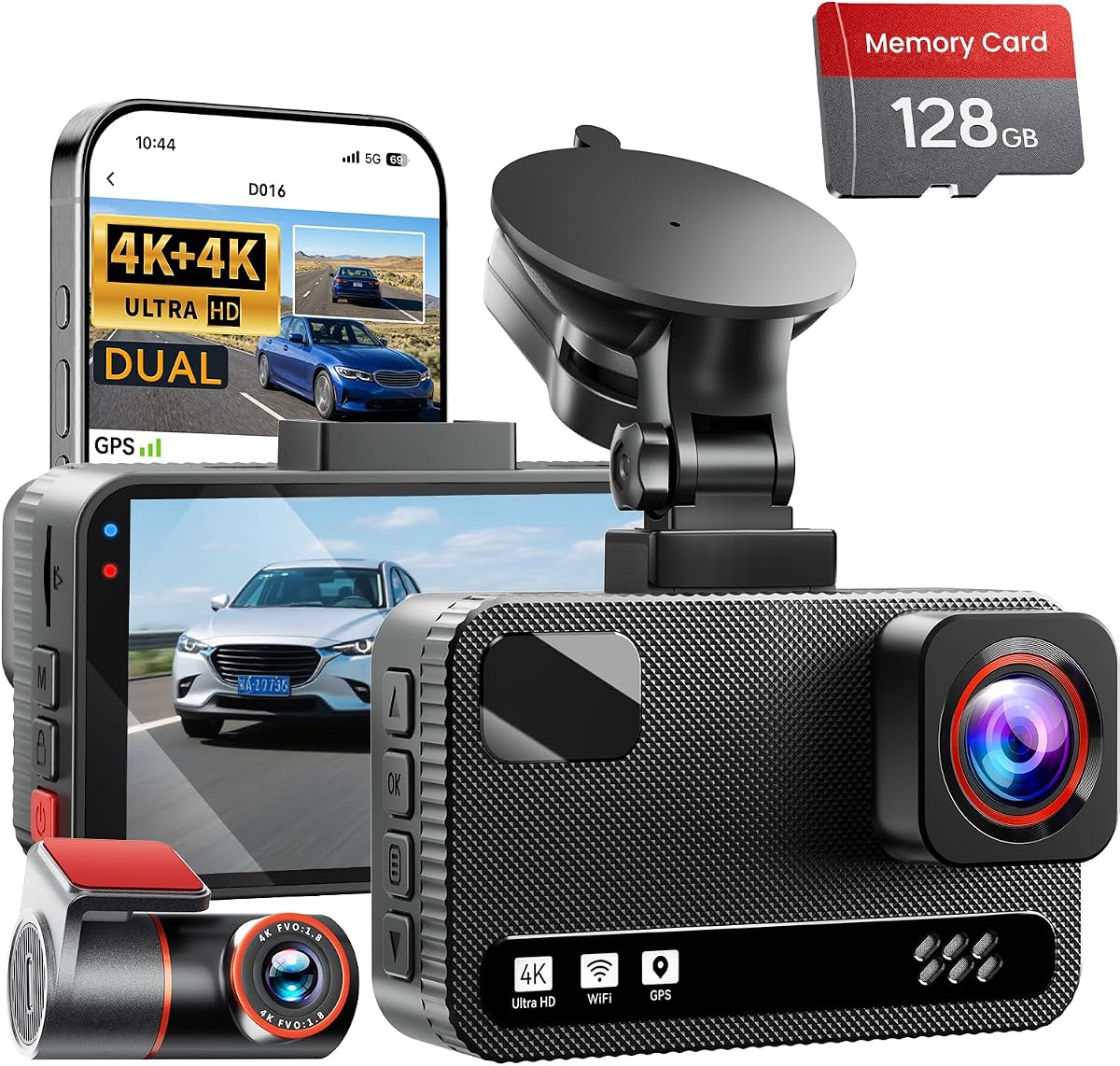
4K+4K Dual Dash Cam
4.9Editor score
True 4K front and rear
Starlight-level low-light sensor
Included 128GB memory card
This guide compares the best Dual Dash CAM under 300 options, covering front and rear video, night vision, parking mode, GPS, Wi-Fi, and storage.
A dual dash camera records the road ahead and behind your vehicle at the same time, giving you broader protection against disputes, reckless drivers, parking impacts, and unexpected incidents. The right model should balance sharp daytime detail, dependable low-light performance, intuitive controls, and reliable storage without exceeding your intended budget.
We compared all ten cameras using the supplied specifications, focusing on front and rear resolution, sensor technology, field of view, night performance, parking surveillance, connectivity, navigation data, and installation requirements. The list also distinguishes true front-and-rear systems from front-and-cabin designs that are especially useful for rideshare and taxi drivers.
Each review explains where the camera stands out, where its compromises may matter, and which drivers it may suit best. Product configurations and availability can change over time, so readers should verify the current specifications, included accessories, compatibility, and price before making a final purchase.
4.9Editor score

4.5Editor score

4.3Editor score
The comparison below highlights each camera's recording resolution, low-light approach, connectivity, and parking coverage. It is a practical way to narrow the field before considering installation, card compatibility, and the type of secondary view you actually need.


The ROVE R2-4K Dual combines an upscaled 4K front camera with 1080p rear recording, making it a balanced choice for drivers who want a polished, connected system without moving into the ROVE PRO tier. Its 4.5 rating reflects a generally strong feature set, particularly the front Sony STARVIS 2 IMX675 sensor, HDR, wide apertures, built-in GPS, and dual-band Wi-Fi.
We may earn a commission when you buy through this link, at no additional cost to you.
The front camera records at 2.5K and upscales to 2160p for playback, while the rear camera records at Full HD. This distinction matters: the nominal 4K front image is not native 4K, but the combination of a STARVIS 2 sensor, F1.5 front aperture, and HDR can still produce useful detail in daylight, tunnels, dusk, and nighttime. The ROVE app supports fast transfers at up to 20MB/s, live viewing, settings management, and firmware updates.
GPS information is valuable because it overlays speed, location, route, and compass data on recordings, while the 3-inch IPS screen lets the driver check orientation and live speed without opening the app. The included 128GB card, microSD support up to 1TB, loop recording, emergency locking, and supercapacitor make the package more complete than many alternatives. The main compromise is that rear footage remains 1080p rather than matching the front camera.
This is a strong recommendation for everyday drivers, commuters, and families who want a capable front-and-rear setup with navigation data and manageable transfers. Choose it if the included storage, strong front sensor, screen, and app experience matter more than native 4K across both channels. Users considering continuous parking surveillance should budget separately for the required hardwire kit.
The front IMX675 sensor, wide aperture, and HDR work together to balance bright headlights against darker road surroundings. Although the front resolution is upscaled, its low-light design is one of the strongest aspects of this model.
Built-in GPS adds route, location, speed, and compass information, while dual-band Wi-Fi simplifies phone review and sharing. These features make the footage easier to organize and interpret after an incident.
We may earn a commission when you buy through this link, at no additional cost to you.
The 4K+4K Dual Dash Cam stands out because it records 3840×2160 from both the front and rear cameras at the same time. That makes it a compelling option for drivers who want more detail behind the vehicle without stepping up to a more specialized premium system. Its 4.9 rating is the highest among the products in this guide.
We may earn a commission when you buy through this link, at no additional cost to you.
The front camera uses a 170-degree wide-angle lens and the rear uses a 150-degree lens, creating broad coverage without requiring a separate cabin-facing camera. A large F1.5 aperture, five-element optical lens, WDR, and the advertised starlight-level sensor are designed to improve high-contrast detail in difficult lighting. Dual-band Wi-Fi enables app-based previewing, downloads, playback, and GPS viewing at speeds stated to reach 20MB/s.
The package includes a 128GB card, and the camera offers loop recording, emergency locking, collision detection, GPS, voice guidance, and photo capture through the app. It also provides time-lapse parking monitoring, locking a one-minute event recording when triggered. A hardwire kit is required for parking mode and is not part of the stated package, so that accessory should be considered before installation.
This model is a good match for drivers seeking true 4K coverage on both channels, broad daytime views, and useful night performance at a budget-conscious level. Its most important limitation is that it comes from a less recognizable brand and has less detailed documentation than some established dash cam lines. Confirm app compatibility, card support, mounting details, and local service expectations before ordering.
Recording 4K from the front and rear gives both channels a resolution advantage over mixed-resolution systems. It can be particularly useful when reading signage, vehicles, or road features outside the immediate center of the frame.
The included 128GB card removes a common extra purchase, and dual-band Wi-Fi supports quick phone-based review. Buyers should still verify the card format and capacity limits in the final package documentation.
We may earn a commission when you buy through this link, at no additional cost to you.
The COOAU D30S is designed for drivers who need to monitor both the road and the passenger compartment. In its dual mode, it records 2560x1440p from the front and 1080p inside, while a separate single-front mode supports 4K at 25fps. That makes it especially relevant to Uber, Lyft, taxi, delivery, and other professional drivers.
We may earn a commission when you buy through this link, at no additional cost to you.
Its interior camera has four infrared LEDs and can record clear black-and-white footage in complete darkness. The front camera combines a large F1.8 aperture with a Sony STARVIS 2 chip, while the stated testing range of -4°F to 158°F supports use across varied climates. Built-in GPS synchronizes recordings with routes, locations, and speed, and the COOAUDash app provides phone control and file sharing without a subscription.
Parking protection includes collision detection, motion detection, and time-lapse options, with a hardwire kit required. A G-sensor protects event footage, loop recording manages storage, and the supercapacitor is designed to handle temperature extremes better than a conventional internal battery. Storage is the main practical drawback because a card is not included, although cards up to 256GB are supported.
This is a strong recommendation for rideshare and taxi operators who want an internal cabin view as much as a traditional rear-road camera. It is less suitable for someone who specifically needs footage directly behind the vehicle. For commercial drivers, the infrared cabin camera, built-in GPS, and app-based management may outweigh the D30S's more specialized layout.
The four infrared LEDs make the inside camera useful after dark, a major advantage for overnight rideshare work. Drivers can review passenger behavior and interior conditions even when visible light is absent.
Built-in GPS, app access, parking detection, and automatic event locking support drivers who regularly need reliable records. The setup is more specialized than a conventional front-and-rear dash cam.
We may earn a commission when you buy through this link, at no additional cost to you.
The VIOFO A229 Plus is a front-and-rear system built around two Sony STARVIS 2 IMX675 sensors. Rather than pursuing 4K, it focuses on 1440p recording, HDR performance, and a front frame rate of up to 60fps. The result is a balanced setup for drivers who prioritize image consistency, low-light clarity, and established app and accessory support.
We may earn a commission when you buy through this link, at no additional cost to you.
Both cameras support HDR, while the front camera can record 2K at 60fps for smoother footage of fast-moving traffic. The sensors are described as providing 2.5 times the dynamic range and 2.5 times the light sensitivity of the earlier STARVIS generation. A quad-mode GPS module supports GPS, BEIDOU, GALILEO, and GLONASS, recording detailed location, speed, and time information.
The upgraded 5GHz Wi-Fi supports previewing, downloading, sharing, and settings changes through the VIOFO app. Twelve voice commands offer hands-free control, and the parking modes include buffered auto event detection, time-lapse, and low-bitrate recording. The HK4 hardwire cable and a suitable high-endurance card are sold separately, adding costs that a buyer should plan for.
This is an excellent choice for drivers who want a refined, established dash cam ecosystem and consistently detailed 2K footage. The trade-off is that it does not match the higher resolution of the 4K alternatives and requires separate accessories. Buyers should also understand that using the front camera at 60fps prevents HDR from being enabled on that channel.
Front and rear HDR can help retain detail in scenes containing headlights, tunnels, shaded roads, and bright sky. The trade-off is that the front camera's high 60fps mode is unavailable when HDR is enabled.
Quad-mode GPS improves the variety of positioning systems available in different locations. For incident review, the stored route, speed, and time can be more useful than visual footage alone.
We may earn a commission when you buy through this link, at no additional cost to you.
The REDTIGER F7N TOUCH combines 4K front recording, 1080p rear video, a STARVIS 2 front sensor, a touchscreen, voice commands, GPS, and fast Wi-Fi. It is a feature-rich option for drivers who want convenient phone control and direct interaction with the camera while still receiving a useful bundle with a 128GB card.
We may earn a commission when you buy through this link, at no additional cost to you.
The front camera uses a 170-degree wide-angle lens, while the rear uses a 140-degree lens. WDR and HDR are included for difficult lighting, and the advertised super night vision is intended to improve low-light visibility. The 5.8GHz Wi-Fi connection works with the REDTIGER Cam app and supports transfers stated to reach 20MB/s. Built-in GPS captures traceable location, speed, and route information.
A G-sensor automatically protects footage associated with sudden movement or impact, while loop recording overwrites older files as storage fills. For parked vehicles, collision-triggered and time-lapse monitoring are available, but a separate hardwire kit is required. The touchscreen allows emergency locking, Wi-Fi control, and photo capture, and the physical buttons provide an alternative for basic operations.
This is a good recommendation for drivers who prioritize front-camera resolution and a broad set of control options. It may be less compelling for someone who needs matching 4K footage from the rear or prefers a completely concealed installation. The included card and 18-month guarantee improve the overall package, while parking-mode owners must add the appropriate hardwire kit.
The touchscreen and voice commands reduce the need to navigate a small menu while driving. Physical buttons remain available for users who prefer tactile access to core functions.
The REDTIGER Cam app, 5.8GHz Wi-Fi, and included 128GB card make it convenient to begin recording and reviewing clips. GPS adds context that can be useful when reconstructing a route or timeline.
We may earn a commission when you buy through this link, at no additional cost to you.
The Affver A4 delivers 4K footage from the front and 2.5K footage from the rear, combining a high-resolution windshield camera with a more detailed view behind the vehicle. Its 4.4 rating places it among the stronger-rated products in the group, while the 3.59-inch IPS screen and low-profile housing keep the system practical for daily use.
We may earn a commission when you buy through this link, at no additional cost to you.
Its upgraded 5GHz WiFi 6 connection is stated to deliver transfers of up to 10MB/s, faster than the prior generation according to the product information. Built-in GPS tracks speed, route, and coordinates and supports journey playback through the app or Windows and Mac GPS player software. The front camera covers 160 degrees, while the rear offers a 155-degree field of view.
Low-light performance is supported by an F1.5 aperture, six-layer lens, and WDR. Loop recording replaces the oldest footage when the card approaches capacity, and a three-axis G-sensor protects recordings following a collision. A 64GB card is included for immediate use, and the dual-port car charger leaves a USB connection available for another device.
The A4 is a good fit for drivers seeking 4K front detail and a higher-resolution rear camera without moving to a premium dual-STARVIS system. The main caveat is that only 64GB of storage is included, which may require a larger card for extensive driving or parking use. Buyers should also verify the final package, app experience, and hardwire requirements before installation.
The upgraded 2.5K rear camera provides more recorded detail than the 1080p rear view offered by several alternatives. That can help when a following vehicle is partly obscured or the relevant detail sits away from the center.
A readable IPS screen and integrated GPS provide live speed, route, and coordinate information. The screen also makes basic configuration easier for drivers who do not want to rely entirely on the app.
We may earn a commission when you buy through this link, at no additional cost to you.
The ROVE R2-4K Dual PRO is the most technically advanced camera in this roundup, pairing a native 4K front camera with 2K rear recording. It uses two different Sony STARVIS 2 sensors, an IMX678 in front and an IMX675 at the rear, along with HDR, wide apertures, and broad viewing angles for a serious front-and-rear system.
We may earn a commission when you buy through this link, at no additional cost to you.
Its dual-band WiFi 6 connection is stated to transfer video at up to 30MB/s, making it the fastest advertised mobile transfer rate among the listed models. Quad-mode GPS supports GPS, BEIDOU, GALILEO, and GLONASS, while the screen and recorded files can show speed, compass, timestamp, route, and location. The ROVE app handles previewing, downloads, settings, and firmware updates.
The package is notably complete, with a 128GB ROVE PRO microSD card and a ROVE Ultimate circular polarizing filter. It also supports cards up to 1TB. Parking protection offers one-frame-per-second time-lapse, motion detection, and collision detection, saving a locked one-minute event when triggered. A hardwire kit is still required and sold separately.
This is a strong recommendation for drivers who want maximum front detail, efficient wireless transfers, and sophisticated low-light hardware without moving beyond the stated budget category. The compromises are the 2K rear resolution and the need to buy a hardwire kit for parking surveillance. It is best suited to enthusiasts and daily drivers who will use the app, GPS, and high-resolution recordings.
Using an 8-megapixel IMX678 in front and a 5-megapixel IMX675 at the rear supports strong sensitivity in both views. The F1.7 and F1.55 apertures are designed to gather more light during difficult conditions.
WiFi 6 and claimed transfer speeds of up to 30MB/s reduce the time needed to move large 4K clips to a phone. This is especially helpful for drivers who review footage soon after a long trip or incident.
We may earn a commission when you buy through this link, at no additional cost to you.
The COOAU Dual Dash Cam pairs a 2.5K front camera with a 1080p interior camera, placing it in the same professional-driver category as the D30S. Its compact 1.5-inch display and relatively small housing are intended to reduce visual obstruction, making it useful for drivers who spend long hours behind the wheel.
We may earn a commission when you buy through this link, at no additional cost to you.
The front camera has a 170-degree field of view and a 170-degree cabin view is provided by the secondary camera, according to the listed wide-angle coverage. Four infrared LEDs support black-and-white cabin recording in darkness, and they can be disabled. The front uses an F1.8 six-glass lens with WDR, while GPS stores route, speed, and location for later review.
The COOAUDash app works with Android and iOS for viewing, recording, downloading, and sharing. Parking mode detects vibration or collision when the car is switched off, although a hardwire kit is required. Loop recording is supported with Class 10 or higher cards up to 256GB, and the supercapacitor has a stated operating range of -4°F to 158°F.
This is a good recommendation for taxi, rideshare, and delivery drivers who want an internal camera and dislike larger dashboard displays. It is not the natural choice for someone seeking a traditional rear-road camera. A memory card must be purchased separately, and the app may temporarily interfere with Android Auto or CarPlay while the phone is connected.
The compact body and 1.5-inch screen take up less windshield space than larger dual-camera systems. That makes the camera easier to position without dominating the driver's view.
Infrared illumination allows the interior camera to record when visible light is minimal. This is valuable for night-shift drivers and provides a different perspective from a conventional rear camera.
We may earn a commission when you buy through this link, at no additional cost to you.
The VIOFO A129 Plus Duo remains a practical front-and-rear choice for drivers who value smooth video, established controls, and a wide range of parking functions. It records 2560x1440p at 60fps from the front and 1080p at 30fps from the rear, giving the front channel a fluidity advantage when traffic or road markings move quickly.
We may earn a commission when you buy through this link, at no additional cost to you.
Both cameras use STARVIS sensors, and HDR balances bright and dark areas to improve detail around headlights and strong contrast. Built-in Wi-Fi provides phone-based previewing, downloads, and settings changes, while the GPS logger stores speed, location, and satellite-corrected time. Speed can also be displayed on the camera screen in kilometers per hour or miles per hour.
Parking mode provides auto event detection, adjustable time-lapse, and low-bitrate continuous recording. The optional HK3 hardwire kit is needed to activate these functions, and a memory card is also not included. Additional conveniences include a G-sensor, motion detection, auto start and stop, loop recording, a microphone, a speaker, a mobile app, and support for cards up to 256GB.
This is a sensible recommendation for drivers seeking a proven dual-camera setup without paying for the newest 4K or WiFi 6 hardware. The 4.2 rating is the lowest in this list, so expectations should be set accordingly. Its main disadvantages are the dated 1080p rear channel and the need to obtain storage and a hardwire kit separately.
A 60fps front recording can make moving vehicles and road details easier to inspect frame by frame. The trade-off is that the rear channel remains Full HD rather than matching the front.
Auto event, time-lapse, and low-bitrate modes let drivers choose between event-focused monitoring and continuous recording. Proper parking surveillance still requires the optional hardwire kit.
We may earn a commission when you buy through this link, at no additional cost to you.
The Coxpal 4K+2K Dual is built around true 3840×2160 front recording and 2560×1440 rear video. Its 8-megapixel Sony STARVIS 2 IMX678 front sensor, F1.8 lens, and HDR position it as a strong high-resolution option, while the hidden, screen-free design gives it a clean appearance behind the rearview mirror.
We may earn a commission when you buy through this link, at no additional cost to you.
The 2.4GHz and 5GHz Wi-Fi connection works with the Coxpal app for viewing, downloading, and sharing, and built-in GPS records route, speed, and location as a watermark or through the PC and Mac GPS player. Parking monitoring offers either continuous 1080p recording or one-frame-per-second time-lapse, with a hardwire kit required. The system supports UHS-1 U3 cards up to 512GB, although no card is included.
Its no-screen configuration may reduce power consumption and heat while keeping the installation compact. The 3M adhesive mount and electrostatic sticker are designed for stable mounting and easier windshield removal. Loop recording overwrites old footage, the G-sensor locks emergency clips, and a manual button preserves selected moments.
This is a compelling recommendation for drivers who want a discreet installation, native 4K front footage, and a detailed 2K rear channel. It is less convenient for users who prefer an on-camera screen for setup, live speed, or immediate status checks. A compatible high-speed microSD card and the appropriate hardwire kit are important additional requirements for full use.
Hiding the camera behind the rearview mirror reduces visual distraction and preserves the cabin's appearance. The screen-free layout also removes an obstruction that can catch the driver's attention.
Native 4K front footage is combined with a 2K rear camera and STARVIS 2 sensor. This balance suits drivers who want detail without enlarging every file to the maximum resolution.
We may earn a commission when you buy through this link, at no additional cost to you.
A dual dash cam should provide dependable evidence, fit your vehicle unobtrusively, and remain easy to operate. The most useful purchase balances front and rear image quality, low-light performance, connectivity, parking-mode support, and the cost of required accessories.
Summary: Choose a front-and-rear layout for general road evidence, or a front-and-cabin layout for professional passenger monitoring.
Summary: Prioritize sensor quality and accurate resolution claims over resolution labels alone, especially for nighttime evidence.
Summary: Look for strong sensors, wide apertures, and HDR or WDR; cabin cameras need infrared illumination for true nighttime monitoring.
Summary: Choose easy phone connectivity and built-in GPS if quick evidence review and route context are priorities.
Summary: Parking surveillance is not complete without the correct hardwire kit, so include installation parts and safe wiring in your plan.
Summary: Check card format, speed, capacity, and included mounts before installation; a bundled card is convenient but not always sufficient.
Summary: Favor simple, glanceable controls and easy event locking, whether they appear on a screen, through voice commands, or in the app.
Summary: Mount securely behind the rearview mirror, conceal wiring safely, and verify that the camera does not obstruct visibility.
Before the first drive, insert the recommended high-speed microSD card, format it through the camera or compatible app, confirm the date and time, and verify that both front and rear channels record. Check the installed view on each camera, adjust the angle for the road and rear window, and make sure the lens is clean. If using GPS, allow the camera sufficient sky visibility to acquire satellite signals before relying on recorded route or speed data.
During use, keep the windshield area and camera lenses free of dust, condensation, fingerprints, and stickers. Review footage periodically through the app, learn where normal and locked event files are stored, and transfer important clips before loop recording replaces them. Use voice control, a touch interface, or the manual lock button only when it does not distract from driving. For parking mode, install the correct hardwire kit, test the trigger, and verify that the vehicle's electrical system remains protected.
Care for the system by inspecting the power cable, mounts, and memory card for damage, particularly in hot weather. Keep vents and heat-dissipation surfaces unobstructed, and follow the manufacturer's guidance for storage and removal during extreme temperatures. Format cards periodically when the camera or app recommends it, back up critical recordings, and avoid removing the card while the device is writing. If footage appears corrupted or recordings stop, check card capacity, formatting, heat, cable connections, and firmware updates before assuming the camera has failed.
A dual dash cam provides evidence from both the road ahead and the area behind your vehicle, which can help establish direction, sequence, and fault after an incident. It also captures a parked vehicle being approached or struck. A single front camera is simpler and may have a lower total cost, but it cannot document the rear view. For frequent parking or full incident reconstruction, a front-and-rear system generally offers broader protection.
4K can increase useful detail, but it does not guarantee readable plates by itself. Sensor sensitivity, aperture, HDR, lens quality, exposure, motion blur, lighting, and how much of the scene occupies the frame all affect readability. A strong 2K camera with good low-light performance may be more useful than a 4K model with weaker exposure control. Compare real nighttime and motion samples whenever possible.
No. A rear camera points through the rear window and records vehicles approaching from behind, while a cabin camera faces the driver and passenger compartment. Cabin cameras are especially useful for rideshare, taxi, and delivery work because infrared LEDs can illuminate the interior at night. Choose according to whether you need rear-road evidence, passenger monitoring, or a combined system that provides both viewpoints.
For the listed models, parking surveillance generally requires a separately sold hardwire kit because the standard accessory connection does not maintain parking power. Hardwiring also requires careful routing and a safe connection to the vehicle's electrical system. Check the specific model's compatibility instructions and local regulations. If you are uncomfortable with vehicle wiring, a professional installation is the safer choice.
It can, depending on the camera and phone connection. The supplied information for the COOAU models specifically notes that Android Auto or CarPlay cannot be used at the same time as the connected dash cam app. Other manufacturers may behave differently, so test your preferred setup before relying on it. Download important files before connecting, and avoid interacting with the phone while the vehicle is moving.
Capacity depends on resolution, frame rate, bitrate, and how often you drive. Included cards range from 64GB to 128GB in this roundup, and several cameras support much larger cards. Because loop recording can overwrite ordinary footage quickly, choose a card with adequate capacity and a suitable speed class. High-resolution 4K recording generally benefits from a high-endurance, high-speed microSD card.
Bundled cards can make setup convenient, but their suitability depends on capacity, speed class, endurance, and the camera's requirements. Some products include a card identified as optimized for reliable 4K recording, while others include a smaller or unspecified card. Confirm the format, UHS speed, maximum capacity, and manufacturer recommendation before recording important events. Keep a known-good card as a backup.
Use the emergency lock, G-sensor protection, or manual lock feature as soon as an event occurs, then copy the file to a phone, computer, or cloud location if appropriate. Locking alone may preserve the clip, but a separate backup protects against card failure, accidental deletion, or later formatting. Review the app's event folder periodically and test the transfer process before you actually need it.
The 4K+4K Dual Dash Cam is the strongest value-oriented choice because it combines true 4K recording on both channels, a 4.9 rating, a 128GB card, and dual-band Wi-Fi. The ROVE R2-4K Dual is the most balanced all-rounder, with a strong STARVIS 2 front sensor, GPS, an integrated screen, and a broad parking feature set. For the most advanced hardware, the ROVE R2-4K Dual PRO adds native 4K front recording, dual STARVIS 2 sensors, WiFi 6, and an included CPL filter.
Your priorities should determine the winner. Choose matching 4K channels for maximum detail, dual STARVIS 2 sensors for sophisticated low-light performance, a front-and-cabin layout for professional passenger monitoring, or a screen-free design for a discreet installation. Do not forget to include a compatible high-speed memory card and the correct hardwire kit if continuous parking protection is important.
Specifications, bundle contents, app compatibility, and prices can change, so check the current listing before purchasing. Confirm the camera's exact front and rear resolutions, storage requirements, parking-mode accessories, and installation requirements. Those checks will help ensure that the model you select meets your recording needs without unexpected purchases or setup problems.